Rep. Eric Burlison Shows Alleged MQ-9/Hellfire ‘Orb’ Footage at a 2025 UAP Hearing
Examine MQ-9 Hellfire missile bright orb Yemen footage, congressional claims, video limits, provenance, and what officials have verified.
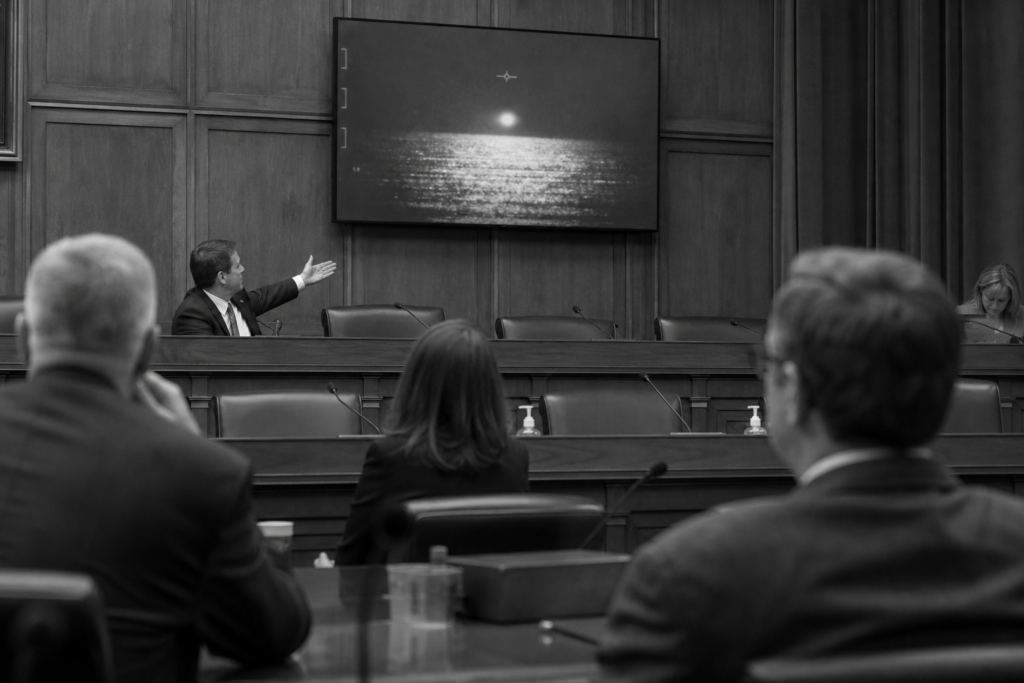
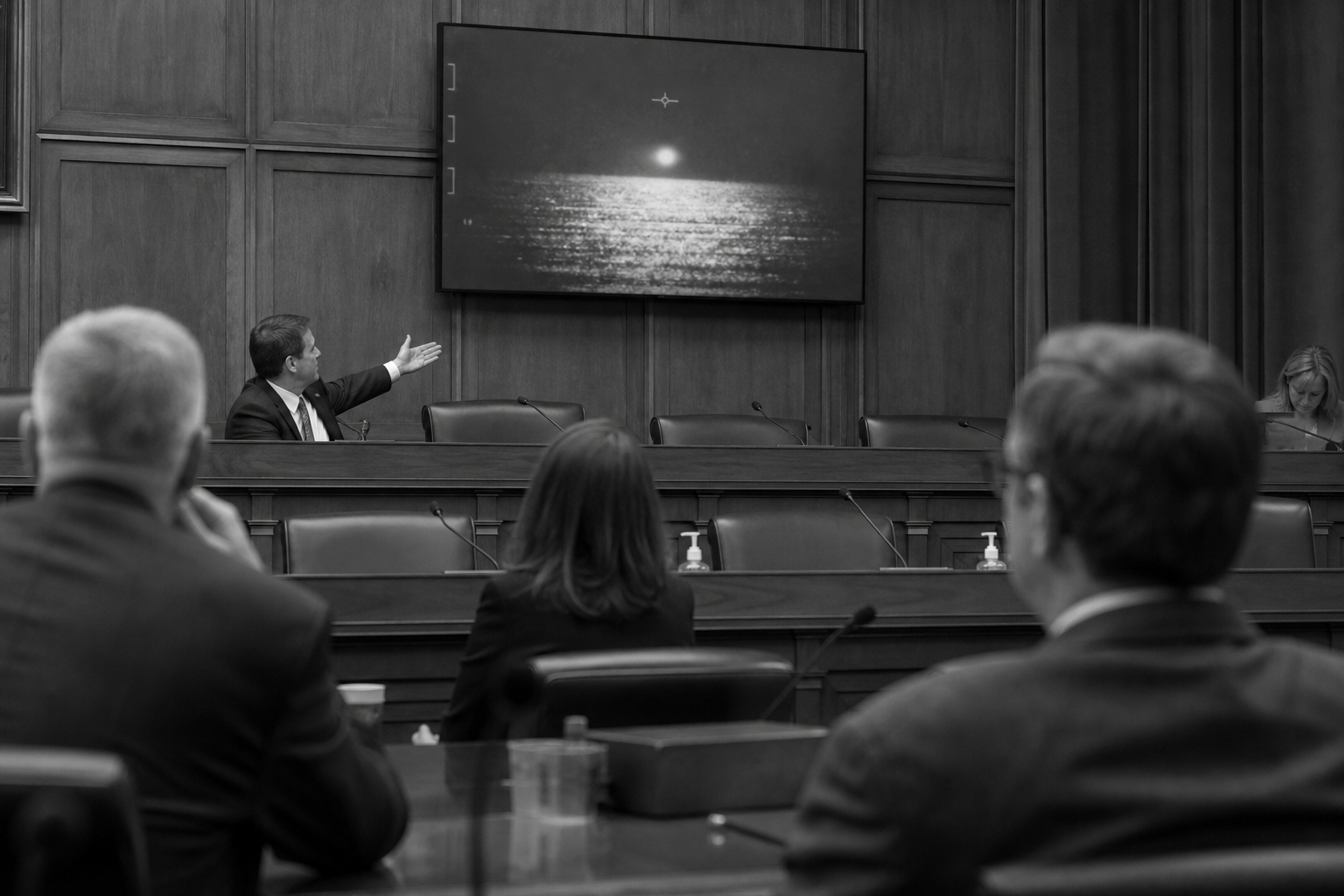
At a September 9, 2025, hearing of the House Oversight Committee’s Task Force on the Declassification of Federal Secrets, Rep. Eric Burlison publicly played footage he described as an MQ-9 Reaper engagement off Yemen’s coast. In the short clip, a bright, round-looking point remains in view as a projectile said to be an AGM-114 Hellfire approaches; the presentation drew attention because Burlison characterized the sequence as a missile striking an unidentified object.
The public display matters, but the MQ-9 Hellfire missile bright orb Yemen footage does not settle every part of that description. Viewers can assess the released sequence: a stabilized military-style view, a luminous target-like signature, an apparent intercept, and the image after it. Those visible elements are different from confirming the aircraft’s identity, the weapon’s type, the date and location of the encounter, a physical impact, or the nature and fate of the object.
This article follows the hearing video, agenda, transcript, and committee record before weighing the Yemen attribution and the claims made on the record. It also separates a sensor image from an object identification: a bright orb is a description of how something appears in the clip, not a demonstrated explanation of what it was. The remaining questions include the footage’s provenance, its available sensor context, and whether the Pentagon or the All-domain Anomaly Resolution Office has authenticated or assessed the incident.
What Happened When the Yemen MQ-9 Video Was Shown in Congress
The hearing’s official title, “Restoring Public Trust Through UAP Transparency and Whistleblower Protection,” identifies the September 9, 2025 public record in which Rep. Eric Burlison of Missouri played the short video excerpt. The event was held by the House Oversight Committee’s Task Force on the Declassification of Federal Secrets, and Burlison introduced the clip during his questioning rather than simply recounting an alleged encounter.
Burlison told the hearing that the footage was taken on October 30, 2024, off Yemen’s coast, and described it as video from an MQ-9 Reaper firing a Hellfire missile at an orb-like object. That on-record characterization supplied the platform, weapon, date, and location attached to the clip. The displayed excerpt showed a bright point, an approaching object characterized as the missile, and an apparent meeting of the two images; it did not show a readable date stamp, map, aircraft identifier, or weapon-label overlay that would independently establish those details.
The committee video therefore confirms a public presentation and Burlison’s stated account in a formal House proceeding. It does not by itself establish the clip’s chain of custody, whether the excerpt was complete, its classification status, a confirmed physical impact, or the identity and outcome of the bright object after the apparent contact.
What the Footage Is Said to Show: MQ-9, Hellfire, and the Bright Orb
The sequence attributed to the clip has four distinct parts, and keeping them separate prevents the headline from doing more work than the images can bear. First, the platform is described as an MQ-9 Reaper; second, the target is described as a bright, orb-like point; third, an AGM-114 Hellfire is said to have been launched toward it; and fourth, the point appears to remain visible or continue moving after the apparent encounter.

Only the visual sequence, if seen in an unedited version, can show a luminous spot against a darker background, a second fast-moving element entering the frame, and a moment at which their paths appear to meet or nearly meet. Those are observations of pixels and timing, not independent proof of an aircraft type, weapon type, location, target range, or physical collision. “Orb” is likewise a descriptive label for the visual signature, not an established description of the object’s shape or composition.
The MQ-9 and Hellfire labels carry specific implications. An MQ-9 is a remotely piloted aircraft, while an AGM-114 Hellfire is a guided missile; identifying either from footage ordinarily depends on readable on-screen symbology, accompanying audio, mission records, or authenticated official attribution. A vague caption or reposted narration is a weaker signal than a complete clip retaining those elements.
“Hellfire missile hits orb footage” therefore accurately describes the reported apparent convergence, but not a demonstrated impact. A visible point after that moment could reflect continued target motion, a change in camera tracking, image persistence, or another unresolved feature of the recording. In the context of reported military UAP intercepts, full-resolution files, timestamps, sensor readouts, and an accountable explanation remain necessary: the clip does not establish what the bright object was or what effect the reported intercept attempt had.
Why the Yemen Location and Video Provenance Matter
“Off Yemen’s coast” is a location claim, not a feature a viewer can reliably derive from a dark-water image. Establishing it would require an accountable link between the recording and the mission: a release statement identifying the event, an unbroken custody record showing who exported and handled the file, and mission context tying the sensor platform to a time and place. None of those materials is included in the public record described for this account, so the Yemen label remains an attribution rather than a verified geolocation.
Video provenance determines how much weight the congressional hearing Yemen orb video can carry. The strongest version would be the original sensor export, preserving embedded time, date, platform, sensor mode, coordinates or other geospatial fields, and a record of any classification review or redaction. A derivative, such as a screen recording, excerpt, or edited compilation, can still document what was shown publicly, but cannot by itself establish that every frame is complete, in order, and running at its original speed. The available material does not establish whether the public clip retains its original metadata or includes omitted footage before and after the apparent encounter.
That gap matters especially for a Yemen UAP Hellfire video because mission context changes interpretation. Knowing whether the camera was tracking a known object, whether other sensors observed it, and whether nearby activity affected the operation could distinguish an isolated visual anomaly from an event with corroborating records. It would also show whether cropping, redactions, overlays, or timing changes alter the apparent geometry. Until that provenance is available, the clip supports discussion of an unusual visible sequence, not a settled account of where it occurred or what participants encountered.
What the Congressman, Witnesses, and Officials Actually Said
The clip entered the September 9, 2025 hearing through Rep. Eric Burlison’s questioning, not through sworn firsthand testimony from an MQ-9 crew member or sensor operator. During the House Oversight proceeding titled “Restoring Public Trust Through UAP Transparency and Whistleblower Protection,” Burlison told the public session that it was recorded on October 30, 2024, off Yemen’s coast, and characterized it as MQ-9 Reaper video showing a Hellfire fired at an “orb-like” object. Those were on-the-record statements by a House member.
The apparent meeting of the projectile and bright point supplied the basis for Burlison’s description, but his remarks did not establish a physical strike as an adjudicated fact. He did not publicly identify the object as a particular aircraft, balloon, drone, natural phenomenon, or extraterrestrial vehicle. The hearing preserves what Burlison said and displayed; it does not include a public military finding resolving the object’s identity or its condition after the apparent encounter.
The available hearing material does not identify a witness who authenticated the recording under oath, testified to operating the MQ-9, or gave sworn evidence that an AGM-114 Hellfire hit the object. Sworn testimony is evidence delivered after an oath; a member’s questions and commentary place claims into a formal congressional record but do not independently prove operational details.
No formal Department of Defense or All-domain Anomaly Resolution Office finding was entered into the available hearing record to identify the Yemen object, validate the clip’s provenance, or characterize the missile’s effect. Later social-media discussion made the footage part of the UAP disclosure debate over public access to government-held information, but unsworn commentary cannot establish alien disclosure or a confirmed missile impact. The defensible account remains Burlison’s dated presentation and attribution.
Could the Video Establish a Missile Impact or an Extraordinary Object?
A screen recording of a distant engagement cannot, on its own, resolve the geometry of the encounter. Infrared imagery renders differences in thermal signal rather than an object’s ordinary visible appearance, while electro-optical video records reflected light and contrast. In either mode, zoom enlarges pixels as well as the subject; compression can smear edges or merge nearby bright features; and glare or sensor blooming can make a compact point look rounder and larger than its physical outline.
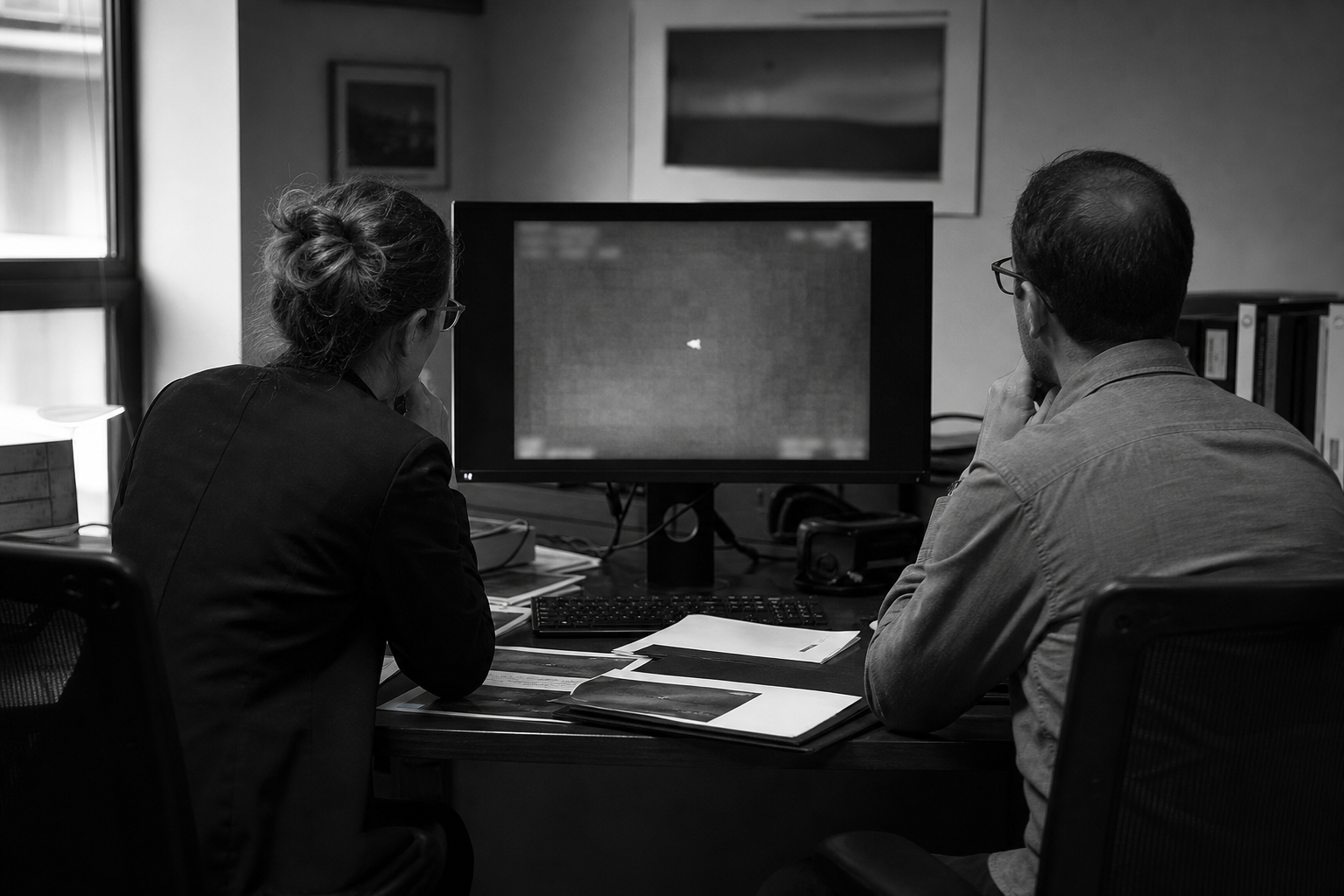
Range is the central missing variable. Without the camera’s position, viewing angle, field of view, zoom setting, and the object’s distance, apparent motion across the frame cannot yield a dependable speed, size, or separation estimate. A tracking system can also pan, stabilize, or recenter as the scene changes. That may make two paths appear to intersect when they are separated in depth, or make a surviving light point seem to continue on an unchanged course after the apparent encounter.
To determine whether an AGM-114 Hellfire actually struck a target, analysts would need the original sensor footage with its metadata, time-synchronized aircraft and weapon telemetry, launch and guidance information, coordinates or range data, and post-engagement observation. Those records distinguish a true intercept from a near pass, a tracking discontinuity, or an edited sequence. A battle-damage assessment and corroboration from other sensors would be needed before characterizing the weapon’s effect, or lack of effect.
The same standard applies to the bright object’s identity. An apparent convergence in the reported MQ-9 Hellfire missile bright orb Yemen footage is a visual event worth examining, but it does not establish exotic material properties, a missile malfunction, or an extraordinary object. Those conclusions require evidence beyond the displayed pixels.
What the Pentagon and AARO Have Confirmed, and What Remains Unverified
The September 9, 2025 House Oversight hearing record preserves Rep. Eric Burlison’s presentation, but it contains no Pentagon statement authenticating the excerpt as an original MQ-9 recording, no official identification of the bright object, and no published AARO assessment tied to the reported October 30, 2024 Yemen event. It also contains no Department of Defense release of the complete sensor file. That is a limit on the public record, not proof that the incident was ignored or that no additional records exist.
An AARO UAP assessment would answer questions the hearing clip cannot: whether investigators accepted the file as military sensor data, matched it to a mission date and operating area, compared it with radar or other collection, and reached an identification or retained it as unresolved. No such assessment appears in the materials underlying this account. An unresolved case is not affirmative evidence of non-human intelligence.
The unanswered points are concrete:
- Whether the excerpt Burlison played was an authentic, unedited military recording, and who held the file before the September 9 hearing.
- Whether October 30, 2024 and “off Yemen’s coast” can be tied to aircraft, coordinates, sensor mode, and mission records.
- Whether the bright point was a tracked target, a sensor artifact, or an object identified in reporting not released publicly.
- Whether an AGM-114 Hellfire was launched, physically intercepted anything, and produced a documented post-engagement result.
- Whether radar, electronic collection, other imagery, weapon telemetry, or crew reporting corroborated the displayed sequence.
- Whether a full-resolution file with metadata will be released, and what operational context remains classified.
Until the Pentagon UFO office or AARO addresses those specific points on the record, the footage remains a consequential item of UAP news rather than an officially resolved engagement.
The Bottom Line: Significant Public Footage, Not a Final Identification
The responsible conclusion is a narrow one: the reported public presentation is important because it focuses attention on potentially military-associated UAP material and the standards needed for meaningful disclosure. It does not turn the clip into a final identification. The on-screen sequence may warrant further investigation, but it cannot establish the bright object’s nature, origin, performance, or fate after the apparent missile encounter.
Future claims should be weighed by the quality of the underlying record, not by how often a short excerpt circulates in UFO sightings 2025 or UAP sightings discussions. Strong signals include a complete official hearing video or transcript; an original file with provenance and relevant metadata; named officials describing its collection and release; corroboration from radar, telemetry, or other sensors; and an attributable Pentagon or AARO assessment. A repost, cropped screen recording, anonymous caption, or assertion that the object “survived” is a weak signal because it supplies none of those controls.
If later records identify the member, venue, date, platform, weapon event, or object differently, this account should be corrected to match the primary record. Transparency is best served by preserving that distinction rather than treating unresolved footage as a settled answer.
What the Yemen MQ-9 Video Does, and Does Not, Establish
The decisive issue is whether the public claim can be connected to evidence that permits independent analysis. A congressional presentation shows that a member placed material before an audience; it does not, without a traceable record, authenticate the clip or establish the circumstances of its collection. Official acknowledgment would tie the video to a named agency and event. Independent verification would allow qualified reviewers to test those claims against the underlying data rather than a shortened public excerpt.
For this reported Yemen incident, the unresolved checkpoints are specific: the complete hearing record identifying the congressman, venue, date, and wording used; the original sensor file rather than a repost or screen capture; metadata establishing when and how it was recorded; a documented chain of custody; mission and location information; and synchronized sensor, aircraft, and weapon data. Those materials would distinguish an apparent on-screen meeting of two points from a demonstrated Hellfire impact and would show whether the bright object was tracked by more than one system.
A formal Pentagon or AARO assessment would not automatically make the object extraordinary, but it would supply an accountable finding and describe the evidence reviewed. Until that standard is met, the footage warrants public interest as a reported military-associated disclosure, while its identity, location, and apparent missile interaction remain unproven.
Sources
Frequently Asked Questions
-
What did the MQ-9 footage shown at the 2025 UAP hearing depict?
Rep. Eric Burlison played a short clip showing a bright, round-looking point, a fast-moving object described as an AGM-114 Hellfire missile, and an apparent convergence between them. The public excerpt did not display readable date, location, aircraft, or weapon-identification overlays.
-
Which congressman showed the Yemen orb video?
Rep. Eric Burlison of Missouri showed the footage during the September 9, 2025 House Oversight Committee Task Force hearing, “Restoring Public Trust Through UAP Transparency and Whistleblower Protection.” He said it was recorded on October 30, 2024, off Yemen’s coast.
-
Did a Hellfire missile destroy the object shown in the MQ-9 footage?
No confirmed evidence establishes that an AGM-114 Hellfire physically struck or destroyed the bright object. Verifying an impact would require the original sensor file, weapon telemetry, guidance data, range information, and post-engagement assessment.
-
Has the Pentagon or AARO identified the bright orb off Yemen?
No Pentagon statement or published All-domain Anomaly Resolution Office assessment in the available hearing record identifies the bright object. The record also contains no official release of the complete MQ-9 sensor file or authentication of the public excerpt.
-
What should you look for to verify the Yemen MQ-9 orb footage?
Look for an original full-resolution sensor export with metadata, including timestamps, platform and sensor details, coordinates, and documented chain of custody. Strong corroboration would also include aircraft and weapon telemetry, radar or other sensor data, mission records, and an attributable Pentagon or AARO finding.