Two lights that appeared to change color and circle each other, with a helicopter nearby, make for an attention-grabbing account from Kapolei, Oahu. But the Kapolei UFO sighting of January 8, 2010 is examined here as a single witness report, not as verified evidence of an extraordinary craft.
The central details belong to the observer’s description: two lights, apparent shifts in color, apparent circling motion, and a helicopter seen in the same setting. “Apparent” matters. At night, an observer’s viewing angle, distance, moving lights, haze, and contrast against the sky can affect both perceived color and perceived motion. A nearby helicopter may be relevant context, but its reported presence alone does not establish its operator, flight path, purpose, or any connection to the lights.
This account will therefore keep three questions separate: what the witness reported, what can be independently established from the surviving record, and what remains unverified. The material available for this article does not itself establish corroborating video, independently matching witnesses, aircraft records, radar data, weather observations, or an official investigation. Unidentified in this context means not identified by the available evidence; it does not mean extraterrestrial or otherwise confirmed anomalous.
What Was Reported Near Kapolei on January 8, 2010
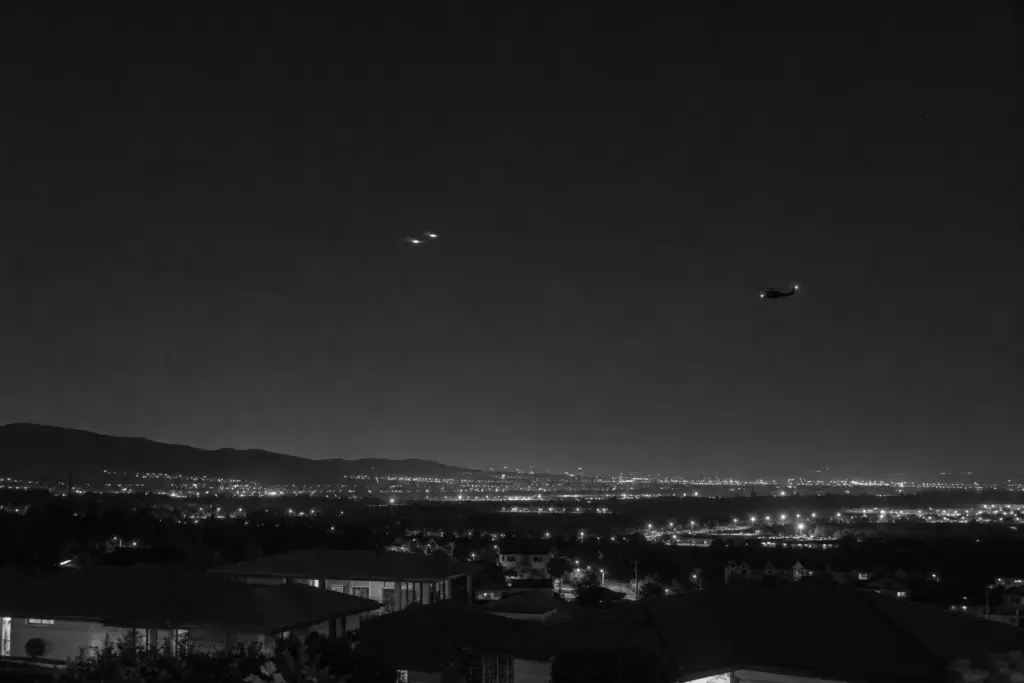
The case label places the observation on January 8, 2010, in the Kapolei area of Oahu, Hawaii. It attributes a short sequence to one observer: two lights appeared to change color, appeared to circle one another, and were seen near what the observer took to be a helicopter. Those are the reported visual elements of the Kapolei Hawaii UFO sighting in 2010; they do not establish the lights’ distance, altitude, speed, or origin.
No original witness-report text, submission record, image, video, or archival metadata has been supplied for this review. The closest available account is therefore incomplete rather than a record that can be quoted or reconstructed in detail. There is no supported basis here for adding a time of night, duration, viewing direction, weather conditions, or exact wording. It is also not possible to determine whether the January 8 date was recorded in Hawaii Standard Time or converted from another time standard.
A witness can faithfully describe an appearance without having enough information to identify its cause. “Near a helicopter” describes perceived context, whereas a verified association would require evidence that identifies the aircraft and ties its position or activity to the lights. On the surviving information, this remains a reported observation, not confirmation of extraterrestrial craft, non-human intelligence, a verified UAP, or a connection between the helicopter and the lights.
The Reported Lights, Motion, and Helicopter
At the level of the witness’s description, “two lights” identifies two visible points of light, not two measured objects. The reported color changes describe how those points appeared to the observer; they do not establish whether the light itself changed, whether a surface was illuminated differently, or whether viewing conditions altered its appearance. That distinction matters in a color-changing lights UFO report because an observed color is a visual impression, while an identification requires additional information about the light source and the conditions of observation.
The reported circling is likewise an account of apparent motion across the observer’s line of sight. Two lights can seem to orbit one another when their angular positions shift from a single viewing location, yet that appearance alone cannot determine their actual paths. Without distance, a reference point, or timed observations, the account does not yield a defensible size, altitude, speed, separation, or maneuvering radius for either light.
The helicopter belongs in the report as a separately perceived element: the witness described the lights as being near a helicopter. “Near” in a night-sky observation can mean close together visually while leaving their real distance from one another entirely unknown. Nothing in the available account establishes that the helicopter and lights interacted, traveled at the same altitude, or were part of a single event. The helicopter UFO sighting description therefore preserves an unusual visual grouping, not a verified relationship between an identified aircraft and unidentified lights.
What the Source Record Documents, and What It Does Not
The available source record is limited to a later summary of the reported event, not a located original submission. It preserves the basic attribution, that one observer described two color-changing lights apparently circling near a helicopter in the Kapolei area on January 8, 2010, but it does not provide the witness’s full, verbatim account. No submission date, publication date, database name, archive identifier, or time standard is available here, so the date cannot be tied confidently to either Hawaii Standard Time or UTC.
That limitation changes how the account should be read. A report-database entry or archived witness narrative can preserve what a person submitted, sometimes alongside timestamps, location fields, investigator comments, and attachments. It is not, by itself, an aviation, military, police, or government investigation. In this case, the available record does not identify an investigating agency or show that any official body evaluated the lights or the reported helicopter.
No photograph, video, audio recording, radar return, flight record, weather observation, investigator note, or independently matching witness account is currently documented in the material available for this review. This does not demonstrate that such material never existed; it means none can presently be linked to and assessed alongside this witness report. The account therefore retains historical interest as a narrowly described observation, while its date, wording, context, and possible identification remain uncorroborated.
The Helicopter: Reported Nearby, Not Identified by the Account
A helicopter can be treated as its own identification problem rather than as evidence that the lights and aircraft were connected. The surviving summary does not give a make or model, registration, operator, call sign, direction of travel, altitude, or stated purpose for the aircraft the witness perceived. It likewise contains no observation establishing that the helicopter maneuvered in response to the lights, tracked them, or shared their position in three-dimensional space.
That absence matters because aircraft identification requires details that distinguish one flight from another. A time-linked flight log, radar or air-traffic record, or an official operational log could potentially show that a helicopter was active over or near Kapolei during the relevant interval. But a record is useful only if the report can be narrowed to a date, local time or UTC time, and location precise enough to compare; this account supplies no such time-of-day anchor.
Reliable local reporting or an attributable official statement from January 8, 2010 could also add context if it described helicopter activity in the same area and timeframe. A general indication that helicopters operated somewhere on Oahu that day would be a weak match, however, because it would not identify the aircraft the witness saw. A match in time and place would establish aviation activity, not automatically explain the lights or prove a relationship between them.
For the present record, “helicopter” remains part of the witness-reported setting of this helicopter UFO sighting, not a verified aircraft identification. The account supports neither an operator nor a mission, and it does not support a conclusion about what the aircraft was doing in relation to the two lights.
Why Lights Can Seem to Change Color or Circle at Night
At night, a point of light supplies very little information about its size, distance, or path. Aircraft lighting is one ordinary possibility: navigation, anti-collision, landing, and other lights can appear as separate colored points, while a turning aircraft may expose or obscure them in changing patterns. That could help account for shifting colors or an impression of movement, but it cannot be applied to this report without a time, viewing direction, duration, elevation above the horizon, or a record tying a particular aircraft to the observation.
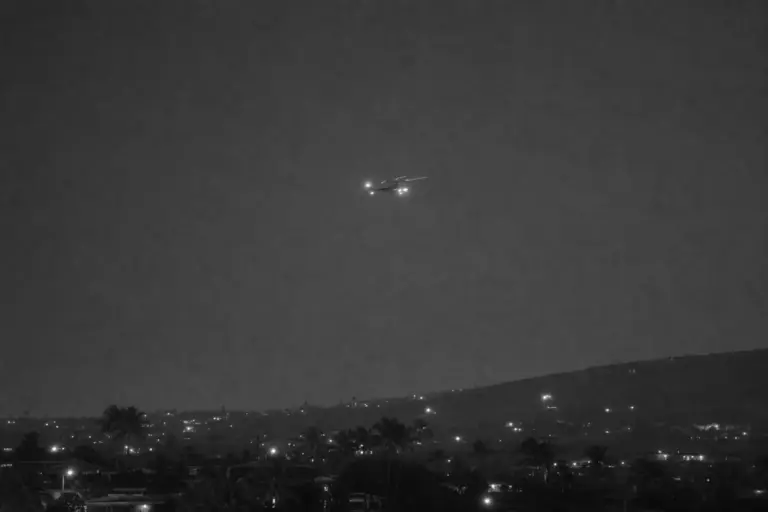
Distant aviation activity can also be visually deceptive. Two aircraft on different routes, or one aircraft seen against another light, can look close together despite substantial separation; changing headings can make their projected paths appear to converge, loop, or orbit. The same limitation applies to bright stars or planets: low-altitude viewing through uneven air can make a steady light seem to flicker between colors. These atmospheric effects are plausible contributors to a night-sky observation, not identifications of the color-changing lights Kapolei Hawaii witness described. No reliable time, sky direction, or weather observation accompanies the surviving account, so no astronomical candidate or weather condition can be matched to it.
Perspective matters even without a camera. A viewer has no fixed scale for judging whether lights are moving together in space, moving independently at different distances, or remaining still while the observer shifts position. Autokinesis, the tendency for a small isolated light to seem to drift or move when watched against a dark, featureless background, can further make motion appear more elaborate than it is. It can plausibly contribute to perceived circling, but it cannot determine what the lights were, whether either light moved physically, or whether the reported helicopter was related to them. The missing contextual details leave these as possible interpretive factors rather than a resolution of the report.
Is the Kapolei Report Confirmed or Still Unexplained?
A stronger case begins when separate lines of evidence converge on the same event. Independent witnesses are most useful when they made their observations separately yet agree on particulars such as time, location, direction, duration, and movement. A photograph or video is more useful when its original file, capture time, location, and unedited sequence can be assessed, rather than when it is an isolated image with no provenance.
Operational records can supply a different kind of test. Radar, air-traffic material, or flight data may place an aircraft at a stated time and position; an identifiable helicopter record could then establish whether the reported aircraft was present and whether its route fits the observation. A documented investigation can preserve those comparisons, identify what was reviewed, and distinguish an unresolved result from a positive identification.
The available Kapolei record does not meet that threshold. It contains a later summary of one witness’s account, but no located original report, independently matching testimony, time-linked photographs and video, aircraft or radar record, or documented inquiry. The helicopter therefore remains reported context rather than an identified flight, and the lights remain unclassified visual observations rather than measured objects.
“Unexplained” here describes a lack of sufficient information to reach an identification. It does not establish a confirmed UFO or UAP, and it is not evidence of alien activity. The most defensible conclusion is narrower: the January 8, 2010 Kapolei account remains an uncorroborated witness report whose reported details cannot be independently resolved from the surviving material.
A Narrow, Source-Conscious Reading of the 2010 Kapolei Account
What endures is modest but specific: a witness account places two apparently color-changing lights, seemingly circling one another, near a perceived helicopter around Kapolei on January 8, 2010. The later summary is the best available record for that claim; the original report and its time convention, Hawaii Standard Time or UTC, are not available to assess.
That makes the account worth preserving accurately among Hawaii UFO sightings, while limiting its conclusion to what the surviving material can bear. The lights were reported, not measured; the helicopter was observed context, not an identified aircraft; and neither element has been independently linked to the other.
Readers seeking wider discussion of UFO disclosure or formal UAP reporting and assessment should rely on separately sourced reporting about those subjects. This isolated historical report neither demonstrates nor meaningfully tests broader claims.
Frequently Asked Questions
What was reported in the Kapolei, Hawaii UFO sighting on January 8, 2010?
One witness reported seeing two lights near Kapolei, Oahu, that appeared to change color and circle each other. The witness also perceived a helicopter nearby, but the report does not establish the lights’ distance, altitude, speed, or origin.
Were the color-changing lights near Kapolei confirmed to be a UFO or UAP?
No. The January 8, 2010 account remains an uncorroborated single-witness report with no evidence confirming extraterrestrial craft, non-human intelligence, or a verified UAP.
Was the helicopter in the Kapolei sighting identified?
No aircraft identification is available. The record gives no helicopter make, model, registration, operator, call sign, flight path, altitude, or mission, and it does not show that the helicopter interacted with the lights.
What can make lights appear to change color or circle at night?
Aircraft navigation or anti-collision lights, changing aircraft headings, atmospheric distortion, and perspective can make lights appear to shift color or move in unusual ways. Autokinesis can also make isolated lights seem to drift or circle against a dark sky.
What evidence would be needed to verify the 2010 Kapolei lights and helicopter report?
Useful evidence would include independently matching witnesses, original photo or video files with timestamps and location data, weather observations, and radar or flight records tied to a specific time and place. The surviving record has none of these, and no official investigation is documented.