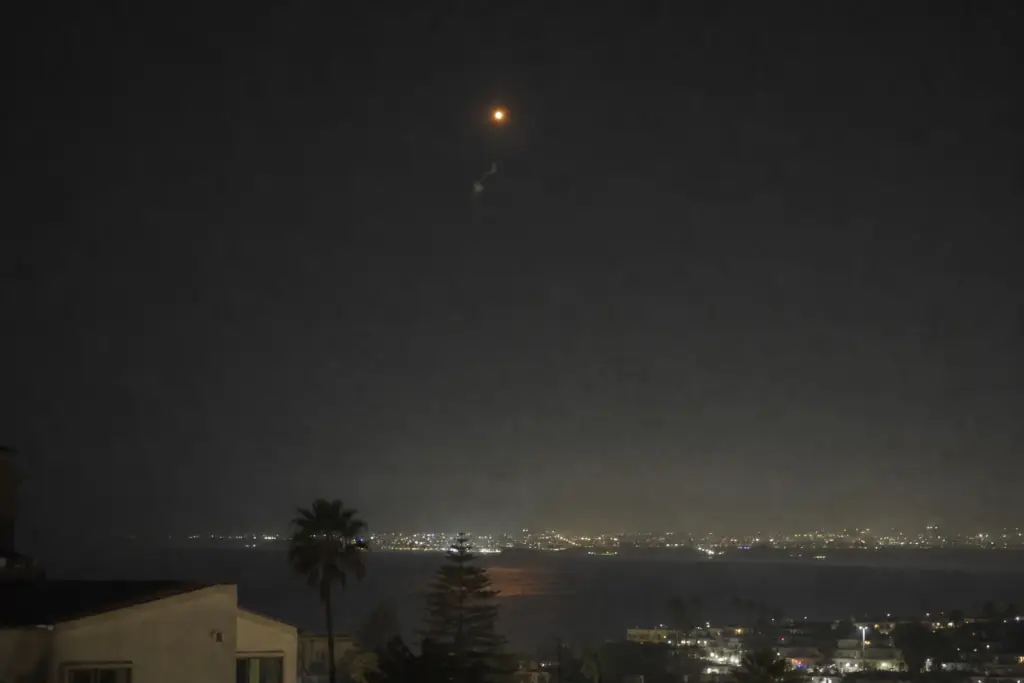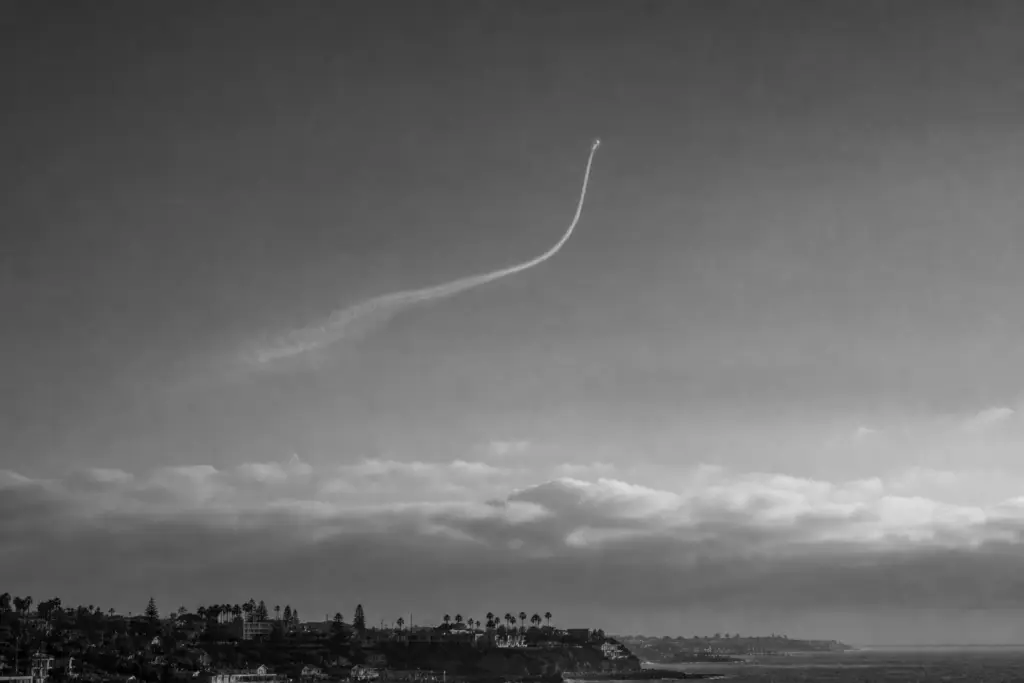
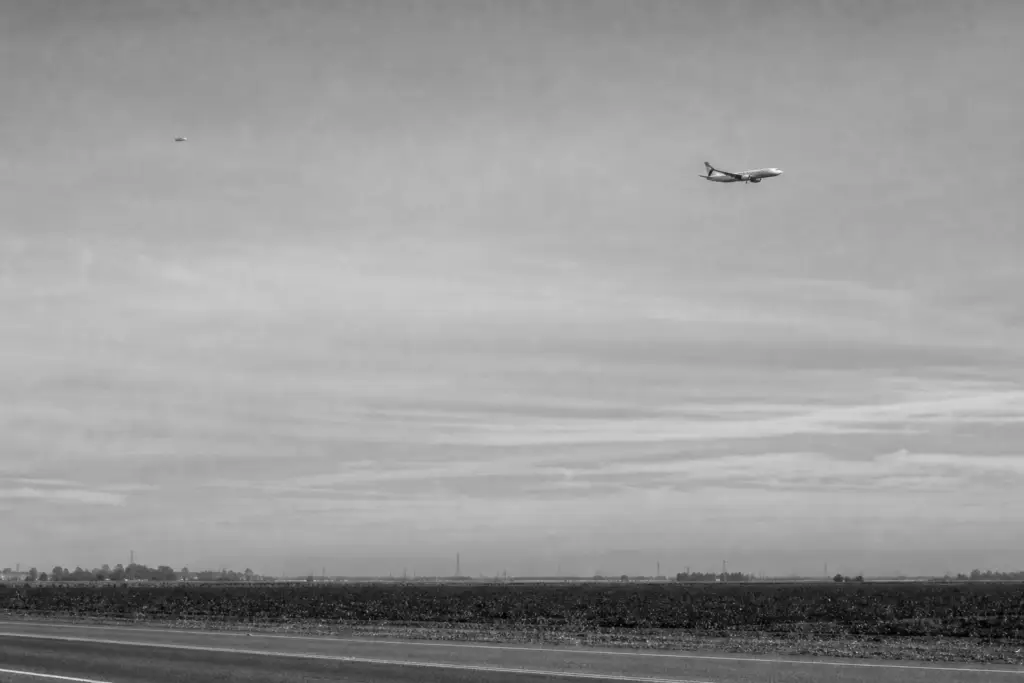
This Patterson CA UFO sighting turns on a small but important distinction: the witness reportedly saw one jet and a separate object, rather than a single aircraft misdescribed in two ways. The account places the observation in Patterson, California, on January 13, 2020, and describes the second object as looking like a jet only momentarily. That limited wording leaves the object unidentified within the report; it does not establish an unusual origin or a confirmed aerial anomaly.
A changing view can alter apparent shape quickly. An ordinary aircraft seen nearly head-on, at an angle, through haze, or with sunlight reflecting from its surfaces may briefly present a jet-like silhouette; so might a distant object whose size, altitude, speed, and direction are not recorded. Conversely, a transient resemblance alone is too weak to identify the second object as another aircraft. The useful question is not whether it looked strange, but whether independent details distinguish it from familiar traffic.
This analysis therefore treats the submission as a single-witness UAP report: evidence that a person reported an observation, not proof of what was present. Its evidentiary weight would rise or fall with particulars such as an exact time and viewing direction, photographs or video, corroborating witnesses, weather and light conditions, and flight or radar records. Those records can test competing explanations without collapsing the reported jet and the separate unidentified object into one conclusion.
What Was Reported in Patterson on January 13, 2020
The event record is narrow: a lone witness reported an observation from Patterson, California, dated January 13, 2020, involving two aerial subjects. One was described as a conventional jet. The other was treated separately in the account and remained unidentified.
The report’s most consequential qualifier is temporal. The unidentified object was said to resemble a jet only momentarily, rather than retaining a clearly jet-like form throughout the observation. That wording preserves a visual impression without supplying an identification: a fleeting silhouette can describe how an object appeared from one viewpoint, not necessarily what the object was.
This Patterson California UFO sighting is therefore best read as a witness-reported two-object observation, not as a record of a confirmed encounter. “UFO” in this context marks the second object as unidentified in the report; it does not establish an extraterrestrial craft, non-human intelligence, military activity, or an official investigation.
The available material does not provide the underlying report’s full text, an exact observation time, a more precise Patterson viewing location, object altitude, travel direction, duration, aircraft identity, attached imagery, radar information, or independent witnesses. Those omissions matter because they prevent a reliable comparison between the known jet’s expected appearance and the separate object’s reported behavior. The January 13, 2020 UFO sighting can document what one person described, but the surviving account is too limited to determine what the second object was.
The Key Detail: One Identified Jet and One Separate Unidentified Object
The distinction depends on assigning each observation to the object the witness actually described. The jet belongs to the conventional-aircraft side of the account: it was recognized visually as a jet, but the surviving record does not tie that recognition to markings, livery, engine sound, a flight number, or a flight-tracking match. It is therefore more accurate to call it a jet-like or conventional-looking aircraft than an independently identified flight.
The second object carries the unresolved detail. Its reported jet-like appearance was momentary, not a durable description of a fixed shape. No available account assigns it a color, lights, speed, altitude, heading, or distinctive structure. Those missing characteristics are important because they would help distinguish another aircraft, a distant unidentified object seen at an unusual angle, or an observation whose form could not be resolved.
Nothing in the retained summary establishes how far apart the two objects appeared, whether either crossed the other’s flight path, or whether they moved at the same apparent rate. A shared patch of sky is a line-of-sight relationship: two objects at very different distances and altitudes can look adjacent from one viewing position. It does not, by itself, show formation flight, pursuit, interception, or any other interaction.
That makes this jet and UFO sighting in Patterson a two-part report rather than evidence that one object transformed into the other. The conventional aircraft provides context for what the witness saw nearby; it does not identify the second object. Conversely, the unidentified object’s brief resemblance to a jet does not establish that it traveled with, followed, or was connected to the visually recognized aircraft.
Why a UFO Might Briefly Look Like a Jet
A jet silhouette is especially vulnerable to brief misreading because it is a familiar outline assembled from only a few cues: a narrow body, swept-looking extensions, and a bright or dark leading edge. At long range, a change in viewing angle can hide an object’s width, expose a reflective surface, or make a thin profile seem winged. If the object banks, turns, or simply moves across the observer’s line of sight, its apparent proportions may change even when its physical form does not.
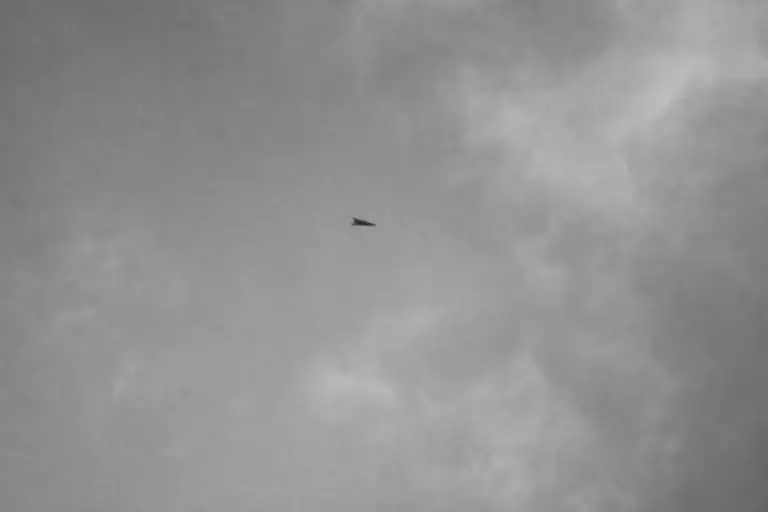
Light and atmosphere can further reduce the reliability of a momentary comparison. Haze softens edges; glare can erase detail or create a bright point; and reflected sunlight can make one surface stand out while the rest blends into the sky. Motion perception adds another uncertainty: an object approaching, receding, or moving against a featureless background may seem to alter speed or orientation without enough visual reference points to judge its distance. These effects are plausible categories, not identifications of the Patterson object.
An apparent shape change would carry more evidentiary weight if the account recorded a sustained sequence, such as a clear orientation before and after a turn, repeated changes seen by multiple people, or imagery showing stable reference points. The retained Patterson summary supplies none of those details: it does not describe a physical transformation, a turn, acceleration, disappearance, lighting pattern, exact viewing conditions, or how long the jet-like resemblance lasted beyond its momentary character. A short impression can therefore preserve a genuine observation while remaining unable, on its own, to distinguish an unusual craft from an ordinary object seen under uncertain visual conditions.
What Records Could Help Identify the Objects
The most useful next step would be to build a time-and-direction record rather than search for a single decisive database hit. For the January 13, 2020 Patterson observation, an exact or narrowly estimated time, the observer’s location, compass bearing, elevation above the horizon, and separate paths for the jet and second object would allow each record set to be compared against the same sky.

- Aviation identification: archived ADS-B and other flight-tracking histories can place publicly received aircraft transmissions into the relevant window. A convincing match would align an aircraft’s track, altitude, heading, and timing with the reported conventional jet or unidentified object. FAA aircraft data and airport or air-traffic records could add context if a particular route, aircraft registration, or nearby departure is implicated. Public tracking is not a complete air picture, however; a missing track is not evidence that an object was extraordinary.
- Weather records: hourly observations, cloud layers, visibility, wind, and sun position can test whether haze, broken cloud, or lighting might have altered apparent form or motion. Their value depends on timing: conditions logged an hour away from the observation may be only a rough proxy for the witness’s view.
- Astronomical and satellite checks: a reconstructed bearing and time can be compared with bright celestial objects, visible satellite passes, and any reported reentry activity. These candidates are useful only when their expected direction and movement fit the account; a loose time estimate can produce misleading apparent matches.
- Contemporaneous observers: local reports, dated photographs, video files with original metadata, or dispatch and airport logs could establish whether anyone else saw either object. Strong corroboration independently converges on time, direction, and behavior. A second account repeating a widely known description is weaker.
The retained account does not supply the precision needed for those comparisons. That leaves these records as a practical test plan, not a retroactive identification of either reported object.
How Much Can Be Concluded From a Single-Witness UAP Report?
A key checkpoint is whether the account permits any reported visual impression to be measured against an independent record. Here, the retained single-witness report establishes that an observer described an aerial observation in Patterson on January 13, 2020, including a conventional-looking jet and another object that briefly looked jet-like. It does not independently establish either object’s distance, altitude, size, physical structure, speed, or origin. Those properties cannot be reliably derived from apparent motion or silhouette when viewing geometry is unknown.
A narrative-only unidentified aerial phenomenon report can preserve a potentially useful observation, but it provides no independent means to distinguish perception from an object’s actual characteristics. An apparent acceleration, for example, may reflect a change in direction at an unknown range; apparent size may reflect a smaller, nearer object. The momentary jet-like resemblance is likewise a reported impression to assess, not an identification or evidence of transformation.
Corroboration changes the evidentiary weight when distinct records converge on the same event. Time-stamped original imagery can preserve sequence and camera metadata; genuinely independent witnesses can be compared for agreement on direction, duration, and behavior; radar can supply measured position and track; and attributable aircraft records can support or exclude a particular conventional flight. The retained Patterson account does not supply those forms of support, or the precise time, location, bearing, duration, original media, and additional observers needed to connect them. It remains unresolved because the available information cannot discriminate fairly among possibilities, not because it demonstrates an extraordinary one.
Where AARO and Official UAP Reporting Fit, and Do Not Fit
Official UAP channels should not be treated as an automatic second investigation of every public sighting report. The Pentagon’s UAP office assesses reports within a defined government framework that gives particular weight to attributable data such as sensor records, military reporting, flight information, and corroborated observations. A civilian narrative can be submitted as information, but it does not thereby become an official case or establish that federal authorities investigated the event.
That distinction matters for readers following UAP news. “Unresolved” describes an observation that available information has not identified; it is not a finding of exotic technology, nonhuman origin, or a withheld government conclusion. The Patterson account has no known link to an AARO assessment, and its missing time, location, media, and independent corroboration would limit any attempt to compare it with official-style evidentiary review. It remains a local witness report, not a proxy for disclosure claims.
Bottom Line: A Specific Report, but Not a Confirmed Identification
The narrowest defensible conclusion is that a witness reported a January 13, 2020 observation in Patterson involving a conventional-looking jet and a separate unidentified object. The second object’s momentary jet-like appearance is the account’s central unusual detail, but a fleeting resemblance does not identify its form, distance, motion, or origin.
The report can fairly remain unresolved because the surviving account lacks the information needed to discriminate among ordinary aerial objects, viewing effects, and a genuinely unclassified observation. “Unresolved” is a record-quality outcome: it means the available material cannot support an identification. It does not demonstrate alien, non-human, or classified technology.
The most valuable additional evidence would be an exact observation time, a specific viewing point, compass directions and elevation for each object, and any original photo or video with intact timestamps and metadata. Independent accounts recorded separately, and consistent on location, direction, duration, and sequence, would be far stronger than repeated retellings of the same Patterson UFO report.
What the Patterson Report Establishes, and What It Does Not
Preservation matters because later summaries can unintentionally merge the recognized jet with the second object or turn a momentary resemblance into a sustained transformation. The strongest surviving account would retain the witness’s original wording, the report’s submission date, and any unedited media, while keeping uncertainty and later interpretation separate from what was initially observed.
A useful reconstruction would test the two reported subjects independently. A narrow observation time and precise Patterson location could be compared with weather conditions and flight records; matching an aircraft’s direction and timing would strengthen a conventional-aircraft explanation for that subject, while a mismatch would not automatically identify the other. Distance, viewing angle, glare, haze, and traffic elsewhere in the sky remain viable explanatory categories because the available narrative does not measure them.
Thus, this single-witness UAP report preserves a defined event claim: a person reported one jet and a separate unidentified object on January 13, 2020. It does not preserve the corroborating information needed to establish either object’s physical characteristics or origin. An unresolved Patterson CA UFO sighting is a limit on the record, not evidence of an extraordinary craft.
Frequently Asked Questions
What was reported in the Patterson, California UFO sighting on January 13, 2020?
A single witness in Patterson, California reported seeing two aerial objects on January 13, 2020: one conventional-looking jet and one separate unidentified object. The unidentified object only momentarily resembled a jet and was not identified.
Did the Patterson UFO report describe an object transforming into a jet?
No. The report described one recognized jet and a separate object that briefly looked jet-like, not one object changing into another. No sustained shape change, turn, acceleration, or physical transformation was recorded.
Why might an unidentified object briefly resemble a jet?
A distant object’s apparent shape can change with viewing angle, haze, glare, reflected sunlight, or movement across the observer’s line of sight. A narrow profile and bright or dark edges can temporarily create a jet-like silhouette without identifying the object as an aircraft.
What evidence would help identify an object seen near a jet?
The most useful details are an exact observation time, precise viewing location, compass bearing, elevation, duration, and separate flight paths for both objects. Original photos or video with timestamps and metadata, independent witnesses, weather records, and archived ADS-B or radar data could test possible aircraft, satellite, or atmospheric explanations.
Does an unresolved single-witness UFO report mean AARO or the government confirmed something unusual?
No. An unresolved report means available information cannot support a reliable identification, not that it proves alien, nonhuman, classified, or exotic technology. The Patterson report has no known connection to an AARO assessment and lacks precise time, location, media, and corroborating evidence.