Multiple NUFORC Reports Describe Three Red Lights Over East San Diego County at Midnight on January 1, 2010
Examine the El Cajon UFO sighting 2010, evidence, local context, and plausible explanations for three red lights on New Year's Eve.
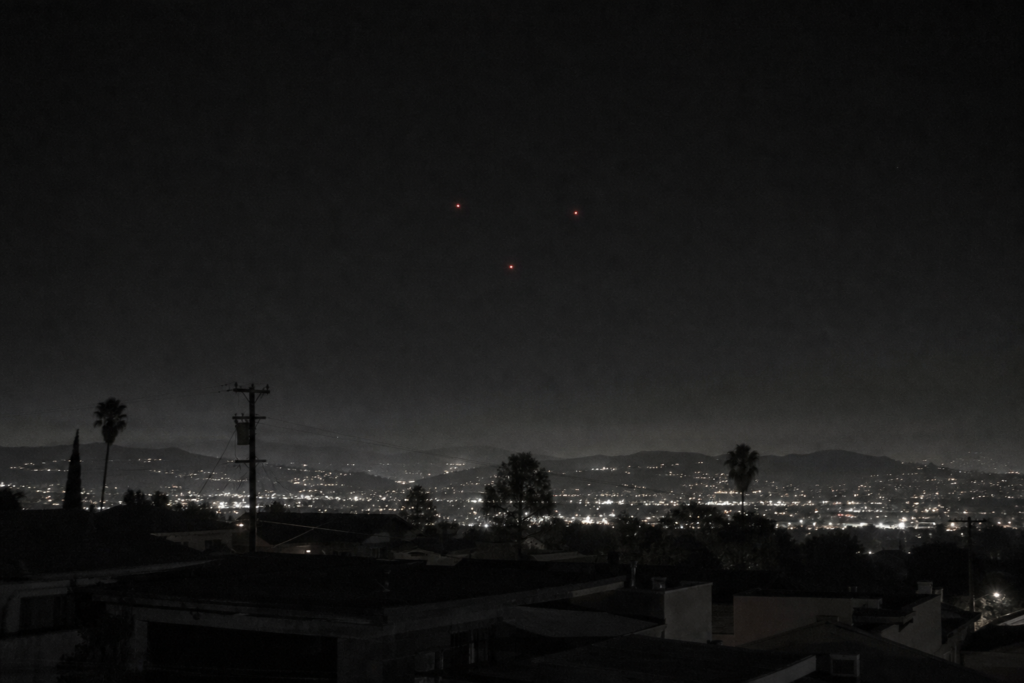
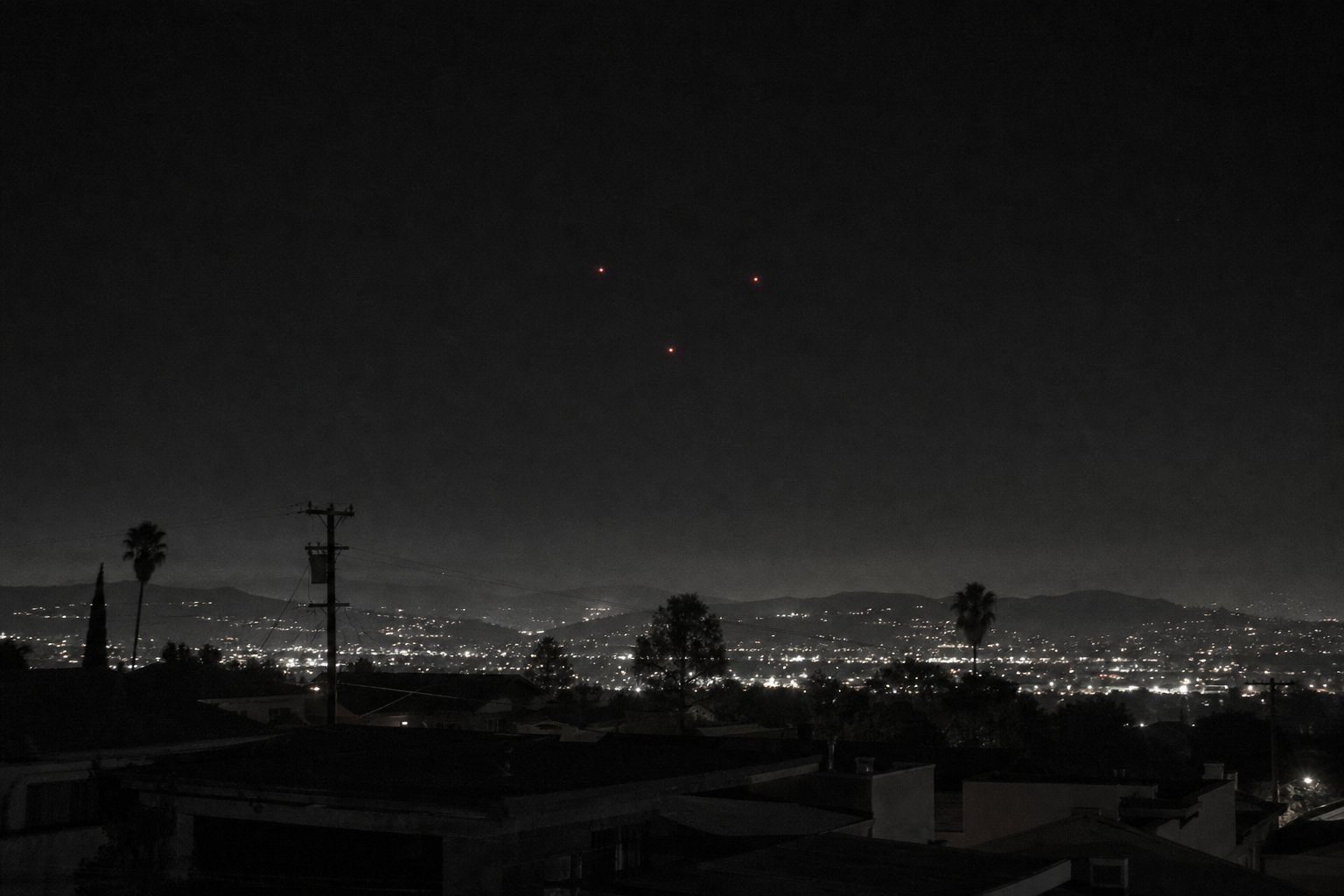
The starting point is modest but important: an El Cajon UFO sighting 2010 has been described as occurring on midnight on January 1, 2010, and involving three red lights that appeared to form a triangle. That description records an observer’s reported visual impression. It does not, by itself, establish that the lights belonged to a single solid object, or to anything extraordinary.
NUFORC’s January 2010 index preserves multiple separately submitted reports from El Cajon, Spring Valley, La Mesa, Lemon Grove, Bonita, and Mount Helix describing three red lights or a triangle-like arrangement around midnight on January 1. The entries establish a cluster of witness reports, not the identity, distance, or physical unity of the lights.
The alleged event date must also be kept separate from a report’s publication, reposting, or database-entry date. A later listing can preserve a claim about January 1, 2010, but it cannot independently corroborate that date or add firsthand detail. For now, the most accurate classification is an insufficiently documented reported sighting: a triangle-like arrangement of red lights was alleged over or near El Cajon on midnight on January 1, 2010, while the underlying record remains unverified.
What Was Reportedly Seen Over El Cajon on New Year’s Eve
The available description contains only two observational elements: three lights, described as red, and an apparent triangular arrangement. Those elements support the narrow wording “triangle UFO El Cajon” only as a label for the report, not as evidence that a triangular craft was seen. A triangle can describe the lights’ pattern from the observer’s viewpoint; it does not establish a visible hull, fixed spacing, common altitude, or a physical connection between the lights.
No named witness account or preserved anonymous submission is available in the material for this article. There is therefore no attributable firsthand wording beyond the condensed claim that a three red lights sighting occurred on midnight on January 1, 2010 in or near El Cajon. Later retellings must not be treated as direct testimony unless they identify and reproduce an earlier report with a date and provenance.
Crucial observational details remain unrecorded. There is no documented viewing address or landmark, clock time, compass direction, elevation above the horizon, duration, apparent size, brightness, flashing pattern, spacing, speed, course, change in formation, sound, or count of observers. The record also does not establish whether the lights moved together, whether they were stationary, or whether the observer saw a dark outline around them. Each of those distinctions would materially affect an explanation: fixed relative positions could be consistent with lights on one object or a distant formation, while independently shifting lights would point to separate sources.
It is equally important not to import familiar “triangle” details into this New Year’s Eve UFO sighting in California. Claims of silent passage, low altitude, a massive dark craft, rapid acceleration, or a hovering maneuver are not documented in the account available here. They may appear in general accounts of triangular-light reports, but they cannot be assigned to El Cajon without a traceable original record.
The most precise reconstruction is consequently brief: an unverified report associates the El Cajon area and January 1, 2010, with three red lights perceived in a triangle-like configuration. Beyond that visual description, the event’s circumstances and behavior are unknown.
Evidence Record: What Can Be Verified and What Cannot
Provenance determines how much weight the report can bear. The strongest starting point would be an original witness submission preserved with its submission date, the witness’s own wording, and enough observational detail to distinguish memory from later retelling. That record is not available here. Nor does the available material include a contemporaneous El Cajon or San Diego-area news report, archived local web coverage, a named second witness, a photograph, video, emergency-dispatch entry, or aviation record tied to the alleged observation.

A database entry or repost can be useful as an index: it may show that someone associated a claim with a place and date. It is not independent corroboration when it supplies no original text, identifies no witness, or merely repeats another listing. Repetition across websites can therefore enlarge the apparent trail without adding a separate observer or a new contemporaneous record.
Different forms of evidence would answer different questions. A local-news item published at the time could establish that the claim circulated promptly and might preserve interviews or location details, though reporting alone would not identify the lights. A photograph or video would be more useful only if the original file were recoverable: its creation time, metadata, sequence of frames, camera settings, and unedited version can help test whether the visible pattern was stable, moving, distant, or altered by exposure. No such media has been made available for this case.
Independent witness accounts would matter most if they were separately recorded and converged on particulars such as time, viewing direction, movement, and duration. Accounts copied from one initial post do not meet that standard. Likewise, dispatch logs or aviation records could potentially place relevant activity in the area, but they would need a usable time and location from the observation before they could meaningfully be compared. No official response, investigation, or corroborating record is established by the present file.
The evidentiary status of this El Cajon UAP sighting is therefore insufficiently documented. The surviving claim supports a report of lights, but not a verified event narrative, a physical object, or a confident identification.
El Cajon and San Diego County Context on January 1, 2010
El Cajon’s setting makes several comparison categories relevant on the night of January 1, 2010, but none can be applied precisely to this report. The surviving description supplies no clock time, street-level vantage point, viewing bearing, elevation above the horizon, or duration, five details needed to align an observation with local conditions.
Weather is time-specific rather than a property of an entire calendar date. Cloud layers, haze, wind, and horizontal visibility can change during a single evening and can alter how distant lights appear: haze near the horizon may diffuse a point light, while a clear line of sight can make it visible from much farther away. No dated weather observation has been connected to a stated El Cajon observation time, so no particular visibility condition can be assigned to the three reported red lights.
Gillespie Field is located in El Cajon, while Montgomery-Gibbs Executive Airport and San Diego International Airport serve the wider county. Aircraft operating to or from those facilities can be visible from eastern San Diego County, but an aviation comparison requires a time window plus direction and apparent height; a flight track elsewhere in the county would not, by itself, account for lights seen from an unknown line of sight. No archived flight match accompanies this California triangle UFO sighting 2010.
New Year’s Eve also raises the possibility of temporary celebration lighting, including fireworks near midnight. Fireworks normally produce rapidly changing, short-lived light patterns, whereas a bright celestial object retains a comparatively fixed position against the stars over a brief observation. The report records neither movement nor duration, and no documented local fireworks event or astronomical direction has been linked to it.
Weather logs, aviation records, holiday-lighting information, and sky charts can therefore narrow possibilities only after an observation is anchored to a reliable time and viewing geometry. For this case, they remain context, not an identification of the reported lights.
Why Three Red Lights Can Look Like a Triangular UFO
A triangular impression can arise from geometry alone: three points of light at different distances may occupy the corners of a triangle in an observer’s field of view without sharing an altitude, speed, or physical structure. In darkness, angular separation is visible but range is not. A light that is nearer and a light that is farther away can therefore seem equally spaced, while small changes in an observer’s position or the lights’ paths can make the apparent triangle rotate, tighten, or expand.
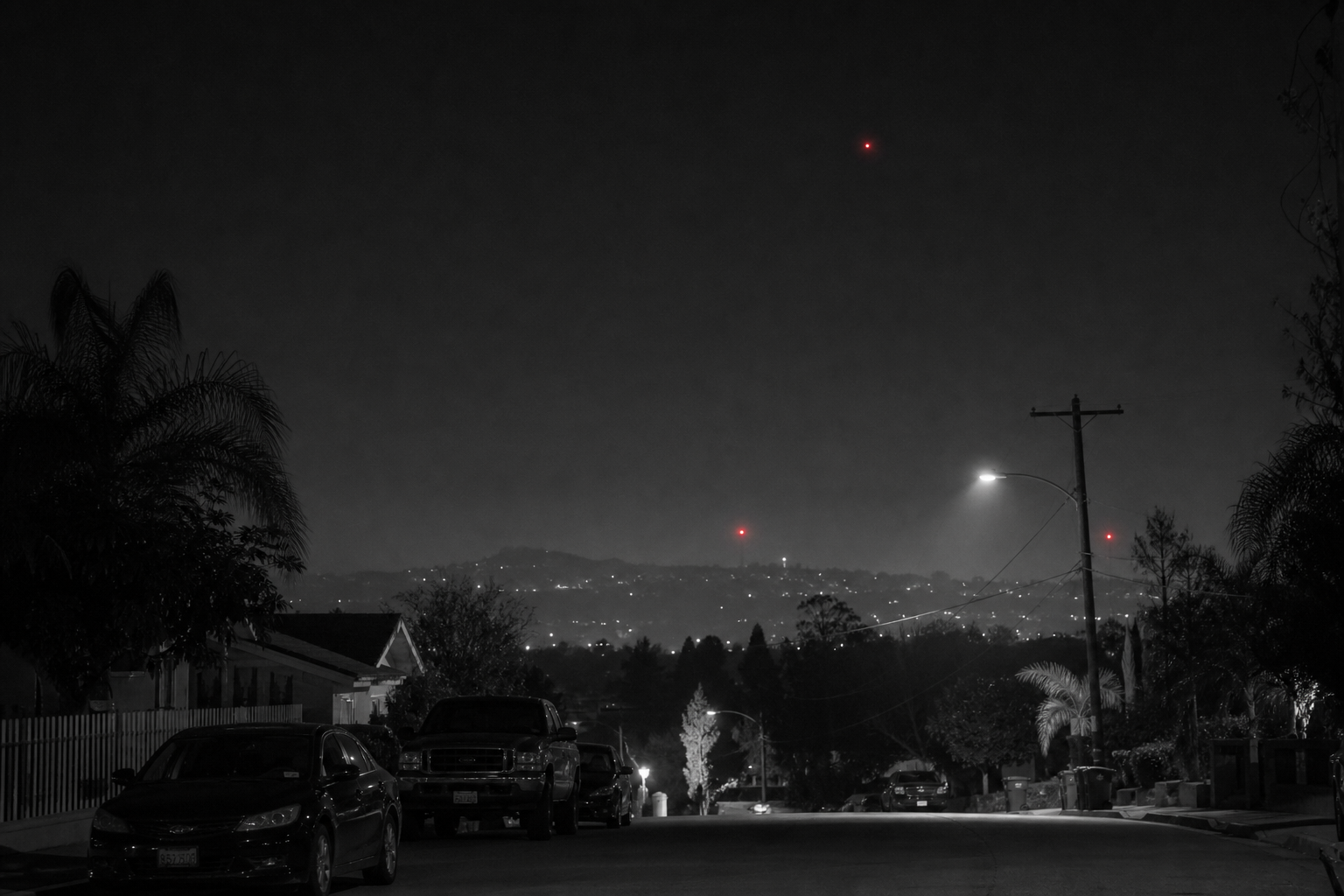
Aircraft lighting is one possible comparison category. A single aircraft can display more than one visible light, and separate aircraft can appear grouped when viewed along similar lines of sight. A formation hypothesis would be stronger if the lights maintained fixed spacing, changed direction together, and showed a common rate of motion; it would be weaker if their separations changed independently or if each light followed a clearly separate course. The surviving description of this triangle UFO does not record those discriminating features, so it cannot establish either a single aircraft, a formation, or rule them out.
Three independently moving airborne lights could also create a temporary pattern. Lanterns, for example, would be expected to drift rather than hold rigid formation, with spacing that gradually changes as wind affects each one differently. Their relevance would depend on reported drift, duration, ascent or descent, and a wind observation for the relevant place and time. None of those details survives for the three red lights UFO California report, leaving the lantern idea plausible but untested.
Fireworks offer a different visual signature: brief rises, bursts, falling sparks, and often changing brightness rather than sustained, evenly separated points. They fit best when the observation was short and near midnight, but that timing alone cannot identify the lights. Consumer drones are likewise not a strong case-specific answer here: the record contains no evidence of controlled hovering, abrupt turns, close-range sound, or a documented operator, and it provides no basis to favor that explanation over other possibilities.
The practical distinction is between a pattern and an object. A visible outline, stable relative spacing, synchronized motion, and a timed observation could test whether three lights belonged together. Here, the reported color and triangular arrangement preserve an unusual-looking visual impression, but not the measurements needed to determine what produced it.
Bottom Line: A Reported Sighting, Not a Demonstrated Extraordinary Event
The appropriate classification is reported and insufficiently documented. The record preserves a narrow allegation: three red lights were associated with El Cajon on midnight on January 1, 2010 and perceived as a triangle. It does not preserve a firsthand account, independent corroboration, a reliable observation time or location, imagery, or behavior details capable of distinguishing a single object from separate lights.
“Conventionally plausible” describes the available alternatives, not a final identification. Aircraft-related lighting, independently drifting lights, and short-lived holiday activity can produce an apparent triangular pattern; none can be matched decisively without the missing timing, direction, duration, and motion information. “Unresolved,” in this limited sense, means that the surviving description cannot support a confident identification, not that it demonstrates an extraordinary cause.
A stronger conclusion would require independently dated material tied to the observation: an original witness statement with usable specifics, corroborating witnesses, authenticated imagery, or records that align with a precise time and line of sight. No such material materially changes the assessment of the El Cajon UFO sighting 2010. Current UFO news or UAP disclosure debates likewise do not supply evidence for this local 2010 account, and the report does not establish non-human intelligence, alien disclosure, an official investigation, or a government cover-up.
What the El Cajon Report Can, and Cannot, Show
The key limitation is not that every unanswered question points toward an extraordinary craft; it is that the questions cannot be tested against a dependable event record. A fixed observation time could be compared with aircraft movements, weather, and holiday activity. A viewing direction and duration could help distinguish a distant aircraft sequence from lights that maintained a common formation. Original imagery or separate accounts from observers in different locations could test whether the triangular appearance was shared rather than a single viewer’s perspective.
None of those discriminating details survives with this allegation. The report can therefore show only that someone associated three red lights, or a triangle-like visual impression, with El Cajon on midnight on January 1, 2010. It cannot show the lights’ distance, altitude, source, relationship to one another, or whether they were attached to one craft at all. Conventional possibilities remain open, but the available material does not select one; an extraordinary explanation remains unproven for the same reason. The responsible outcome is a preserved but undetermined local sighting claim, not a verified identification.
Sources
Frequently Asked Questions
-
What was reported in the El Cajon triangle UFO sighting on New Year’s Eve 2010?
The report associated El Cajon, California, with three red lights seen in a triangle-like arrangement on December 31, 2010. It does not document a visible craft, a hull, fixed spacing, or proof that the lights came from one object.
-
Were three red lights seen over El Cajon, California, in 2010?
A reported sighting described three red lights in or near El Cajon on New Year’s Eve 2010. The claim is unverified because no original witness submission, named witness, or independently dated contemporaneous record is available.
-
Is there photographic or video evidence of the El Cajon UFO report?
No photograph, video, original media file, or recoverable metadata has been supplied for the El Cajon report. There is also no documented local-news account, dispatch entry, aviation record, or official incident record tied to the alleged sighting.
-
What details would help identify three red lights seen in a triangle?
Useful details include the exact time, viewing location, compass direction, elevation, duration, apparent spacing, motion, brightness pattern, sound, and whether the lights moved together. Fixed spacing and synchronized movement could support a common source, while independently changing positions would favor separate lights.
-
Could the El Cajon triangle of red lights have been aircraft, lanterns, or fireworks?
Aircraft lights, multiple aircraft, drifting lanterns, and New Year’s Eve fireworks are conventionally plausible possibilities. The report lacks the time, direction, duration, wind conditions, and movement details needed to select any one explanation, so it remains undetermined rather than verified as extraordinary.