A triangle of lights is a viewing pattern, not a measured airframe: it can arise when separate objects align from one observer’s position. The 2020 Grand Junction, Colorado account describes three nonflashing lights arranged in that pattern and appearing to travel east-southeast (ESE), but it does not establish a single craft or an extraordinary cause.
The distinction matters. “Three steady lights” describes visible points of light; “triangle” describes their geometry in the observer’s sky; and “moving ESE” records perceived direction rather than a plotted route. Distant aircraft, lights on one aircraft, drones, satellites, or perspective effects can sometimes look like a grouped triangle. The description alone cannot determine distance, altitude, size, physical connection, or origin.
This article treats the Grand Junction Colorado UFO sighting 2020 as a report requiring support. It separates the stated observation from later interpretation, then asks whether a precise date and time, vantage point, duration, original media, independent witnesses, aviation activity, or sky-condition records can corroborate or challenge it. Without those time-matched details, the responsible finding is not that the lights were extraordinary, but that the account is insufficiently documented for a firm identification.
What Was Reported Over Grand Junction in 2020
No traceable original witness submission, report-database record, publication date, timestamp, named witness, photograph, video, or contemporaneous local news account has been supplied for this examination. The available claim is therefore not a fully recoverable incident record; it is an unverified description attributed to a 2020 Grand Junction-area sighting.
That description reports three lights over or near Grand Junction, Colorado. They were perceived as steady rather than flashing, arranged in a triangular pattern, and moving toward the east-southeast. Each element is an observation claim: “steady” describes how the lights appeared to the observer, “triangle” describes their apparent arrangement in the sky, and “ESE” describes perceived travel from that observer’s position. None establishes altitude, distance, speed, duration, or whether the lights belonged to one object.
The distinction is consequential. A fixed-looking triangle can result from three separate lights sharing the same general line of sight, for example, aircraft at different distances or lights whose spacing is compressed by perspective. Conversely, three lights that appear grouped need not remain in a rigid formation. Without a dated observation time, a specific viewing location, and a description of changes in spacing or brightness, the reported direction cannot be matched responsibly to aviation, satellite, weather, or astronomical records.
In short, the Grand Junction UAP sighting 2020 account preserves a narrow reported sequence, three apparently steady lights, triangular geometry, and apparent ESE movement, but leaves the basic provenance and observing conditions unresolved. Those omissions make it insufficiently documented, not affirmatively unexplained.
Three Lights in a Triangle: What the Observation Does, and Does Not, Show
Geometry in the night sky is angular, not physical. Three points of light separated across an observer’s field of view can form a triangle even when the sources are independent, widely separated, or at different distances. Perspective can also compress depth: objects that are far apart along the line of sight may look closely grouped, while a changing viewpoint can make a loose arrangement seem orderly.
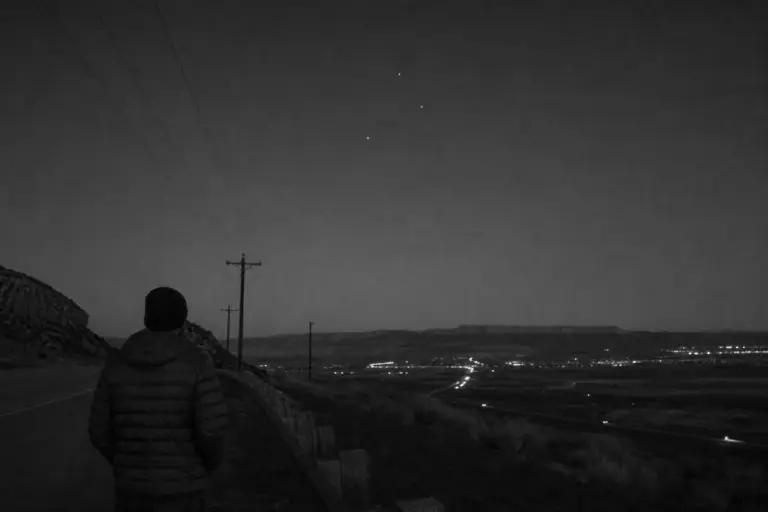
For the reported triangle formation lights, “steady” is a limited visual description. It means no flashing or obvious brightness cycle was recalled; it does not establish a particular light technology, rule out intermittent lights missed by the observer, or show that all three lights were mounted on the same structure. Likewise, apparent shared ESE travel describes the group as seen from one location. It does not, by itself, demonstrate rigid spacing, common altitude, or a single speed.
A stronger claim, that the triangle lights over Grand Junction, Colorado were a triangle-shaped craft, would require evidence of a physical connection between the lights. Useful indicators would include fixed relative spacing through motion, a visible dark outline obscuring background stars, coordinated turns, or imagery with known time, location, and an unaltered original file. A weak indicator is simply that three unidentified lights in the sky retained a triangular-looking arrangement for part of an observation.
No sketch, photograph, video, or witness detail about changing separation, navigational colors, blinking, disappearance, or brightness variation is available here. Nor is there a reference object that would permit a defensible estimate of size, altitude, distance, or speed. The reported pattern therefore supports only an apparent three-light geometry, not conclusions about structure or origin.
Assessing the Reported East-Southeast Movement
“East-southeast” adds a directional impression, not a measured flight path. From a ground observer’s viewpoint, it can mean the lights appeared to drift toward the ESE portion of the horizon or across that sector of the sky. It does not establish a compass heading, ground track, altitude, or speed. A light moving laterally at one distance, one approaching or receding along the line of sight, and several unrelated lights seen in sequence can produce similar apparent motion.
A reliable track requires fixed reference points and time. The useful distinction is between “it moved ESE from where I stood” and a plotted course derived from successive positions against landmarks, stars, or an accurately oriented image. A report that notes the lights passed from above a particular ridge or building toward another identifiable landmark is stronger than a bare compass label, because the sightline can be reconstructed. Elevation angle matters as well: movement near the horizon and movement high overhead do not describe the same sky path.
For this ESE moving lights sighting in Colorado, the available account supplies neither a precise date nor local time, time zone, observing position, duration, entry and exit points, elevation, or stated compass reference. It also lacks an independent record matched to the same interval. Those omissions prevent a case-specific comparison with any possible aircraft, satellite, or other sky activity.
Direction becomes discriminating only when those details overlap: a defined Grand Junction vantage point, an exact observation window, and a record capable of being plotted against it. Until then, ESE remains a useful part of the witness description, but not evidence of a verified route.
Plausible Explanations to Test Before Calling the Lights Unidentified
Several lights sharing an apparent course should first be treated as a grouping in the observer’s view, not as proof that they belonged to one object. For the reported Grand Junction, Colorado, 2020 event, three steady lights in a triangle appearing to move ESE, the available description is too thin to rank one conventional explanation decisively.
- Formation flight or separate aircraft: This possibility fits if the lights maintained roughly consistent relative positions, showed intermittent red, green, white, or anti-collision flashes, or followed a route consistent with aircraft arriving, departing, or transiting the area. It becomes less persuasive if all three lights remained continuously steady, held an unusually rigid close triangle through substantial motion, and displayed no separable aircraft-like behavior. Even then, apparent steadiness can reflect distance, glare, or limited observation time.
- Aircraft viewed at an angle: A single aircraft can present several visible lights, such as forward-facing, wing-area, or flashing lights, that appear spatially arranged when seen head-on or obliquely. Changes in the triangle’s shape, brightness, or spacing as it crossed the sky would support that interpretation. A fixed three-point pattern with no visible connecting body does not establish one aircraft, but neither does it rule one out.
- Satellites or a Starlink-like group: These are worth testing only against an exact time and observing location. Smooth, uniform motion and lights that remain steady relative to each other would be relevant supporting observations. A compact triangle that turns, changes spacing, hovers, or travels below the horizon would weaken a satellite explanation. Without a time window, no pass prediction can identify this case specifically.
- Drones: Multiple drones can create deliberate geometric patterns and can change formation or hold position. Audible rotor noise, abrupt turns, low apparent altitude, or motion near a local event area would favor that possibility. The report provides none of those discriminators.
- Sky or ground lighting effects: Reflections, distant lights seen through haze, or moving beams projected onto clouds can distort brightness and apparent motion. Nearby landmarks, cloud cover, and whether the lights stayed aligned with the ground would matter; none is preserved in the account.
These are testable alternatives, not retrospective identifications. In the absence of a date, time, vantage point, or original media, the Grand Junction report remains insufficiently documented to distinguish among aircraft, satellites, drones, lighting effects, or another unresolved cause.
What Evidence Could Corroborate, or Challenge, the Report
Meaningful comparison begins by anchoring every record to the same observation window: a specific 2020 date, local start and end time, Grand Junction-area vantage point, and the sky sector where the three lights first and last appeared. The surviving description supplies only the year, location, apparent triangular arrangement, and ESE movement. That is not precise enough to associate a flight, satellite pass, or weather record with this event rather than unrelated activity on another night.
- Contemporaneous witness material: A message, notebook entry, original submission, or local publication made near the observation could preserve the missing clock time and duration. Separate accounts are corroborative only when they were independently recorded and converge on particulars, for example, three nonflashing lights, similar triangular spacing, an ESE apparent path, and the same part of the Grand Junction sky. Later retellings derived from one account are repetition, not independent confirmation.
- Original image or video files: A camera-original file is more useful than a screenshot or reposted clip because it may retain capture time, device model, frame sequence, exposure settings, and compression history. Those details can test whether the three points remained present across frames or instead changed with focus, zoom, stabilization, or automatic exposure. Media alone would still not measure altitude, distance, speed, or prove a structure connecting the lights.
- Flight records: ADS-B data can plot participating aircraft against a defined minute and observer position, testing whether recorded traffic occupied the relevant ESE sector. A close time-and-direction match would strengthen an aircraft lead. A blank result from one archive is narrower: reception can be incomplete, historical playback may be limited, and not every aircraft necessarily appears in a given dataset.
- Satellite and weather comparisons: Historical orbital data can test whether visible satellites crossed the local sky during the stated minutes. Archived cloud cover, visibility, haze, and wind observations can help assess whether atmospheric conditions affected apparent brightness or motion. Neither exercise can identify this case from “2020” alone.
The practical distinction is between a failed search and positive anomaly evidence. No supplied primary report, independently recorded witness account, original media file, precise date, or local time allows these tests to be performed for this Grand Junction UFO report. An absent match in one aviation, satellite, or weather database would show only the limits of that search, not establish an anomalous craft.
Evidence Gaps in the Grand Junction Account
The limiting problem is not merely that the lights lack a label; it is that the account lacks the information needed to test labels fairly. The reported elements, three steady lights, an apparent triangular arrangement, movement toward ESE, Grand Junction, and a 2020 timeframe, are not accompanied by a precise date and local time, exact observing position, viewing direction, elevation, or duration.

- Behavior record: There is no account of whether the spacing changed, lights brightened or dimmed, blinked, altered course, stopped, or disappeared behind terrain or cloud. Those distinctions could separate a stable visual grouping from several independently moving lights.
- Authentic primary material: No original witness statement, unedited image or video file, capture metadata, or traceable chain of reposting is available to authenticate the claim or establish when and where any media originated.
- Independent corroboration: No separately recorded witness account is available to compare the reported triangle, duration, and apparent ESE movement from another location.
- Matched records: Without a narrow time and vantage point, aviation tracks and satellite passes cannot be meaningfully matched to this observation.
“Unidentified aerial phenomenon” can therefore describe the unresolved report in a narrow sense: the available information does not support a confident identification. It says nothing definitive about a craft’s shape, technology, operator, or origin.
What Can Responsibly Be Concluded
The appropriate finding is evidentiary rather than exotic: this is an insufficiently documented 2020 Grand Junction report. It preserves an observation of three apparently steady lights in a triangular arrangement moving toward ESE, but does not establish whether the lights were aircraft, satellites, drones, one structured object, or another cause. A triangular pattern alone does not show a triangular craft; three separate lights can form that appearance from one viewing position.
The most useful new material, in order, would be:
- An original witness account giving the date, local start and end time, exact vantage point, and observations of spacing, brightness, and motion.
- Original photo or video files, rather than reposts, with intact capture metadata and a clear chain of custody.
- An independent account from another observer, especially one that fixes the same lights against landmarks.
- Time-matched aviation, satellite, and weather records that can be compared against that defined observation window.
Until such material emerges, this Grand Junction Colorado UFO sighting 2020 should be classified as insufficiently documented, not as a confirmed craft, a confirmed anomaly, or evidence for any particular origin.
Frequently Asked Questions
What was reported over Grand Junction, Colorado in 2020?
The report describes three apparently steady, nonflashing lights in a triangular sky pattern moving toward east-southeast. It provides no precise date, local time, witness identity, original photo, video, or traceable primary report.
Does a triangular pattern of three lights mean there was a triangle-shaped UFO?
No. Three separate lights can appear triangular from one observer’s position because sky geometry is angular and perspective can compress spacing and depth. A physical triangular craft would require evidence such as fixed spacing, coordinated turns, a visible outline, or time-stamped original imagery.
Can three steady lights in a triangle be an aircraft formation?
Yes. Separate aircraft or multiple visible lights on one aircraft can appear as a triangle, especially when viewed at an angle or from a distance. Aircraft-like indicators include red, green, white, or anti-collision flashes, changing spacing, and a route consistent with local air traffic.
Why can lights appear to move in formation at night?
Separate lights at different distances can seem grouped because perspective compresses their apparent spacing along the observer’s line of sight. Apparent shared movement toward ESE does not establish a common altitude, speed, rigid formation, or single physical object.
How can a Grand Junction lights sighting be checked against aircraft and satellite records?
Record the exact date, local start and end time, viewing location, sky sector, elevation, duration, and entry and exit points. Those details can then be compared with ADS-B aircraft tracks, historical satellite passes, and local cloud, haze, visibility, and wind records; the available 2020 report lacks the information needed for that comparison.