At the center of the Travis Walton abduction claim is a documented five-day disappearance and an explanation that remains unverified. On November 5, 1975, Walton, a 22-year-old logger, was riding with coworkers near Snowflake, Arizona, when the crew reported seeing a bright, hovering object. They said Walton left their truck, approached it, and was struck or taken by a force from the object. When he did not return, the incident became an urgent missing-person case, and the crew’s account immediately drew police scrutiny.
Walton reappeared five days later with a story of being taken aboard a craft by nonhuman beings. That account transformed a local investigation into the best-known 1975 Arizona UFO encounter and, eventually, a national controversy. The established record supports that Walton was missing and that the men made extraordinary reports; it does not independently establish an extraterrestrial cause.
This article separates reported experience from corroborated fact, follows the investigation and public response, and weighs the evidence that keeps the case contested. Polygraph results, witness agreement, later recollections, skeptical objections, and the heavily fictionalized Fire in the Sky film each matter, but none should be confused with conclusive proof.
Why the Travis Walton Case Became a National UFO Controversy
The story moved beyond rural Arizona because it combined two kinds of news that were difficult to reconcile: a five-day missing-person investigation and a shared account of an aerial encounter from several members of the same logging crew. In November 1975, near Snowflake and the Turkey Springs area of the Apache-Sitgreaves National Forest, Walton’s absence gave law enforcement an immediate, conventional question to pursue, whether he had been harmed, had left voluntarily, or whether the men with him were responsible. The crew’s UFO report made that inquiry nationally unusual.
Public attention intensified after Walton returned and described an abduction by nonhuman beings. Participant testimony is significant because it supplies a consistent central narrative from the people directly involved; it is not the same as independent physical evidence capable of identifying a non-human intelligence. Polygraph examinations later became part of the public argument, but they measure physiological responses under testing conditions rather than establish that every detail of a statement occurred. Skeptics consequently focus on gaps in corroboration, possible motives, and changes in recollection, while supporters emphasize the crew’s long-standing account. The Travis Walton case remains important in Arizona UFO history precisely because neither position converts a reported experience into a government finding or confirmed extraterrestrial event.
The Reported Encounter and Five-Day Disappearance: A Timeline
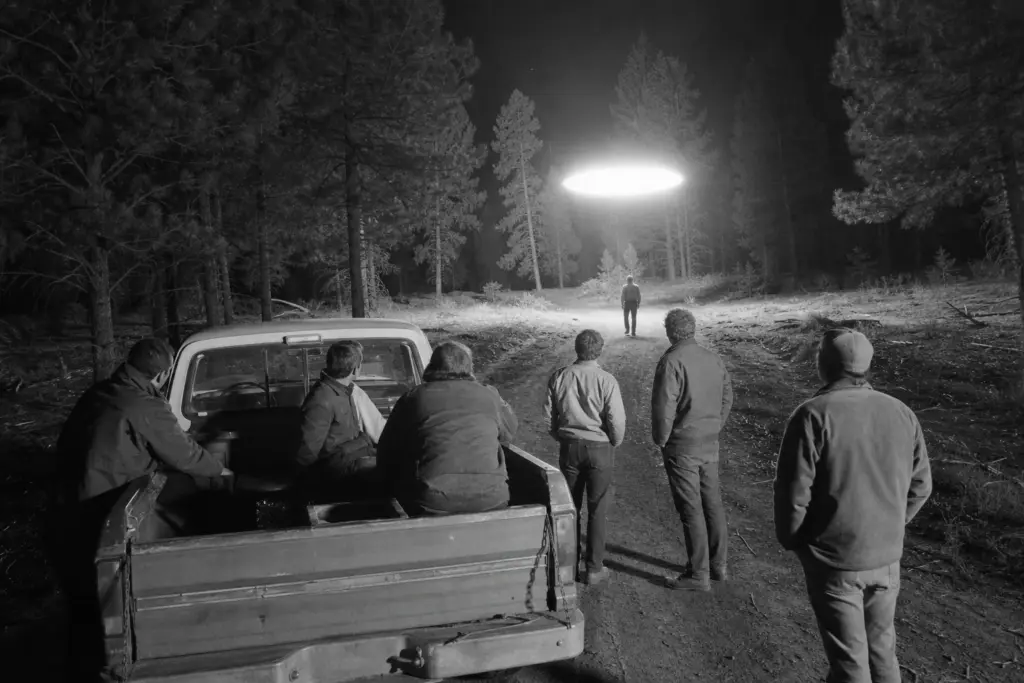
On the evening of November 5, 1975, seven members of a logging crew were traveling back from their work area in Mike Rogers’s pickup truck through the Turkey Springs country. Rogers, the crew foreman and driver, later said the men saw a bright object ahead of the vehicle in a clearing. Travis Walton, then 22, got out and moved toward it despite the others’ objections.
The account converges on the sequence that followed more clearly than on the object itself. Rogers and several coworkers, including Dwayne Smith, Allen Dalis, Steve Pierce, and Ken Peterson, said Walton was near the light or object when a sudden flash or beam struck him. They reported that he fell or was thrown backward, prompting Rogers to drive away in fear. Descriptions of the object’s shape, distance, color, motion, and the precise effect on Walton have varied among witnesses and in later retellings. Those details are therefore reported testimony, not independently established observations.
After driving some distance, the crew said they turned back to look for Walton but could not find him. Rogers and the others returned toward town and reported the incident, beginning the Navajo County Sheriff’s Office response as a missing-person matter. At that point, the documented issue was straightforward: Walton had been last seen in the forest and had not returned with the men who said they had left him there. The unusual explanation did not remove the need to establish where he was or whether he had been harmed.
The shared timeline is the firmer part of the 1975 Arizona UFO encounter: Walton vanished after the crew’s workday on November 5 and reappeared early on November 10. Walton later reported awakening disoriented near Heber, Arizona, and telephoning his family from a public phone. His relatives collected him and he was brought back into contact with authorities. That return ended the immediate search, but it did not independently settle what happened during the five-day interval.
For assessing the Travis Walton disappearance, the distinction matters. The dates, the crew’s report, the ensuing investigation, and Walton’s return are historical events; the bright object, the alleged force, and Walton’s later account of where he had been remain claims that depend principally on participant recollection.
From Missing-Person Search to National Headlines
For investigators, the crew’s unusual explanation did not displace the ordinary questions raised by any disappearance: where Walton was, whether he had been injured, and whether the last people known to have seen him could account for their actions. The Navajo County Sheriff’s Office therefore treated the loggers’ account as information to test, not as a reason to suspend scrutiny.
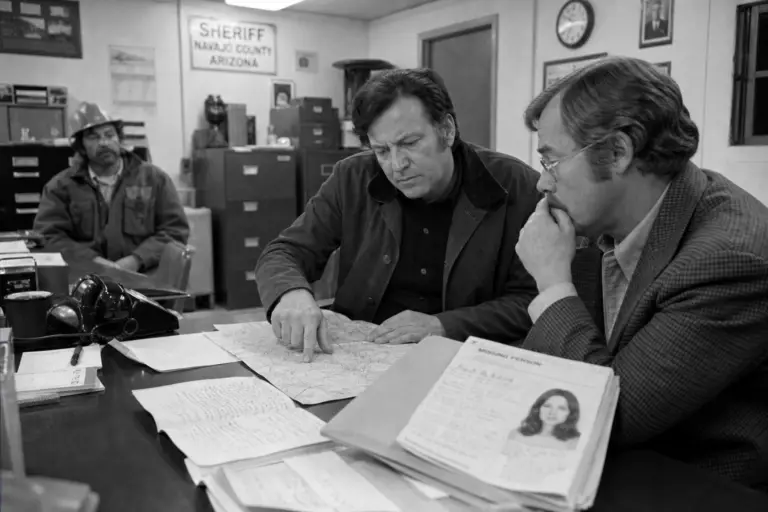
That scrutiny was a normal feature of a missing-person inquiry, rather than evidence that authorities had established wrongdoing by Mike Rogers or the other crew members. Their accounts could be compared for timing, movements, and the decision to leave and later return to the clearing; search activity could focus on the reported location; and investigators could look for a conventional explanation for Walton’s absence. The UFO element made the account exceptional, but it did not remove the crew from the center of the investigation.
Public suspicion followed the same logic, though it was often expressed more sharply in early reporting and conversation. A man was missing in remote forest country, and the witnesses’ account involved a bright aerial object and a sudden disappearance. Contemporary news coverage could therefore frame the story both as a possible crime investigation and as an extraordinary UFO report, two frames that carried very different assumptions about what had happened.
Walton’s return early on November 10 changed the immediate problem. The search for a missing man ended, while investigators could begin taking his account alongside those of the crew. His reported explanation pushed the 1975 UFO case beyond local coverage and into national circulation. That attention made the story famous; it did not itself supply independent corroboration for an extraterrestrial cause.
What Walton Said Happened, and What the Record Can Confirm
Walton’s own account supplied the element the search could not: an explanation for the interval after the reported blast of light. He said he first regained awareness in an unfamiliar, brightly lit interior, lying on what he understood to be a table. He described small, humanlike beings nearby, panic, and an attempt to escape. In the basic version he gave after returning, he said he then encountered taller figures, lost consciousness again, and later found himself outside near Heber, Arizona.
Walton said he reached a phone booth and called his brother-in-law, Grant Neff, after the experience. That call and his reappearance are externally reportable events; the interior setting, the beings, the sequence of consciousness and blackout, and the means by which he arrived near Heber are firsthand testimony. The distinction is crucial. Eyewitness testimony can establish what a witness says he experienced, but it cannot by itself identify the cause of the experience or account independently for the missing days.
Later retellings of the Travis Walton UFO encounter added texture and sequence through interviews, published narratives, and hypnosis-related recollections. Those versions are useful for tracing how Walton understood and narrated the event over time, but they should not be treated as interchangeable with his earliest statements. Hypnosis is a memory-retrieval technique, not a test that distinguishes accurate recollection from suggestion, imagination, or later information; more detail therefore does not automatically mean stronger corroboration.
That leaves the Arizona UFO abduction case with a clear evidentiary divide: Walton’s reported ordeal is central to why the case endured, while the extraordinary parts remain subjective claims rather than publicly verified proof of an extraterrestrial event.
Polygraphs, Witness Consistency, and the Case’s Major Disputes
Polygraph claims became part of the dispute after the November 5, 1975 report and Walton’s November 10 return. Walton and members of Mike Rogers’s logging crew underwent polygraph examinations, and supporters emphasize reported favorable results. A polygraph records changes in respiration, perspiration-related skin conductance, and cardiovascular activity as an examiner asks relevant and comparison questions; it does not detect a UFO, recover missing time, or measure whether an event was objectively true.
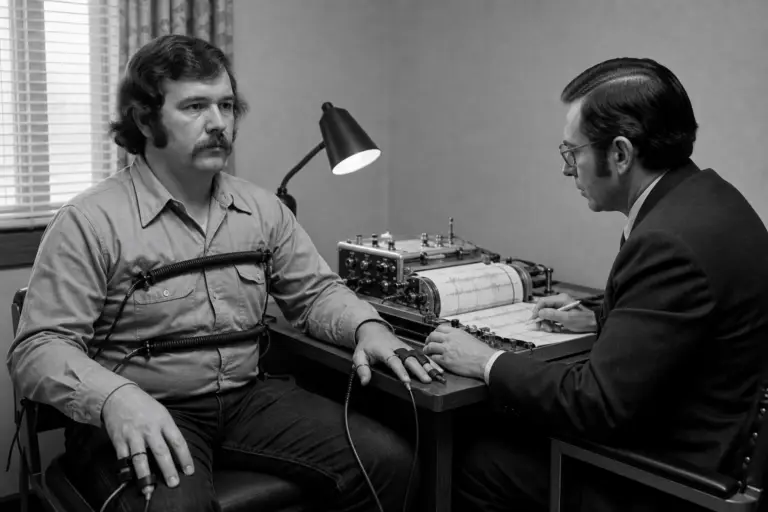
The Travis Walton polygraph test is therefore evidence of an examiner’s credibility judgment under particular testing conditions, not physical proof that Walton was abducted. Question wording matters: “Did you make up this story?” tests a different proposition from “Were you taken aboard a nonhuman craft?” Anxiety, expectation, examiner technique, and a witness’s sincere but mistaken belief can affect interpretation. Disagreement over the examinations’ procedures and reported results is one reason polygraph evidence has remained suggestive to supporters rather than decisive to critics.
The seven men in Rogers’s pickup retained a common outline of the Turkey Springs episode: they reported a bright object, said Walton left the vehicle, and described a flash or force before they drove away and later returned. That agreement is more significant than a lone account, but the witnesses experienced the event together on the same November evening and had opportunities to discuss it afterward. Their accounts also varied in details such as the object’s appearance, their positions, and the exact sequence of the crew’s reactions.
Walton’s condition upon reappearing near Heber has likewise been interpreted in opposing ways. Distress, hunger, fatigue, or physical discomfort after five days away could be consistent with his account, but none identifies what caused the absence. A skeptical investigation instead asks whether a planned disappearance, a hoax, or another ordinary explanation could account for the November 5–10 timeline, the crew’s testimony, and Walton’s later narrative. Proposed motives, including publicity, a prospective book, and the crew’s financial difficulties, supply possible reasons for fabrication, not proof that fabrication occurred.
As with the earlier Betty and Barney Hill alleged abduction case, the central evidentiary gap remains material corroboration: no publicly verified medical finding, forensic trace, photograph, or physical artifact establishes that a nonhuman craft took Walton. The case records persistent testimony, a real disappearance, and disputed credibility assessments; it does not convert polygraph examinations or witness consistency into scientific confirmation of an extraterrestrial cause.
How Fire in the Sky Changed the Story’s Public Image
The 1993 film Fire in the Sky gave the case its most influential popular image, but it is an adaptation rather than a historical record. It retained the recognizable framework: an Arizona logging crew, Walton’s disappearance, and his subsequent claim of an abduction. Its version of events, however, reshaped personalities, dialogue, chronology, and the visual encounter for dramatic effect.
The distinction is clearest in the film’s celebrated interior sequence. The screen version depicts a prolonged, nightmarish ordeal involving grotesque beings and invasive procedures. Walton’s published account described fear and strange beings, but not that elaborate sequence in the same form. Anyone searching for the Fire in the Sky true story should therefore separate the movie’s horror imagery and recurring abduction-story conventions from Walton’s own changing retellings and from the limited contemporaneous record.
The film’s reach amplified a story already sustained by books and mass media, including television interviews, UFO conferences, and organizations such as MUFON. Repetition gave the case a familiar narrative shape within mass-media UFO culture: a missing logger, frightened coworkers, and an alleged return from a craft. That visibility explains its durability, but cinematic recognition does not add independent corroboration to the abduction claim.
What the Travis Walton Case Establishes, and What It Does Not
The soundest conclusion depends on keeping different kinds of evidence separate. The record establishes that Walton was reported missing after the crew’s November 1975 account, that his absence prompted an intensive local investigation and wide publicity, and that he later returned. It also establishes that Walton and several crew members continued to describe an extraordinary encounter. Those facts show that a real disappearance and a durable set of claims existed; they do not identify the cause.
Testimony and favorable polygraph interpretations can matter when judging whether participants appeared sincere, but neither supplies independent confirmation of what they saw or experienced. Skeptical concerns, including inconsistencies at the margins, possible incentives, and the limits of retrospective recollection, do not by themselves establish a hoax. They matter because an extraterrestrial explanation would require stronger corroboration: independently testable physical traces, reliable instrumental records, or evidence that excludes ordinary alternatives.
On that standard, the Travis Walton abduction claim does not prove alien contact, non-human intelligence, or a government UFO cover-up. No official inquiry produced publicly verified evidence for those conclusions. The unresolved space between persistent witness testimony, disputed credibility tests, and missing physical corroboration is not a minor detail; it is the reason the case remains debated rather than settled.
Why the Travis Walton Case Remains Unresolved
A useful checkpoint is whether a piece of evidence can distinguish a real disappearance from the explanation offered for it. On November 5, 1975, seven men reported a bright object near Turkey Springs, and Walton was absent until November 10. Their continuing agreement on that broad sequence gives the episode unusual weight, even though accounts differed at the margins. Eyewitness agreement shows that several people described a core event similarly; it cannot independently identify the light, the reported force, or the cause of Walton’s missing time.
Polygraph results occupy the same middle ground. Tests given after Walton’s return were offered in support of his account and those of other participants, but a polygraph measures physiological responses during questioning, not the objective reality of an alleged craft or abduction. Favorable interpretations may bear on an examiner’s judgment of apparent candor under particular conditions. They do not convert November 1975 testimony into independently verified extraterrestrial evidence, while the lack of such evidence does not establish that every participant fabricated the event.
Fire in the Sky, released in 1993, made the Arizona episode culturally unforgettable while blurring adaptation and testimony, particularly through its invented graphic interior-abduction imagery. The Travis Walton abduction claim remains one of many unresolved UAP-related incidents for a precise reason: the disappearance, investigation, return, and public controversy are historical events, but the claimed extraterrestrial cause has never been independently demonstrated.
Frequently Asked Questions
What did Travis Walton say happened in the 1975 Arizona UFO encounter?
Walton said he approached a bright hovering object near Turkey Springs, Arizona, on November 5, 1975, and was struck by a flash or force. He later said he woke inside a brightly lit craft with nonhuman beings before reappearing near Heber, Arizona.
How long was Travis Walton missing?
Travis Walton was missing for five days. He disappeared after the logging crew’s report on November 5, 1975, and reappeared early on November 10, 1975.
Did Travis Walton and the logging crew pass polygraph tests?
Walton and members of Mike Rogers’s logging crew underwent polygraph examinations, and supporters cite favorable reported results. Polygraphs measure physiological responses during questioning, not whether an alien abduction objectively occurred.
Is Fire in the Sky based on a true story?
Fire in the Sky is based on the broad framework of Walton’s 1975 disappearance and claimed abduction by an Arizona logging crew. The 1993 film substantially changed personalities, dialogue, chronology, and the graphic interior-abduction sequence for dramatic effect.
What evidence would be needed to prove the Travis Walton UFO abduction claim?
Independent corroboration such as verified physical traces, reliable instrumental records, forensic evidence, or artifacts that exclude ordinary explanations would be needed. The case documents a real five-day disappearance and persistent witness testimony, but no publicly verified evidence proves an extraterrestrial cause.