In November 1975, a reported roadside encounter near Turkey Springs, Arizona, turned a routine trip home for a logging crew into one of UFO history’s most enduring disputes. Six men later said their co-worker, Travis Walton, approached a luminous object in the forest and vanished after an apparent burst of light. Walton was missing for five days before reappearing, injured and disoriented by his own account, with a story that he said explained the lost time.
Those broad events make the Travis Walton abduction case unusually memorable; they do not establish that an abduction occurred. A missing-person investigation and the crew’s reports are different kinds of evidence from the extraordinary explanation later attached to them. Likewise, an eyewitness’s immediate statement carries a different evidentiary weight from a recollection retold decades afterward or a scene reshaped for a film.
This account follows that distinction closely: the loggers’ reported 1975 Arizona UFO encounter, Walton’s disappearance and return, the investigation, and the contested polygraph record. It will identify what is documented, who claimed what, and where the record stops short of a verifiable conclusion, explaining why the episode remains unresolved rather than proved.
The Travis Walton Case: A Famous Alleged Abduction, Not a Settled Fact
At 22, Travis Walton was a forestry worker on a contract logging crew in northeastern Arizona. On the evening of November 5, 1975, the other men in the crew reported an unusual lighted object beside the road near their work area and said Walton disappeared after leaving their truck. Their account brought a local missing-person response before it became a nationally known UFO narrative.
The case’s prominence rests on an unusual combination of elements: several coworkers gave versions of the same central event, Walton was absent for roughly five days, and he later offered an account he characterized as an abduction. Those points are significant, but they answer different questions. Multiple witnesses can corroborate that a group reported an incident; they cannot, by themselves, identify what the object was or establish what happened during Walton’s absence. A missing-person investigation establishes that authorities treated his disappearance as real and urgent, not that any proposed explanation was proved.
That distinction is central to the Travis Walton UFO case. Supporters emphasize the crew’s persistence and Walton’s later testimony; critics focus on the absence of physical evidence capable of independently confirming an extraterrestrial event, as well as inconsistencies and disputes surrounding later accounts. The record therefore warrants close examination rather than a simple verdict.
What the Logging Crew Reported Seeing Near Turkey Springs
Mike Rogers, the crew’s foreman and the driver that evening, said the men were riding back from their logging job in his truck when they noticed a bright object off the road near Turkey Springs. The site is commonly described as being in the Apache-Sitgreaves National Forest area of northeastern Arizona, although accounts differ in their precise road and distance descriptions.
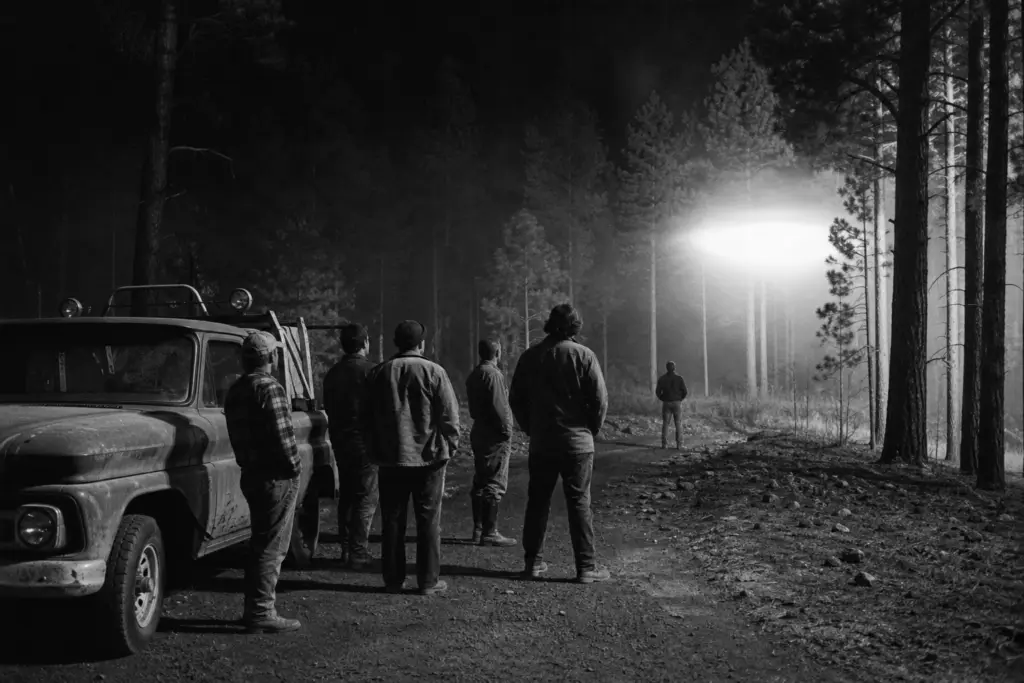
The other occupants were Travis Walton, Dwayne Smith, John Goulette, Steve Pierce, and Allen Dalis. In their accounts to the Navajo County Sheriff’s Office and in later retellings, the central sequence of the 1975 Travis Walton UFO encounter remained broadly similar: Rogers stopped after the crew saw a luminous, disc-like object among the trees; Walton got out of the truck and moved toward it while the others stayed inside.
The men did not describe every detail identically. Estimates of the object’s size, height, color, and the exact interval before the flash varied across recollections. But Rogers and the other crew members generally said a sudden burst, beam, or flash of light struck Walton, who appeared to be thrown backward. They then said Rogers drove away rapidly because the men feared the object might affect the truck or its occupants as well.
That departure is an important part of the Travis Walton log crew narrative: the witnesses said they fled first, then realized Walton was no longer with them and faced the consequences of leaving him behind. Their statements are central testimonial evidence because several people described the same basic episode. They are not, however, physical proof that the lighted object was a UFO, nor can witness agreement alone establish the cause of the reported flash or Walton’s subsequent absence.
The Five-Day Disappearance and the Search for Walton
Once the crew reached town, their report set two obligations in motion: locate a missing man and determine whether the men who had left him behind were concealing a crime. The Navajo County Sheriff’s Office treated Walton as missing, while the extraordinary explanation and the crew’s initial flight from the scene gave investigators reason to examine more conventional possibilities, including an assault, accident, or coordinated false account.
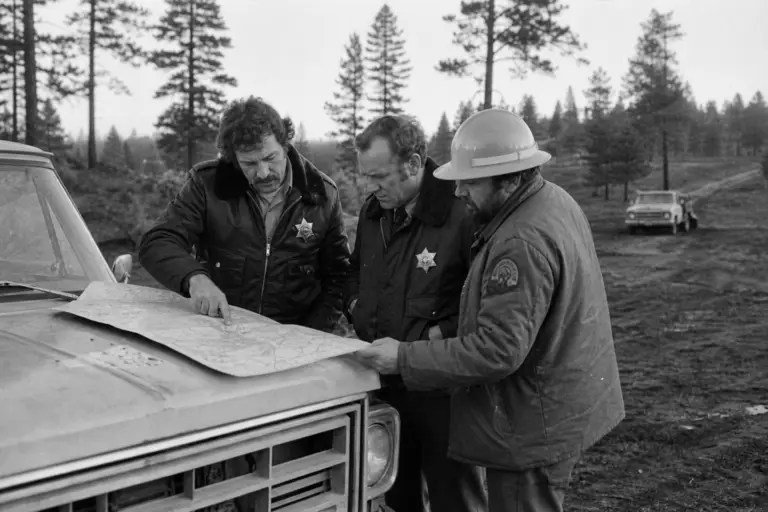
Search activity focused on the reported forest location and the circumstances of Walton’s absence. That response is a documented investigative fact; it is different from proof of what caused the disappearance. Officers could establish that the crew had reported Walton missing and that he had not returned home in the intervening days. They could not recover evidence that independently identified the reported light, flash, or its alleged effect on him.
The Travis Walton disappearance ended late on November 10, 1975, roughly five days after the crew’s report. Walton later said he regained awareness near Heber, Arizona, and sought help after calling family. His return resolved the immediate missing-person emergency, but it did not convert the crew’s account into a verified abduction. A person’s absence and later reappearance are observable events; the explanation for time unaccounted for remains a separate evidentiary question.
Investigators could interview the participants, compare their accounts, search the area, and assess Walton’s condition after his return. Those steps could test parts of the timeline and look for signs of violence or deception. They could not determine, from the disappearance alone, whether an extraterrestrial event occurred. Later paranormal interpretations therefore go beyond what the search itself established.
Walton’s Account: What He Said Happened During the Missing Time
Walton’s explanation for the missing interval came from his own recollections, not from an observation by the other men in the truck. He said he first regained consciousness in an unfamiliar enclosed space, lying on a table-like surface and in pain. In his account, several small, humanlike beings were nearby; he reacted with fear, struggled, and later encountered a taller figure wearing what he interpreted as a helmet or protective covering.
In The Walton Experience, and in later interviews, Walton described being moved through craft-like interiors, including a larger room or hangar area, before being taken aboard another vehicle. He said the experience ended with his being left near Heber, confused and physically distressed. These descriptions are the basis for the label “Travis Walton alien abduction,” but they remain descriptions of an alleged abduction as Walton remembered and narrated it.
The timing of those details matters. The immediate public record established that Walton had returned; the more elaborate account of interiors, beings, movement between craft, and his interpretation of events is preserved principally in his testimony, his book, and subsequent retellings. A useful distinction is between the stable core of his narrative, awakening among unfamiliar beings and later finding himself back in Arizona, and particulars that have been expanded, clarified, or differently emphasized over time.
That does not by itself prove either fabrication or accuracy. It does mean the interior experience cannot be treated as corroborated eyewitness evidence from the logging crew. Evaluating it requires comparing when a detail first appeared, how consistently Walton presented it, and whether any independent record can establish more than his disappearance and return.
Polygraphs, Credibility, and the Evidence at the Center of the Controversy
The reported tests are often treated as a bridge between the crew’s 1975 statements and the extraordinary explanation Walton later offered. Accounts of the case describe polygraph examinations involving Walton and members of the Arizona logging crew, but a reported favorable result has limited meaning without the examiner’s name, test date, full question sequence, charts, scoring method, and written conclusion. Those particulars are not interchangeable: a test conducted soon after Walton’s November 10 return addresses a different evidentiary moment than a later examination conducted after the story had become public.

A polygraph examination records changes such as respiration, pulse, and skin response while an examinee answers prepared questions. An examiner may interpret a pattern as indicating deception or nondeception, but the instrument does not detect an alien craft, reconstruct Walton’s five missing days, or establish that an event occurred as described. A question such as “Did you knowingly harm Travis Walton?” tests a narrower proposition than “Did you see an object near Turkey Springs?”; neither question independently validates an abduction account.
Question wording is therefore central to the dispute. A witness might answer sincerely about what he believed he saw on November 5, 1975, while still being mistaken about the object or its cause. Likewise, several crew members giving broadly similar answers can support the proposition that they maintained their account under examination, but cannot rule out shared perception, later discussion, memory error, or a coordinated narrative. The strongest signal would be a preserved report identifying the examinee, examiner, questions, charts, and interpretation; a bare assertion that someone “passed” is much weaker.
Later claims of voice stress analysis raise a separate problem. This method purports to infer stress from characteristics of recorded speech, so its value depends on the original recording, the analyst’s protocol, the exact questions, and a complete report rather than a favorable summary. It is not physical evidence of where Walton was between November 5 and November 10, nor can it distinguish an extraordinary explanation from a sincerely held recollection.
A skeptical investigation consequently asks what credibility tests cannot provide: independently verifiable traces at the forest site, recordings of the reported object, or evidence establishing Walton’s location during the disappearance. Critics also point to possible motives, the effect of fear and elapsed time on memory, and differences among later retellings. Those objections do not prove a hoax, just as reported polygraph results do not prove an abduction; together, they leave the Travis Walton abduction case dependent principally on contested testimony.
Why Fire in the Sky Is Not a Literal Record of Walton’s Story
The 1993 film Fire in the Sky is a dramatization built from the Travis Walton incident’s broad premise: a logging crew reports a strange light, one man disappears, and he returns with an extraordinary explanation. Its purpose is narrative and emotional impact, not reconstruction of testimony or investigative records.
The clearest divergence is the onboard sequence. The film presents Walton’s experience as graphic body-horror, including a terrifying, nearly wordless assault by alien figures. Walton’s published and spoken account described fear, unfamiliar beings, and medical-looking surroundings, but not that cinematic sequence or its tone. The movie also compresses the chronology and reshapes relationships and conflicts among the crew to create suspense.
Those choices matter because the film’s most memorable images can easily be mistaken for part of Walton’s original account, illustrating how abduction-story conventions and media portrayals can shape public memory. They are not evidence of what the loggers reported near Turkey Springs, what Walton recalled after his return, or what investigators could establish. Fire in the Sky helped fix the case in popular culture, but it should be treated as an adaptation, not a documentary record of the alleged event.
Why the Case Remains Unresolved Rather Than Verified
What keeps the case alive is not a single decisive exhibit but the unusual convergence of a group account, a real multi-day absence, and an investigation that began immediately. The crew agreed on the central claim that something extraordinary occurred near Turkey Springs, while Walton’s return gave the episode a concrete timeline that ordinary rumor lacks. For supporters, that combination makes dismissal feel inadequate.
It does not, however, bridge the gap from an unexplained report to a verified abduction. Like the Betty and Barney Hill alleged abduction case, the crucial observations, the object, Walton’s apparent injury, and his later interior experience remain dependent largely on participant testimony. Reported polygraph outcomes may bear on how an examiner interpreted a subject’s physiological responses, but they cannot identify what caused those responses or establish that a non-human event occurred. No independently conclusive physical record resolves where Walton was during the missing days or what the crew saw.
That is why the Travis Walton abduction case occupies an enduring but limited place among UAP sightings: a heavily discussed historical claim with witnesses and genuine unresolved questions, not evidence that non-human intelligence has been established. Its notoriety reflects the strength and persistence of the narrative as much as the boundaries of the evidence available to test it.
The Lasting Mystery of the Travis Walton Case
Its cultural afterlife has made careful separation especially important. The loggers’ account of the roadside light, Walton’s account of the missing interval, and the official effort to find a missing man belong to different parts of the record; none independently confirms the others’ most extraordinary interpretation.
Reported polygraph results remain relevant to the participants’ claimed sincerity, but not as a scientific verdict on events. A polygraph registers physiological responses to questions, so even an examiner’s favorable conclusion cannot establish where Walton was, identify the reported object, or demonstrate an extraterrestrial cause.
Fire in the Sky amplified the case for a much larger audience, while substituting invented horror imagery for key features of Walton’s own later narrative. That distinction explains why popular memory can be more vivid than the underlying testimony.
The lasting significance of the Travis Walton abduction case lies in that tension: a shared crew narrative, a disappearance that prompted an immediate search, and a witness account that has endured for decades, set against evidentiary gaps no retelling has closed. It remains an influential alleged encounter, not verified proof of an alien abduction.
Frequently Asked Questions
What happened to Travis Walton in 1975?
On November 5, 1975, an Arizona logging crew said Travis Walton approached a luminous object near Turkey Springs and was struck by a burst of light. He disappeared for roughly five days and reappeared near Heber, Arizona, on November 10.
Where did the Travis Walton UFO incident happen?
The reported encounter occurred near Turkey Springs in the Apache-Sitgreaves National Forest area of northeastern Arizona. The crew was returning from a logging job when they said they saw a bright, disc-like object off the road among the trees.
What did the Arizona logging crew say they saw?
Mike Rogers and five other crew members said they saw a luminous, disc-like object near the road. They reported that Walton left the truck, a sudden beam or flash struck him, and he appeared to be thrown backward before they drove away in fear.
Did Travis Walton and the other witnesses pass polygraph tests?
Accounts describe favorable polygraph results for Walton and some crew members, but the evidentiary value depends on preserved records such as the examiner, date, questions, charts, scoring method, and written conclusion. A polygraph measures physiological responses and cannot prove what the object was or where Walton was during the five missing days.
How accurate is Fire in the Sky compared with Travis Walton’s account?
Fire in the Sky retains the broad premise of a logging crew, a strange light, and Walton’s disappearance, but it is not a literal reconstruction. Its graphic onboard body-horror sequence, compressed timeline, and altered crew relationships differ substantially from Walton’s published account.