The Travis Walton UFO case endures because its central fact pattern is both stark and unresolved: in November 1975, a young Arizona logging worker disappeared for five days after his six co-workers reported an encounter with a bright aerial object. Walton later returned with an account of an abduction; the men in the truck described seeing him struck or thrown by a burst of light. Neither description, by itself, establishes what caused the event.
This article separates four evidentiary layers that are often blurred together. First are the documented contours of a missing-person case: a report, a search, and Walton’s return. Second is the crew’s eyewitness testimony about what they said occurred near their work site. Third is Walton’s own account of the days he was gone, much of it recorded or elaborated after the fact. Fourth is the unresolved inference that the reported object and experience were extraterrestrial. A record that someone vanished and reappeared corroborates the disappearance; it does not independently authenticate an alien craft or abduction.
The chronology will identify where accounts were made close to the events and where later retellings add detail. It will also treat polygraph results as contested investigative evidence, not a truth machine, and distinguish the reported case from the horror-oriented dramatization in Fire in the Sky.
The 1975 Disappearance: Why the Travis Walton Case Still Draws Attention
The lasting interest lies in the gap between an event that generated a missing-person investigation and the extraordinary explanation attached to it. The reported encounter occurred in Arizona on November 5, 1975; Walton was absent for roughly five days before reappearing. Those bookends make the episode investigable, but they do not identify the cause of the absence.
That distinction governs the account that follows. A report to authorities, search activity, and Walton’s return are events that can be assessed through records and contemporaneous reporting. The six logging crew members’ descriptions of a luminous object, and Walton’s account of what occurred while he was missing, are witness claims: potentially important, sometimes mutually corroborative, but not independent physical confirmation of an extraterrestrial event.
The key test is therefore not whether every detail has a conventional answer. It is whether a particular claim has support beyond the people who made it, whether its timing is clear, and whether later versions alter the earlier account. Polygraph examinations belong in that limited evaluative category: investigative tools whose results remain disputed rather than proof.
The 1993 film Fire in the Sky amplified the case for a wide audience, but its horror-centered scenes are a fictionalized adaptation, not a factual reconstruction of the reported 1975 events.
Travis Walton Timeline: From November 5, 1975, to His Return
The useful chronology separates the crew’s description of the roadside event from the observable response after Walton was reported missing.
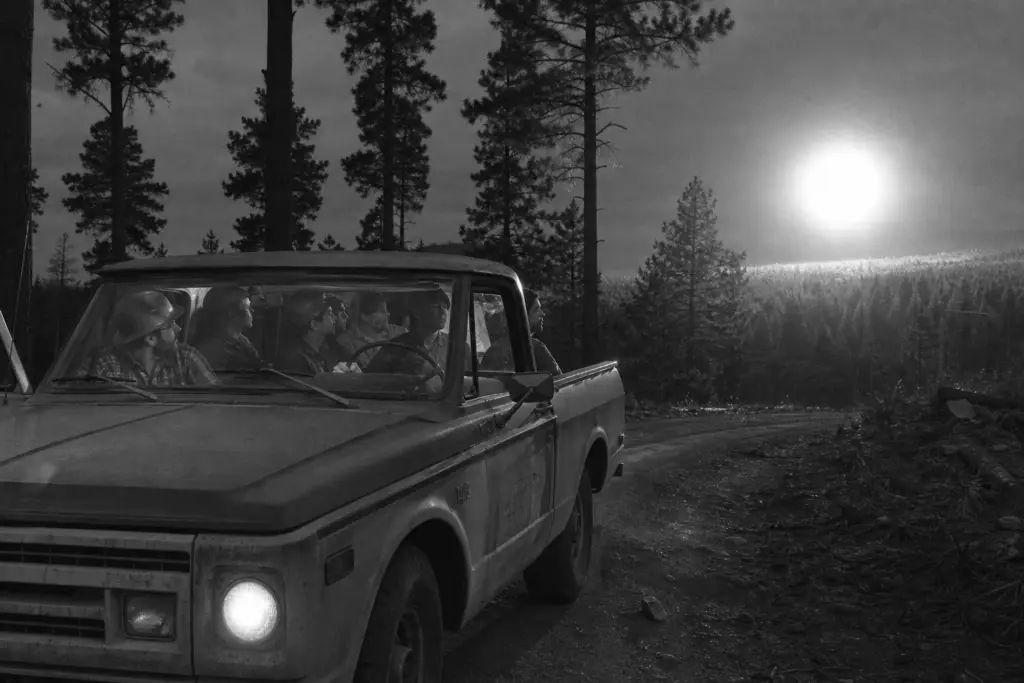
- Wednesday, November 5, 1975, participant account: Travis Walton and six fellow logging workers were driving back from a job in the Turkey Springs area near Heber, Arizona. The men later said their truck encountered a bright, hovering object; Walton got out, and they saw a burst of light strike or throw him. The object, the light, and the immediate cause of Walton’s disappearance rest on their testimony.
- Night of November 5, report to authorities: The other men left the location and reported Walton missing. The report established a reported location, a missing person, and witnesses available for interview. It did not establish what the crew had seen.
- November 6–9, search period: Search activity and press coverage followed during the days Walton remained absent. This portion of the Travis Walton timeline supports that he had not been located during that interval; it cannot reconstruct his movements or explain the absence.
- Monday, November 10, return: Walton reappeared after roughly five days and sought help at a gas station in Heber. His return is the second fixed point in the chronology. His explanation for the intervening days is a separate participant claim, not something the return itself proves.
The Turkey Springs UFO incident therefore contains more than one kind of evidence: a reported absence, a search, and a return on one hand; an asserted aerial encounter and alleged abduction on the other. Polygraph examinations later became part of the public dispute, but contested test results cannot settle what happened during the missing days.
What the Six Logging Crew Members Said They Saw
The reported roadside episode rests on six men who remained in the truck after Walton stepped out: driver Mike Rogers and crew members Dwayne Smith, Allen Dalis, Ken Peterson, Steve Pierce, and John Goulette. Their accounts make them the central Travis Walton witnesses, but they are accounts from people who shared the same work crew, vehicle, and rapidly unfolding experience, not six independent observations gathered separately.
In the core version they have repeated, the logging crew saw an intensely bright object ahead on the forest road. Walton reportedly left the truck and moved toward it. The others said a powerful light or beam then hit him, or appeared to throw him backward. Believing he had been badly hurt or killed, Rogers drove away with the remaining men before they returned to seek help. That sequence, object, Walton leaving the truck, flash or beam, flight, is the area of broad agreement.
Details are less stable. Descriptions of the object’s shape, height, color, sound, movement, and the exact effect of the light have varied between early witness accounts and later interviews, books, and public appearances. Those differences matter because a claim such as “a bright light was seen” is broader than a precise reconstruction of where each person stood, how far Walton was thrown, or what the object physically was.
Shared testimony can reinforce the proposition that the men consistently reported an alarming event on November 5, 1975. It cannot independently establish the source of the light, authenticate an extraterrestrial craft, or fill in what happened after Walton was no longer with the group. Later retellings may preserve participants’ memories, but they are not substitutes for an observation by an uninvolved witness or physical evidence.
Walton’s Account: What He Later Claimed Happened During the Missing Days
Walton’s own narrative begins where the other men’s observations end. In his retrospective account, he said that, after the burst of light, he regained awareness in a confined, medical-like environment. He described pain, disorientation, bright illumination, and small nonhuman-looking figures near him. He said he reacted in fear and tried to escape.
In later versions of the Travis Walton abduction claim, he described moving through additional interior spaces and encountering figures that appeared more humanlike. He characterized the experience as an examination or treatment rather than a continuous, clearly remembered journey. The sequence is important because it supplies the case’s familiar “abduction” imagery, but it is a personal recollection, not an event observed by the six loggers.
Walton also said he was ultimately released near Heber, Arizona, and sought help after realizing time had passed. His descriptions have acquired more scene-level detail through interviews, books, and other retellings: the appearance of the beings, the layout of the setting, and the order of particular episodes are not always presented identically. A broad account of awakening among unfamiliar beings is therefore a stronger description of his recurring claim than any single elaborate reconstruction.
That distinction changes how the alleged encounter should be weighed. The crew could report Walton’s departure and later absence; they could not witness an interior setting, beings, medical procedures, or his release. Nor does a detailed retrospective account itself provide independently testable physical evidence for those elements. It records what Walton said he experienced during the missing days, while leaving the claimed cause and setting unresolved.
What the Documentary Record Supports, and What Polygraphs Can’t Settle
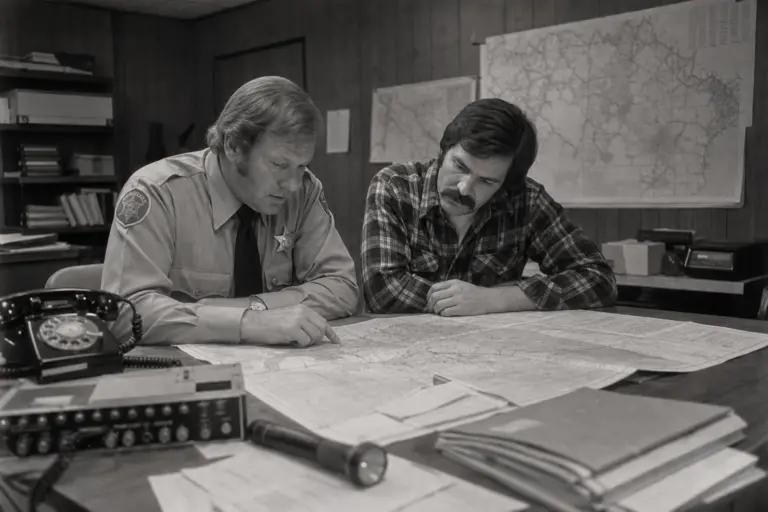
The crew’s November 5, 1975 report to the Apache County Sheriff’s Office is the first practical checkpoint in the record. It places Walton with a logging crew working near Turkey Springs, Arizona, and helps establish why the men were travelling together on that route. The missing-person search that followed, along with dated local news coverage, supports an actual investigative response; none identifies what produced the light the men described.
Walton’s November 10 return supplies a second observable checkpoint. He was reported to have contacted family after appearing near Heber and to have received medical attention during the immediate aftermath. Such records can help establish when he reappeared, who encountered him, and what condition observers recorded at that time. They cannot show where he spent the preceding days or determine whether reported hunger, fatigue, distress, or physical symptoms came from the experience he later described.
This creates a practical hierarchy for Travis Walton evidence. Work and search records bear on the crew’s presence, Walton’s absence, and the response by authorities and community members. The six men’s statements are evidence of what they said they saw; Walton’s accounts are evidence of what he said happened after the others lost sight of him. A report dated during November 5–10 is stronger for establishing timing than a later retelling, but prompt testimony still does not resolve the cause of the event.
Reported Travis Walton polygraph examinations do not bridge that evidentiary gap. A polygraph records physiological responses, such as breathing, pulse, and perspiration, while an examiner asks chosen questions; it does not detect truth or identify an external event. Question wording, testing conditions, and an examiner’s interpretation can affect the result. At most, a favorable result reflects an examiner’s assessment of a person’s responses in that particular session. It cannot authenticate a craft, prove an abduction, or turn the documented 1975 disappearance and search into physical confirmation of the claimed encounter.
What Remains Unverified: Gaps, Contradictions, and Competing Explanations
The decisive gap is physical. Nothing publicly established in the case supplies a recoverable craft, material trace tied to a nonhuman source, photograph, instrument reading, or observation by an uninvolved witness that would independently verify either an alien vehicle or an abduction. The crew’s shared account corroborates that they reported a startling episode; it does not convert the reported object into an identified object.
Misperception is one possible explanation: an unfamiliar light, viewed briefly at night from a moving vehicle and followed by alarm, can be interpreted differently by witnesses. That possibility accounts for uncertainty about the light’s identity, but it does not by itself account for Walton’s multi-day absence. Stress and memory effects offer a second possibility. They can affect attention, sequencing, and later recall, particularly when people repeatedly revisit a frightening experience. They are more relevant to changing detail than to proving that the participants consciously invented the event.
A fabricated disappearance is another skeptical hypothesis. It would explain the lack of independent visual evidence and could, in principle, account for a narrative built around a missing-person episode. Its practical difficulty is that it requires a plausible account of Walton’s whereabouts, the coordination or acquiescence of multiple participants, and the choices that led to an immediate law-enforcement search. Those difficulties make fabrication an unresolved inference rather than a demonstrated solution.
Later descriptions create a separate provenance problem. A detail first appearing in a book, interview, documentary, or memory and media retelling cannot be treated as equivalent to a detail recorded near November 1975. Decades of repetition can preserve a core claim while reshaping its edges. Independent verification is therefore strongest for the disappearance and response, weakest for the unseen interval, and absent for the alleged extraterrestrial cause.
How Accurate Is Fire in the Sky? The Film Versus the Reported Case
The 1993 Fire in the Sky turns the reported case into a horror film, not a screen reconstruction. Its abduction sequence emphasizes grotesque bodily restraint, invasive procedures, and hostile-looking beings. Walton’s later published account also described fear, disorientation, and a medical-like setting, but its sequence and imagery differ substantially from the film’s set piece.
The Robert Lieberman film also compresses and reshapes events for dramatic effect, including the men’s reactions, interpersonal conflict, and the presentation of Walton’s return. Those changes matter because a dramatization can supply memorable images that viewers later mistake for part of the original report, drawing on familiar abduction narrative tropes. The film is therefore useful evidence of the case’s cultural reach, not of what occurred during the unobserved days.
That distinction is especially important in the Fire in the Sky case: broad media visibility can preserve a claim and enlarge its audience, but it cannot independently corroborate the craft, the alleged abduction, or any particular interior experience. For factual comparison, the relevant baseline remains the contemporaneous disappearance record and clearly labeled participant accounts, not a movie’s most vivid scenes.
Bottom Line: A Documented Disappearance, an Unverified Explanation
The sound conclusion is narrower than the story’s cultural afterlife. The available record supports a reported disappearance, a law-enforcement search, and Walton’s subsequent return; it also preserves the logging crew’s account of an unusual light and Walton’s later account of what he believed happened while he was absent.
Those layers do not carry equal weight. They do not independently identify the light as a UFO, establish an alien abduction or non-human intelligence, or demonstrate government participation, suppression, or a cover-up. Polygraph results add an examiner’s interpretation of responses, not physical confirmation of the underlying account. Public attention, repeated testimony, and decades of retelling can make an allegation durable without converting it into proof.
When the Travis Walton UFO case appears in modern UFO disclosure or UAP disclosure debates, a practical evidence ladder helps keep the claims distinct:
- Contemporaneous records: reports, search records, and dated coverage establish the externally observable sequence.
- Direct participant testimony: the crew and Walton establish what they reported and believed, while leaving the proposed cause unresolved.
- Later recollections: books and interviews may add detail, but their distance from 1975 limits their independent weight.
- Media portrayals and inference: films, documentaries, and claims of hidden knowledge are not evidence unless tied to independently testable material.
The case remains historically documented as a disappearance surrounded by extraordinary claims, not as a verified explanation for what caused it.
What the Travis Walton Case Can, and Can’t, Establish
A disciplined finding depends on matching each proposition to the kind of evidence that could actually support it.
- The documented layer establishes that a missing-person report, search response, absence, and return occurred. It records an episode requiring investigation; it does not identify its cause.
- The crew’s testimony supports the fact that six co-workers consistently described an alarming light and Walton’s disappearance from their perspective. Their shared account cannot independently establish the identity or origin of the object.
- Walton’s account supplies the claimed interior experience and release, but those events had no independent observer or publicly established physical trace.
- Polygraph examinations may show how an examiner interpreted a subject’s physiological responses. They cannot prove that a remembered event occurred as described or distinguish an extraterrestrial explanation from another possibility.
Alternative explanations remain possible without becoming proven merely because they are conventional; likewise, the absence of a settled conventional account is not evidence for an alien abduction. The Travis Walton UFO case is therefore compelling as an unresolved, historically recorded disappearance and a durable set of witness claims. It does not demonstrate that an extraterrestrial craft or abduction occurred.
Frequently Asked Questions
What happened to Travis Walton in 1975?
On November 5, 1975, Travis Walton disappeared after six Arizona logging co-workers said they saw him struck or thrown by a burst of light near a bright hovering object in the Turkey Springs area. He reappeared on November 10 after roughly five days missing.
How long was Travis Walton missing?
Travis Walton was missing for roughly five days, from the night of November 5, 1975, until his return on November 10. A missing-person report, search activity, press coverage, and his return are the best documented points in the timeline.
Who were the witnesses in the Travis Walton case?
The six logging crew members who remained in the truck were Mike Rogers, Dwayne Smith, Allen Dalis, Ken Peterson, Steve Pierce, and John Goulette. They consistently reported seeing a bright object, Walton leaving the truck, and a flash or beam before they fled to seek help.
Did Travis Walton pass a polygraph test?
Reported polygraph examinations became part of the public debate, but they do not prove Walton’s account or identify what happened during his absence. Polygraphs measure physiological responses such as pulse, breathing, and perspiration, and results can be affected by question wording, conditions, and examiner interpretation.
How accurate is the movie Fire in the Sky compared with the reported Travis Walton case?
The 1993 film Fire in the Sky is a horror-oriented dramatization rather than a factual reconstruction. Its graphic abduction scenes, interpersonal conflict, and presentation of Walton’s return differ substantially from Walton’s later account and the contemporaneous missing-person record.