Transmedium UAP: What Does It Mean?
Learn what a UAP transmedium report means, why air-to-water claims matter, and how sensors, cases, and official reviews assess the evidence.
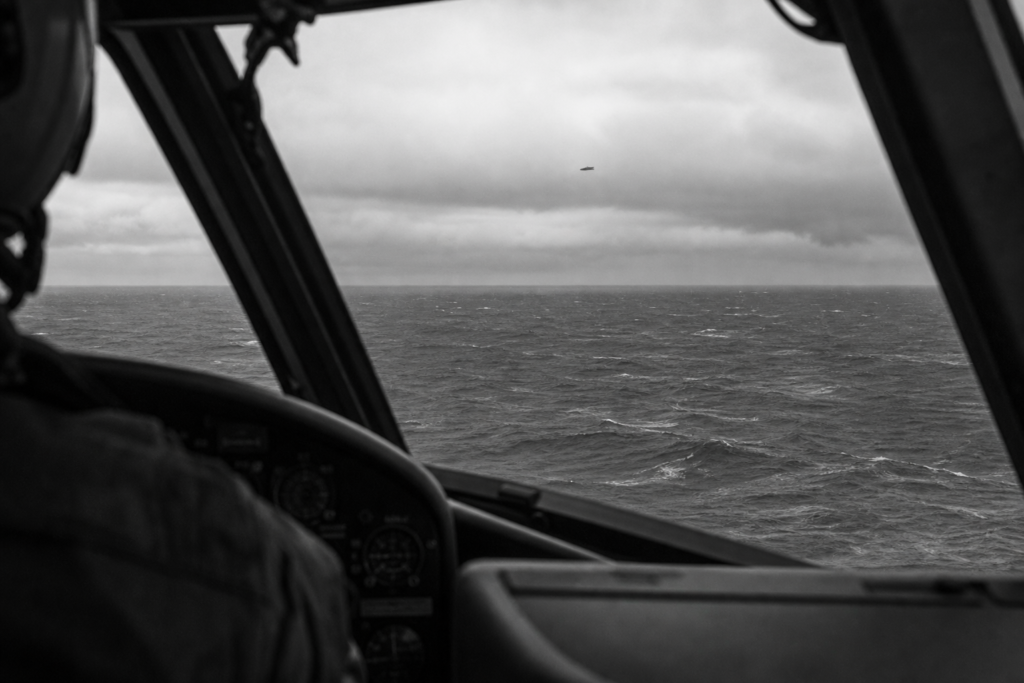
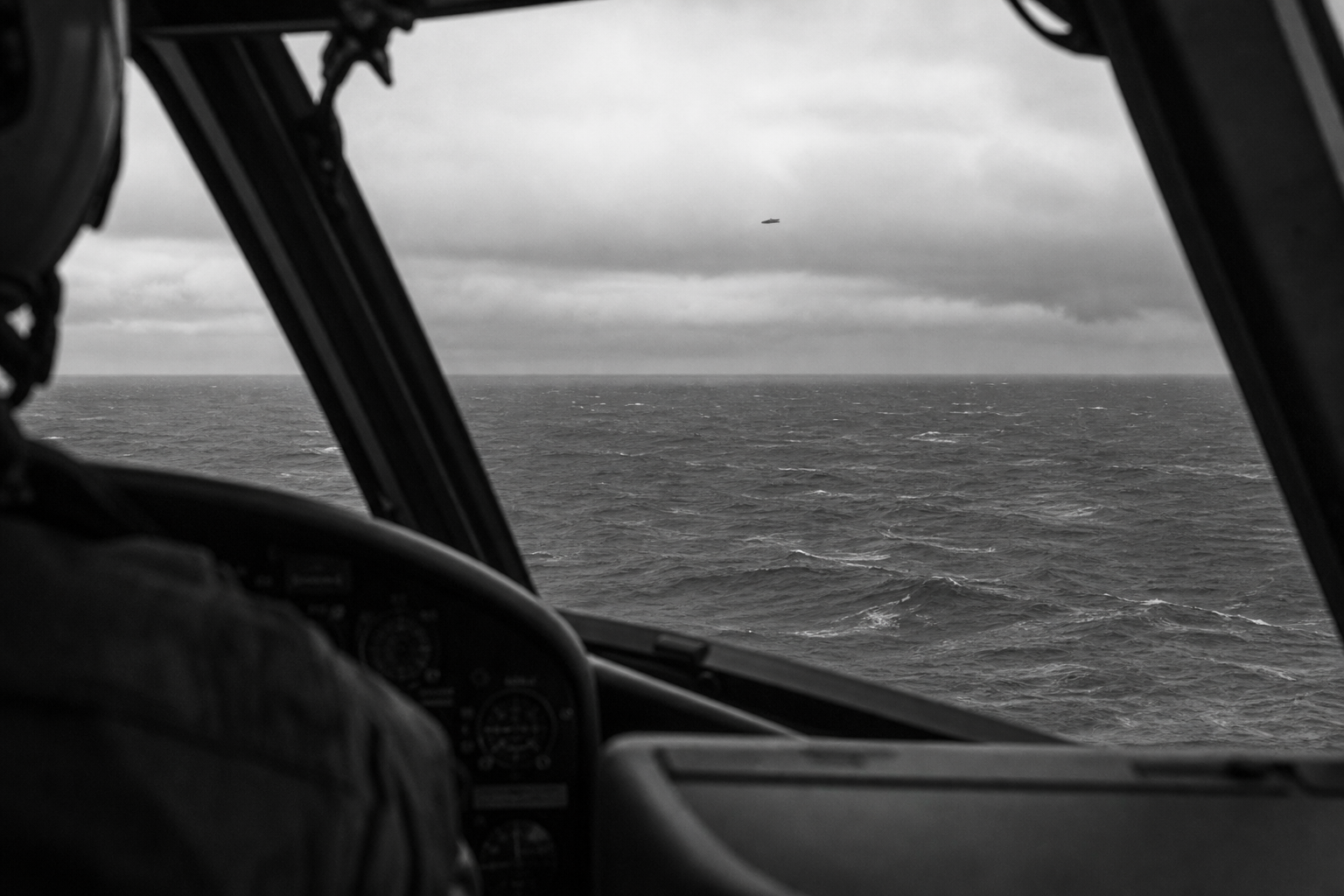
Reports of an object moving from air into water, or emerging from water into air, draw attention because the boundary between those environments is demanding. A UAP transmedium is not a proven class of craft; it is a descriptive label for an unidentified object or phenomenon reported or inferred to cross more than one physical medium, usually air and water.
That distinction matters. An apparent water entry is an observation to investigate, not by itself proof that an object retained extraordinary speed, maneuvered underwater, or used unfamiliar technology. Water creates far more drag than air, while the transition itself can obscure a target, interrupt a track, and complicate estimates of range, size, and velocity. A video that appears to show a descent toward the sea may document only the camera’s line of sight unless independent data establish the object’s position and subsequent movement.
This article separates reported observation from sensor interpretation, inference, and speculation. It defines the term, explains the relevant physics, and sets out what corroborated multisensor data, environmental context, and exclusion of ordinary alternatives would need to show. It also examines prominent public material and official review in proportion to what the public record can support. No publicly verified evidence establishes that a transmedium UAP is extraterrestrial or non-human technology.
What Does “Transmedium UAP” Mean?
In practice, transmedium attaches to the claimed trajectory, not to an established kind of vehicle. It is used as UAP terminology when an unidentified anomalous phenomenon appears, in an account or data display, to pass between environments such as air and water. The label leaves open whether there was a single physical object, an incomplete sensor track, or a mistaken interpretation of what the sensors recorded.
The distinction has three levels. A reported observation is what a witness or video appears to show: for example, a target descending toward the ocean. A sensor interpretation is the conclusion drawn from radar, infrared, or other data that the same target continued across the boundary. A verified physical event would require enough position, timing, and tracking information to establish actual entry and subsequent movement rather than an apparent crossing.
That is why “what is a transmedium UAP?” has a deliberately limited answer: it is an unresolved description of reported behavior. It does not identify a propulsion method, demonstrate unusual performance, or establish an origin. The stronger the claim, especially one involving sustained travel in both air and water, the stronger and more independent the evidence must be.
Why an Air-to-Water Transition Would Be Technically Significant
At the surface, a vehicle encounters an abrupt change in density and resistance. Air is thin enough that aircraft can use wings and control surfaces efficiently; water is far denser, so hydrodynamic drag rises sharply and the loads on a fast-moving body can become severe. A genuine domain transition therefore is not simply a matter of continuing on the same course: it requires the structure, controls, propulsion, and sensors to remain effective as the surrounding medium changes.
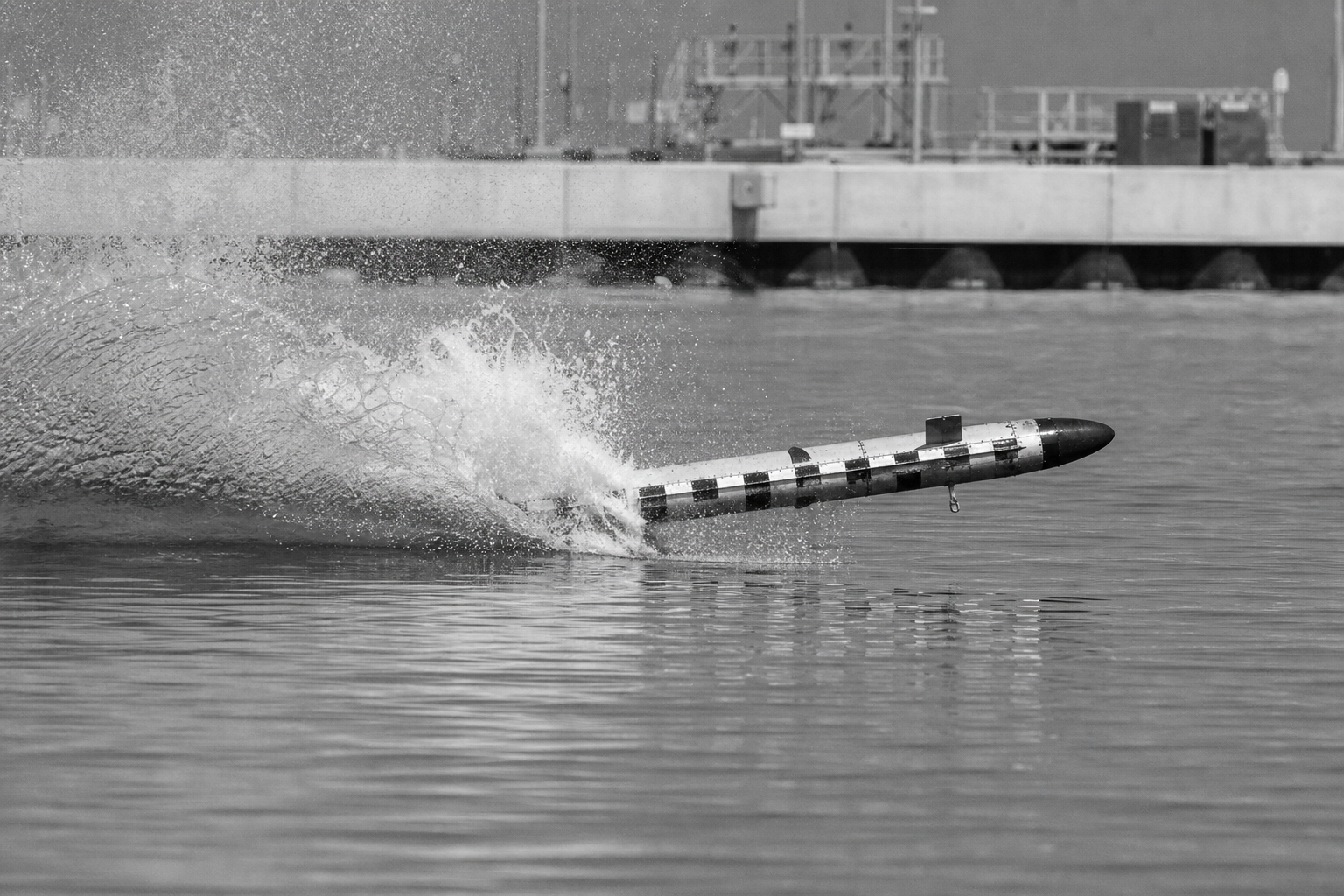
Pressure adds a second constraint. Underwater pressure increases with depth, while an aircraft is designed principally for pressure differences associated with altitude and a submarine for external pressure at depth. Conventional systems address those missions differently. A splashdown capsule is built to survive a controlled water impact and float; a submersible is shaped and strengthened for underwater operation; an amphibious aircraft can land on water but does so at managed speed and with a hull designed for it. None of those examples demonstrates effortless, high-speed travel in both environments.
A confirmed air-to-water UAP track would thus deserve technical scrutiny because it could reveal either an unusual engineering solution or a misunderstanding of the event. The interface also limits visibility: spray, glare, waves, refraction, and the loss of a line of sight can make an object appear to enter water when it has merely become obscured, passed behind the horizon, or left a sensor’s field of view. Distinguishing those possibilities requires a continuous, well-calibrated track on both sides of the surface. Difficulty is not impossibility, and it is not evidence of exotic technology; it defines what a strong claim would need to account for.
From a Sighting to a Claim: What the Evidence Must Show
The decisive issue is not whether a clip looks dramatic, but whether the underlying record can establish one continuous object, a reliable path, and a crossing of the surface. A defensible transmedium claim rises through an evidence ladder rather than beginning with its most extraordinary interpretation.
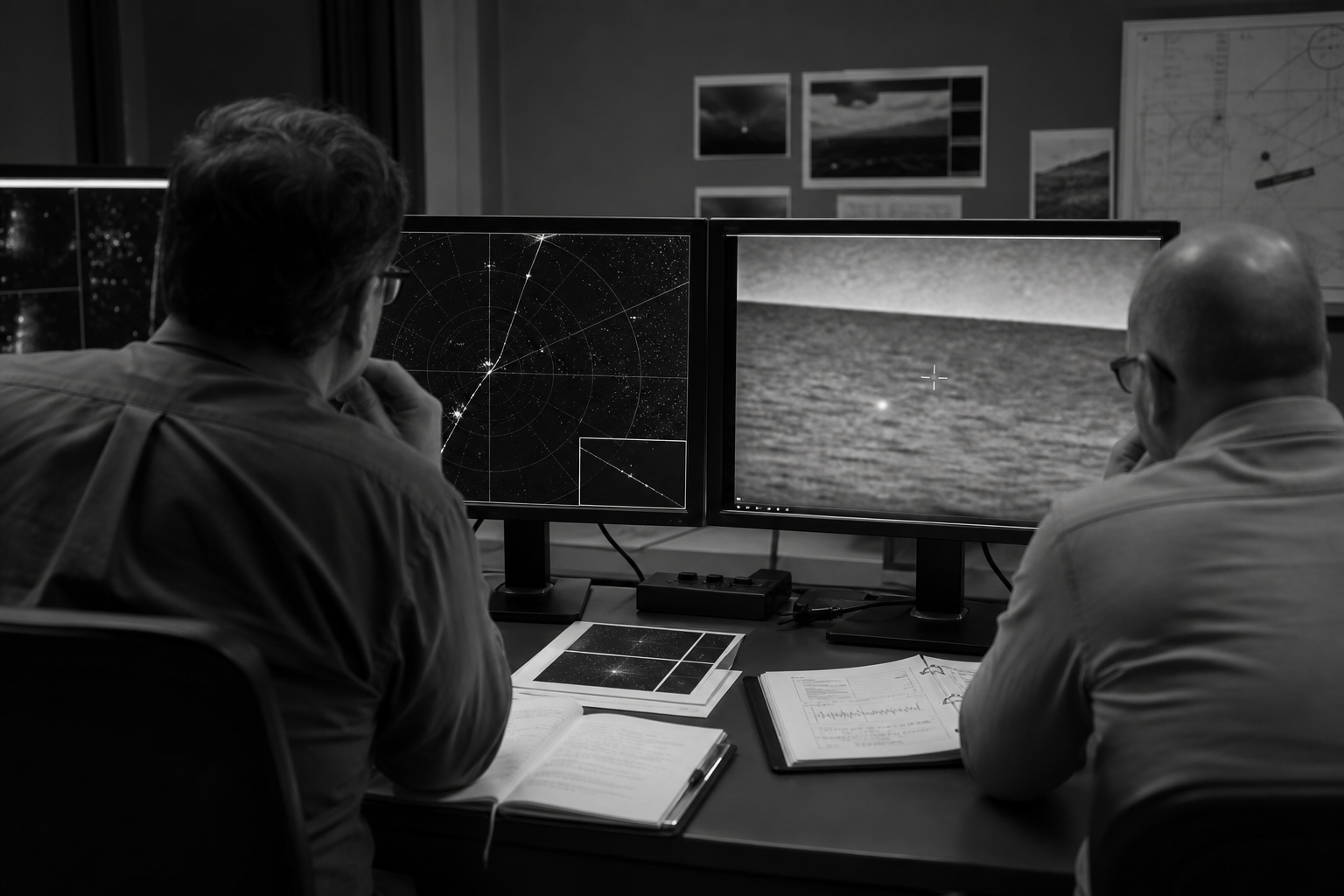
- Reported observation: an eyewitness may sincerely describe an object descending toward the sea or emerging from it. That account identifies what the person perceived, not the object’s range, speed, size, or actual contact with water.
- Single-camera footage: video can preserve a useful visual record, but a frame sequence without measured range and camera orientation cannot by itself turn apparent angular motion into a physical trajectory. A disappearing target may have entered water, passed behind waves or the horizon, or left the field of view.
- Instrument track: radar or infrared can add timing and directional information. Its value depends on known sensor position, calibration, tracking quality, environmental conditions, and whether the system retained an original, time-synchronized file rather than only an edited excerpt.
- Apparent water entry: this is a reported or inferred event until a continuous track locates the target at the surface and then detects it below the surface. A visual splash, loss of an infrared image, or a radar track ending near water is not equivalent to demonstrated underwater travel.
- Independent corroboration: the strongest case would align visual, radar, infrared, and, where relevant, sonar records from separate systems. Multi-sensor corroboration matters because each sensor has different blind spots; agreement on time, position, and trajectory makes a mistaken interpretation less likely.
Even that final level would establish unusual behavior only after analysts tested mundane explanations, sensor artifacts, and track misassociation. An unresolved UAP sighting is therefore an unresolved interpretation, not proof of a novel craft, and not evidence that the object was extraterrestrial or non-human technology.
How Sensors Can Create an Apparent Water Entry
Sensor geometry can turn an ordinary loss of track into a seemingly dramatic descent. Parallax is the apparent shift of a target against a distant background as the observing aircraft or ship moves; without a measured range, it can make a far-off object seem to race sideways or plunge toward the surface. The same missing distance prevents a video viewer from converting angular movement into reliable speed, size, altitude, or maneuvering. A target that slips below the horizon, behind a wave crest, under sun glare, or beyond the camera’s line of sight has disappeared from that view, not necessarily entered the sea.
Electro-optical video records visible light, while infrared imagery maps heat contrast rather than a literal outline of an object. Zoom, image stabilization, autofocus, digital cropping, and an automatic tracking gate can change the apparent motion or scale of a target on screen. A bright infrared spot can also broaden, dim, or vanish as contrast changes against clouds, water, or sky. Those effects do not make a recording false; they mean that apparent shape, velocity, and terminal movement may remain an unresolved interpretation unless the original metadata establishes the camera’s orientation, field of view, zoom state, time, and position.
Other instruments add different constraints but introduce different ambiguities. Radar estimates range and motion from returned energy, yet sea clutter, returns from waves and weather, can obscure weak low-altitude tracks or contribute to track misassociation. Sonar detects sound underwater, not an airborne object; a sonar non-detection may reflect coverage, depth, noise, geometry, or a target outside its search area. A strong assessment tests whether visual, infrared, radar, and sonar timing and locations describe one continuous path. Treating every gap as a sensor artifact is as unwarranted as treating every gap as proof of submersion.
Publicly Discussed Cases: What They Show, and What They Do Not
Three frequently discussed examples illustrate why a compelling narrative and a complete track are not the same thing. The reported 2004 Nimitz encounter includes pilot accounts of an object near a disturbed patch of ocean, while the Navy-associated footage released publicly records a separate infrared observation. Reported observation: the accounts and video are notable. Unresolved interpretation: the public footage does not independently show one object crossing from air into water, so it is not verified transmedium activity.
The Go Fast video UAP provides a clearer lesson in measurement. The clip shows an infrared target apparently moving quickly over water. Confirmed observation: the camera recorded angular motion against an ocean background. Inference: extraordinary speed depends on target range, altitude, aircraft motion, and wind; different assumptions can yield very different ground-speed estimates. The recording also ends without showing a surface crossing. It therefore does not, by itself, demonstrate either exceptional velocity or water entry.
The 2013 Aguadilla infrared video is often presented as a transmedium UFO case because the target appears to approach, pass into or near the water, and later reappear. That sequence is an apparent observation, not a publicly settled reconstruction. The available video lacks the full sensor, range, environmental, and corroborating underwater record needed to establish a continuous submerged path. Competing interpretations, including a distant airborne target, changing infrared contrast, or more than one object, remain possible. None of these cases publicly verifies extraterrestrial or non-human technology.
What AARO and Official Reviews Say About Transmedium Reports
AARO, the Pentagon UFO office formally known as the All-domain Anomaly Resolution Office, evaluates reports by seeking attribution rather than treating “unidentified” as a final finding. Its process distinguishes a report that lacks enough usable data from one that has been resolved: a case may remain open because key details such as sensor calibration, range, environmental conditions, or a continuous track are unavailable.
Confirmed observation: the Department of Defense acknowledges that military and other personnel submit UAP reports. Unresolved interpretation: an unresolved report does not establish extraordinary movement, much less a vehicle operating through air and water. For an alleged transmedium event, analysts would need to connect the relevant sensors to the same target across the transition and rule out ordinary objects, atmospheric effects, sea-surface interference, and mismatched tracks.
AARO UAP reviews also separate public evidence from assertions about material that is not publicly available. A claim that classified records contain a decisive answer cannot be independently assessed from public video, testimony, or an allegation alone. Official conclusion: acknowledgment of UAP reports is not confirmation of non-human technology, alien disclosure, a government cover-up, or a crash-retrieval program. Those are separate claims requiring separate, testable evidence.
The Bottom Line: Unusual Does Not Yet Mean Extraordinary
Headlines are the start of an inquiry, not its conclusion. When reading UAP news, or future posts labeled “UFO sightings 2025” or “UFO sightings 2026”, separate the reported observation from the interpretation placed on it.
- Strong signal: a named source releases raw or near-raw data, explains the sensor’s position and settings, preserves a continuous track through the air-water boundary, and provides independent corroboration from another instrument or observer.
- Weak signal: a short clip, a retold eyewitness account, or a claim that an object “vanished into the ocean” without range data, timing, or a demonstrated underwater continuation.
- Essential test: analysts must meaningfully examine ordinary alternatives, including glare, parallax, sea-surface clutter, lost line of sight, and mismatched sensor tracks.
A credible transmedium conclusion requires more than an apparent descent toward water: it requires a well-documented crossing of the interface by the same tracked target. An unresolved observation remains an unanswered question. It is not, by itself, verified extraordinary capability or evidence of alien or non-human technology.
How to Assess a Transmedium UAP Claim
Treat each new claim as a chain whose weakest link sets the conclusion. A clip that appears to show a descent is only the first link; the stronger claim requires a continuous identity for the target before, at, and after the surface event.
- Establish the track: ask whether timestamps, location, range, altitude, and sensor orientation tie the airborne and underwater detections to the same target. Two detections close in time are not necessarily one continuous journey.
- Test the geometry: distinguish measured motion from apparent motion. A moving camera platform, uncertain distance, horizon effects, glare, and wave masking can alter the perceived path.
- Look for independent confirmation: video is stronger when radar, another optical system, or an underwater sensor constrains the same event. Multiple sensors help only when their timing and target association are established.
- Match the claim to the evidence: “unresolved” means the available information does not permit a reliable identification. It does not mean extraordinary speed, novel propulsion, or non-human origin has been demonstrated.
The practical standard for a UAP transmedium report is therefore disciplined uncertainty: retain the observation, investigate ordinary explanations, and reserve extraordinary conclusions for data that can survive that process.
Sources
Frequently Asked Questions
-
What does transmedium mean in UAP reports?
Transmedium describes an unidentified object or phenomenon reported or inferred to cross more than one physical medium, usually air and water. It describes a claimed trajectory, not a confirmed type of craft, propulsion system, or origin.
-
Why is air-to-water movement by a UAP considered unusual?
Water is far denser than air, creating sharply higher drag and potentially severe loads on a fast-moving object. A genuine transition would require structure, controls, propulsion, and sensors that function across both environments while handling increasing underwater pressure.
-
What evidence is needed to verify a transmedium UAP?
Verification requires a continuous, time-synchronized track showing the same target before, at, and after the air-water boundary. The strongest evidence combines calibrated visual, infrared, radar, and potentially sonar data with known sensor positions, range, timing, and environmental conditions.
-
Did the Nimitz, Go Fast, or Aguadilla videos verify transmedium UAP activity?
No publicly available footage from the Nimitz encounter, Go Fast video, or 2013 Aguadilla case verifies a single object continuously crossing from air into water. The public records lack the complete range, sensor calibration, environmental data, and corroborating underwater track needed to establish submerged travel.
-
What should you look for when evaluating a transmedium UAP claim?
Look for raw or near-raw data, timestamps, location, range, altitude, camera orientation, and a continuous track through the surface boundary. Strong claims also need independent sensor corroboration and testing of ordinary explanations such as parallax, glare, sea clutter, horizon loss, and mismatched tracks.