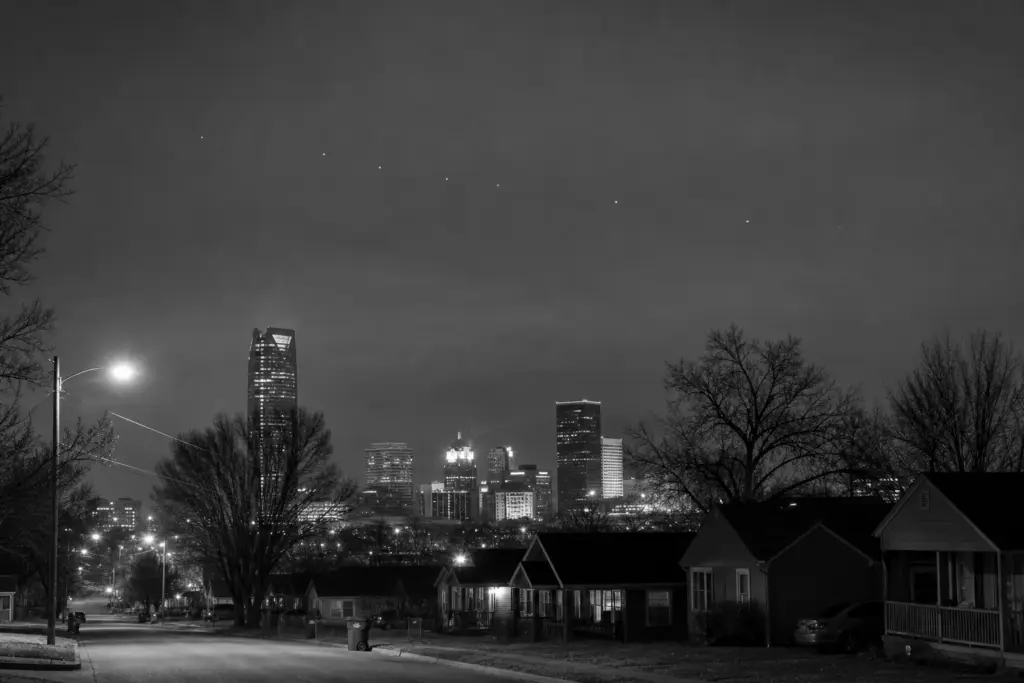
On January 24, 2020, an account linked to Oklahoma City described ten lights traveling across the night sky before disappearing one at a time. That pattern is memorable, but it is not an identification: the date, place, count, motion, and sequential fading are the reported features to investigate, not proof of an extraterrestrial or otherwise extraordinary event.
This examination of the Oklahoma City UFO sighting January 24 2020 starts with a stricter question than “what were the lights?”: what survives in the record, and in what form? Original, unedited video and a firsthand account carry more weight than an uploader’s caption, a news paraphrase, or a later repost stripped of time, location, and context. A clear chain of provenance can support details such as direction, duration, spacing, color, and weather; its absence sharply limits what any conclusion can establish.
The reported formation and one-by-one disappearances are useful clues only when tested against the full observation. Lanterns, aircraft, satellites, drones, clouds, haze, and changing viewing angles can produce lights that appear to travel together or wink out in sequence, but each possibility must fit the claimed timing, location, movement, and visibility conditions. The result is a case file with a plain boundary: a reported sky event may be real as an observation while its cause remains unconfirmed.
What Was Reported Over Oklahoma City on January 24, 2020
The usable case description is narrow: the report places the observation in Oklahoma City on January 24, 2020 and describes ten lights moving across the sky before disappearing individually. “Ten” is the claimed count, not a count independently established by a calibrated image, multiple named witnesses, or an official record. Likewise, “Oklahoma City” identifies the reported setting; it does not yet establish a precise viewing point within the city rather than elsewhere in the metropolitan area.
The account’s key observational claims are apparent shared travel and a sequential loss of visibility. Those details matter because a compact group that holds similar spacing presents a different evidentiary question from unrelated lights seen in the same part of the sky, while lights vanishing one at a time can reflect an ordered change in brightness, distance, or line of sight rather than a single abrupt event. The surviving description does not, by itself, supply a reliable direction of travel, duration, elevation, color, weather context, or distance estimate.
No earliest traceable witness submission, original unedited video, upload timestamp, or independently contemporaneous record is provided in the material available for this examination. That leaves the event date and location as attributes of the report, rather than corroborated facts, and prevents a meaningful separation of a possible original account from later reposting or paraphrase. The case therefore begins with unidentified lights in the sky as reported, not with a confirmed craft, official investigation, or extraordinary explanation.
Reconstructing the Reported Path, Formation, and Disappearances
A useful reconstruction separates the few reported elements from the measurements that would turn a sighting into a track. The stated count is ten lights. Beyond that, the available description does not preserve whether the lights formed a straight line, a curved chain, a compact cluster, or unevenly spaced groups. That distinction matters: steady, repeated gaps can indicate objects sharing a route or perspective alignment, while irregular spacing may point to separate lights seen within the same field of view.
No usable record fixes a compass bearing, starting point, ending point, angular elevation above the horizon, or travel speed. “Across the sky” can describe anything from a short movement near a roofline to a long passage overhead; without a landmark-based direction and an elapsed time, apparent speed cannot be compared meaningfully with candidate causes. The Oklahoma City UAP sighting of January 24, 2020 also lacks preserved observations of color, flicker, changes in brightness, and whether the lights remained visually uniform.
The phrase “disappearing one by one” is the most specific behavioral claim, yet it leaves several materially different possibilities unresolved. A light can fade gradually, blink off sharply, pass behind a cloud edge or building, become too dim to see, or leave the observer’s viewing angle. A sequential fade along the direction of travel would carry different weight from random losses throughout a cluster, but the surviving account does not identify the order, interval, or visual character of the disappearances.
- Documented in the available description: a reported total of ten lights, apparent travel, and individual disappearances.
- Not preserved: observer position, observation time and duration, formation geometry, bearing, elevation, speed, color, weather visibility, and a frame-by-frame account of each loss of visibility.
Those omissions do not disprove the witness report. They set the limit on what can be inferred from it: the Oklahoma City lights disappearing one by one is a reported pattern, not a sufficiently measured path or physical performance profile.
What the Available Evidence Can, and Cannot, Establish
Provenance determines how much weight each surviving item can carry. The strongest record would be the original video file, preserved from beginning to end, with its creation metadata intact and an identifiable uploader able to describe where, when, and how it was recorded. That combination can tie an apparent sequence of lights to a particular device and observation, while also allowing review for cuts, compression artifacts, exposure changes, and omitted moments before or after the visible event.
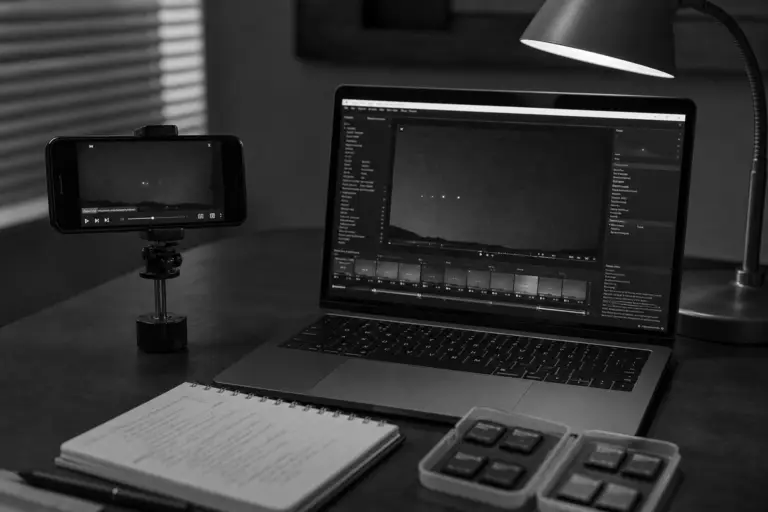
A first-person account is different evidence: it preserves what an observer recalls seeing, including details a camera may miss, but its date, location, count, and interpretation remain personal testimony unless independently supported. A local-news repost may establish that the claim was circulating at a particular time, but it does not become an independent observation merely by repeating an uploader’s caption. Later social-media shares are weaker still when they remove the original video, upload date, account history, or context and add only dramatic descriptions.
No original video file, metadata record, complete recording, named independent witness, or traceable chain from an initial uploader to later circulation is available in the material considered here. The January 24 event date, Oklahoma City setting, ten-light count, apparent shared travel, and sequential disappearances therefore remain attributes of the report rather than separately established measurements.
Even an authenticated recording would have firm limits. From one viewpoint, video can show that light-like points appeared in the frame and seemed to move or fade relative to visible landmarks. Without a known camera location, field of view, reference landmarks, a second synchronized viewpoint, or external tracking data, it ordinarily cannot establish distance, physical size, altitude, true speed, or identity. A skyline, road, roofline, or horizon feature that can be geolocated would materially strengthen the location claim; its absence leaves the image untethered from the stated place.
The practical result is narrow but important: the available record supports evidence-led analysis of a reported visual pattern, not a reconstruction of ten identified objects traveling through measured Oklahoma City airspace.
Could Lanterns, Aircraft, Satellites, Drones, or Other Causes Fit?
Each candidate explanation predicts a different visual pattern. Chinese lanterns are small airborne flames carried by the wind: a loose group can drift in the same general direction, vary in spacing, and fade separately as flames weaken or haze obscures them. That is a plausible broad fit for warm, slowly moving lights and staggered disappearances. It becomes weaker if the lights held a rigid geometric arrangement, moved quickly across a large arc, or traveled in a direction inconsistent with the wind at the claimed time and viewing point.
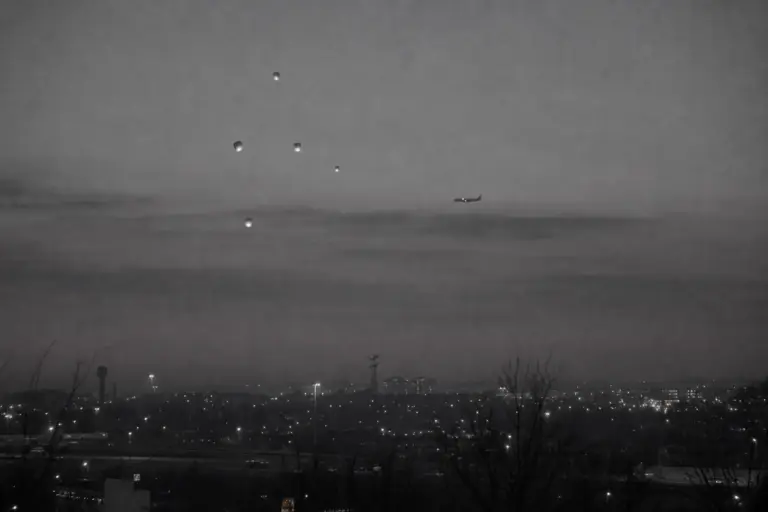
An aircraft formation would more often produce stable relative spacing and lights with recognizable navigation-light behavior, although distance can reduce several aircraft to steady points. It could account for shared travel, but a ten-light formation requires records consistent with the reported time, direction, and line of sight. A sequence of disappearances could result from turns or changing angles, yet a formation that simply extinguished light by light without changes in route would be a less natural fit.
Drones can create deliberate lines, clusters, and coordinated light changes. They are therefore a stronger conceptual match if the group appeared structured and the lights vanished in a programmed sequence. Their weakness is practical rather than exotic: a useful match needs a nearby launch area, a duration and apparent scale consistent with local operation, and some independent indication of an event or operator. None is preserved in the available case record.
Satellites can appear as a chain when several objects follow similar orbital paths; a Starlink-like train is the familiar modern example. But the January 2020 report needs a date-specific pass and viewing geometry before that label has value. A satellite train would normally maintain a broadly linear progression, while individual lights may fade at different points as illumination geometry changes. Fixed astronomical objects do not fit claimed shared travel, and a re-entry or debris event would more often suggest rapid motion, fragmentation, uneven brightness, or a short-lived trail rather than ten orderly, persistent points.
These are hypotheses, not identifications. The missing direction, duration, brightness, weather, flight-track, launch-pass, and event information prevents any one explanation from being ranked as the demonstrated cause of the reported Oklahoma City lights.
Why Lights Disappearing One by One Is Not, by Itself, a Classification
Sequential loss of visibility is an optical observation, not a demonstrated action by the lights themselves. A moving group can meet a thin cloud edge, haze layer, or a band of shadow at slightly different moments; the faintest point drops below the observer’s threshold first. Increasing distance can produce the same order of fading. So can a low viewing angle in which buildings, trees, or uneven horizon features cover objects one after another.
Perspective also changes apparent brightness. A light that turns, banks, rotates, or simply follows a slightly different path may direct less light toward the viewer without stopping or switching off. In recorded footage, auto-exposure can darken a whole scene after a bright object enters the frame, while autofocus, compression, and digital noise reduction can erase the dimmest points first. A useful distinction is whether each light fades gradually while the scene’s brightness changes, or ends abruptly against a stable, unobstructed background.
Stronger evidence would tie the sequence to a precise viewing location and time, hourly weather conditions, a mapped horizon, and an original continuous video that permits frame-by-frame review of exposure and focus behavior. Synchronized recordings from separated locations would be especially valuable: if the same lights vanished at matching times despite different foregrounds and cameras, obstruction and device effects would weaken. Without those controls, the Oklahoma City strange lights 2020 account preserves a striking reported effect, but not enough information to classify its cause as unresolved in a meaningful physical sense.
What Official UAP Records and Disclosure Debates Do Not Show
A public post, video upload, or retelling of unusual lights does not automatically become a report held by a government UAP office. A formal record would normally leave a trace such as a named reporting channel, case or incident number, receiving agency, date of submission, or an official response. None is available in the case material examined here for the January 24, 2020 Oklahoma City account. That means there is no documented official inquiry or identification to add to the claimed observation, but it does not turn the absence of a public file into evidence that the lights were concealed or extraordinary.
Public UAP records and later UAP news concern institutional handling of reports; they do not retroactively authenticate every local civilian sighting circulated online. Likewise, UFO disclosure and UAP disclosure debates address claims about government-held information in general, not a demonstrated provenance for these ten lights. A government record, if one surfaced, could establish that an agency received an allegation; it would still need supporting timing, location, sensor, weather, and flight information to identify what was seen. Conversely, no public record cannot independently rule out lanterns, aircraft, satellites, drones, or other ordinary causes.
Bottom Line: A Reported Event, With Identification Dependent on Better Evidence
The defensible finding is limited: an Oklahoma City–area account attributes ten traveling lights and a one-by-one disappearance sequence to January 24, 2020. The date, exact viewing site, count, route, duration, and visibility changes remain uncorroborated beyond that account. The available material therefore supports neither a specific conventional identification nor a claim that the event was unexplainable.
Lanterns, aircraft, satellites, drones, and changing atmospheric visibility remain possible in principle, but none can be responsibly selected without observations that discriminate among them. A continuous original recording might reveal whether spacing changed, lights flickered, or camera exposure shifted; a repost or brief description cannot.
Materially stronger assessment would require:
- the raw, complete video file and preserved creation metadata;
- the observer’s exact coordinates, local timestamps, compass direction, and duration;
- independent witnesses or synchronized recordings from separate locations;
- contemporaneous weather, flight, satellite-pass, and local-event information tied to that time and place.
What Can Be Said About the Oklahoma City Lights
The appropriate label is unidentified in the available record, not identified as a particular object or phenomenon. That label describes an evidentiary gap: the account preserves an unusual reported appearance, while the information needed to test it, independent timing, location, geometry, and provenance, has not survived in a usable form.
The one-by-one disappearance remains a feature worth noting, but it cannot decide among causes. A real sequence of fading points could reflect separate lights dimming, objects crossing uneven visibility, or the limits of a camera and observer’s line of sight. It would become more diagnostic only if a complete recording showed the lights’ brightness, spacing, and motion before and during each disappearance.
A credible identification would need evidence that links the observation to the sky conditions at a specific moment: an original file with intact metadata, a fixed viewing position and compass bearing, corroboration from separately located observers, and records capable of testing candidate tracks or activities. Without that convergence, the Oklahoma City UFO sighting of January 24, 2020 remains a reported event with unresolved cause, not evidence for any extraordinary origin.
Frequently Asked Questions
What were the ten lights seen over Oklahoma City on January 24, 2020?
The report described ten lights traveling across the Oklahoma City night sky and disappearing one at a time. Their identity was not established because no original video, verified witness record, precise location, direction, duration, or weather data is available.
Did anyone identify the Oklahoma City lights that disappeared one by one?
No confirmed identification is documented. The lights remain unidentified in the available record, and there is no traceable official investigation, authenticated footage, or independent corroboration that establishes what they were.
Could lanterns, aircraft, satellites, or drones explain the Oklahoma City 2020 sighting?
All are possible in principle, but none can be selected as the demonstrated cause. Lanterns can drift and fade separately, aircraft can maintain spacing, satellites can appear in a line, and drones can create coordinated formations and programmed light changes.
Was the January 24, 2020 Oklahoma City sighting reported to a government UAP office?
No documented government UAP report, case number, receiving agency, submission record, or official response is available for this sighting. The lack of a public government file does not prove the lights were hidden, extraordinary, or unexplainable.
What evidence is needed to identify an unexplained lights sighting?
Useful evidence includes a complete original video with intact metadata, exact observer coordinates, local timestamps, compass bearing, duration, and independently recorded footage from separate locations. Weather records, flight tracks, satellite-pass data, and local event information must also match the specific time and location.