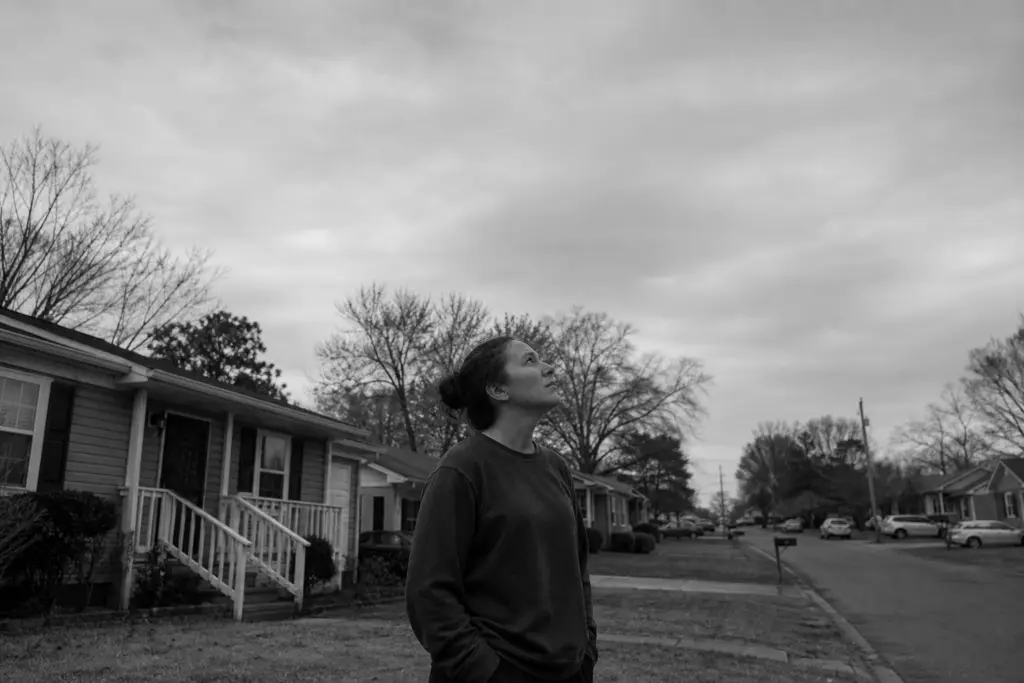
A rumble that appears to hold one position overhead for roughly 10 minutes is an unusual experience: low-frequency sound can be hard to locate, and a listener may reasonably perceive it as coming from the sky rather than from a distant ground source. That perception, however, is an observation to investigate, not evidence by itself of an extraordinary object or event.
The Lawrenceville GA UFO sighting March 10 2020 label refers here to a reported stationary sky rumble in or near Lawrenceville, Georgia, on that date. The account’s date, place, duration, and interpretation must be kept separate. A witness report records what one person recalled hearing and how it seemed to behave; independently verified evidence would require supporting material such as additional contemporaneous accounts, identifiable aircraft activity, weather observations, recordings, or official incident records.
This article begins by reconstructing the available report without adding details it does not contain. It then considers whether any corroboration can be located and weighs ordinary possibilities, including aircraft noise, atmospheric sound propagation, industrial or ground noise, and weather-related phenomena, against the reported characteristics. A plausible category is not a proven answer, just as an unresolved account is not confirmation of a UAP. The aim is a clear finding about the limits of the evidence.
A 10-Minute Sky Rumble Reported in Lawrenceville: What This Article Can Establish
The key boundary is simple: the account concerns a sound. A listener’s description of a rumbling apparently fixed in the sky does not, on its own, establish that any object was seen, much less that it was an unidentified aerial phenomenon. “Stationary” describes the perceived behavior of the sound, not a confirmed position of a craft or other source.
This examination will treat the earliest accessible submission as a witness account: evidence of what its author reported, rather than independent proof that the event occurred exactly as described. The next step is to isolate its stated date, Lawrenceville-area location, approximate 10-minute duration, wording, and any indication of a visual observation. Details absent from that record cannot be supplied by later labels or assumptions.
Corroboration has a different evidentiary role. A contemporaneous recording, separate nearby report, flight or weather record, or emergency-service entry could help test the account; none should be presumed merely because a report was submitted. The analysis will therefore compare the reported features with aircraft-related noise, unusual atmospheric propagation, distant industrial or ground sources, and weather-related sound, while recognizing that a compatible explanation is not a demonstrated cause. The appropriate result may be unresolved, not extraordinary.
What Was Actually Reported on March 10, 2020
The available material preserves only a short set of event descriptors, not a full contemporaneous narrative. It places the report in the Lawrenceville, Georgia, area and assigns the occurrence date as March 10, 2020. No approximate clock time is available in the record provided for this review.
- Location: Lawrenceville or its surrounding area is the stated geographic reference. It does not identify a street, neighborhood, precise listening position, or distance from any possible sound source.
- Date: March 10, 2020 is the claimed event date. The available material does not distinguish that date from a possible later submission date.
- Duration: The reported episode lasted about 10 minutes. “About” matters: it conveys an estimate by the reporting person, not a timed recording.
- Sound: The defining description is a strange rumbling perceived as being in the sky. No audio clip, loudness estimate, rhythmic pattern, pitch description, or account of whether it rose or faded is included.
- Apparent position: The rumble was characterized as stationary. That records the listener’s impression that the sound did not seem to travel; it does not establish a fixed aerial location.
Equally important is what this Lawrenceville sky rumbling report does not preserve. The material available here contains no stated altitude, compass direction, weather conditions, nearby aircraft identification, flight path, ground-source observation, or count of other listeners. It also provides no visual description of an object, lights, shape, motion, or visible trail. A lack of those details is not evidence that none existed at the time; it means they cannot responsibly be added to the witness report now.
No original database entry, report-form image, archive capture, or contemporaneous post containing fuller wording was supplied for this examination. The narrow reconstruction is therefore limited to a reported roughly 10-minute rumble near Lawrenceville on the stated date that seemed fixed overhead, rather than a documented visual UFO encounter.
Verification Check: Documented Details, Missing Evidence, and Corroboration
The evidentiary gap is not merely a missing detail; it determines what the report can support. The available source record documents that an account was attributed to Lawrenceville and dated March 10, 2020, with an estimated 10-minute rumble perceived as stationary. It does not establish the reporting person’s identity, the submission’s provenance, or whether the event date and report date were the same.
No separate local reports from identifiable witnesses were provided for this review. Repeated retellings, database labels, or later discussions would not count as independent corroboration unless they could be traced to distinct people describing the event without relying on the original account.
Likewise, the available material includes no audio or video, no file metadata showing when or where a recording was made, and no contemporaneous local-news coverage. A recording with a preserved creation time and location would be a stronger signal than an undated clip reposted years later, because it could be compared with conditions and activity at the reported time.
No public-safety call log, municipal record, airport-operation record, weather observation, or agency case file was supplied here. That absence does not show that no such material exists, and it does not disprove the listener’s experience. It does mean the reported source, precise location, estimated duration, and cause cannot be independently fixed from the present record.
For the Lawrenceville GA UFO sighting March 10 2020, the responsible finding at this stage is limited: a short witness-style sound report is preserved, but accessible corroboration is not.
Plausible Explanations for a Rumbling That Seemed to Come From the Sky
Several ordinary source categories remain possible, but none can be ranked from this record. Aircraft operations, including an aircraft holding, climbing, descending, or passing at a distance, can produce a sustained low rumble; helicopter noise can also seem persistent when the listener cannot see the aircraft. Those possibilities would become stronger with a clock time, a location precise enough to compare with flight activity, or a recording that preserved the sound’s changing pitch and volume. None of those details is available here.
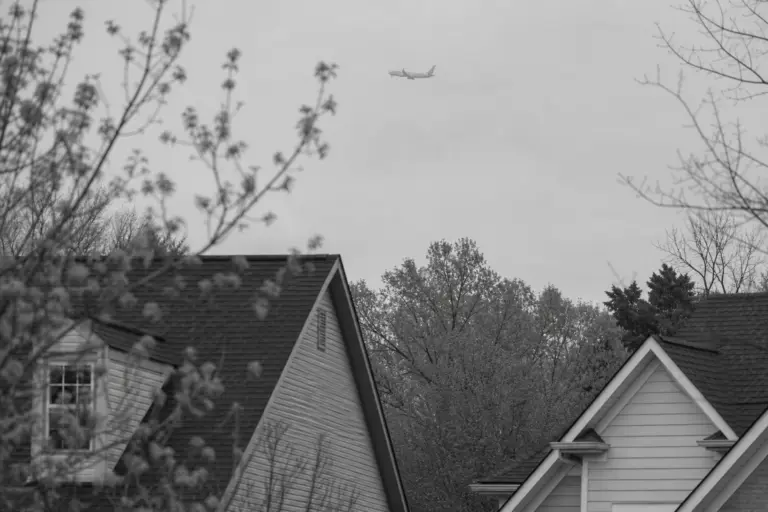
Distant aircraft noise is also shaped by atmospheric acoustics: the way sound travels through changing air conditions can make a far-off source seem louder, closer, or harder to place than expected. Buildings, slopes, and other surfaces may reflect or mask portions of a low-frequency sound, while the listener hears the remaining rumble as if it were overhead. A perceived fixed location is therefore a weak locator for a sound source, particularly without observations from other positions.
Ground-based activity is equally untested. Construction equipment and industrial machinery may run steadily; road traffic, rail movement, utility equipment, and large mechanical systems can create a droning component that is difficult to distinguish from an airborne source. The useful distinction would be whether the sound arrived in pulses, changed as vehicles moved, was accompanied by felt vibration, or was audible indoors as well as outdoors. The report preserves none of those characteristics.
A vibration transmitted through the ground or a structure can further complicate perception, because a listener may experience a room, window, or nearby surface resonating while assigning the sound to the sky. That does not establish a ground source in Lawrenceville; it identifies another plausible pathway requiring evidence. On the available description, aircraft, distant propagation, and local mechanical or transportation noise are all possible but untested explanations, not findings.
Could Public Records Resolve the Question?
A retrospective inquiry would need to begin by narrowing the event window. A date alone cannot meaningfully match a sound to activity in the air or on the ground; the useful comparison is a clock time, a specific listening location, and the reported roughly 10-minute duration. Without those anchors, records can identify possibilities for March 10 but cannot tie one of them to this particular rumble.
FAA flight data and historical flight-tracking archives are the most direct tests of an aviation hypothesis. They can sometimes show an aircraft’s route, altitude, direction, and proximity during a defined interval. Airport operations information may add context on arrivals, departures, training, helicopter activity, or other visible aviation patterns. Public tracking, however, is not a complete record of every aircraft operation, and historical coverage varies by service, aircraft equipment, and retained data. More importantly, a track passing near Lawrenceville would be a lead to evaluate, not proof that the aircraft produced the reported sound.
Weather observations for the relevant hour could help assess whether wind, cloud layers, precipitation, or other weather conditions might have affected sound propagation or supported a weather-related explanation. Their value depends on timing: an all-day weather summary is weaker than an official hourly observation aligned with the report. The same time-and-place standard applies to local government notices, roadwork schedules, utility outage or maintenance alerts, rail notices, and emergency notifications. A notice is useful when it identifies activity close enough and long enough to fit the account; a general notice for the wider area is not a match.
Contemporaneous local reporting, public-agency posts, and independently dated resident accounts could supply the missing comparison point: whether multiple people described a similar sound at approximately the same time. For searchable historical records labeled a Georgia UAP sighting March 2020, that distinction is decisive. Records reviewed without a time-and-location match should be treated as untested context, while the absence of a located record should not be treated as evidence for any particular explanation.
Do Other Georgia UFO or UAP Reports Add Context?
A meaningful regional comparison would look like a cluster, not a search result count. The stronger pattern would be separately submitted accounts from nearby places on March 10, 2020, each giving a reasonably precise time and describing an audible, sustained rumble with similar changes, or lack of change, in loudness and apparent direction. Reports that align within a short interval could support investigation of one broad-area source, such as distant aviation activity or sound carried unusually far.
By contrast, a list of Georgia UFO sightings is weak context when its entries concern lights, moving objects, or different dates and locations. A visual report may be worth comparing only if it is contemporaneous, geographically plausible, independently recorded, and includes observations that could connect it to the sound. Repeated retellings of one original post do not become multiple witnesses; independence matters because copying can create the appearance of a reporting cluster without adding evidence.
No independently documented set of matching Georgia reports has been supplied for this review. That leaves other UAP sightings as untested background rather than corroboration of the Lawrenceville account.
Later reports cannot bridge that gap. UFO sightings in 2025 or UFO sightings in 2026 may be separate events, but they cannot validate a sound reported in Lawrenceville in 2020. National UAP disclosure debates likewise do not provide the missing local time, location, recording, or independent witness account needed to assess this particular rumble.
Bottom Line: An Unexplained Report Is Not a Confirmed UAP
The appropriate finding is narrower than either a dismissal or an extraordinary conclusion. A rumbling near Lawrenceville on March 10, 2020 was reported as lasting about 10 minutes and seeming stationary overhead; that is the reported detail. No supplied material independently verifies its source, position, or even a visual object. Aviation, atmospheric sound transport, weather, and ground-based noise remain plausible categories, while the available record cannot distinguish among them.
An unidentified sound is simply a sound that cannot yet be assigned a source. Identifying one would require a usable time window and location plus an independent match, such as a recording, separate contemporaneous witnesses, flight activity, weather observations, or a documented local event. Without that convergence, “unexplained” remains an evidence limit, not support for a non-human craft or a government cover-up.
Useful follow-up would preserve the earliest post or archive capture, seek independently written accounts from that date, and compare date-specific public records. For any future event, note the exact time, listening location, duration, direction, weather, and changes in loudness; retain original audio or video files with metadata. UFO disclosure and UAP disclosure are broader policy subjects, but neither independently authenticates this local report.
What the Lawrenceville Rumble Report Can, and Cannot, Show
The decisive issue is not whether the reported sound felt unusual, but whether the account can be connected to an independently traceable event. It cannot on the material available here. The record preserves a claim of a roughly 10-minute rumble near Lawrenceville on March 10, 2020; it does not preserve the time, exact listening point, original submission, recording, visual observation, or a second account that would allow that claim to be tested.
That leaves several conventional categories open without making any one of them the answer. Aircraft or helicopter activity could fit a sustained aerial rumble, but requires time-linked flight information. Atmospheric conditions could make distant sound seem overhead or stationary, but require hourly weather observations. A weather-related or ground-based source remains possible as well, yet neither can be tied to this report without a description of conditions, vibration, direction, or nearby activity.
A stronger future case would combine an original archived report with independently dated local witnesses, unedited audio carrying usable metadata, and records that overlap in time and place: flight tracks, airport activity, weather observations, emergency calls, or local-agency notices. A match among those materials would narrow the cause; conflicting records could eliminate hypotheses.
For historical-search purposes, the Lawrenceville GA UFO sighting March 10 2020 is best treated as an unresolved sound report, not evidence that a UFO or UAP was present. Its value lies in identifying a specific claim for investigation, and in showing exactly how much corroboration is still missing.
Frequently Asked Questions
What was reported in Lawrenceville, Georgia, on March 10, 2020?
A person reported hearing a strange low rumble near Lawrenceville that seemed fixed overhead for about 10 minutes. No clock time, exact location, audio recording, visual object, lights, or flight details were preserved in the available account.
Was the Lawrenceville sky rumbling a confirmed UFO sighting?
No. The report documents an unexplained sound, not a confirmed UFO or UAP, because it contains no visual observation and no independently verified evidence of an aerial object.
What can cause a stationary rumbling sound in the sky?
Possible causes include distant aircraft or helicopter noise, atmospheric conditions that carry low-frequency sound, industrial machinery, road or rail traffic, utility equipment, and structural vibration. A sound that seems stationary overhead does not prove that its source was fixed in the sky.
Were there other UFO or UAP reports in Georgia that night?
No independently documented group of matching Georgia reports from March 10, 2020 was provided. Reports from different dates, locations, or involving lights and visible objects do not corroborate the Lawrenceville rumble.
How can a historical UFO sighting report be verified?
Verification requires a specific time, precise location, and independent evidence such as original audio or video metadata, separate contemporaneous witnesses, FAA flight tracks, airport records, hourly weather observations, or emergency-service logs. A useful match must overlap the reported roughly 10-minute event in both time and place.