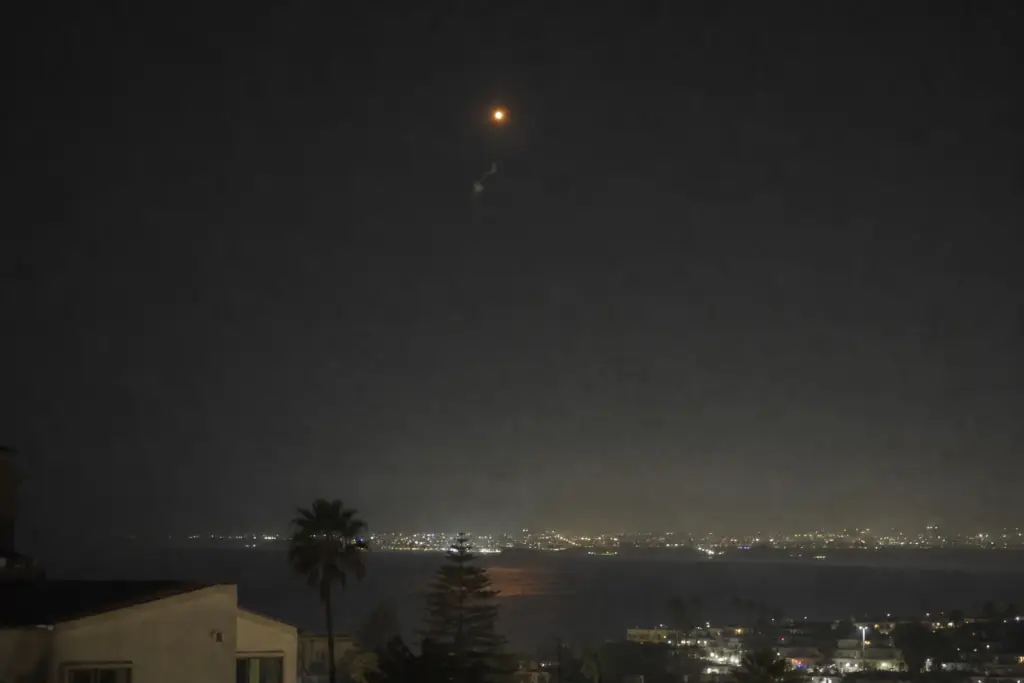
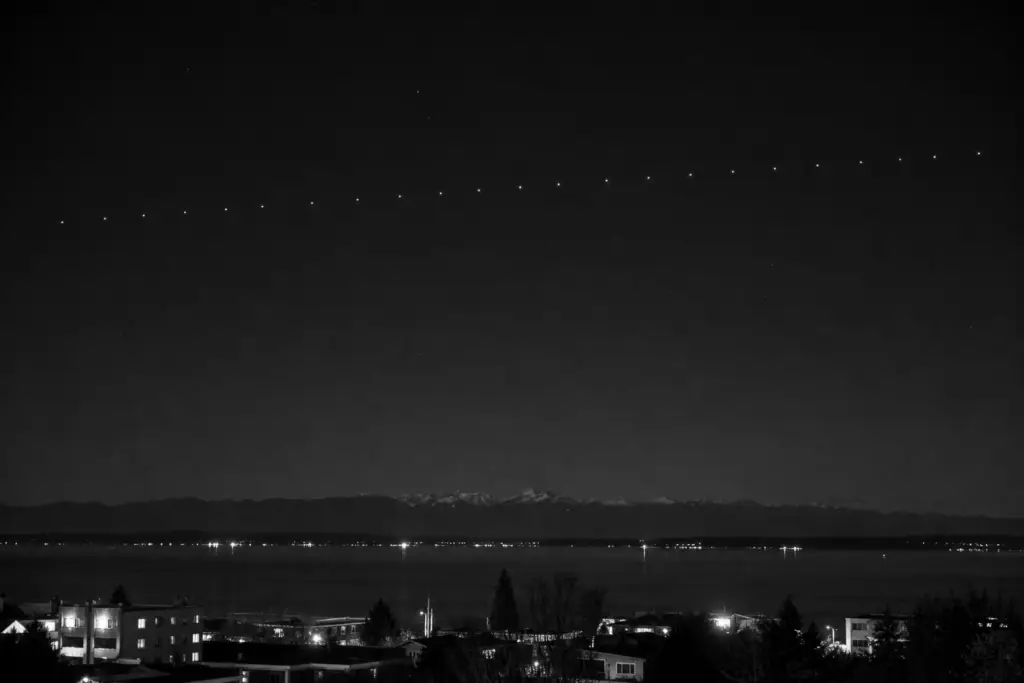
The decisive starting point is not how uncanny the lights appeared, but whether the surviving record can place a coordinated procession in the Edmonds sky on March 7, 2020. Bright points that hold roughly even spacing, move at a common pace, make no audible sound, and vanish within minutes can look less like ordinary aircraft traffic than a deliberate formation.
This investigation treats the Starlink satellite formation Edmonds WA March 7 2020 description as a claim to test, not a label to assume. A satellite train is a group of recently deployed satellites that can remain comparatively close together in low Earth orbit, producing a string-like effect as the satellites reflect sunlight after local sunset or before dawn. That striking appearance is not unique to Starlink.
The analysis separates the reported date, location, and apparent west-to-east movement from stronger identifying signals: contemporaneous witness material, the timing of relevant launches, whether an orbital pass could have crossed the local sky, and whether the reported behavior fits satellites better than aircraft, drones, lanterns, or another object class. Direction is a useful clue, not a standalone identification; the conclusion will be limited to what the surviving evidence can support.
What Was Reported Over Edmonds on March 7, 2020
The surviving description fixes four elements of the alleged Edmonds event: the place was Edmonds, Washington; the date was March 7, 2020; more than one light was seen; and the group was described as moving generally from west to east. Those are the reported parameters of the sighting, rather than independently established measurements.
No original witness post, dated local-news account, photograph, video, precise observation time, duration, light count, or observer address has been supplied in the available record. That absence matters because each item serves a different evidentiary purpose: a timestamp permits a pass comparison, an unedited image or video can preserve spacing and motion, and a specific viewing location and bearing make the claimed track testable.
The phrase “formation” should therefore be read as a witness description of several lights sharing an apparent path, not proof that the objects held a fixed geometric pattern or moved in coordinated flight. Likewise, west-to-east is a broad visual impression; without a compass bearing or a recorded horizon reference, it cannot establish an orbital ground track.
At this stage, the Edmonds WA Starlink sighting is best classified as plausible but unverified. It is a historical report of unusual lights, not a confirmed observation of unidentified craft and not yet a documented Starlink identification. The next test is whether the date and likely viewing conditions can be reconciled with a relevant satellite group.
Why a Starlink Satellite Train Can Look So Unusual
A recently deployed cluster can appear less like isolated satellites than a deliberate string of lights. A Starlink satellite train is a loose procession of satellites following broadly the same path after release, before their spacing becomes less visually obvious. To a ground observer, that can produce several similar points advancing at a common pace, often with gaps that look surprisingly regular.
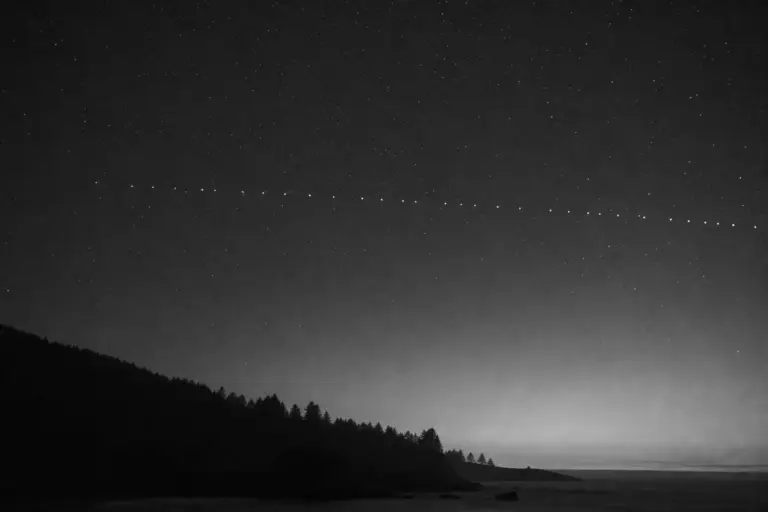
The lights are not self-illuminated in the usual sense; their visibility depends on sunlight reflecting from satellites in low Earth orbit that remain sunlit while the observer’s ground location is in dusk or darkness. That geometry can make twilight especially effective for a satellite formation sighting. Individual points may brighten, dim, or disappear as their angles to the Sun and viewer change, so a procession can seem to switch on and off rather than behave like a continuous aircraft light.
This differs from the familiar view of one satellite crossing alone or an airplane showing navigation lights. A chain of quiet, similarly moving points can look organized and unfamiliar, particularly when its spacing is the most memorable feature. Describing that initial experience as a UFO or UAP sighting is reasonable as a statement that the observer had not identified it at the time; it does not, by itself, establish an extraordinary cause. For Edmonds, the appearance is compatible with a Starlink-style train, but the missing time and original imagery still prevent the visual description from proving that identification.
Could a Starlink Launch Have Produced This View in Early March 2020?
One launch sits closest to the reported date: SpaceX launched 60 Starlink satellites from Cape Canaveral on February 17, 2020, 19 days before March 7. Earlier 2020 deployments occurred on January 6 and January 29, placing those groups 61 and 38 days before the Edmonds report. The February 17 batch is therefore the strongest chronological candidate for a March 7 formation, because its satellites had had the least time to spread apart.
That distinction matters. A launch date marks when a batch was released into low Earth orbit; a verified overhead pass identifies whether that batch crossed a particular observer’s sky at a particular time. Nineteen days is consistent with satellites from one deployment still appearing as a recognizable procession, whereas the January 6 group had been in orbit for more than two months. But even the February 17 SpaceX Starlink mission cannot be assigned to Edmonds from elapsed time alone.
The missing checkpoint is unusually specific: no precise local observation time, observer coordinates, historical two-line orbital data, or archived Edmonds pass prediction accompanies the March 7 account. Those details would allow a reconstruction to test whether the February 17 satellites were above Edmonds, illuminated by the Sun, and traveling on a track that an observer could have described as west to east. A launch 19 days earlier is a strong contextual match; an orbital pass at the reported time would be the identifying match.
For the reported March 7 2020 Starlink sighting in Washington, the launch chronology supports a plausible but unverified conclusion. The February 17 deployment could still have produced a grouped view on March 7, while the older January batches are weaker candidates on spacing alone. Without a time-specific historical pass match, however, the launch record cannot independently establish that the Edmonds formation was Starlink.
How to Test the West-to-East Direction Claim
Direction is best treated as a reported visual impression, not a measured track. “West to east” may describe where the lights first appeared and where they disappeared, but the apparent direction of travel can change with the observer’s viewpoint: a path that arcs overhead may be remembered as crossing left to right, while buildings, shoreline, hills, and a limited opening in the sky can obscure much of the route.
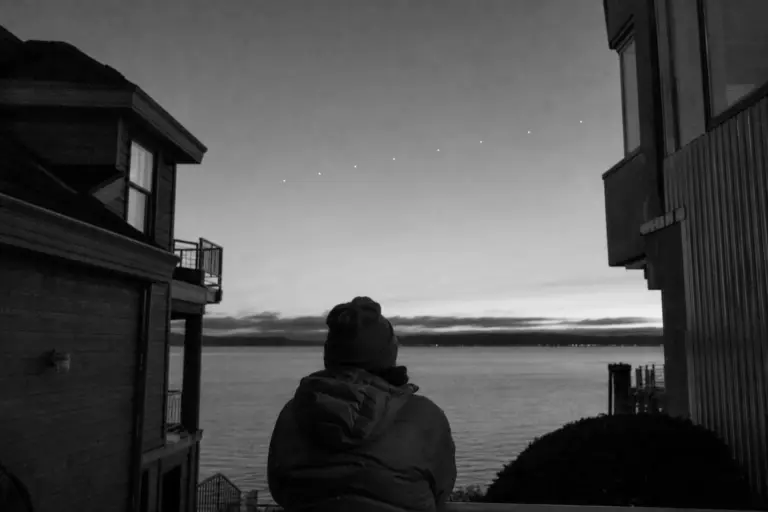
A meaningful reconstruction needs four linked values. The time fixes the sky’s geometry; the Edmonds location sets the observer’s horizon; azimuth identifies the compass bearing of each point in the sky; and elevation measures how high above the horizon the lights appeared. The predicted trajectory then shows whether an orbital pass entered the visible sky in the reported direction, rose or set where expected, and followed a path compatible with the description.
For example, a useful match would place several relevant objects above Edmonds during the same narrow time window, moving across the same sector of sky and remaining illuminated at the reported elevations. A weak match would merely show that a satellite was somewhere over the broader region that evening. A contradiction would be stronger still: if reconstructed tracks place the candidate group below the horizon, traveling through a different part of the sky, or passing hours away from the observation, the Starlink interpretation would lose support.
That test requires archived orbital-tracking records, including historical position data recorded near March 7, 2020, rather than a modern tracker’s display. Those elements can be propagated into a date-appropriate pass prediction for Edmonds, then compared against any recoverable witness timestamp, viewing direction, horizon description, photograph, or video metadata. Without a time or elevation estimate, the reported Starlink formation moving west to east remains a useful lead but cannot uniquely identify Starlink; many visible orbital passes can be described in similarly broad compass terms.
What Else Could a Line of Moving Lights Be?
Several ordinary possibilities can produce a remembered line of lights, but they leave different traces. Another satellite group could resemble Starlink most closely: similar points, steady apparent motion, no obvious flashing, and a shared path. The practical discriminator is not the general appearance but a date-specific orbital prediction that places multiple objects over Edmonds at the reported time.
A sequence of aircraft can look linear when planes are using the same approach or departure corridor. Aircraft commonly separate or converge in apparent spacing, show blinking navigation or anti-collision lights, and may reveal red, green, or white light combinations. Their pace can seem slower near the horizon, and sound may arrive after the lights pass. A timestamp paired with a local flight-track record would make that explanation testable; a broad west-to-east description alone does not distinguish it.
Lanterns and drone swarms tend to behave less like an orbital procession. Their gaps can change, individual lights can climb, drift, hover, dim irregularly, or diverge, and nearby drones may produce audible rotor noise. Those behaviors would weigh against a single satellite track. Conversely, a fixed-looking sequence that retains its order and crosses the visible sky at one common pace is more compatible with objects sharing an orbital route.
Image and video evidence needs its own screening. A file with an original timestamp, location information, an identifiable horizon, a continuous unedited view, and reports from nearby observers is far more useful than a cropped repost. Exposure settings, camera movement, autofocus, and a narrow field of view can also alter apparent spacing, brightness, and speed. Later UFO news coverage cannot replace those missing particulars for this localized report.
A strong Starlink identification would join contemporaneous material to a matching historical pass prediction for several satellites. It is merely plausible when the lights were described as quiet, similarly spaced, and steadily moving but no precise time or provenance survives. It is unsupported when the account lacks those details and an alternative, especially logged aircraft traffic or a contradictory orbital track, fits the available record better.
The Most Defensible Conclusion About the Edmonds Formation
The appropriate verdict is plausible but unconfirmed. The reported Starlink satellite formation over Edmonds, WA, on March 7, 2020 has features compatible with a satellite train, multiple lights sharing an apparent route and pace, but compatibility is not identification. The available record does not establish an observation time, preserve original media, or supply a reconstructed pass for a named Starlink group.
| Claim | What the record supports | Verdict effect |
|---|---|---|
| Edmonds, March 7, 2020 | Place and date are part of the surviving report. | Provides a starting point for reconstruction. |
| Several lights moved west to east | A general witness description, without measured bearings or time. | Consistent with, but not distinctive of, Starlink. |
| A particular Starlink batch crossed the sky | No launch-to-pass match has been established. | Prevents a likely or confirmed identification. |
Its unusual appearance still has an ordinary potential explanation: a quiet sequence of similarly bright points can look intentional, especially when it emerges against a darkening sky and crosses a limited opening between buildings or trees. That reaction explains why an observer might initially call the formation unidentified; it does not establish an extraordinary origin.
The uncertainty could be narrowed by an original timestamped photograph or video with a recognizable horizon, an eyewitness account giving a viewing location and duration, archived weather conditions, local flight-track data, and a historical orbital prediction showing multiple relevant satellites above Edmonds in the same interval. A good match requires the time, sky sector, direction, and illumination to agree together; a date-only resemblance would remain weak.
This is also a bounded historical claim, not evidence about UFO sightings 2025 or sightings reported in 2026. Those are separate events with separate records. For March 7, 2020, the responsible conclusion is that Starlink remains a reasonable hypothesis, but the title’s identification cannot be independently verified from the material that survives.
Frequently Asked Questions
Why do Starlink satellites appear as a line or formation of lights?
Recently deployed Starlink satellites can remain relatively close together after launch, creating a string-like procession of similar lights. They are visible when they reflect sunlight while observers on the ground are in dusk or darkness.
Were Starlink satellites visible over Edmonds, Washington, on March 7, 2020?
A Starlink train was plausible but not confirmed over Edmonds on March 7, 2020. The surviving report gives the date, location, multiple lights, and general west-to-east movement, but it lacks a precise observation time, original media, and a historical pass match.
What Starlink launch could have caused lights over Washington in early March 2020?
The strongest chronological candidate was SpaceX’s February 17, 2020 launch of 60 Starlink satellites from Cape Canaveral. It occurred 19 days before March 7, while the January 29 and January 6 deployments were 38 and 61 days earlier.
Can Starlink satellites appear to move west to east?
Starlink satellites can appear to move west to east from a particular viewing location, but broad direction alone cannot identify them. A reliable test needs the observation time, Edmonds location, compass bearings, elevation, and archived orbital data from March 7, 2020.
How can you tell a Starlink satellite train from aircraft, drones, or a UFO sighting?
A Starlink-like train typically appears as quiet, similarly bright points moving at a common pace along one path, without obvious blinking lights. Aircraft often show red, green, or flashing lights and changing spacing, while drones and lanterns may hover, drift, climb, diverge, or make noise; confirmation requires a date-specific orbital pass prediction matching multiple objects.