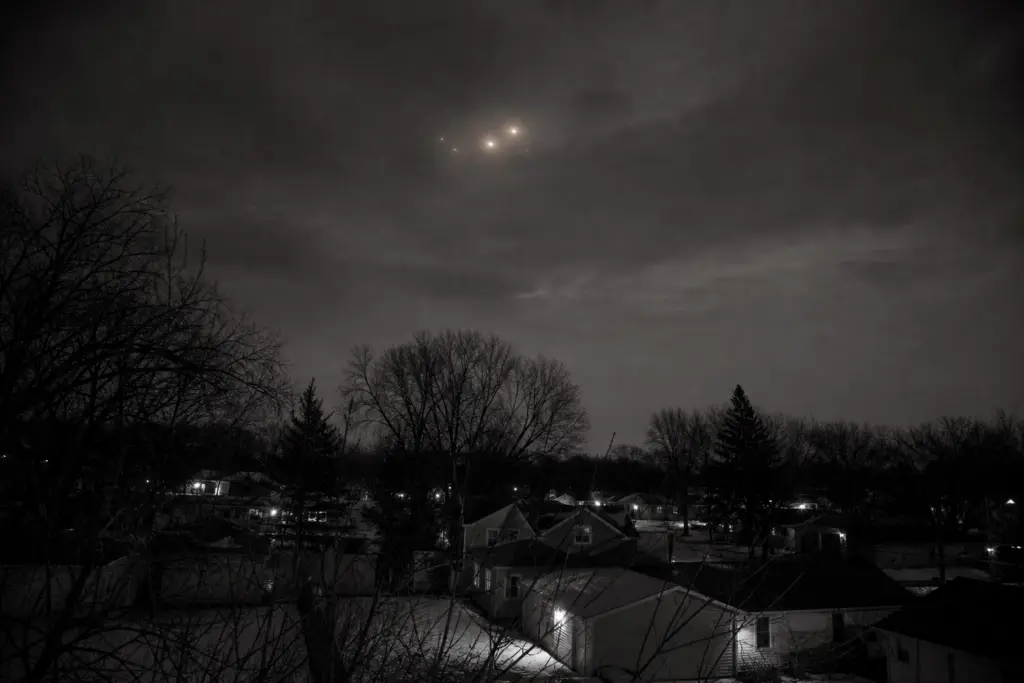
The Janesville WI UFO sighting reported for January 29, 2020 centers on an unusual visual account: a witness described a sphere accompanied by lights likened to fireballs. That language records an observer’s impression of apparent form and brightness, not a demonstrated identification of an object, its distance, speed, or origin. It is nonetheless the detail that makes this local report worth examining carefully.
“UFO” and the newer term “UAP” mean unidentified at the point of reporting; neither label establishes an extraterrestrial craft or any other extraordinary explanation. A meteor can produce a brief fireball-like streak, aircraft lights can appear grouped or distorted at night, and drones, lanterns, or viewing conditions can alter perceived shape and motion. Whether any of those categories fits depends on particulars such as duration, direction of travel, sound, weather, sky position, imagery, and independent witnesses.
This account will keep the boundary between observation and inference clear. It will reconstruct the reported sphere and fireball-like lights, assess what the available record can test, and identify the missing evidence that prevents a firm conclusion. An unresolved report is a record of something not identified from the information available, not proof that it was anomalous.
What Was Reported Over Janesville on January 29, 2020
The date attached to this local account is January 29, 2020, and its stated location is Janesville, Wisconsin. Those details place it within a specific historical setting, but they do not by themselves establish when the report was submitted, where in or around Janesville the observer stood, or whether anyone else saw the same event.
For this review, the distinction between an event date and a report date matters. An event date identifies when the observation was said to occur; a submission or publication date identifies when that recollection entered a database or public record. A prompt report can preserve more precise conditions, while a later report may still be sincere but offers fewer ways to test details against weather, aviation, astronomical, or local records.
The available account is treated as a witness report of a sphere-like appearance and fireball-like lights, not as a measurement. Visual language can convey how an event looked to the observer, yet it cannot independently determine range, physical dimensions, altitude, speed, material, or origin. A nearby small light and a distant large light may create similar apparent impressions.
That is why this Wisconsin UFO sighting is examined as a bounded record: the reported time and place guide the inquiry, while the description supplies observations to compare with possible explanations. The following sections separate the witness’s wording from conclusions the surviving information cannot support.
The Witness Description: A Sphere and Fireball-Like Lights
The surviving description is notably compact. It characterizes the observed form as a “sphere” and associates it with lights the witness compared to fireballs. Read literally, those are two related but distinct parts of the account: “sphere” conveys an apparent outline or overall visual impression, while “fireball-like” describes how the lights appeared in brightness, glow, or intensity.
Neither expression identifies a physical object. A sphere-like appearance can result from a genuinely round-looking body, a concentrated point of light, glare, defocus, haze, or an observer’s inability to resolve detail at distance. Likewise, fireball-like lights are a visual comparison, not a report that a meteor, bolide, flame, or burning object was established. The wording does not determine whether the lights were on, within, behind, or separate from the apparent sphere.
The available material does not preserve further quoted witness detail that would sharpen the reconstruction. It does not provide a reported clock time, observation length, compass direction, color, count of lights, flight path, changes in brightness, apparent angular size, or audible sound. It also does not establish whether the witness understood the sight as one object with associated lights or as multiple lights seen together.
Those omissions matter because they prevent the phrase sphere sighting Janesville WI from becoming more precise than the record permits. A stated direction and duration, for example, could distinguish a brief streaking impression from a slowly tracked light; a color sequence or count could help establish whether the observer perceived a single luminous source or several. Without such details, the account preserves an unusual appearance but not a complete visual profile.
The most faithful reconstruction is therefore limited: a witness reported a sphere-like sight over Janesville on January 29, 2020, accompanied by or associated with fireball-like lights. It is appropriate to retain the witness’s descriptive language in discussing a possible sphere UFO report, but not to convert that language into a settled account of shape, propulsion, distance, or origin.
What the Janesville Report Can, and Cannot, Establish
An unidentified report records that an observer could not confidently name what was seen; it does not turn the observation into a determined object. Identification requires details that can be tested against a specific candidate, rather than an unusual appearance alone. In this case, the witness report preserves a visual impression but lacks the measurements needed to assign a physical explanation.

Distance is the central limitation. The same apparent point or sphere can be a small nearby light, a larger distant light, or a bright source whose glare obscures its outline. Without a known distance or a reference object, apparent size cannot establish actual size. For the same reason, movement across the sky cannot reliably establish speed, altitude, or trajectory: a nearby slow-moving light and a distant fast-moving light may produce a similar visual track.
Stronger identification evidence would connect the observation to independently recorded facts. A time-stamped photograph or video can preserve direction, duration, light pattern, and changes in appearance; audio may capture aircraft-like sound; radar or flight data may place an aircraft in the relevant airspace; and named, independently gathered witness accounts can test whether multiple observers saw comparable motion and features. None of those forms of corroboration is documented in the available Janesville record.
The material reviewed here also does not document photographs, video, audio recordings, radar returns, an official investigation, investigation notes, or independently identified witnesses. That is a statement about the surviving record, not proof that no such material or observers ever existed. It means the report cannot establish an object’s origin, technology, or extraordinary character.
The appropriate status is therefore an unresolved sighting: a reported observation that remains insufficiently detailed for a confident identification. That conclusion neither dismisses the witness report nor elevates it into evidence of a non-human craft; it defines the limit imposed by the available information.
Possible Explanations and How They Compare With the Description
Each candidate explanation would leave a different pattern in a fuller observation, and that pattern is missing here. The reported sphere-like appearance and fireball-like lights are too limited to rank one explanation above the others; they can only define the details that would make a comparison meaningful.
- Meteor or other bright astronomical event. A meteor hypothesis would be strengthened by a brief, one-directional streak or descent, a changing brightness trail, and a tightly known time that could be compared with independent fireball reports. It would be weakened if the light held a fixed position or remained visible for an extended period. A bright planet or star can also appear unusually prominent through haze or focus effects, but that possibility depends on whether the sight stayed stationary relative to the horizon.
- Aircraft lighting. Navigation, landing, and anti-collision lights can merge into a single bright shape at distance, particularly when an aircraft approaches nearly head-on. Supporting details would include regular flashing, steady directional travel, an audible engine sound, or flight activity matching the time and direction. The present description does not preserve any of those comparison points.
- Drone. A nearby drone could present one or more bright lights and may appear sphere-like when its body is obscured by darkness or glare. Hovering, abrupt local repositioning, low apparent altitude, and a short observation distance would make that category more worth considering. Conversely, a distant-looking light crossing a large portion of sky would call for a different comparison; neither behavior is recorded.
- Lantern or wind-borne light. A floating lantern would ordinarily be assessed through its warm glow, gradual drift, upward movement after release, and any indication of wind direction. Multiple lights might suggest separate lanterns rather than one structured object. Without motion, duration, color, or weather observations, the fireball-like comparison alone does not distinguish this possibility.
Viewing conditions can alter every category. Glare can enlarge a point light into an apparent orb, while cloud, haze, window reflections, autofocus, and an observer’s changing viewpoint can make one light seem to shift, pulse, or divide. Useful discriminators would be whether the sight was viewed outdoors, whether it passed behind clouds or foreground objects, and whether its apparent behavior changed when the observer moved.
For this Janesville report, a precise time, compass direction, duration, weather conditions, and motion description would be the minimum facts needed to test these alternatives against event, aviation, or astronomical records. Until such details emerge, the possibilities remain unidentified comparison categories rather than identifications.
Corroboration, Contemporaneous Records, and Remaining Gaps
The evidentiary value of a local sighting rises sharply when separate records converge on the same time, direction, and behavior. An independently documented nearby witness is stronger than a second database entry that merely repeats the original submission: independence requires a distinct observer, a separately recorded account, and enough timing and location detail to show both people could have seen the same event.
For the material available here, there is no preserved second-witness statement from Janesville or a nearby community, no image or video with usable provenance, and no instrument record tied to the observation. Nor does the supplied record include a contemporaneous local-news account, a public-agency incident report, aviation query, or documented follow-up that identifies the reported lights. Those absences do not establish that nothing else was seen; they mean this case cannot draw corroboration from those channels on the present record.
Contemporaneous records would serve different tests. A weather observation could indicate cloud cover, visibility, wind, or haze, weather conditions that affect both what was visible and how a light appeared. A precisely timed aviation record could test whether an aircraft was operating along the reported line of sight. A fireball-network report or independently timed astronomical observation could test a brief meteor-like event. Without a time of day, viewing direction, duration, or trajectory, none can be matched responsibly to this report.
Report timing also matters. A submission made after the event can still preserve a sincere observation, but memory commonly retains an unusual overall impression more readily than exact sequence, duration, direction, and scale. Those missing details are not minor omissions: they are the measurements that would distinguish a stationary astronomical light from a moving aircraft, or a brief meteor from a drifting illuminated object.
The remaining gap is therefore evidentiary rather than merely interpretive. The Janesville account stands as one witness’s recorded description, but it lacks the independent, time-linked material needed to strengthen or narrow an explanation.
A Reported Observation, Not a Proven Identification
The record supports a narrow conclusion. On January 29, 2020, a witness reported a sphere-like sight over Janesville, Wisconsin, with lights compared to fireballs; the surviving account does not provide enough independently testable detail to identify what produced that appearance.
“Unidentified” describes the status of the report, not the nature of the object. An extraordinary conclusion would require affirmative evidence that ordinary categories cannot account for it, whereas this case lacks the timing, directional, behavioral, and corroborating material needed even to discriminate reliably among those categories. The appropriate assessment is unresolved, not confirmed anomalous.
Future reports become far more useful when they preserve a prompt observation time, viewing location, compass direction, elevation, duration, motion, sound, weather, and original photos or video with their unedited files. A second independent account recorded separately can also turn a memorable description into a testable event.
Readers following broader UFO news or UAP news can use those subjects as context for how sightings are investigated, but they do not add evidence to this Janesville report. Its value is as a carefully bounded historical witness account: notable for what was described, limited by what was not recorded.
Frequently Asked Questions
What was reported over Janesville, Wisconsin, on January 29, 2020?
A witness reported a sphere-like sight over Janesville, Wisconsin, with lights described as resembling fireballs. The surviving account does not include a clock time, direction, duration, color, flight path, or sound.
Was the Janesville sphere sighting identified as a UFO or extraterrestrial craft?
No. The report remains unresolved because the available information cannot identify the source of the observed lights or establish an object’s distance, size, speed, altitude, technology, or origin.
What evidence is missing from the Janesville 2020 UFO report?
The available record contains no documented photographs, video, audio, radar data, official investigation, independently identified witnesses, or usable time and direction details. These missing facts prevent a reliable comparison with aviation, weather, meteor, or astronomical records.
Could the fireball-like lights over Janesville have been a meteor, aircraft, drone, or lantern?
Yes, each is a possible comparison category, but the report lacks the details needed to choose among them. A meteor would usually involve a brief streak, aircraft may show regular flashes and directional travel, drones may hover or reposition locally, and lanterns often drift with the wind.
What should you look for when trying to identify an unexplained light in the sky?
Record the exact time, viewing location, compass direction, elevation, duration, motion, color, sound, weather, and any original unedited photo or video files. Compare those details with flight activity, weather conditions, fireball reports, and independently recorded witness observations.