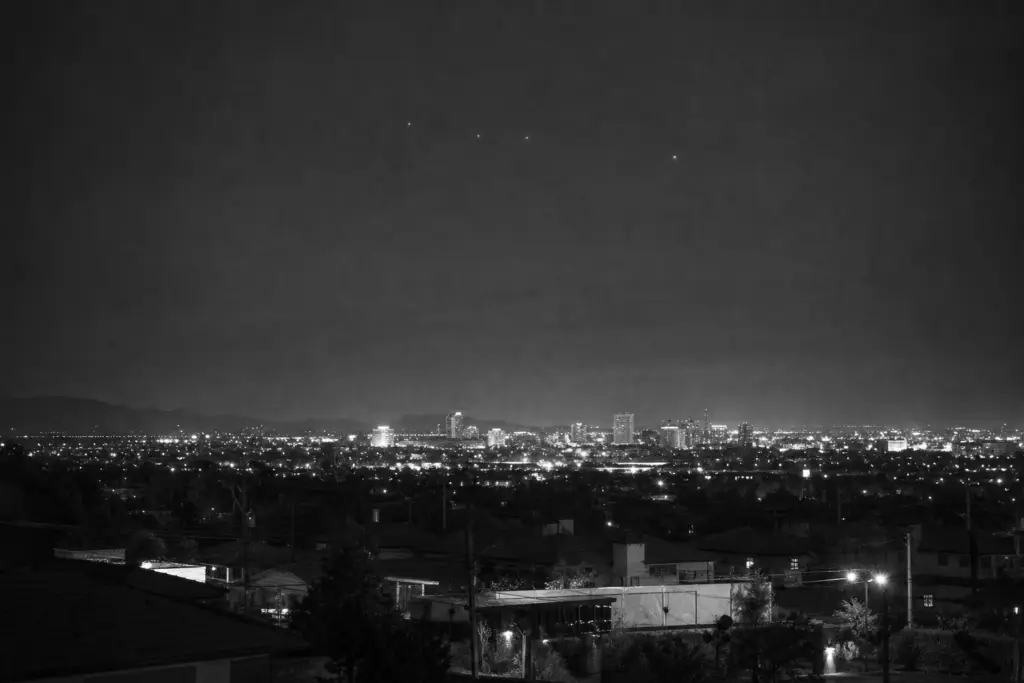
A reported Phoenix UFO sighting on January 9, 2020 centers on an attention-grabbing description: orb-like lights said to form a rectangle or angular pattern over the city, with their brightness or apparent arrangement changing as observers watched. That description is unusual, but it is a description of an observation, not a verified identification of an object, vehicle, or phenomenon.
This report examines the claim at the level the available record can support. It will separate material traceable to an original witness account or upload from later retellings, and distinguish an observation date from a posting date. Details such as the precise time, viewing direction, duration, number of lights, and whether any surviving image or video is original materially affect how much can be concluded. A crisp geometric pattern in a low-light image, for example, may reflect perspective, camera focus, exposure, or the viewer’s interpretation as much as the physical positions of distant lights.
The analysis will test conventional possibilities, including aircraft, drones, satellites, and ground-based lights, against the reported pattern and changes rather than declare a solution without adequate evidence. It will also keep this January 2020 claim separate from the 1997 Phoenix Lights: the shared location explains the association, but it does not establish a shared event or cause.
What Was Reported Over Phoenix on January 9, 2020?
The usable claim is narrow: material circulating under the date January 9, 2020 describes lights seen from Phoenix, Arizona, as making a rectangle-like or angular display and changing in intensity or apparent layout. “Orb-like” is a visual label for points of light, not evidence that the lights were spherical objects. Likewise, a perceived rectangle may describe the observer’s line of sight rather than the physical spacing of anything in the sky.
At present, the report cannot be tied here to an authenticated first witness post, original media file, or contemporaneous submission that fixes the observation’s time, neighborhood or vantage point, compass direction, duration, light count, color, or motion. Those omissions matter. A post dated January 9 could describe an earlier observation; a reposted clip can lose its upload time and location; and a still image cannot by itself show whether lights changed position, dimmed, or simply appeared differently as exposure changed.
For that reason, “Phoenix UAP sighting January 9 2020” is best treated as a search label for an asserted observation, not an identification. The reported rectangle of lights over Phoenix in January 2020 may be a faithful account of what a viewer perceived, but the surviving claim does not yet establish a discrete aerial object, a single formation, or an anomalous cause. The next question is therefore provenance: what material can be traced back to the observation itself, and what details entered later retellings?
What Is Documented, and What Is Still Unverified
The evidence ledger begins with provenance, not with how often a claim has been repeated. For this review, no authenticated first-post package, an original upload tied to a named account, preserved file, and contemporaneous observation details, is available. That leaves the January 9, 2020 attribution as an asserted event date rather than a fixed observation time.

- Directly traceable material: an original photo or video file, its earliest identifiable public upload, and the witness’s unedited account. Together, these can preserve what was recorded and when it entered the public record.
- Repeated retellings: screenshots, clipped video, compilations, narration, and later articles. They may preserve the basic Phoenix rectangular lights sighting claim, but they do not independently establish the date, location, or circumstances of recording.
A platform timestamp marks when that platform received a post; it does not necessarily mark when the lights were observed. Likewise, a repost can be visually identical to an earlier clip while stripping the account name, caption, location tag, and upload history that would allow its path to be traced. A useful chain of custody follows media from the recording device through each transfer or upload; a break in that chain does not prove alteration, but it prevents confident claims about originality.
Metadata can help only when it comes from the original file and remains intact. Creation time, device information, and location fields may be absent, changed during sharing, or insufficient on their own to establish what appears in a frame. A screenshot is weaker still: it records a display at one moment, not the recording conditions, sequence, or source file.
Independent corroboration means separate observers or recordings whose accounts can be linked to the same place and time without copying one another. Multiple posts repeating changing orb lights over Phoenix, Arizona are not multiple witnesses if they descend from one upload. No such independently authenticated set is available here. The record therefore does not support determinations of altitude, distance, physical size, light count, duration, or origin; those details must remain unverified rather than inferred from the apparent geometry.
How a Rectangle of Changing Lights Can Look More Structured Than It Is
A rectangle is especially easy to perceive when several bright points occupy roughly four corners of a viewer’s field of view. It does not require the lights themselves to hold a rigid, rectangular spacing: perspective can compress depth, while a change in the observer’s position or viewing angle can make an irregular grouping seem to align and then break apart.
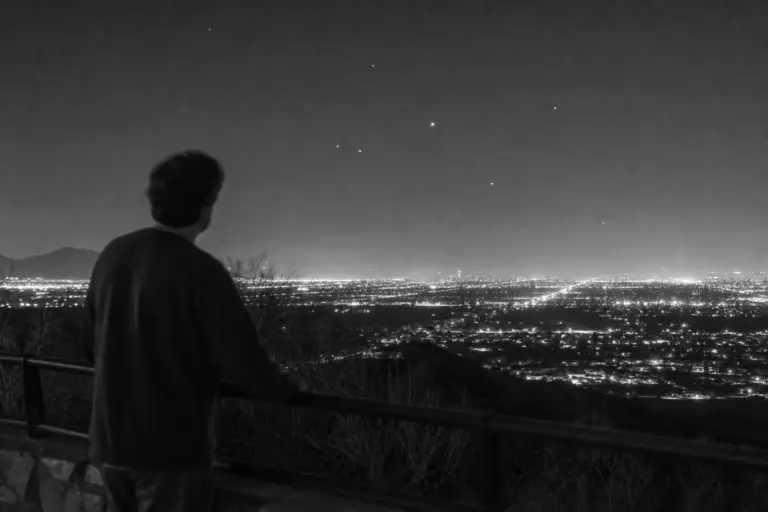
The description orb-like lights is also compatible with the limits of night viewing. At sufficient distance, a light’s apparent shape is dominated by glare, focus, and contrast rather than the outline of whatever produces it. In video, a small bright point can expand into a soft disk when autofocus hunts, exposure rises, or digital zoom enlarges a few pixels. Compression can further merge adjacent points or make a dim light appear and disappear between frames.
Brightness changes need not mean that a light changed its physical form or position. A camera may adjust exposure as bright sources enter or leave the frame; slight hand movement can shift a light against a darker or lighter background; and haze, thin cloud, or uneven air can attenuate lights differently along nearby lines of sight. Stabilization may reduce broad shake while introducing small frame-to-frame shifts that make a fixed pattern look mobile.
Perceived movement has the same scale problem. Without a known distance, elevation, direction, duration, or foreground reference, a viewer cannot reliably turn an apparent drift into speed, altitude, or size. A close light moving slowly, a distant light moving more quickly, and an aircraft lighting arrangement viewed at an oblique angle can produce similar impressions. For unidentified lights in the sky, a strong record would show the pattern continuously across original frames and pair it with independent observations from known locations; an intermittent or heavily zoomed image supports a description of appearance, not an extraordinary conclusion.
Plausible Explanations to Test Before Reaching an Extraordinary Conclusion
A fair comparison starts by asking whether a proposed cause can reproduce several features at once: multiple lights, an apparently angular layout, changes in brightness, and the reported viewing circumstances.
- Aircraft or helicopters: Several aircraft on different headings, or a helicopter seen with navigation, landing, and anti-collision lights, could create separated points whose apparent spacing changes with perspective. This possibility is weaker if the lights held a fixed rectangle for a well-established interval without recognizable motion or blinking. A useful test needs an observation time narrowed to minutes, a viewing direction, a vantage point, and preserved flight-history records; a missing track would not by itself exclude aviation activity.
- Drones: A coordinated drone display can produce deliberate geometric arrangements and programmed brightness changes, making it a potentially good fit for a compact, orderly pattern. It is less persuasive for lights reported as distant, high, or spread across a broad portion of the sky. Evaluation would require the observer’s location, estimated angular extent and duration, plus evidence of a nearby event, operator, or contemporaneous local recording.
- Satellites or a satellite train: Sunlit satellites can appear as moving points and can brighten or fade as their reflective angle changes. They generally fit a line or loose sequence better than a stable rectangular formation, however. Archival orbital predictions matched to the exact minute, Phoenix viewing location, direction, and elevation are needed before satellites can be meaningfully compared with this Arizona UFO sighting from January 2020.
- Astronomical objects: Bright planets and stars can provide fixed reference lights, while cloud or camera exposure can make their brightness seem variable. They do not readily account for a changing multi-light formation unless other lights, motion, or image effects are also involved. The necessary comparison is a precise time, direction, and elevation against a sky chart.
- Ground-based lights: Distant towers, buildings, vehicles, or event lighting can form a convincing pattern when viewed over a dark horizon. Their fit depends on whether the lights remained aligned with terrain or foreground features; they fit poorly if a reliable wide view shows them crossing the sky. A mapped sightline from the witness location is the key test.
- Camera artifacts: Autofocus, digital zoom, lens flare, stabilization, and compression can alter the shape and apparent position of bright points. These effects can explain orb-like disks and abrupt changes in recorded footage, but cannot determine what was present without the original file. Unedited media, device details, and a wider reference shot would separate an optical artifact from an external light pattern.
None of these categories can be selected responsibly from the currently unpinned date label alone. Their value is not that they dismiss unusual UFO sightings, but that each supplies a specific, testable expectation for a better-defined observation.
Why This Report Should Not Be Confused With the 1997 Phoenix Lights
Shared geography is the only established link between the January 2020 claim and the event commonly called the Phoenix Lights. The latter name refers to reports associated with 1997; it is not a category into which every later report of lights over metropolitan Phoenix automatically falls. The reported rectangle or angular arrangement in 2020 is also a different description from a historical label, not evidence of a common cause.
A meaningful comparison requires event-level particulars rather than resemblance in retellings. For each report, the useful questions are whether the observation date and time are fixed, whether original photographs or video survive, how many witnesses can be shown to be independent, how long the lights were observed, where observers were located, and whether contemporaneous news, aviation, emergency, or official records can be tied to the same interval. Those details establish the scope of an event; they do not, by themselves, identify the lights.
The January 2020 record does not currently provide the anchored time, location, duration, witness chain, or original-media provenance needed for that comparison. It therefore cannot inherit the scale, documentation, or significance readers may associate with the Phoenix Lights 1997. Phoenix’s earlier history can understandably influence how an unusual nighttime pattern is interpreted, especially when online posts use familiar UFO language. But historical association is not corroboration: a separate Phoenix UAP sighting January 9 2020 would need its own independently traceable evidence before any connection could be assessed.
Current Assessment: Unidentified Does Not Mean Extraordinary
The most defensible conclusion is limited but clear: a claim exists that lights over Phoenix were seen in a rectangle-like arrangement and appeared to change, but the available record does not establish the observation window, vantage point, original media, or physical identity of those lights. “Unidentified” here describes an evidence gap, not an identified anomalous object.
That gap cannot support claims of alien or non-human activity, a secret government platform, or military involvement. Each would require affirmative, case-specific evidence, such as reliably located original footage, a fixed time and direction, independent witnesses, and records that rule in rather than merely fail to rule out a particular cause. The absence of those materials leaves several ordinary possibilities open without selecting any one of them.
Future researchers can materially improve the record by preserving and documenting future observations responsibly: preserving the unedited file and its metadata; recording the observer’s exact location, compass bearing, start and end times, and visible landmarks; separating independent accounts from reposts; and comparing the verified interval against weather, astronomical, satellite, and aviation information. A strong match is one in which separate accounts converge on the same details; a weak match is a repeated description with no traceable origin.
Interest in UAP disclosure or UFO cover-up claims may shape the searches that bring readers to this report, but broader policy debates do not authenticate a Phoenix-specific post or identify its lights. Until better primary evidence emerges, the January 9, 2020 account remains an unverified reported sighting rather than evidence of an extraordinary event.
Sources
Frequently Asked Questions
What was reported over Phoenix, Arizona on January 9, 2020?
The claim described orb-like lights over Phoenix forming a rectangle-like or angular pattern. Observers reportedly saw changes in brightness or apparent arrangement, but no verified object or phenomenon was identified.
Was the January 9, 2020 Phoenix rectangle of lights identified?
No. The available record lacks an authenticated original witness post, original media file, fixed observation time, viewing direction, duration, and independently verified witnesses.
Can aircraft, drones, or satellites look like a rectangle of lights at night?
Yes. Aircraft on different headings, coordinated drones, distant ground lights, and camera effects can produce angular-looking groups and changing brightness, while satellites more commonly resemble lines or loose sequences than stable rectangles.
What evidence is needed to verify a Phoenix UAP sighting?
Useful evidence includes the unedited original photo or video, intact metadata, exact observer location, compass bearing, start and end times, visible landmarks, and independent witness accounts. Researchers can then compare the verified time and direction with aviation, weather, satellite, and astronomical records.
Is the 2020 Phoenix lights report connected to the Phoenix Lights of 1997?
No connection has been established beyond both reports involving the Phoenix area. The 2020 claim lacks the anchored time, location, duration, witness chain, and original-media provenance needed to compare it meaningfully with the 1997 event.