On April 24, 1964, Socorro police officer Lonnie Zamora reported an unusual encounter outside Socorro, New Mexico: an egg-shaped object on the ground and two apparent figures nearby. The Lonnie Zamora Socorro sighting endures not because it settled what he saw, but because a named law-enforcement witness reported it promptly and investigators later examined the location.
That distinction matters. Zamora’s account is testimony: evidence of what he said he observed, not independent proof of an extraordinary craft or its occupants. Reported impressions, disturbed ground, and vegetation effects are physical-trace claims that can show a site was examined, yet do not by themselves identify what made them. Official records, including the Project Blue Book investigation, reveal how authorities handled the report; they do not turn every later retelling into a verified fact.
This account separates those layers, Zamora’s observations, the traces investigators recorded, and the conclusions they could or could not reach, from later speculation. It also tests the leading interpretations against the central details rather than choosing a dramatic answer where the surviving evidence leaves uncertainty.
Why the 1964 Socorro Case Still Draws Attention
Its importance rests on the unusual combination of circumstances rather than on any single dramatic detail. On April 24, 1964, Officer Lonnie Zamora was a serving Socorro, New Mexico, police officer who made a prompt report after the event. He described what appeared to be a landed, egg-shaped object and two figures near it; investigators subsequently recorded claims of impressions and affected vegetation at the location. That sequence, named witness, near-immediate reporting, a specific site, and an official inquiry, gave the Socorro UFO incident a stronger historical record than many fleeting 1964 UFO sightings.
Those features are not all the same kind of evidence. Zamora’s description establishes what he reported seeing. Site photographs and investigators’ notes can establish that marks or disturbed ground were observed, but cannot alone establish their cause. An interpretation goes further: it proposes whether the event involved an aircraft, a misperception, a hoax, an unidentified conventional activity, or something unknown. A persuasive explanation must address the central report together, the object, apparent figures, departure, and traces, rather than simply attaching a label to one detail.
The case therefore warrants careful attention without carrying conclusions the evidence cannot bear. An unresolved investigation is not confirmation of extraterrestrial visitation, non-human intelligence, or a government cover-up. It means that the surviving record does not securely identify what produced the reported experience and the documented claims at the site.
What Officer Lonnie Zamora Reported on April 24, 1964
Zamora’s own account begins while he was pursuing a speeding car through Socorro on the late afternoon of April 24, 1964. He reported hearing a sudden, loud roar and seeing what appeared to be a flame or smoke beyond the town’s southern edge. Believing an explosion or possible accident might have occurred, he broke off the traffic pursuit and drove toward the arroyo area to investigate.
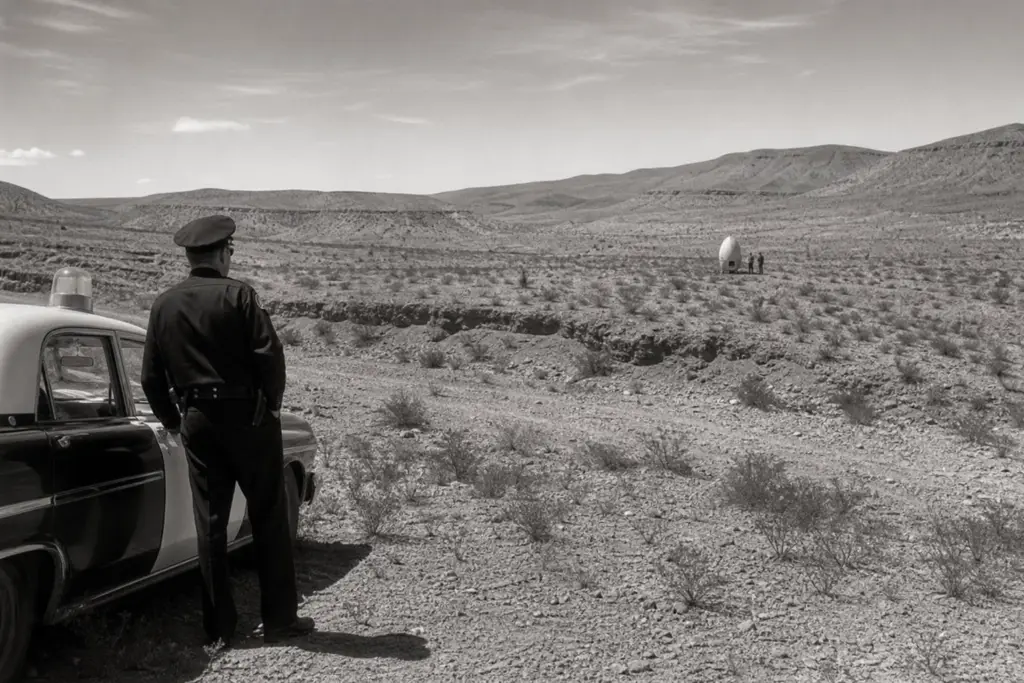
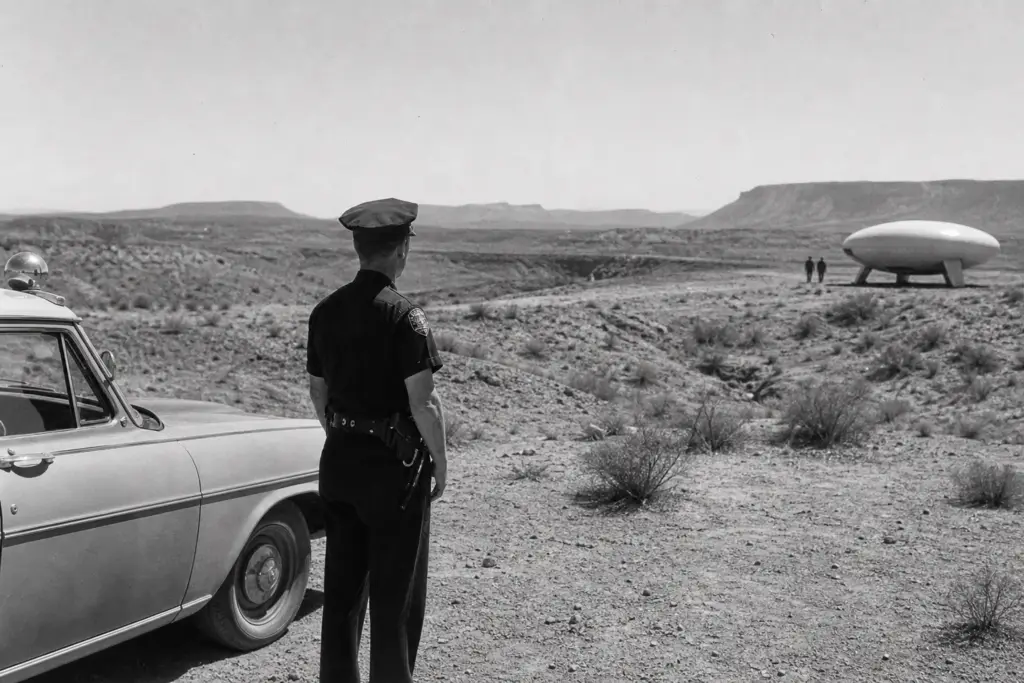
As he approached on a rough road, Zamora said he saw a light-colored object on the ground and two small, humanlike figures nearby. His attention initially went to the figures, which he seems to have interpreted as people in need of assistance. He then described the object as having an oval or egg-like form rather than the recognizable outline of a car, helicopter, or ordinary aircraft. This is testimony: it records what he perceived during a brief, stressful encounter, not an independently established description of an object or its occupants.
Zamora reported that the figures moved out of view as he drew nearer. He then heard the loud sound again, saw flame or exhaust beneath or behind the object, and watched it rise and depart at speed. In early tellings, the core sequence is stable: pursuit, roar, approach to the arroyo, apparent object and figures, then a rapid departure. Later accounts differ more on such particulars as exact distances, the figures’ appearance, the direction of travel, and how long each phase lasted. Those differences matter because a reconstruction should retain the shared elements of Lonnie Zamora testimony without turning later embellishment into a contemporaneous observation.
The Reported Egg-Shaped Craft and Its Marking
Zamora’s description of the object combined several details that became inseparable from the case: an oval, light-colored body; a smooth, metallic-looking surface; and supports beneath it that he compared with landing gear. He estimated the object at roughly car-sized, though such dimensions were necessarily judged across uneven ground during a short and alarming encounter. “Egg-shaped” is therefore a useful shorthand for the reported outline, not a measured engineering description of a craft.
In his early accounts, Zamora also associated the object’s departure with a very loud roar and a flame or exhaust-like effect. Those features matter because they distinguish his reported Zamora egg-shaped craft from a silent distant light or an ordinary aerial misidentification. They do not, however, establish a propulsion system: he observed sound, brightness, apparent flame, motion, and a rapidly changing viewing angle, not machinery that investigators could identify.
The most debated visual detail is the red insignia Zamora said he saw on the side. Case records and later reproductions have rendered the marking differently, often as a curved or arrow-like geometric emblem. A drawing records a witness’s attempt to reproduce a brief visual impression; it is not a recovered logo, and small differences in copies should not be treated as evidence of multiple objects or a concealed design.
These particulars give the Socorro report unusual specificity, but specificity is not independent confirmation. No authenticated photograph shows the object in place, and no verified recovered material established its color, dimensions, supports, marking, or origin. The appearance remains Zamora’s reported observation of an unidentified aerial phenomenon, to be weighed alongside, but not replaced by, the later site investigation.
The Two Apparent Figures: What Was Reported, and What Was Not Established
The figures were a fleeting part of Zamora’s view, not a sustained close-range observation. In his early account, he described seeing two small, humanlike forms near the object before they disappeared from sight as he approached over uneven arroyo terrain. He did not provide a reliable basis for identifying faces, sex, age, or other personal characteristics.
That distinction is central to the Lonnie Zamora Socorro sighting. “Two small figures” preserves what the officer reported visually; “occupants” would add an unproven relationship between the forms and the object. The report did not independently establish whether they were people, what they wore, where they came from, or whether they entered, exited, or controlled the object.
Distance, brief duration, shifting sightlines, and the urgency of the encounter limit how much descriptive weight the observation can bear. A witness may accurately report seeing apparent figures while remaining unable to determine their identity. No separate witness, photograph, recovered clothing, biological evidence, or other independent record established that the figures were non-human intelligence, or established any identity at all.
Landing Impressions, Burned Vegetation, and Other Physical-Trace Claims
The site evidence is more limited than a recovered object, yet it is the part of the episode that moved beyond a single visual report. Accounts of the scene describe ground marks interpreted as landing impressions, disturbed soil around them, and vegetation characterized as scorched or burned. Such observations can support the narrower point that people examining the location found and recorded unusual-looking features after Zamora’s report; they do not, by themselves, establish what made them.
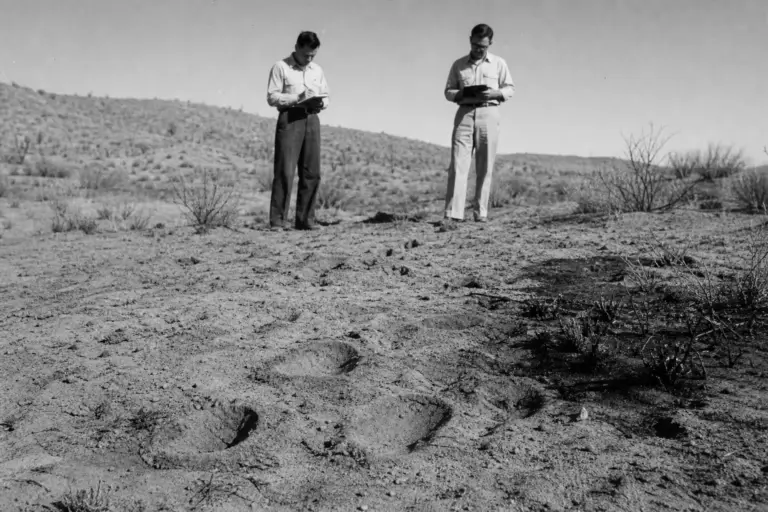
That distinction turns on diagnostic value. A clearly measured impression can preserve its shape, spacing, depth, and relation to nearby terrain. Photographs can show that a mark existed when investigators arrived. Neither measure identifies a cause unless the mark contains distinctive, testable characteristics that exclude ordinary vehicles, people, animals, erosion, prior activity, or damage produced during the response itself. “Landing impressions” is therefore a descriptive interpretation, not a demonstrated finding that a craft touched down.
Burned vegetation presents a similar problem. Darkened plants or soil may be consistent with heat, flame, crushing, or other disturbance, but appearance alone cannot distinguish among those mechanisms. Useful testing would require documented sampling locations, collection dates, contamination controls, secure custody, laboratory methods, and retained results that another analyst could evaluate.
The surviving physical-trace claims are consequently corroborative only in a modest sense: they indicate that investigators had a specific scene to inspect and features to record. No authenticated material, securely preserved sample series, or repeatable forensic analysis is available here to connect the Socorro UFO landing traces conclusively to the reported egg-shaped object, or to identify a terrestrial or extraterrestrial source.
How the Air Force and Project Blue Book Investigated the Report
The response did not end with the first inspection of the arroyo. Zamora notified local authorities soon after the event, and the report moved through military channels to the Air Force’s Project Blue Book, the program then responsible for collecting and assessing reports of unidentified aerial phenomena. That pathway mattered because it produced interviews, site observations, and a case file rather than leaving the account solely as a later recollection.
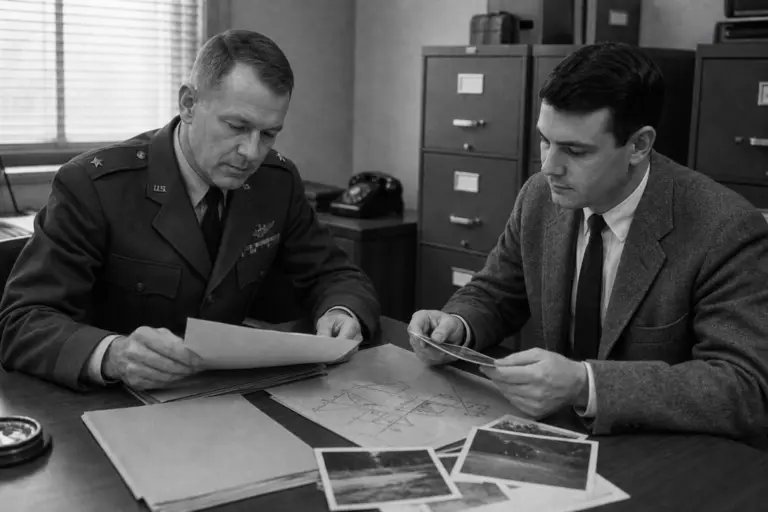
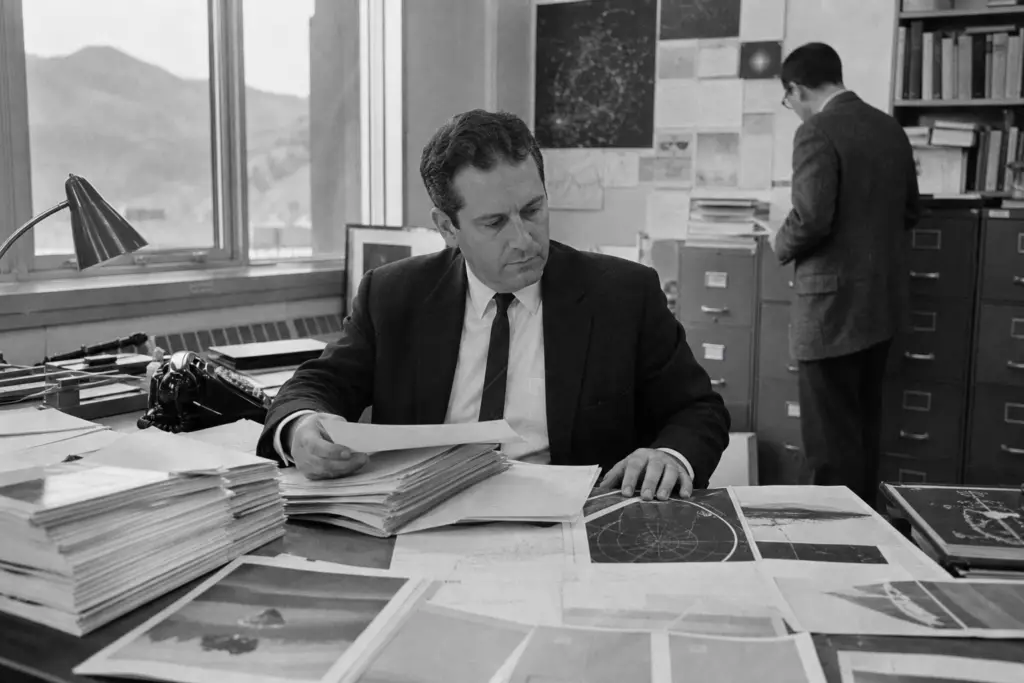
J. Allen Hynek, Project Blue Book’s scientific consultant, took an active interest in the Socorro report and visited the area during the inquiry. His role was evaluative rather than dispositive: he could assess whether a proposed explanation fit the witness account and available observations, but he could not turn incomplete traces or a brief visual encounter into a determined origin. The official investigation therefore had to separate Zamora’s reported object and apparent figures from what personnel could independently observe after the departure.
Project Blue Book Socorro records ultimately retained the incident as unidentified. In that classification, “unidentified” means investigators lacked enough reliable information to assign a confident conventional explanation; it does not mean the Air Force established an extraterrestrial craft, nonhuman occupants, or advanced secret technology. A strong identification would connect the report to a specific known object or event and account for its central features. The available record did not do that.
Later allegations that the case was suppressed or that decisive evidence was withheld should be kept distinct from the documented official investigation. The existence of surviving Project Blue Book material and recorded follow-up shows that the report was handled, but neither the file nor its unresolved label supplies proof for a cover-up claim.
Possible Explanations and the Limits of the Evidence
A misidentification hypothesis must explain more than an unusual light or distant aircraft: it must fit Zamora’s reported ground-level oval object, the brief appearance of two figures, the roar and apparent exhaust, the rapid departure, and the features later noted at the site. It can account for some perception errors under stressful, fast-moving conditions, but becomes weak if it relies on a different event for each reported element.
Secret or experimental activity offers a similarly partial possibility. It could, in principle, explain an unfamiliar machine, personnel nearby, and noise; it does not become persuasive without evidence linking a specific operation to Socorro at the relevant time and showing why its reported appearance and traces match. A hoax likewise needs a workable mechanism: people, props, and marks could imitate parts of the episode, but the proposal must account for the prompt report and the absence of demonstrated planning, rather than merely asserting motive.
The remaining category, an unknown event, is a record-keeping conclusion: available information does not securely distinguish among explanations. Later speculation may elaborate the story, but it cannot substitute for contemporaneous evidence. The Lonnie Zamora Socorro sighting remains compelling and unresolved; it does not prove extraterrestrial visitation, alien disclosure, or non-human intelligence.
Why the Socorro Sighting Remains Unresolved
The evidentiary value of the case lies in its layers rather than in any one detail. Zamora provided a contemporaneous personal account of an oval object, apparent figures, noise, and departure; people who visited the location recorded marks and altered vegetation; and Project Blue Book created an official investigative record. Those layers reinforce that a report was made, a scene was examined, and the event received serious attention. They do not convert the reported appearance, occupants, or mechanism into independently established facts.
The crucial missing link is diagnostic evidence: material that could identify what produced the impressions, account for the disturbed ground, or establish the nature of the object beyond eyewitness perception. The traces were compatible with an unusual event at the site, but they were not exclusive to a particular cause. Nor did the investigation produce a confirmed vehicle, operation, participants, photograph, or physical sample that could settle competing explanations.
That is why the Socorro incident occupies an unusual historical position among documented UAP cases that remain unresolved. It is stronger than a bare, retrospective tale because its principal witness was identified, his report was prompt, and officials followed up. Yet an unidentified finding records an evidentiary limit, not an extraordinary conclusion. The case remains notable because it was documented seriously and still resists a decisive explanation, not because extraterrestrial visitation has been established.
Frequently Asked Questions
What did Officer Lonnie Zamora report seeing in Socorro in 1964?
On April 24, 1964, Socorro police officer Lonnie Zamora reported seeing a light-colored, oval or egg-shaped object on the ground outside Socorro, New Mexico. He also reported two small humanlike figures nearby, a loud roar, an apparent flame or exhaust effect, and the object’s rapid departure.
What was the egg-shaped craft in the Socorro UFO incident?
Zamora described a roughly car-sized, light-colored object with an oval or egg-like form, a smooth metallic-looking surface, and supports resembling landing gear. He also reported a red curved or arrow-like marking, but no authenticated photograph or recovered material verified its dimensions, design, or origin.
Did investigators find physical evidence at the Socorro sighting location?
Investigators recorded ground marks described as landing impressions, disturbed soil, and vegetation characterized as scorched or burned. These observations confirmed that a specific site was examined, but no preserved samples or forensic analysis conclusively identified what caused the marks or vegetation damage.
What did Project Blue Book conclude about the Lonnie Zamora case?
Project Blue Book retained the Socorro incident as unidentified after receiving reports, conducting interviews, and examining the site. The classification meant there was not enough reliable information for a confident conventional explanation, not that the Air Force confirmed an extraterrestrial craft or nonhuman occupants.
What evidence would be needed to determine what happened in the Socorro UFO sighting?
A persuasive explanation would need to account for Zamora’s reported ground-level object, two apparent figures, loud roar, apparent exhaust, rapid departure, and the recorded site features together. Stronger evidence would include authenticated material, documented samples with secure custody, repeatable laboratory analysis, or records linking a specific vehicle, operation, or hoax to Socorro on April 24, 1964.