On April 24, 1964, Socorro police officer Lonnie Zamora radioed in an unusual encounter on rough ground just outside Socorro, New Mexico. He described seeing a white, egg-shaped object near an arroyo and two small figures beside it before the object departed. The Lonnie Zamora Socorro sighting has endured not because its most dramatic interpretation was established, but because the report was prompt, detailed, and followed by an official examination of the location.
That distinction matters. Zamora’s own account is testimony: it records what he believed he saw during a brief, stressful sequence of events. Marks and other conditions noted at the scene are physical observations, not an automatic identification of their cause. Project Blue Book’s involvement documents an Air Force inquiry and an unresolved case file; it does not convert the event into proof of an extraterrestrial craft.
This account follows those categories in order. It separates the officer’s reported observations from what investigators recorded on the ground, identifies where later retellings add uncertainty, and weighs proposed explanations by how well they fit the available record. The result is a factual reconstruction of a remarkable report whose ultimate explanation remains unsettled.
Why Officer Lonnie Zamora’s Socorro Report Remains Important
The case’s historical weight rests largely on its evidentiary sequence. Zamora was a serving Socorro police officer acting in the course of his duties when he made his report on April 24, 1964. His account entered official channels quickly, bringing local authorities and Air Force personnel to a specific area outside town rather than leaving only a retrospective story with no identifiable scene.
That sequence gives the Officer Lonnie Zamora UFO sighting a stronger record than a report reconstructed long afterward: his personal description, the location investigators examined, and the administrative response can be compared without treating them as the same kind of evidence. Zamora’s description of an unusual oval object and two figures is testimony; conditions recorded at the site are separately observed facts; later explanations are interpretations tested against both.
Project Blue Book did not reach a confirmed conventional identification in the available record, which is why the Socorro UFO incident of 1964 remains widely discussed. “Unexplained,” however, describes the limits of the investigation, not a demonstrated extraterrestrial cause. The durable question is therefore narrower and more useful: how well can any proposed explanation account for the prompt report, the setting, and the subsequent inquiry?
What Zamora Reported Near the Socorro Arroyo
Zamora’s own account begins with ordinary police work: he was pursuing a speeding car through Socorro on the afternoon of April 24, 1964, when he noticed a bright flame or smoky-looking discharge in the sky to the southwest. He initially interpreted it as a possible explosion, perhaps near the dynamite storage area outside town, and broke off the pursuit to investigate. That change of course matters because the unusual observation was not the reason he had first been driving in the area.
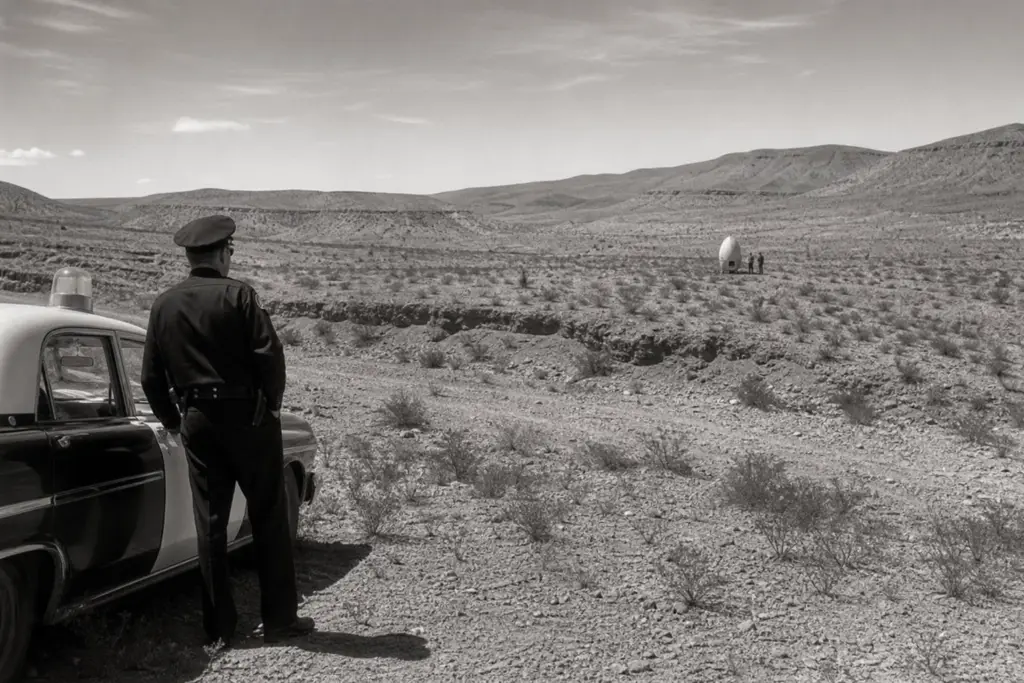
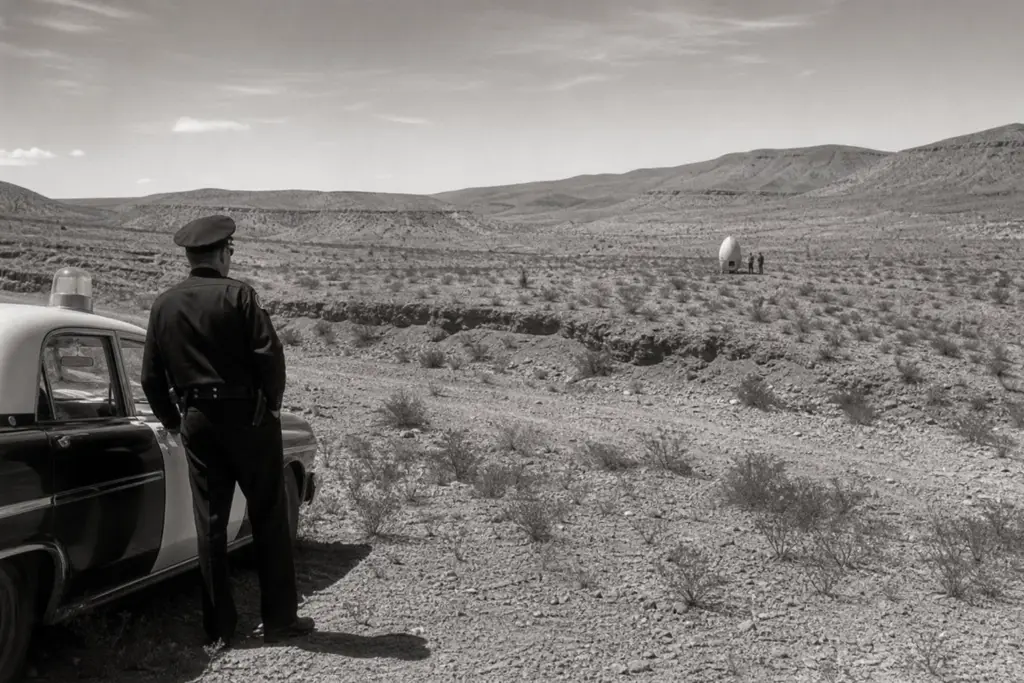
He headed toward rough ground south and southwest of Socorro, where a dirt track led toward an arroyo and low, broken hills. In his early statements, Zamora described seeing what he first took to be an overturned car and two figures nearby. As he approached, the terrain repeatedly interrupted his view: the object sat below or beyond a rise, and the arroyo’s uneven ground made its scale, distance, and orientation difficult to judge from the road. Only after moving closer did he describe the object as a white, oval or egg-shaped craft rather than a vehicle.
The radio report belongs to the core chronology, not to later embellishment. Zamora notified dispatch while investigating what he believed could be an accident or emergency outside town, creating a near-contemporaneous official record of his location and concern. The 1964 Socorro UFO sighting therefore did not begin as a polished story assembled after the fact; it developed from an officer’s changing interpretation of something glimpsed across difficult terrain.
Later retellings often supply sharper details, exact driving speeds, extended dialogue, a fixed number of seconds for each stage, or highly specific reactions by the figures. Those additions should be treated cautiously unless they can be traced back to Zamora’s early police and Air Force interviews. The firmer sequence is narrower: a speeding-car pursuit, an apparent flame or smoke, a detour toward the arroyo, a closer view of an anomalous object and figures, and a prompt call for assistance.
The Egg-Shaped Craft, Two Figures, and Reported Marking
The object’s appearance is clearest when kept close to Zamora’s own early description. He reported a white, oval or egg-shaped form on the ground, rather than a conventional airplane, helicopter, or automobile. He also described what appeared to be supporting legs or landing gear beneath it. Those features account for the familiar image of the Socorro egg-shaped craft, but they were observations made during a brief, stressful encounter across uneven ground, not measurements of an object preserved for later inspection.
Zamora initially noticed two small figures near the object. At first he reportedly interpreted them in ordinary terms, as people beside what might have been a disabled vehicle. Their visibility was limited by distance, terrain, and the short interval before his attention returned to the object and its departure. The contemporaneous account supports that he saw two humanlike figures near the site; it does not establish who they were, what they wore, or whether they were occupants of the object. Calling them “aliens” therefore adds a conclusion that Zamora’s observation alone cannot supply.
One of the most repeated details in the Zamora UFO case is a dark marking on the side of the white object. Zamora later made a simple sketch for investigators. Its value lies in provenance: it records the officer’s attempt, soon after the event, to show a feature he believed he had seen. Its limitation is equally important. A hand-drawn recollection is not a photograph, and the mark’s exact geometry, orientation, and meaning cannot be recovered with certainty from later redrawn versions.
The departure sequence belongs in the same evidentiary category as the shape and marking: reported perception, not independently captured instrumentation. Zamora described sound, dust, and a flame or exhaust-like effect as the object rose and moved away. These details help reconstruct what he believed he witnessed, while leaving open whether distance, angle, noise, and the abruptness of the event affected how each feature appeared.
Landing Traces and the Air Force Investigation
The ground evidence gave investigators a place to examine, but not an object to identify. Site records associated with the Socorro investigation describe disturbed areas consistent with impressions or depressions in the soil, along with marks in the vicinity and reported effects on nearby vegetation. Photographs and diagrams matter because they preserve the investigators’ layout of the scene rather than relying entirely on later memory.
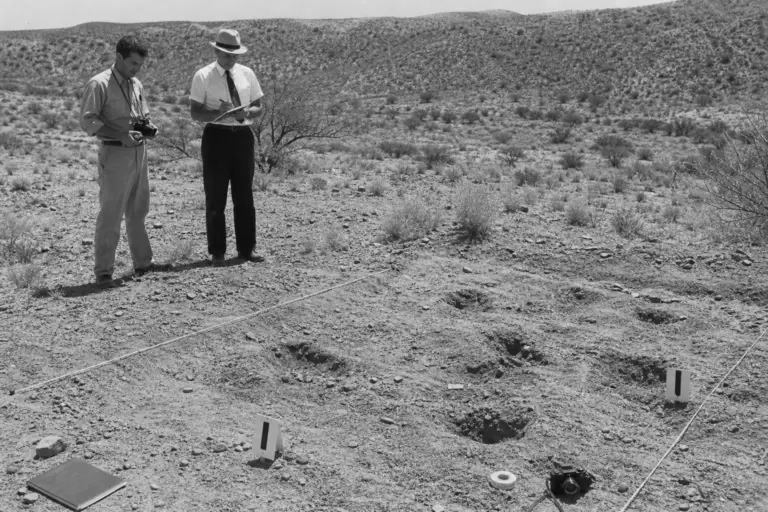
Those traces are supporting evidence of a reported event at a particular location, not a physical signature capable by itself of proving what made them. A depression can be measured for position, spacing, depth, and shape; it cannot, without a known comparison source, establish the make or origin of the thing that produced it. Likewise, scorched or damaged vegetation, if present, may be consistent with heat, exhaust, fire, or other disturbance, but it does not independently confirm Zamora’s description of the object, its occupants, or its departure.
Local authorities were involved promptly because the report originated with a police officer on duty. Air Force personnel subsequently gathered statements and examined the location as part of the Project Blue Book Socorro incident inquiry. That sequence is significant: the case file could compare an early witness account with a specific physical setting and investigator observations. It does not turn every later-repeated detail into a contemporaneously verified fact.
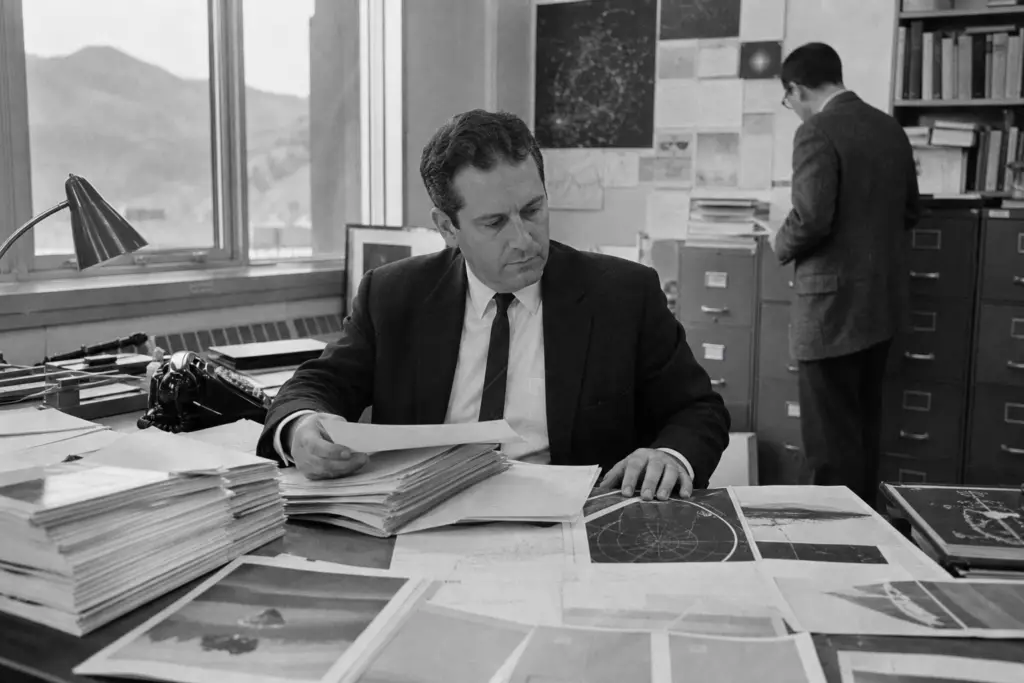
J. Allen Hynek, Project Blue Book’s scientific consultant, took an interest in the case, reflecting its unusual combination of a named law-enforcement witness, a promptly identified site, and reported traces. His interest should not be mistaken for certification of an extraordinary explanation. A scientific adviser’s attention means that a report merited scrutiny; it does not supply missing measurements, samples, or an identified craft.
The official distinction is central. An investigation that fails to assign a report to a known aircraft, vehicle, hoax, astronomical object, or other conventional category records an unresolved identification. An extraterrestrial conclusion would require affirmative evidence tying the object to a nonhuman origin. The surviving account of the Lonnie Zamora Socorro sighting supports the first proposition, an investigation without a settled conventional answer, not the second.
Could the Socorro Sighting Be Explained?
Competing explanations should be judged by their complete fit, rather than by whether any one detail seems familiar. A military or experimental-activity hypothesis proposes that Zamora encountered a test article, aircraft, or support operation connected in some way to the region’s defense and research activity. The nearby White Sands Missile Range makes that possibility worth considering, but proximity is only a starting point. A strong version would need a dated operational record and a vehicle capable of accounting together for the reported ground-level object, apparent figures, rapid departure, and marks at the location.
No such identifying record is established in the material considered here. A generic reference to secret testing therefore explains less than it appears to: it supplies a possible category, not a demonstrated object or operation. The same limitation applies to proposals involving an unusual helicopter, experimental aircraft, or ground vehicle. Such a vehicle might account for noise, dust, exhaust-like effects, or disturbed ground, but it must also fit the arroyo terrain and the visual details Zamora reported without requiring unsupported additions.
A hoax is a different claim. It requires evidence that someone deliberately staged the scene or misled Zamora, such as identified participants, a plausible constructed object, preparation of the marks, or a contemporaneous admission. Suspicion based solely on the unusual nature of the report is weak evidence, particularly when the report was made during an officer’s duty period and brought investigators to a location quickly. The available record does not turn that circumstance into proof of sincerity, but neither does it supply a documented staging mechanism.
Perceptual distortion offers the most modest explanation: distance, uneven ground, urgency, glare, dust, and a short viewing interval can alter estimates of shape, size, motion, and identity. It is especially relevant to the reported figures and marking. Yet distortion alone does not identify what was actually present or explain the site observations. For the Lonnie Zamora Socorro sighting, each proposal remains an interpretive possibility unless it connects the timeline, terrain, testimony, and physical scene with affirmative evidence.
What the Socorro Record Supports, and What It Does Not
A useful checkpoint is to separate what the record preserves from what it cannot identify. It preserves Zamora’s prompt account of an unusual observation near Socorro, followed by a timely response that examined a specific location. His description establishes what he believed he saw, including an oval form and two figures. It does not independently establish the identity, construction, or origin of either.
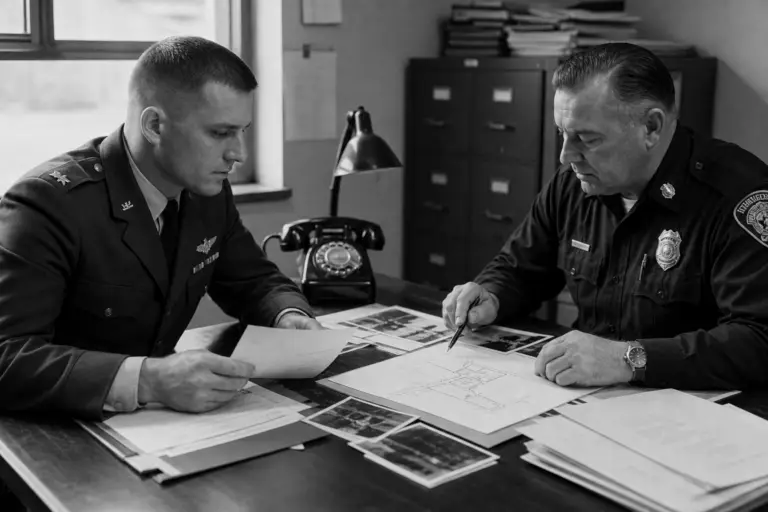
The site examination corroborates place and timing, not a solution. Marks and disturbed ground show that investigators found features worth recording; without a uniquely identifying physical sample or a demonstrated mechanism, they cannot determine what produced them. Likewise, the figures remain observations from a brief encounter, not identified occupants. Project Blue Book’s unresolved handling means the available official record did not securely assign the event to a known cause; it is not affirmative evidence of an extraterrestrial cause.
That distinction remains useful amid modern discussion of UFO disclosure and UAP disclosure. Historical cases are most informative when testimony, contemporaneous investigation, and later interpretation remain separate. The Lonnie Zamora Socorro sighting merits attention because those layers survive for comparison, even though the central identity question remains open.
A Well-Documented Report, Not a Settled Explanation
A useful final test is whether each surviving record answers the same question. Zamora’s near-contemporaneous account preserves what he perceived near Socorro; the site examination preserves investigators’ mapping of physical features at a defined location; and the official case file preserves that authorities treated the report as requiring assessment. These are mutually relevant records, but they do different work. Neither witness testimony nor ground marks can replace the missing object, a diagnostic sample, or an independently recorded image.
That limitation also sets the standard for later explanations. A persuasive account must address the timing, terrain, reported departure, and scene findings together, rather than matching one feature or invoking New Mexico activity in general. Conversely, an explanation that falls short does not turn the report into proof of extraterrestrial visitors. The case endures because its documentation permits careful comparison while leaving the central identity question unanswered.
Frequently Asked Questions
What did Officer Lonnie Zamora report seeing near Socorro in 1964?
On April 24, 1964, Socorro police officer Lonnie Zamora reported seeing a white oval or egg-shaped object on rough ground near an arroyo outside Socorro, New Mexico. He also reported two small humanlike figures beside it before the object rose and departed.
What symbol did Zamora report seeing on the egg-shaped craft?
Zamora reported seeing a dark marking on the side of the white object and made a simple sketch for investigators soon after the event. The surviving sketch records his recollection, but its exact geometry, orientation, and meaning are not certain.
Were there physical traces at the Lonnie Zamora sighting site?
Investigators documented disturbed ground, impressions or depressions in the soil, nearby marks, and reported effects on vegetation at the Socorro site. These features supported that something had disturbed the location, but they did not identify what produced them.
Did Project Blue Book explain the Socorro UFO case?
Project Blue Book investigated the Socorro report after local authorities and Air Force personnel examined the site. The available record did not establish a confirmed conventional identification, leaving the case unresolved rather than explained.
What should an explanation for the Socorro UFO sighting account for?
A credible explanation must fit Zamora’s prompt report, the April 24, 1964 timeline, the rough arroyo terrain, the reported object and figures, the departure effects, and the ground traces. A claim based only on nearby military activity, a possible hoax, or perceptual error does not fully resolve the case without affirmative evidence connecting those details.