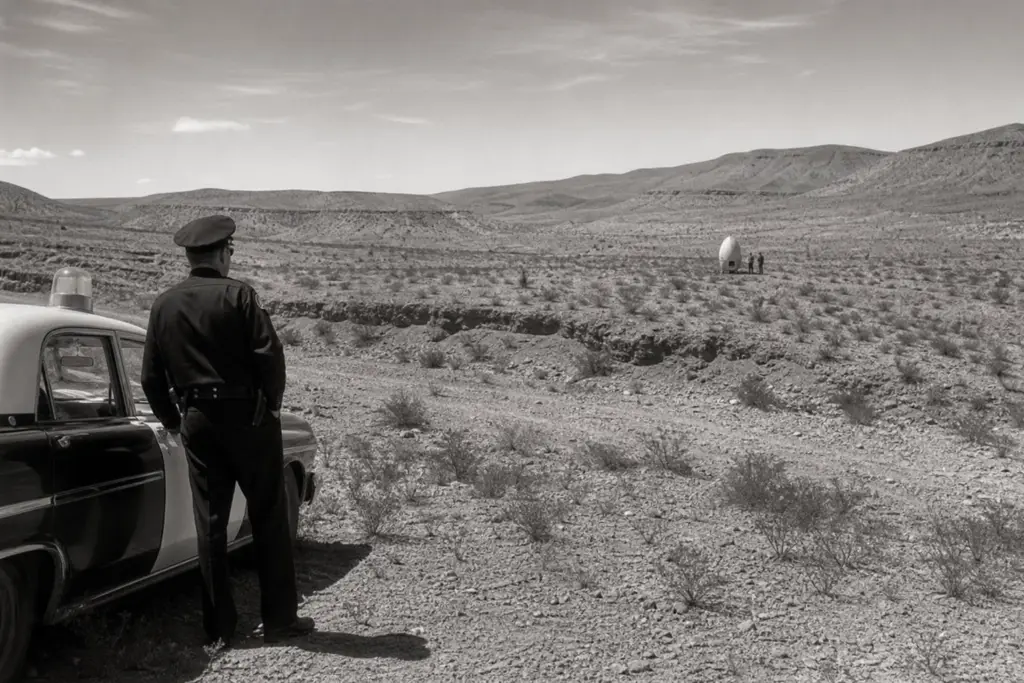
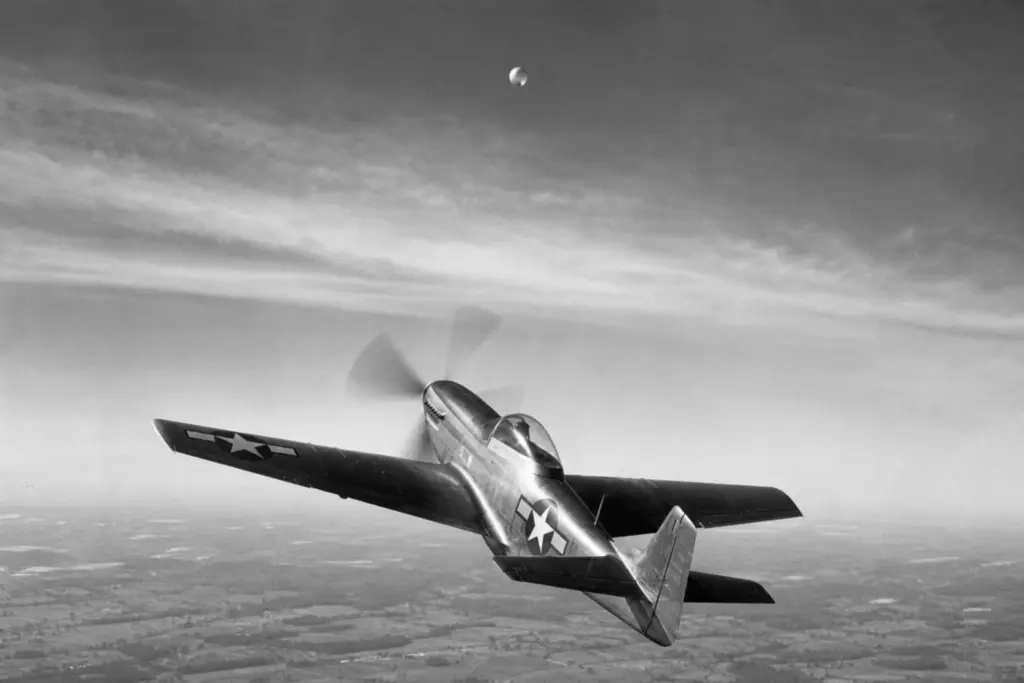
On January 7, 1948, a routine response to reports of an unidentified object near Fort Knox and Godman Air Force Base ended with a Kentucky Air National Guard pilot dead in the wreckage of his P-51 Mustang. Captain Thomas F. Mantell Jr. had climbed in pursuit of something observers could see but could not identify; he did not return.
The Mantell UFO incident is extraordinary not because it supplies proof of an extraordinary craft, but because the basic tragedy is firmly documented while the object’s identity has remained a subject of reconstruction and debate. Mantell’s fatal crash occurred during the pursuit. That sequence does not, by itself, establish that the object caused the crash, or that it was beyond conventional explanation.
This account separates the contemporaneous sighting reports, flight orders, and crash evidence from interpretations that accumulated afterward. It follows the early investigation, including the hypothesis that Mantell lost consciousness from oxygen deprivation at high altitude, and explains why a Navy Skyhook research balloon later became the leading identification for the object. It also distinguishes a leading explanation from a perfectly preserved solution: gaps and conflicting details in a 1948 record leave room for careful uncertainty.
For early UFO history, the case endures because public alarm, military response, aviation risk, and official explanation converged in one fatal afternoon over Kentucky. Its lesson begins with a precise distinction: unidentified at the time did not mean unexplainable forever, yet a later explanation must still be weighed against the surviving evidence.
The Mantell Incident: A Fatal Pursuit During America’s Early UFO Era
The decisive fact is the flight’s outcome: Captain Thomas F. Mantell Jr., an officer of the 165th Fighter Squadron, was killed after his P-51 Mustang crashed near Franklin, Kentucky, on the afternoon of January 7, 1948. He had been directed to investigate a conspicuous object reported in the Fort Knox area.
“Unidentified” is important but limited language. It records that observers and military personnel could not then assign the object a reliable identity; it does not establish an extraterrestrial, non-human, or hostile origin. The January 7, 1948 UFO incident therefore begins with a real sighting report and a real intercept effort, not with a demonstrated conclusion about what was in the sky.
Mantell climbed after the object while other pilots broke off. The documented sequence supports a fatal crash during the pursuit, but it does not show that the object physically brought down the P-51.
The record must be read in layers: what ground and air witnesses reported, what commanders assumed in real time, what crash investigators inferred about the flight, and why a high-altitude Skyhook balloon later became the leading explanation for the object.
What Witnesses Reported Near Fort Knox and Godman Air Force Base
Shortly after 1:45 p.m. on January 7, personnel at Fort Knox and civilians in the surrounding area began reporting a bright object in the afternoon sky. Descriptions preserved in the early case record were not uniform: some ground witnesses called it white or silvery, others saw a reddish edge or glow; its outline was variously described as circular, cone-like, or resembling a parachute. Estimates that it was 200 to 300 feet across reflected visual impressions rather than instrument measurements.
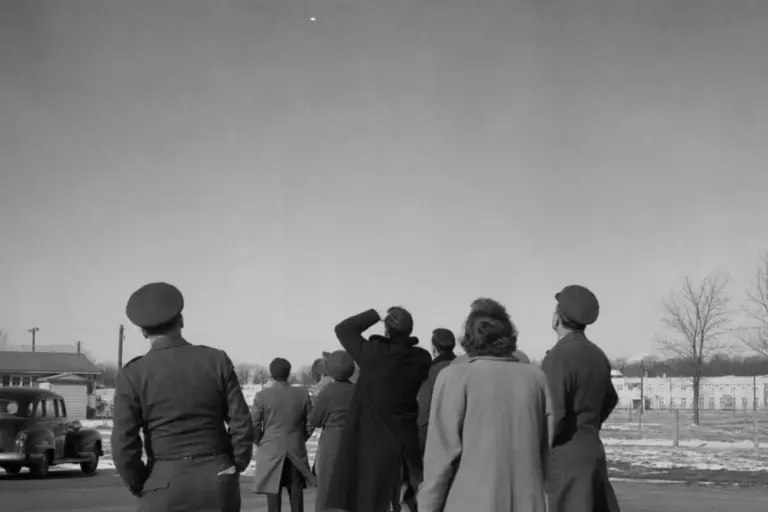
Personnel in the control tower at the nearby Army airfield also watched the object for an extended period. Their concern was practical: an aerial object conspicuous enough to be seen from the ground near a major military installation could be an aircraft, a balloon, or another object requiring identification. They did not have a confirmed altitude, range, course, or origin. A report that appeared stationary could equally reflect an object at great distance or one moving in a way observers could not resolve from the ground.
A four-plane flight of P-51 Mustangs from the Kentucky Air National Guard’s 165th Fighter Squadron was returning from a training flight when it was asked to investigate. Mantell’s formation turned toward the reported object and climbed. The pilots’ airborne accounts likewise varied from the ground reports: they could see a pale object ahead and above them, but could not identify its shape or establish a reliable distance. To an interceptor crew, “above” was an operational problem, it meant further climbing, not proof of an exceptional altitude or speed.
That limited information explains the response in this Kentucky UFO incident of 1948. In the immediate postwar flying-saucer climate, commanders had reason to take an unrecognized object near Fort Knox seriously without claiming it was hostile. The sighting prompted an intercept because it was sustained, visible to multiple observers, and unresolved, not because personnel had determined what the object was.
Why Captain Thomas F. Mantell Jr. Pursued the Object, and How the Flight Ended
The intercept became a climb because the pilots judged the object to be above them and still receding upward. Captain Thomas F. Mantell Jr. led the formation toward it, relaying that he could see a large object ahead; the practical aim was identification, not an attack. A military pilot closing on an unknown visual target must gain altitude until its shape, direction, and relation to the aircraft can be judged, but that choice also reduced the margin for error in an aircraft operating near the limits of its high-altitude support equipment.
The P-51 Mustang was a powerful wartime fighter, but sustained flight at high altitude depended on a functioning oxygen supply and a pilot remaining physiologically capable. As the formation climbed, the accompanying pilots discontinued the pursuit. Their reported reasons and the heights at which they turned back vary among later accounts, but the underlying sequence is consistent: Mantell continued upward while the other aircraft descended or returned.
That distinction matters. The surviving history supports a high-altitude pursuit followed by Mantell’s isolation from the formation; it does not support treating every oft-repeated radio quotation as a verbatim transcript. Reports that he described the object in particular terms, and estimates that place him at one precise altitude or another, come through recollection and later retelling. The more secure facts are that radio contact with Mantell was lost and that he did not return to base.
Mantell’s aircraft subsequently crashed near Franklin, Kentucky, killing him. The Thomas Mantell crash occurred after the ascent, but the record does not establish that the object struck the P-51 or caused a mechanical failure. The investigation would instead focus on the hazards created by altitude, especially the possibility that inadequate oxygen left the pilot unable to control the aircraft, and on the separate question of what the pilots and observers had been trying to reach.
The Early Investigation: Hypoxia, Uncertainty, and the Venus Theory
The crash inquiry separated two questions that public discussion often fused: why Mantell’s P-51 fell, and what had drawn the flight upward. For the first, physiological incapacitation became the central explanation. At altitude, reduced oxygen pressure can produce hypoxia, a shortage of oxygen reaching the brain that impairs judgment, coordination, vision, and consciousness before a pilot necessarily recognizes the danger.
That mechanism fit the broad sequence. Mantell continued climbing after the other pilots abandoned the intercept, then ceased communicating and crashed without evidence that the unknown object had collided with his aircraft. The relevant issue was not simply whether a P-51 carried an oxygen system, but whether oxygen was available, operating, and being used effectively during a sustained high climb. An oxygen-equipped aircraft offered protection only while its equipment and mask were functioning and the pilot could use them. The early Air Force investigation therefore treated loss of consciousness from inadequate oxygen as the most plausible account of Mantell’s loss of control, while leaving the object’s identity unresolved.
Investigators also considered Venus. The planet can be exceptionally bright and, under the right viewing conditions, can be mistaken for an unidentified flying object by observers lacking a stable reference for distance or motion. Its appearance in the relevant portion of the sky made it an understandable early proposal, especially when reports described a bright, high object.
But Venus could not neatly account for the full record: multiple witnesses described a large, structured-looking object, and pilots pursued something they believed was changing position relative to them. Later reviewers therefore regarded the Venus idea as, at most, a possible contributor to some observations, not a satisfactory identification for the entire January 7 sighting. The Mantell UFO incident thus entered the record with a comparatively strong crash explanation and a still unsettled explanation for the target.
The Skyhook Balloon Explanation: Why It Became the Leading Account
A different candidate emerged as later researchers connected the January 7, 1948 sighting with the Navy’s high-altitude balloon work. A Skyhook balloon was not an ordinary small weather balloon: it was a large research platform designed to lift instruments into the upper atmosphere, where its altitude could put it beyond easy recognition from the ground or from a fighter climbing beneath it.
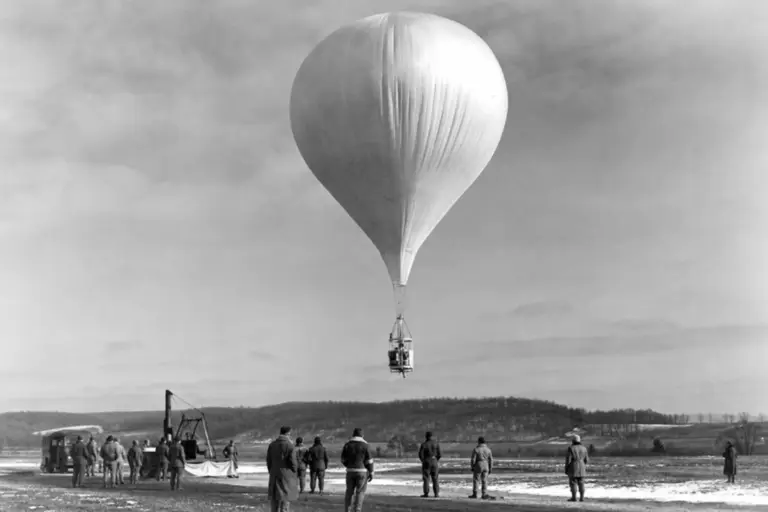
That matters because a sunlit balloon and its suspended equipment could present as a bright, pale, unusually large object with an uncertain shape. At long range, observers had no reliable way to calculate its size or distance; an object drifting with upper winds could also appear to climb, hover, or change direction as the viewer’s own position changed. Those characteristics fit more of the reported visual record than Venus did, without requiring the object to have performed extraordinary maneuvers.
The Navy Skyhook program also helps explain why an immediate identification was difficult. High-altitude research flights were not necessarily known to local Air Force personnel, and some balloon activity involved limited-distribution or security-sensitive work. A balloon could therefore be both conventional in origin and genuinely unidentified to the officers directing Mantell’s intercept that afternoon.
The match remains a later reconstruction rather than a conclusive chain of identification. Accounts linking a Skyhook balloon to the sighting depend on imperfect launch, tracking, and timing records, while witness descriptions were inconsistent and do not establish a unique balloon profile. Still, the explanation became the leading conventional account because it offers a plausible physical target at the relevant altitude and explains its brightness, ambiguous form, and apparent motion. It does not alter the separate finding that Mantell died after his P-51’s high-altitude pursuit ended in a crash.
What the Evidence Establishes, and What Remains Uncertain
The key checkpoint is the boundary between a documented flight sequence and estimates made from a distant visual target. The record supports reports of an object, a military intercept, Captain Thomas F. Mantell Jr.’s high-altitude P-51 ascent, and his fatal crash near Franklin, Kentucky. Hypoxia is the leading crash explanation because it accounts for likely pilot incapacitation during the ascent; it does not demonstrate a collision or other direct action by the object.
- Well supported: the pursuit was a real military response to a real-time unidentified sighting, and Mantell’s fatal flight followed that response.
- Reasonably inferred: oxygen deprivation impaired Mantell as altitude increased, leaving the aircraft without effective control.
- Unresolved: the object’s exact height, range, size, color, and form. Ground observers and climbing pilots had no instrument-based measurement of those variables.
- Incomplete: the exact wording and sequence of every radio transmission, and whether each reported observation can be tied to one particular Skyhook balloon flight.
Classified or limited-distribution balloon work and gaps in surviving records can explain why immediate identification was difficult; they do not, by themselves, establish a government UFO cover-up or concealed extraterrestrial contact. That distinction matters when UFO news or UAP news treats an incomplete historical file as proof of a hidden conclusion.
Why the Mantell Incident Still Matters in UFO History
Its public impact reached well beyond Kentucky. Coming months after the first “flying saucer” reports of 1947, the Mantell UFO incident gave the new subject a stark human consequence: an Air National Guard officer had died during an attempt to identify an aerial object. Newspaper attention helped fix the episode in the public imagination as an early test of whether authorities understood what was in the sky.
The institutional chronology matters. Project Sign handled the Air Force’s first organized UFO inquiries; Project Grudge followed, and Project Blue Book later inherited the broader subject. Treating Blue Book as the original Mantell investigation blurs how quickly official thinking changed. For present-day UFO disclosure and UAP disclosure debates, the case offers a durable standard: distinguish contemporaneous observations from later reconstructions, preserve records that permit review, and weigh a plausible explanation without converting uncertainty into proof of an extraordinary cause.
The Enduring Lesson of the Mantell Incident
The clearest checkpoint is to separate the crash sequence from the object’s eventual identification. On January 7, 1948, Captain Thomas F. Mantell Jr. died when his P-51 crashed after climbing to investigate the reported object. The ascent placed him in conditions where hypoxia was a serious and plausible danger; it does not demonstrate that the object attacked, struck, or mechanically disabled his aircraft.
The object deserves a similarly careful description. A Navy Skyhook balloon is the leading conventional explanation because its size, altitude, appearance, and limited contemporary visibility could fit important parts of the reports. Yet it is a reconstruction assembled after the event, not an indisputable identification supported by a complete, uninterrupted tracking record. The weaker claim is that every witness detail precisely matches a balloon; the stronger claim is that the balloon hypothesis explains the sighting more credibly than extraordinary alternatives.
That is the enduring lesson of the Mantell UFO incident: an initially unidentified observation can trigger a real and hazardous response, while incomplete reporting can leave later accounts vulnerable to embellishment, as recent unidentified airborne objects over North America also showed. Mantell’s death is not mythology, and uncertainty about the object is not evidence of extraterrestrial visitation. Keeping those propositions separate honors the pilot, clarifies the historical record, and preserves the distinction between documented evidence and the stories built around it.
Frequently Asked Questions
What was the Mantell UFO incident?
The Mantell UFO incident occurred on January 7, 1948, when Kentucky Air National Guard Captain Thomas F. Mantell Jr. led P-51 Mustangs to investigate a bright unidentified object reported near Fort Knox and Godman Air Force Base. Mantell continued climbing after the other pilots turned back and died when his P-51 crashed near Franklin, Kentucky.
How did Captain Thomas Mantell die?
Captain Thomas F. Mantell Jr. died when his P-51 Mustang crashed near Franklin, Kentucky, after a high-altitude pursuit of an unidentified object. Investigators considered hypoxia, or oxygen deprivation that can impair judgment and cause unconsciousness, the leading explanation for his loss of control.
What did Thomas Mantell chase on January 7, 1948?
Mantell chased a bright, pale object seen by military personnel and civilians near Fort Knox shortly after 1:45 p.m. Witnesses described it inconsistently as white or silvery, circular, cone-like, parachute-like, or edged with red, and no reliable measurements established its size, range, or altitude.
Was the Mantell UFO ever identified as a Skyhook balloon?
A Navy Skyhook research balloon became the leading conventional explanation, but the identification is not conclusive. Large high-altitude balloons could appear bright, pale, unusually large, and difficult to judge for distance or motion, but incomplete launch, tracking, and timing records prevent a definitive match.
What evidence should you look for when evaluating claims about the Mantell incident?
Separate the documented facts from later interpretations: a reported object, a military intercept, Mantell’s high-altitude ascent, lost radio contact, and his fatal crash are well supported. Claims that the object attacked the P-51, caused a mechanical failure, or proved extraterrestrial visitation are not supported by the surviving evidence.