Gunfire, a hurried drive into Hopkinsville for help, and a police visit punctuated the Sutton farmhouse report on an August night in 1955. Occupants described small, oddly luminous figures around the rural property near Kelly, Kentucky, and said they fired at them before leaving the scene and later returning. Those claims, rather than a proven encounter with nonhuman visitors, form the starting point of the Kelly–Hopkinsville Encounter.
The episode endures in Kentucky UFO history because several people connected to one household described an alarming night in close succession, and because the report quickly drew law-enforcement attention and press coverage. Yet its familiar “Hopkinsville goblins” label belongs largely to later popular culture; it can obscure both the witnesses’ varied descriptions and the gaps in the surviving record.
This account separates testimony from what contemporary reporting and official records can independently show. It follows the reported timeline, identifies where accounts agree or diverge, and weighs explanations without forcing a choice between extraterrestrials and fraud. The leading skeptical view, that owls, darkness, stress, and repeated misidentification shaped the event, fits some reported features but does not neatly resolve every detail witnesses later described.
The Kelly–Hopkinsville Encounter: A Landmark but Contested 1955 Report
The event is best treated as a historical case file with several layers, not as a settled mystery. At its center are the accounts given by people at the Sutton farmhouse near Kelly during the night of August 21–22, 1955. Around those accounts sit the response by local authorities, early newspaper coverage, later interviews, and decades of retelling that often blend together details of unequal reliability.
This distinction changes how the Kelly–Hopkinsville Encounter should be read. Witness testimony can establish what people said they saw, heard, and did; it cannot by itself establish the identity of the reported figures. Police attendance establishes that a disturbance was reported seriously enough to prompt a response, not that officers verified an extraordinary cause. Likewise, a dramatic detail repeated in a later book or documentary is weaker than a detail recorded in the first days after the incident unless its earlier basis can be identified.
The sections that follow identify the household members and visitors connected to the report, reconstruct the claimed sequence from the first sighting through the trip into Hopkinsville and the return to the farm, and separate surviving press, police, military, and Project Blue Book material from later embellishment. The record supports an unusual and frightened group report; no scientific investigation established that the beings described were extraterrestrial or non-human.
Who Was at the Sutton Farmhouse, and What Did They Initially Report?
“Eleven witnesses” is a useful headline figure but a poor substitute for a roster: it combines adults, children, and people whose involvement in particular sightings is unclear. Early accounts identify the adult group as Glennie Lankford; her sons Elmer “Lucky” Sutton and John Charley Sutton; their wives, Vera and Alene; visitor Billy Ray Taylor and his wife, June; and O. P. Baker. Children were also in the household, although early newspaper stories and later retellings do not supply a consistent roster or age breakdown.
That distinction matters because being present did not make each person a direct observer. Taylor, Lucky Sutton, John Charley Sutton, and other adults are most often connected with the outdoor figures and the gunfire later described. Other occupants reportedly heard the disturbance, stayed indoors during portions of it, or were present when the group went for help. Police, reporters, and military personnel who arrived afterward belong to the documented aftermath, not the initial body of alleged observers.
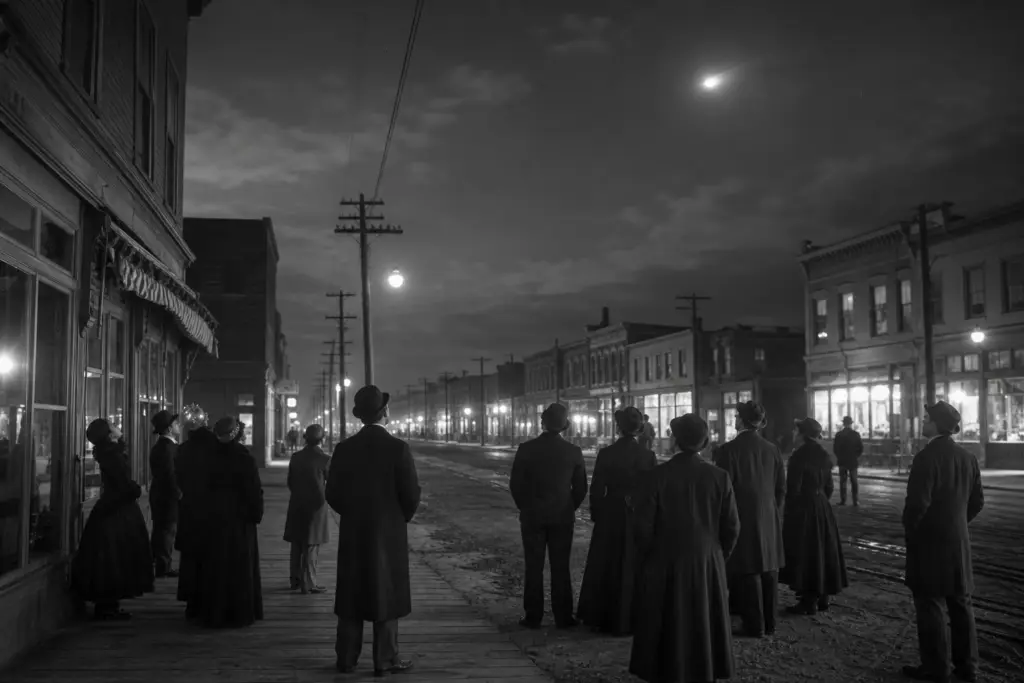
In the witnesses’ account, the disturbance began before any figure reached the house. Taylor said that, while outside getting water, he saw a bright object or light cross the sky and descend beyond the property. Accounts differ over whether it was blue-green, multicolored, or simply luminous, and over the precision of its motion. The narrower point that survives those variations is that the household placed an unusual aerial light before the reported appearance of small figures.
For the Sutton family UFO encounter, the strongest reading is therefore a connected but uneven body of testimony: several people at one home experienced a frightening disturbance, while the surviving record does not show that every person present independently saw each reported detail.
How the Reported Events Unfolded on August 21–22, 1955
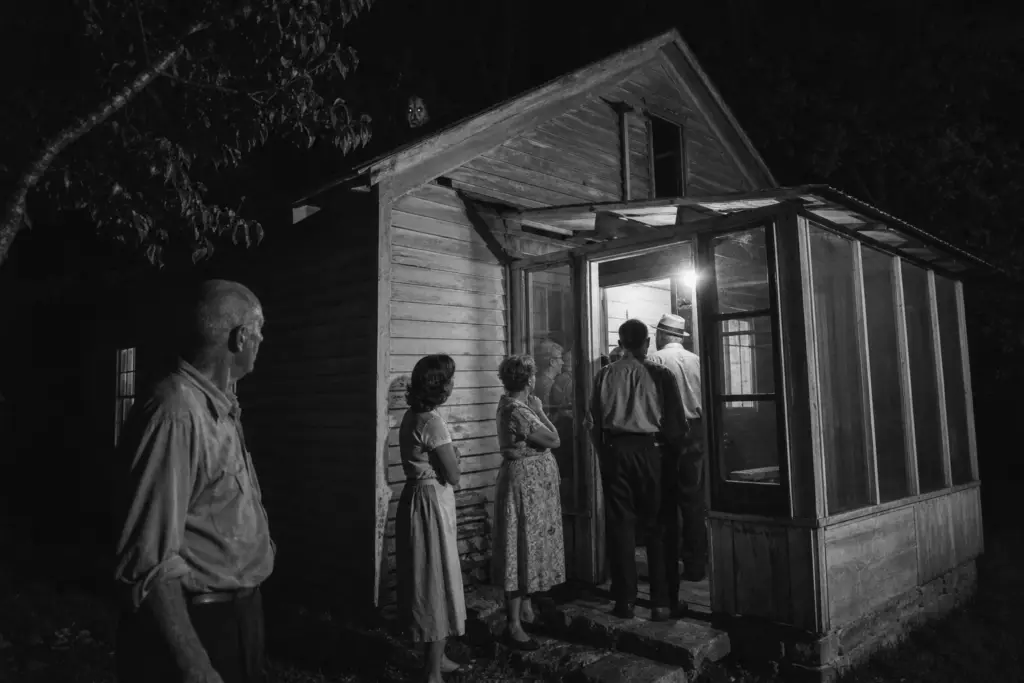
In the family’s account, the disturbance became immediate when a figure appeared near the house after dark. Early press accounts and later witness recollections broadly agree that the adults described small beings with unusually large heads, prominent eyes, thin limbs, and a metallic, bright, or reflective appearance. They did not use the later popular label “Hopkinsville goblins” as a precise species name; it is folklore shorthand for figures whose descriptions varied from telling to telling.
Lucky Sutton and Billy Ray Taylor were commonly identified as the men who first went outside with firearms. They reportedly fired at a figure near the yard and then at another seen near a window or roofline. Witnesses characterized the creatures as moving away quickly, sometimes seeming to float or to rise rather than fall after being hit. Those are reported perceptions, not independently established ballistic findings: the surviving story does not demonstrate what was fired at, whether anything was struck, or what caused the movements the household interpreted as extraordinary.
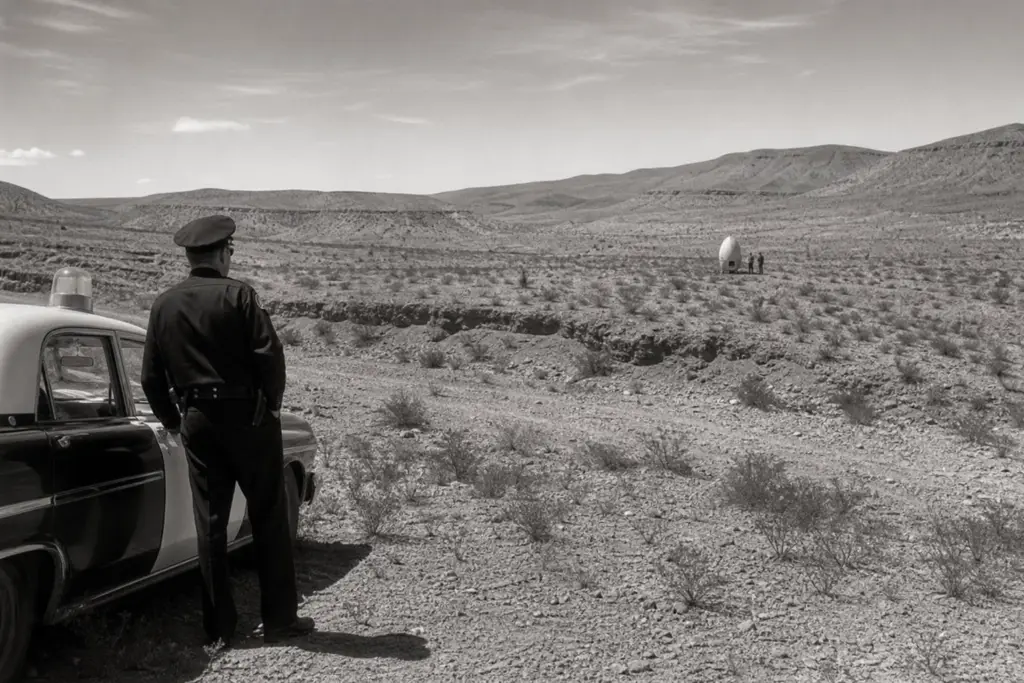
The occupants then drove into Hopkinsville to seek help, bringing the report to police late on August 21, 1955. Officers and other responders went back to the farmhouse, found the frightened group, and searched the immediate area. Their arrival is a crucial point in the timeline because it is an externally documented response to the family’s complaint, while the reported figures themselves were not present for officials to observe. The search did not settle the identity of what the witnesses believed they had seen.
After the visitors left, the household said the activity resumed and continued intermittently into the early hours of August 22. This return-to-the-house portion helps explain why the Kelly–Hopkinsville UFO incident was remembered as an extended night rather than one brief sighting. It also requires care: familiar details such as exact numbers of beings, green skin, clawed hands, telepathic behavior, prolonged rooftop battles, or a fully specified spacecraft often appear most vividly in much later retellings. The earliest account supports a narrower sequence, frightening figures near the farmhouse, gunfire reported by the occupants, a trip for help, an official visit, and further claimed sightings after the group returned.
What Contemporary Records Show: Police, Military, Press, and Project Blue Book
By midnight on August 21–22, the complaint had moved beyond the farmhouse: Hopkinsville police, county officers, Kentucky State Police personnel, and men reported to be connected with nearby Fort Campbell went to the Sutton property. That local police response corroborates a concrete point in the chronology, the occupants came into town frightened enough to seek help, and authorities treated it as a disturbance worth attending. The responders arrived after the reported gunfire and did not see the figures themselves, so their presence cannot establish what had been in the yard or at the windows.
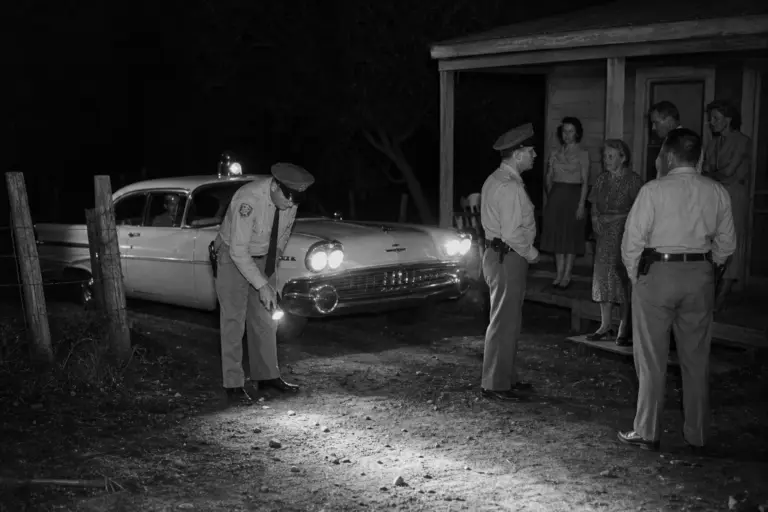
Early press accounts describe officers searching the house, yard, and surrounding ground after the family’s late-night report. Accounts of Fort Campbell involvement likewise support official interest in an unusual civilian complaint near the post, but surviving public retellings do not supply a complete military field report naming every participant, recording a direct observation, and reaching a finding. That is the important distinction: attendance or contact shows that the story reached military-connected personnel; it is not evidence that the Army identified, recovered, or confirmed a nonhuman presence.
Newspapers made the incident public almost immediately. Dated reports published on August 22 carried the Sutton household’s claims of small figures, shots fired, and the journey into Hopkinsville, Kentucky; wire-service treatment then carried a compressed version of those claims beyond western Kentucky. Such coverage is strong evidence of what witnesses and officials were saying within a day of the event. It is weaker evidence for the beings’ identity, because several papers could be repeating one wire dispatch or one interview rather than documenting separate observations.
Available Project Blue Book references place Hopkinsville among reports known to the Air Force’s UFO-reporting system in 1955. A file reference, index entry, or summary can demonstrate institutional awareness of the August 21 report; it does not by itself demonstrate a full on-site Air Force investigation or an official solution. The documentary trail therefore establishes a reported emergency, an official visit, and rapid public attention, while leaving the central visual claim dependent on the household’s testimony.
The Owl Theory and Other Explanations: What Fits the Testimony?
The great horned owl theory is strongest where the reported figures appeared briefly at night near eaves, rooflines, or windows. An owl seen front-on can present a broad head with ear tufts that read as points or “ears”; its large forward-facing eyes can catch artificial light; and a sudden, quiet flight or hop can look strikingly unlike an expected animal. In that sense, the theory offers one concrete way to connect pointed head shapes, luminous-looking eyes, and movement around the house without assuming that every observer saw a separate creature.
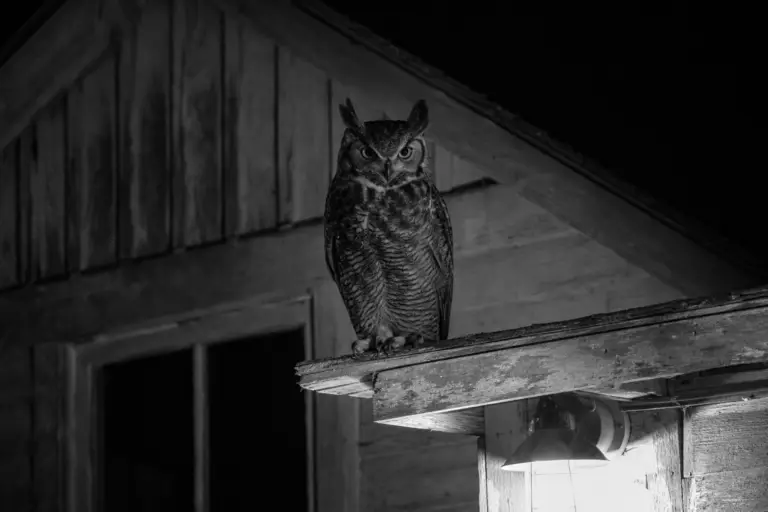
Its weakness is scale and repetition. The household’s descriptions did not reduce neatly to one animal observed once: occupants reported several appearances, more than one figure, unusual body proportions, and reactions to gunfire that they regarded as abnormal. A nocturnal animal hypothesis can explain how a bird or other wildlife might have initiated alarm, but it does not by itself reconstruct each claimed sighting or establish that all witnesses were looking at the same object from the same position.
Darkness changes the evidentiary value of visual detail. At uncertain distance, a light source can make eyeshine or a pale surface seem self-luminous, while shadows conceal a body’s outline. Fear, hurried movement, and the rapid exchange of warnings within a family group can also make separate glimpses feel like a continuous, coordinated threat. Those factors do not mean the witnesses invented their experience; they mean confidence in fine details, height, color, number, and exact motion, should be lower than confidence that people at the farmhouse were frightened by something they believed they saw.
The reported bright object or meteor belongs to a different question. A distant light in the sky could have prompted Billy Ray Taylor’s initial attention or supplied a memorable opening to the night, but it cannot on its own account for later reports of small humanoid figures at windows and along the roofline. Treating the meteor report as proof of the figures, or treating an owl as a complete explanation of the entire episode, asks either idea to cover more than the testimony securely permits. Plausibility is not a complete reconstruction.
Why the Case Still Matters in UFO History
Its historical weight comes from the speed with which a private family alarm became a public story. The occupants’ trip to Hopkinsville brought police attention to the farmhouse that same night, and newspaper coverage carried their account far beyond Christian County. That sequence preserves more than a later legend: it shows that several people linked to one household made an extraordinary report in close succession and that authorities treated their fear as a real disturbance requiring a response.
The case also became unusually durable folklore. “Hopkinsville goblins” is a memorable label, well suited to books, documentaries, festivals, and the wider history of close-encounter reports, but it can blur the difference between the witnesses’ changing descriptions and the standardized creature image that later culture prefers. A strong historical reading gives greatest weight to accounts recorded nearest August 1955; a weak one lets later illustrations, dramatic reconstructions, and repeated anecdotes fill gaps in the original record.
That is why the Kelly–Hopkinsville Encounter remains useful as well as famous. It demonstrates how an event can be important without being evidentiary proof of its most dramatic interpretation. The surviving material supports that frightened Sutton-family household members and visitors reported figures, gunfire, a search for help, and further activity after returning home. It does not establish aliens, a case-specific government cover-up, or a verified non-human intelligence event. Modern “UAP sightings” is an umbrella term for contemporary reports, not a retrospective official classification that resolves what happened at Kelly.
What the Kelly–Hopkinsville Encounter Can, and Cannot, Tell Us
The most defensible conclusion rests on the difference between corroboration of a report and corroboration of its cause. The accounts, the urgent trip into Hopkinsville, the officers’ visit, and the rapid press attention establish that a connected group of people experienced or participated in a genuine alarm over one night. They do not preserve physical evidence capable of identifying the figures, reconstructing every shot, or independently testing each observation.
That gap leaves room for ordinary explanations without making any one of them a complete solution. The great horned owl theory has a concrete advantage where witnesses described bright eyes, pointed head shapes, and fleeting appearances near the house in darkness. Stress, expectation, changing sightlines, and repeated discussion within one household could also have shaped how ambiguous sights were interpreted. But an explanation that plausibly fits some reported moments is not the same as a demonstrated reconstruction of the entire experience.
The police response, reported military involvement, newspapers, and Project Blue Book references make the episode unusually well recorded for its era, chiefly because they help fix its timing and show that the claim prompted prompt attention. Those materials are weakest where later retellings seek certainty: none converts frightened testimony into a verified extraterrestrial event, nor do they establish a hoax or one conventional cause.
So the Kelly–Hopkinsville Encounter endures not as conclusive evidence that visitors from another world came to a Kentucky farmhouse, but as a well-documented episode of extraordinary claims: immediate, memorable, and still resistant to a final evidentiary resolution.
Frequently Asked Questions
What happened during the Kelly-Hopkinsville Encounter in 1955?
On the night of August 21 to 22, 1955, occupants of the Sutton farmhouse near Kelly, Kentucky, reported small luminous figures around their home. They said they fired at the figures, drove to Hopkinsville for help, and experienced further sightings after police and other responders searched the property.
How many people reported the Kelly-Hopkinsville incident?
The incident is often described as involving 11 witnesses, including adults, children, and visitors at the Sutton farmhouse. The adult group included Glennie Lankford, Lucky and John Charley Sutton, Vera and Alene Sutton, Billy Ray and June Taylor, and O. P. Baker.
Did police investigate the Sutton farmhouse UFO report?
Yes. Hopkinsville police, county officers, Kentucky State Police personnel, and reportedly men connected with Fort Campbell went to the Sutton property after the group sought help late on August 21, 1955. Responders searched the house, yard, and nearby ground but did not see the reported figures.
What was Project Blue Book’s position on the Kelly-Hopkinsville case?
Available Project Blue Book references show that the Air Force UFO-reporting system was aware of the Hopkinsville report in 1955. The surviving references do not establish a full on-site Air Force investigation, an official solution, or confirmation of a nonhuman event.
Were the Hopkinsville goblins aliens or could they have been owls?
No evidence established that the figures were aliens. The great horned owl explanation fits reported bright eyes, pointed head shapes, and brief nighttime appearances near windows or rooflines, but it does not fully account for every claimed sighting, number of figures, or reaction to gunfire.