Japan Airlines Flight 1628: What the Public Record Establishes
The authenticated FAA file records a serious air-traffic report, three crew witnesses, intermittent and disputed radar returns, and a safe landing—but it does not establish what the reported objects were.
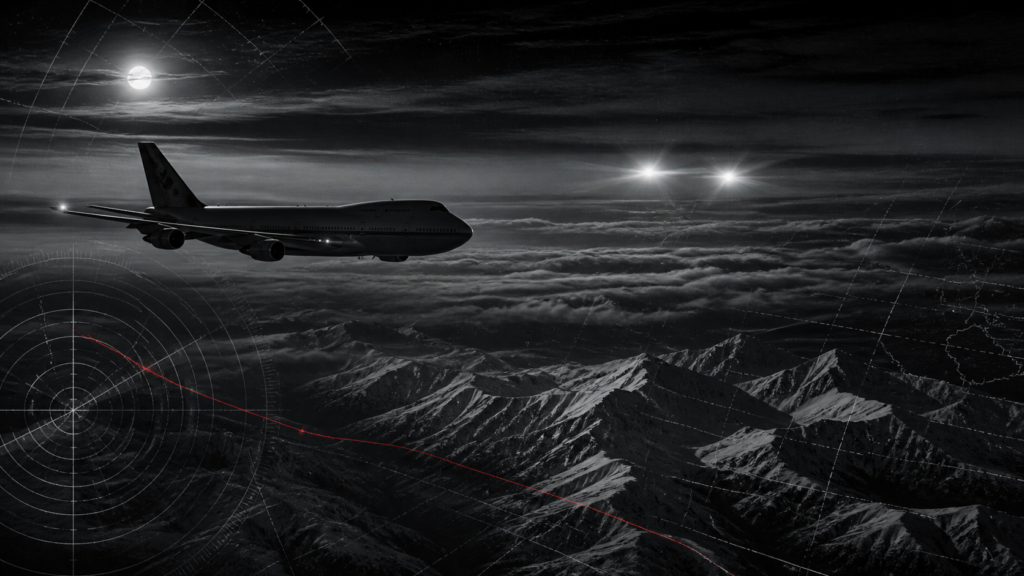
Japan Airlines Flight 1628 has often been compressed into a single dramatic claim: a cargo crew saw an enormous unidentified craft over Alaska and radar confirmed it. The authenticated Federal Aviation Administration record is both more substantial and more complicated. It preserves a certified air-traffic-control transcript, an incident form, crew interviews, a captain’s written statement and drawings, radar-related printouts, simulated radar images, internal chronology, and public-affairs material. That record establishes that the crew made an unusual and sustained report and that controllers treated it as an operational matter. It does not establish the identity, size, origin, or physical nature of what the crew perceived.
This distinction matters. A 2007 CIA Freedom of Information Act case log points to a request involving the incident, but a log entry is not the underlying evidence. Publication became defensible only after the National Archives made the FAA series and its individual digitized files directly retrievable. Readers can therefore inspect the government-held records rather than relying on later summaries. That evidence-first approach is the same one described in our primary-source guide and sources and methodology.
What happened on the flight
On November 17, 1986, Japan Airlines Flight 1628, an all-cargo Boeing 747, was flying from Keflavik, Iceland, toward Anchorage. The FAA incident record identifies Captain Kenju Terauchi, First Officer Takanori Tamefuji, and Flight Engineer Yoshio Tsukuba as the three people aboard. No one was injured, the aircraft was not damaged, and the flight landed safely. The FAA narrative says the captain reported traffic near the aircraft while flying in Alaskan airspace and that the reported traffic remained in the vicinity through a descent and turns, including a 360-degree turn, before the crew said it was no longer visible.
The official paperwork contains a small but revealing clerical inconsistency. The front of one FAA form displays November 17, 1987, while its narrative, routing information, and the rest of the case file place the event on November 17–18, 1986. The certified transcript is dated January 9, 1987 and explicitly covers communications from 0214 to 0259 UTC on November 18, 1986. The mismatch is a form error, not evidence of two encounters, and it is a reminder to compare fields across the full file instead of treating one scan as infallible.
What the certified ATC transcript records
At 0219 UTC, the crew asked Anchorage Center whether it had traffic in front of the aircraft. The controller replied that it did not. The crew then reported two traffic targets visually about one mile ahead and near the same altitude. A few minutes later, the crew said the target or traffic had disappeared from view, while the controller said no radar replies were being received. This opening sequence confirms a real-time report, but it does not begin with ground radar independently identifying an unknown aircraft.
The radar picture then became less clear. At approximately 0225 UTC, an Anchorage controller said a radar hit appeared about five miles behind Flight 1628. The crew placed its perceived traffic elsewhere—roughly eight miles away at the eleven-o’clock position. A military Regional Operations Command Center operator described a “surge primary return” and explicitly said the return might be erroneous. Controllers compared positions, briefly discussed a primary target, and then reported losing it. Later, Fairbanks Approach repeatedly said it could see only Flight 1628’s target and nothing separate from the aircraft.
That sequence is why the familiar phrase “confirmed on radar” is too broad. The record contains intermittent primary returns discussed by more than one facility, but it also contains uncertainty about whether a return was erroneous, differences between reported visual and radar positions, loss of the return, and controllers who saw no second target. Primary radar can display reflections without a transponder code; it does not automatically identify the reflecting source, and a short-lived return near a tracked aircraft is not by itself proof that it corresponds to a visually reported object. The transcript supports the narrower conclusion that controllers investigated uncertain returns while the crew continued to report visual traffic.
Maneuvers and checks
The transcript documents operational responses rather than passive observation. The crew requested a heading change away from the object and later requested descent from flight level 350 to 310. Controllers approved deviations as necessary for traffic. At about 0236 UTC, Anchorage asked Flight 1628 to make a right 360-degree turn and report what the traffic did. During this period, the military center confirmed that no military aircraft was operating in the area. These steps show that controllers took the crew’s report seriously enough to check known traffic and authorize maneuvering.
Serious treatment is not the same as an extraordinary finding. The FAA file does not contain a final scientific identification of an object, a recovered physical sample, a calibrated photograph from the cockpit, or a continuous multi-sensor track that can be matched frame by frame to the crew’s visual account. Its recreated radar screens are simulations prepared to illustrate the incident, not photographs captured live during the encounter. Its computer printouts and controller statements require technical interpretation and do not erase the inconsistent detections preserved in the transcript.
The witnesses and their descriptions
The full series includes separate interviews with all three crew members, plus Captain Terauchi’s written statement and drawings. That is important because it prevents the case from resting entirely on a later media retelling. The records show that the captain supplied the most elaborate descriptions. The other crew members corroborated that unusual lights or traffic were seen, but the existence of multiple witnesses does not make every later size estimate or interpretation equally well supported. Witnesses can share an observation while differing about form, distance, and meaning—especially at night when range cues are limited.
The flight crew’s professional experience is relevant to credibility, but it does not turn visual estimates into instrument measurements. The public record does not provide a known physical reference at the reported object’s distance from which a reliable size could be calculated. Descriptions such as a very large aircraft or a massive object are therefore witness reports, not established dimensions. Our claim-evaluation guide explains why a trained observer and a calibrated measurement answer different questions.
What the file establishes—and what it does not
The strongest defensible summary has five parts. First, the event was reported in real time by an airline crew, not invented years later. Second, FAA controllers documented and responded to the report. Third, the government record preserves intermittent radar discussions, including uncertain primary returns, but not uniform or continuous corroboration. Fourth, the crew changed heading, descended, and completed a 360-degree turn under controller coordination before the reported traffic was eventually lost. Fifth, the available record does not identify the source of the crew’s perception.
The file does not establish an extraterrestrial vehicle, a classified American platform, or any other proposed explanation. Nor does the lack of a settled identification prove that nothing unusual occurred. “Unidentified” here describes the limit of the surviving evidence. It is a status, not an origin claim. That is also why later stories about suppression, secret meetings, or definitive radar proof must be evaluated separately against their own documentation rather than attached automatically to the FAA package.
JAL 1628 belongs on the historical UAP timeline because the underlying aviation record is unusually extensive and now publicly inspectable. It also belongs beside the site’s coverage of the National Archives’ UAP releases, which has made source-level review easier. Its evidentiary value lies not in a slogan but in the tension preserved by the record: credible witnesses, a genuine safety response, transient radar indications, contrary radar observations, and no demonstrated identification.
Sources
- National Archives guide to textual and microfilm UAP records
- NARA: FAA series 733667, Information Releases Relating to Unidentified Flying Object
- NARA: FAA Form 8020-5 Aircraft Incident Record
- NARA: certified transcript of communications between ATC and JAL 1628
- NARA: transcript of FAA interview with Captain Terauchi
- NARA: Anchorage ARTCC radar tracking printout
- CIA Reading Room: 2007 FOIA case log