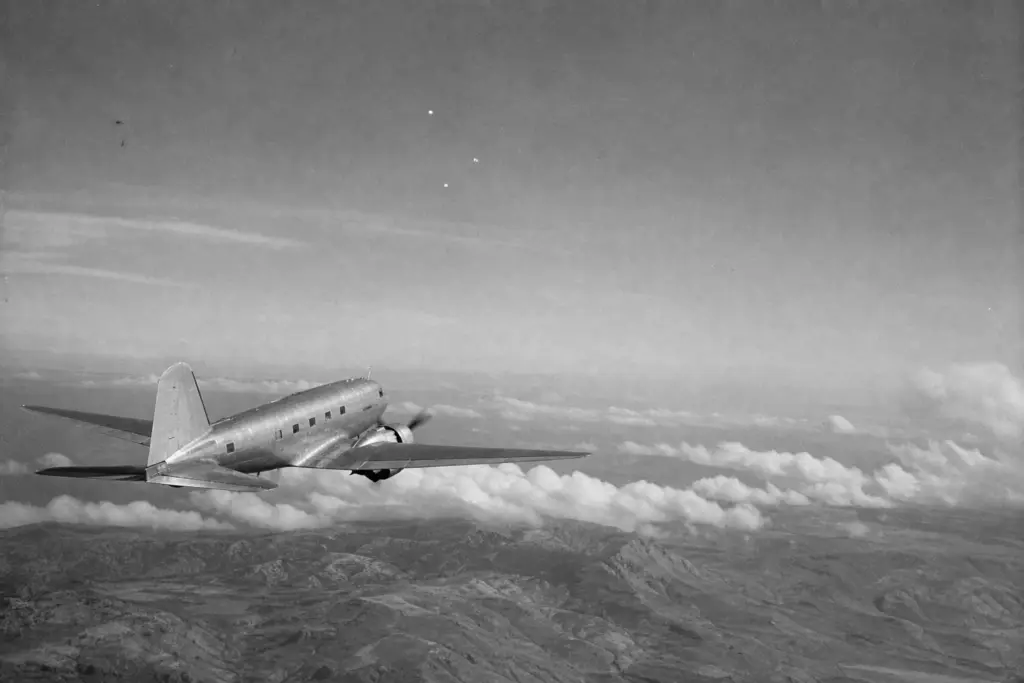
On July 4, 1947, during the first great American “flying-saucer” wave, crew members aboard a United Airlines flight from Boise, Idaho, toward Pendleton, Oregon, reportedly saw nine objects they could not identify. That is the restrained core of the Flight 105 UFO sighting: a report by commercial aviation personnel, not evidence that the objects were extraterrestrial craft.
The case merits close attention because airline crews were accustomed to observing skies, aircraft, weather, and navigation conditions. Yet professional experience does not by itself settle what an unusual aerial observation was. “UFO” is used here in its historical, literal sense, an unidentified reported object, not as a conclusion about origin or technology.
This account separates the strongest documented elements from details added or altered in later retellings. It traces the reported Boise-to-Pendleton leg, identifies the witnesses only where the record supports doing so, follows how the story entered print and later case files, and distinguishes press attention from a documented official investigation. The surviving evidence can establish that a notable report was made; whether it can establish the identity, distance, altitude, or nature of the nine objects is a different question.
Flight 105 on July 4, 1947: What the Record Actually Supports
The usable starting point is a reported in-flight observation, not a recovered object, instrument record, or adjudicated finding. In the account associated with United Airlines Flight 105, crew members traveling on the Boise-to-Pendleton leg on July 4, 1947 reported seeing nine aerial objects. Those elements, airline, flight number, route, date, and number reported, form the case’s documentary core; descriptions of appearance, movement, distance, and duration require closer scrutiny.
That distinction matters because a witness report establishes that people made an observation and described it as unidentified. It does not independently establish what was observed. Aviation personnel can be historically important witnesses because their work involves sustained attention to the sky and familiar airborne phenomena, but experience does not supply missing measurements or rule out every ordinary explanation.
This section therefore treats the Flight 105 UFO sighting as a bounded historical report. The pages that follow give priority to the earliest attributable accounts, separate contemporaneous reporting from later embellishment, and reserve conclusions for details the surviving record can actually bear. No extraterrestrial origin, non-human intelligence, or confirmed government UAP determination follows from the reported nine objects alone.
What the United Airlines Crew Reported Seeing
The reported count, nine, is the one descriptive element carried forward here because it belongs to the case’s stated documentary core. Beyond that count, this reconstruction should not turn a later, more vivid narrative into a crew statement without an attributable contemporary report, original statement, airline record, or archival case document.
No such record has been supplied here that securely names the Flight 105 pilot, copilot, or other crewmember. It would therefore be improper to attach names and roles drawn only from later UFO compilations. A named pilot witness is a stronger historical link when the name appears in contemporary coverage or an operational record; an unnamed “United crew” report preserves the event’s basic claim but leaves the chain of testimony less complete.
The same distinction applies to the objects’ appearance and performance. “Nine objects” describes the reported observation. Claims that they were discs, bright lights, metallic craft, in formation, or making extraordinary maneuvers are separate propositions, each requiring its own early, identifiable attribution. So are numerical claims about altitude, range, airspeed, duration, and visibility: without recorded measurements or a contemporaneous quotation, such figures are not data recovered from the pilot observation.
For that reason, the careful account of the Flight 105 nine UFOs remains deliberately narrow. The crew reportedly saw nine aerial objects they could not identify during the Boise-to-Pendleton leg. The surviving material available for this article does not establish their physical size, distance, trajectory, or origin, and it does not support treating later descriptive additions as settled eyewitness evidence.
Where Flight 105 Was Flying, and Why Context Matters
The route supplies a corridor, not a plotted encounter point. Flight 105 was reported to be traveling westward from Boise toward Pendleton, but the material available here does not fix where along that leg the objects appeared, the aircraft’s altitude, its heading at the instant of observation, or the time of day. A map can therefore illustrate the Boise-to-Pendleton corridor; it cannot legitimately mark a sighting location.
That missing geometry matters. An airline crew looking through a windscreen or side window sees an object against a changing background of sky, terrain, cloud, and glare. Its apparent position can be described relative to the aircraft, but that does not by itself reveal its position over the ground. A low object nearby and a much larger object far away can occupy a similar apparent angle in the viewer’s field of vision.
Distance is the central unresolved variable in the Boise to Pendleton UFO sighting. Without a measured range, reliable landmarks behind the objects, or a correlated observation from another location, apparent size cannot yield physical size; apparent motion cannot yield speed. An object seeming to hold position may have been following a similar line of sight, while one seeming to move rapidly may have reflected the aircraft’s own motion or a change in viewing angle, practical limits with aviation-safety relevance.
July 4 establishes the calendar date, not illumination or weather at the moment of the July 4 1947 Flight 105 sighting. Reconstructing sun position, cloud cover, or visibility would require a dependable time and location first. Those are plausible lines of inquiry, but they remain reconstruction rather than established operational context. The sound conclusion is narrower: the airline crew made its report somewhere during the documented Boise-to-Pendleton leg, under visual conditions whose specific features have not been preserved here.
How the Flight 105 Sighting Entered the Historical Record
Provenance is the next limitation. The material preserved for this account does not include a dated newspaper clipping, wire-service dispatch, crew statement, United Airlines record, or contemporaneous military memorandum that can be identified as the first publication of the report. It therefore cannot responsibly assign an origin point to the Flight 105 story or treat a later narrative as a transcript of what the crew said.
That distinction determines how much weight a record deserves. A direct statement is the witness’s own signed, recorded, or reliably quoted account; it preserves the closest available link to perception, though witnesses can still be mistaken. Near-contemporary newspaper coverage may report an interview promptly, but it is also a newsroom rewrite: editors can shorten wording, combine accounts, or adopt the era’s “flying saucer” language. An official memo records what an agency received or did with a report; it does not automatically authenticate the observation itself.
Later catalogues and historical UFO books serve a different purpose. They can preserve a case name, date, route, or citation trail, but they are secondary compilations unless they reproduce a traceable earlier document. A useful catalogue entry identifies its newspaper, file, archive collection, or memorandum date. A weak one supplies polished witness names, performance details, or an explanation without showing where those particulars originated.
For the early UFO reports, the practical source ladder is direct testimony first, then dated contemporary reporting, then identifiable official records, and finally retrospective records collections. No supplied record here establishes a formal government case file or investigation for Flight 105. That gap does not disprove the report; it means the historical record presently supports a narrower conclusion than later retellings may imply.
A July 1947 Case, Not Kenneth Arnold, Maury Island, or Roswell
Chronology is the first checkpoint: the Flight 105 report belongs to the early-July phase of the 1947 wave, whereas Kenneth Arnold’s widely publicized sighting near Mount Rainier occurred on June 24. Arnold was a private pilot describing a separate visual observation in Washington State; Flight 105 concerns an airborne observation attributed to a commercial-flight crew over the Idaho–Oregon route. The shared 1947 setting does not merge the two reports.
Kenneth Arnold’s account became the public reference point for the emerging “flying saucer” vocabulary. That attention may help explain why later UFO news used familiar language, but shared terminology establishes neither a common event nor a common cause. Similar labels can result from a fast-moving news environment as readily as from similar objects.
Maury Island and Roswell pose different evidentiary questions. Maury Island involved a ground-based claim involving alleged debris and intermediaries; Roswell concerned reports and official statements connected with material recovered near an Army airfield in New Mexico. Such accounts turn on custody, contemporaneous records, and the provenance of claimed physical material. The available Flight 105 record contains no comparable recovery claim; its central issue is the preservation and specificity of an in-flight witness report.
The useful comparison is therefore chronological and methodological. These were distinct 1947 narratives, involving different witnesses, locations, alleged events, and surviving records. Combining them can make the flying-saucer era appear more unified than the evidence permits and can blur the limited, historically notable character of the Flight 105 account.
Was It Investigated, and Has It Been Explained?
A formal inquiry leaves a different kind of trail from a reported sighting. A filed report records that someone passed information to an organization; press attention records that the account circulated publicly; an investigation normally produces a referral, assigned office, interviews, findings, or correspondence showing that officials evaluated the claim.
The material available for this article identifies none of those investigative records for Flight 105. It does not establish a military referral, a civil-aviation inquiry, or a case file later incorporated into Project Blue Book. That is not evidence that no official ever heard of the report; it means that an official response cannot be asserted from the surviving material presented here.
Nor is there a supplied radar track, photograph, recovered material, or independently preserved ground observation that could test the crew’s report against an instrument or physical record. Those forms of corroboration answer different questions: radar can bear on whether something registered at a location and time, while physical evidence can be examined for origin and custody. Neither is available here.
A conventional explanation also cannot responsibly be selected on the present record. Sunlit aircraft or reflections would require the missing observation time, heading, illumination, and geometry; birds or balloons would require a description, distance estimate, and movement data; a misidentified aircraft would require traffic information. Each is possible in principle, but none accounts for this particular report without assumptions the record does not supply.
The proper conclusion is therefore narrow: unexplained in the surviving record does not mean inexplicable in principle. It means the Flight 105 account lacks the contemporaneous investigative and observational detail needed to determine what the nine reported objects were.
What Flight 105 Can, and Cannot, Tell Us About UAP History
The decisive checkpoint is the difference between an observation report and an identification. The historical value of this case lies in its association with the July 1947 flying-saucer wave: United Airlines personnel reportedly made an airborne observation, and the account preserves a count of nine objects.
A credible witness report and proof of an object’s identity are different evidentiary achievements. The former supports the conclusion that observers reported something unusual; the latter requires information sufficient to assess distance, size, speed, trajectory, illumination, and alternative identifications. Here, the absence of contemporaneous testimony, precise observation geometry, independent corroboration, and a documented inquiry prevents that second conclusion.
The appropriate standard for sensational retellings is source provenance: do they separate the reported date, route, and count from later-added descriptions, named witnesses, or claims of extraordinary performance? If not, they enlarge the record rather than report it. The Flight 105 UFO sighting alone supplies no documented basis for claims of non-human intelligence, extraterrestrial craft, a government cover-up, or a connection to modern UAP disclosure.
The Enduring Significance, and Limits, of the Flight 105 Report
A stated object count is a useful boundary, not a reconstruction of an encounter. The surviving account retains nine reported objects and a July 4, 1947 date, while leaving the observation’s timing, position, witness identities, and descriptive particulars insecure.
That limited core still merits preservation. A report attributed to commercial aircrew belongs in the aviation and UAP history of the 1947 flying-saucer wave; its airline, flight number, route, date, and count distinguish it from an undated anecdote. Those anchors do not turn the account into a measured event, however: no contemporaneous firsthand statement, exact observation geometry, or formal investigative file is available here.
Later references demonstrate that the Flight 105 story continued to circulate, not that every repeated detail originated with the crew. Its early-July date supplies context rather than linkage; it does not make the report evidence for Kenneth Arnold, Maury Island, Roswell, or any other separate 1947 episode.
The Flight 105 UFO sighting is therefore best retained as a bounded historical report: substantial enough to record an unusual aerial observation attributed to airline personnel, but too thinly preserved to identify the nine objects or support claims about their origin.
Frequently Asked Questions
What happened during the United Airlines Flight 105 UFO sighting?
On July 4, 1947, crew members on United Airlines Flight 105 reportedly saw nine unidentified aerial objects while flying from Boise, Idaho, toward Pendleton, Oregon. The surviving record does not establish the objects’ appearance, size, speed, altitude, or origin.
Did the Flight 105 crew really report seeing nine UFOs on July 4, 1947?
Yes. The documented core of the case is that United Airlines Flight 105 crew members reported nine unidentified objects during the Boise to Pendleton leg on July 4, 1947. The report establishes that an observation was made, not what the objects were.
Where was United Airlines Flight 105 flying when the objects were seen?
Flight 105 was traveling westward from Boise, Idaho, to Pendleton, Oregon. No surviving record fixes the exact sighting location, observation time, aircraft altitude, or heading when the nine objects were reported.
Was the Flight 105 UFO sighting investigated by the government?
No documented government investigation has been identified for Flight 105. There is no supplied military referral, civil aviation inquiry, Project Blue Book file, radar track, photograph, or recovered material connected to the report.
How is the Flight 105 sighting different from Kenneth Arnold’s 1947 UFO report?
Kenneth Arnold reported a separate sighting near Mount Rainier, Washington, on June 24, 1947, while Flight 105 involved a commercial airline crew flying the Idaho to Oregon route on July 4. The two cases share the 1947 flying-saucer wave but involve different witnesses, locations, and evidence.