The pale, wide-eyed face on the cover of Communion remains an instant visual shorthand for alien encounter stories: intimate rather than astronomical, frightening rather than triumphant. When Whitley Strieber’s Communion appeared in 1985, its first-person account invited readers into an experience described not as distant science fiction but as fractured, bodily, and emotionally unresolved memory.
That combination mattered. The book did not originate every element now associated with alien-abduction narratives, reports of strange beings, lost time, and unexplained nighttime episodes all had earlier histories, but it gave dispersed motifs a mass-cultural form that was unusually vivid and repeatable. Its cover helped fix the popular image later called the “grey alien”; its voice made uncertainty itself part of the drama; and its broad circulation gave audiences a shared reference point for discussing purported encounters.
This is an inquiry into cultural influence, not a ruling on what happened to Strieber. Personal testimony, recollections shaped through hypnosis, and independently corroborated evidence are different kinds of material, carrying different evidentiary weight. The question is how a contested memoir changed the imagery, language, and expectations through which later experiencers, investigators, filmmakers, and readers understood the possibility of abduction.
Communion as a Cultural Turning Point, Not Settled Evidence
Published by William Morrow in 1985, Communion reached readers as a major commercial book rather than a niche case file. That scale changed the terms of the conversation: a wide public could recognize a common face, a common emotional register, and a common set of questions around nocturnal fear, fractured recall, and unnamed visitors.
Its historical importance is therefore measurable in reception and reuse, not dependent on accepting its events as literal fact. Whitley Strieber presented the book as his attempt to grapple with anomalous personal experiences. Testimony can show what a witness remembers, believes, or struggles to describe; it does not by itself establish the external cause of an experience. Independent evidence would require material or observational support that can be assessed apart from the witness’s account.
That distinction keeps two conclusions from being confused. Communion became a cultural turning point because later alien-abduction narratives could borrow, answer, or resist its imagery and emotional vocabulary. But its prominence did not convert reported encounters into verified evidence of non-human intelligence. The book’s enduring force lies precisely in how it made uncertainty, rather than a neat extraterrestrial explanation, part of the modern story.
What Existed Before 1985: The Earlier Roots of Abduction Lore
By 1985, the basic materials of an abduction story were already familiar. In 1950s contactee accounts, alleged visitors often delivered messages to selected humans; science fiction had long supplied spacecraft interiors, medical examination, lost time, and vulnerable people taken from ordinary settings. Those earlier traditions varied in tone, contactees often stressed cosmic instruction, while fiction could make the encounter adventurous or horrific, but they made extraordinary visitation narratively legible.
The 1961 experience reported by Betty and Barney Hill supplied a more intimate and frightening model. Their account linked a nighttime drive, missing time, beings aboard a craft, and later recollection under hypnosis. Travis Walton’s widely publicized 1975 report similarly placed an alleged taking within a recognizable sequence of light, a close encounter, absence, and return. Neither case established the cause of what witnesses reported, but both helped move alien-abduction literature away from the earlier image of willing contact and toward distress, bodily exposure, and uncertain recall.
Alien-abduction hypnosis had also become an important, and controversial, story-making tool. Hypnotic regression aims to prompt recall through a highly suggestible altered state; it can produce detailed narratives, but detail is not independent confirmation. Later research and public debate over recovered memories sharpened the concern that questioning, expectation, and repetition can shape or confabulate recollection. The evidentiary distinction matters: a hypnosis session may document what a person came to remember, not what objectively occurred.
Communion therefore did not originate grey-eyed visitors, missing time, invasive encounters, or fractured memory. Its achievement was to recombine established elements through the voice of a successful mainstream novelist and present them with an emotional ambiguity that earlier contactee optimism and case-file reporting often lacked. That recombination made an existing repertoire easier for a much larger audience to recognize, repeat, and argue over.
The First-Person Voice That Made “the Visitors” Feel Immediate
What gave Communion its special force was not a new inventory of incidents but the feeling of being locked inside a narrator’s disorientation. Strieber wrote in the first person as a known novelist confronting events he could not arrange into a stable explanation: fear in familiar rooms, gaps in recall, physical exposure, and the unsettling possibility that his own memory was incomplete. A case file can place testimony at a distance; this nonfiction memoir form makes the reader inhabit the pauses, reversals, and dread. The result was a model for Whitley Strieber alien abduction accounts in which emotional immediacy mattered as much as a chronology of alleged events.
Missing time functions especially well in that model because it is both a plot device and a limit on testimony. It supplies a blank that invites reconstruction, while also preventing neat resolution. Strieber’s narrative voice does not simply announce an answer and move on; it repeatedly weighs competing meanings, alien encounter, psychological disturbance, spiritual intrusion, or something not yet named. That openness gave later experiencer narratives a useful tonal choice. A weak account merely piles up certainty and detail; the more recognizably Communion-like account treats detail, fear, and interpretation as separate things, allowing the witness to report an experience without claiming a final theory for it.
His preferred label, “the visitors,” was crucial to that shift. “Aliens” points immediately toward a science-fiction category and an extraterrestrial conclusion. “The visitors” instead describes a relationship: someone or something has entered private space, crossed a boundary, and left the person trying to understand why. The phrase could therefore sound intimate and ominous without settling what the beings were. It became a flexible vocabulary for audiences who found “little green men” too comic and “extraterrestrials” too definitive.
That literary flexibility is not corroboration. First-person testimony can convey genuine terror and confusion while leaving the cause unresolved, particularly where recalled material has been shaped by interviews or hypnosis. Communion‘s influence lies in making that unresolved condition compelling, and in teaching a broad audience that an abduction narrative could be presented as fractured personal experience rather than as either cheerful contact or a completed investigative proof.
How the Cover Helped Standardize Grey Alien Imagery
A full face can do what an ambiguous recollection cannot: make an encounter recognizable at a glance. Communion placed its being close to the reader, without spacecraft, scenery, or explanatory apparatus. The pale skin, tapered jaw, tiny mouth, reduced nose, and large black eyes condensed unease into a simple frontal arrangement. Its expression is difficult to classify as hostile, vulnerable, intelligent, or empty; that uncertainty mirrors the book’s refusal to settle the visitors’ identity.
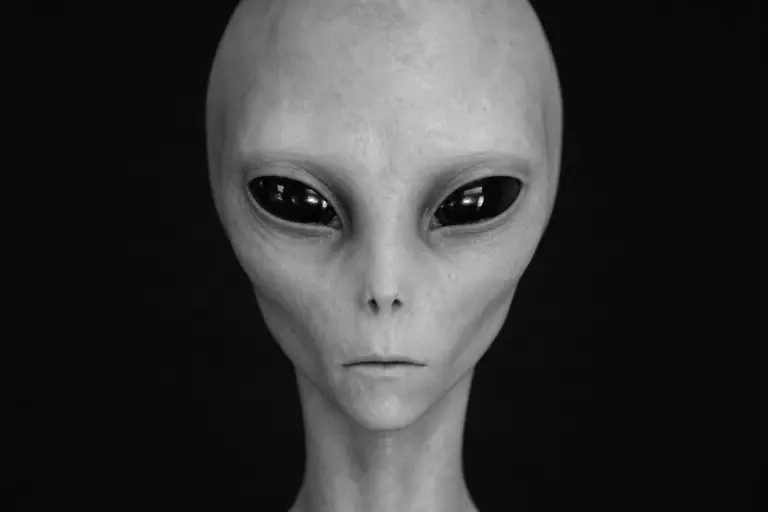
Small humanoids and exaggerated eyes did not begin with this cover. Earlier UFO accounts and science-fiction imagery had already offered varied versions of diminutive, nonhuman figures, from overtly fantastical creatures to more austere, humanlike visitors. The difference was visual consistency. Rather than presenting a creature as part of a busy adventure scene, the Communion cover image isolated a few features that could survive almost any reproduction: a smooth pale face, a narrow chin, a minimal mouth, and eyes that dominate every other detail. That economy made grey alien imagery readily legible even when artists changed the body, setting, or implied origin.
The practical cultural effect was a reusable shorthand. A viewer did not need to know Strieber’s individual episodes, or accept them as factual, to recognize the face as a signal for abduction, lost memory, nighttime intrusion, and alien contact. Later uses could invoke that association seriously, skeptically, or comically; the same basic design worked because it carried a ready-made emotional charge. In that sense, the image became more portable than many of the book’s claims. It did not create every precursor to the modern “grey,” but it gave diffuse motifs a memorable default form, and made the alien encounter look intimate enough to meet the reader’s gaze.
From Singular Account to Reusable Abduction Template
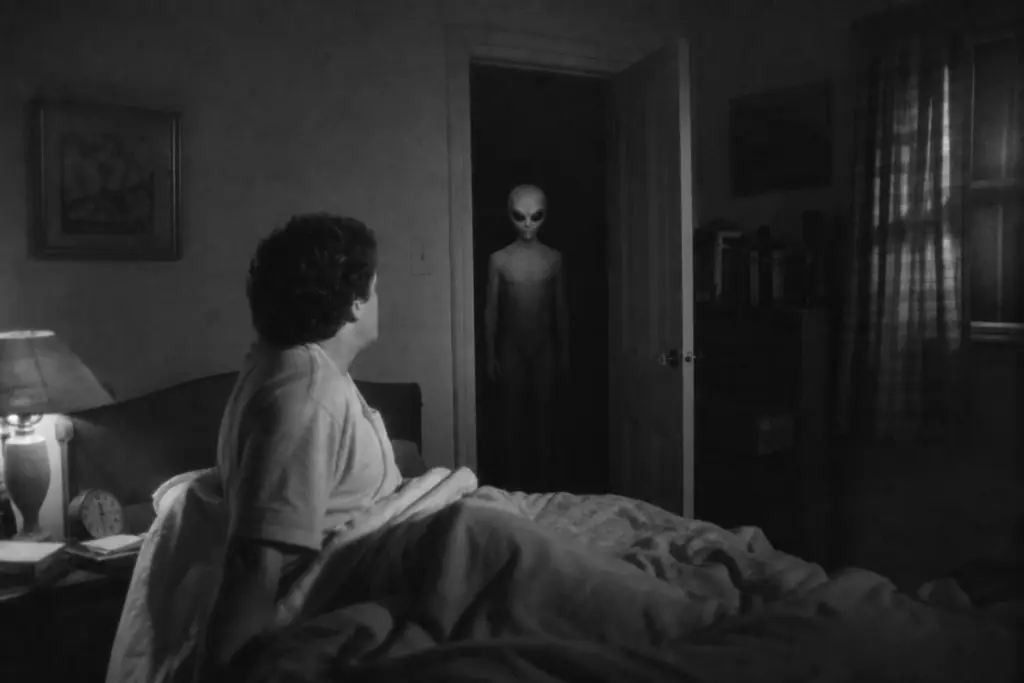
Once those signals were available, an encounter could be told as a sequence rather than a fully resolved event. A person wakes in a familiar bedroom, notices an anomalous presence, loses a stretch of time, recalls an examination or bodily intrusion in flashes, and is left unsure whether terror, curiosity, or both best describes the aftermath. That sequence gave modern alien abduction stories a flexible dramatic structure: each missing segment could sustain uncertainty without preventing the narrator from describing intense subjective consequences.
Communion also made incompleteness itself meaningful. Fragmented recollection was not merely a weakness to be explained away; it became part of the story’s emotional logic. Later accounts often used screen memories, apparently ordinary recollections thought to conceal a more disturbing encounter, to account for mismatches between conscious memory and a recovered narrative. The idea heightens suspense, but it also makes the account difficult to test: an absent memory can be treated either as no evidence of an event or as evidence that the event has been concealed.
That ambiguity circulated through a feedback loop. Budd Hopkins’s investigative model emphasized recurring abduction patterns and the recovery of hidden material, while John E. Mack treated experiencers’ accounts as psychologically and spiritually consequential without requiring a simple physical explanation. Books, interviews, televised reconstructions, and support networks then supplied audiences with recognizable scenes and terms through which new experiences might be narrated. Shared motifs in abduction reports can therefore reflect cultural availability, interview expectations, and sincere efforts to make sense of frightening experiences; repetition alone does not establish a shared external cause.
Hypnosis is central to that caution. It can produce detailed, emotionally compelling recollections, yet detail and conviction do not by themselves demonstrate historical accuracy. Memory-recovery methods have long been disputed because suggestion, repeated questioning, and prior exposure to narrative material can influence recall. The stronger reading of Whitley Strieber’s Communion is cultural rather than evidentiary: it supplied an expressive template in which invasive intimacy, dread, fascination, and the visitors’ unresolved identity could coexist, then gave later narrators a form they could adopt, revise, or resist.
Why Communion Still Shadows UFO Disclosure Conversations
An unidentified object in a military record is not a visitor in a bedroom. Official discussion of UAP, observations that remain unidentified after available review, addresses a limited question: what was observed, by whom, and whether the available data resolve it. An abduction account makes a much larger claim about personal contact, motive, memory, and the nature of an intelligence behind the event. The first question can remain open without supplying evidence for the second.
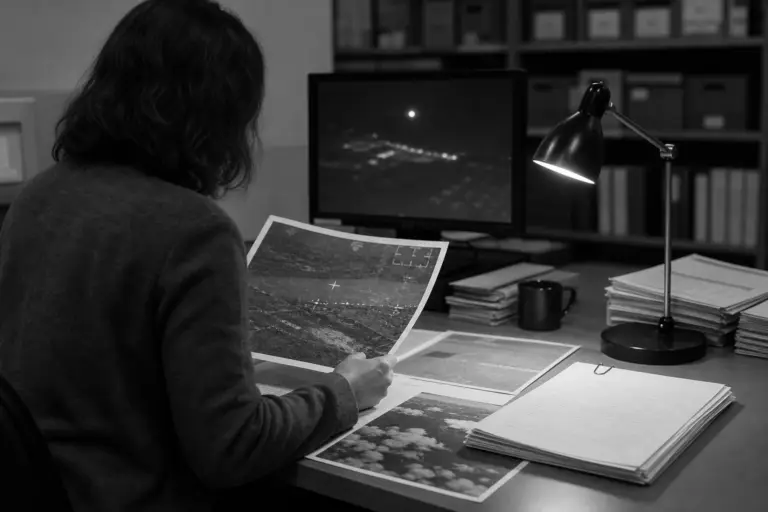
That boundary is hard to hold because UFO disclosure rhetoric often activates an older cultural vocabulary of hidden files, withheld knowledge, and a possible non-human presence. The grey face associated with Communion gives such speculation an immediately recognizable figure. A report about an ambiguous object or incomplete government record can therefore be mentally completed into a familiar scenario of secret recovery, alien intent, and concealed encounters, even when the material itself establishes none of those links.
A useful interpretive test is to separate an observation from the explanation attached to it. A strong claim identifies what evidence can support, an anomalous sighting, a sensor reading, or an unresolved record, while a weak claim treats uncertainty as proof of a particular alien narrative. Whitley Strieber’s Communion still matters in UAP disclosure conversations because it helped make the latter inference culturally intuitive. Government interest in unidentified phenomena may justify further inquiry, but it does not independently corroborate Strieber’s reported encounters, recovered memories, or implied account of who the visitors were.
Communion’s Lasting Influence Was a Storytelling Framework
Its endurance comes from compression: older motifs were gathered into a form that readers could readily recognize, retell, and adapt. The intimate “I” of the account made uncertainty part of the drama rather than a defect to be edited out; the Visitors supplied a name that preserved mystery; and the close-up face supplied an image that could stand in for an entire encounter. A disrupted night, a fragment of recall, an ambiguous presence, and an unresolved aftermath became a flexible structure for later alien abduction narratives.
That framework could travel across memoir, television, film, parody, and online testimony because it did not require agreement about a single explanation. It allowed fear and fascination, bodily vulnerability and cosmic speculation, to coexist. Its weakness as proof is inseparable from its strength as storytelling: recovered or hypnotically shaped memories may be vivid without independently establishing their cause.
Whitley Strieber’s Communion therefore matters less as a final answer to what occurred than as an explanation for the forms later accounts take. Its visual and narrative vocabulary still helps audiences imagine what an alien encounter looks and feels like, and helps turn uncertain material in UFO disclosure debates into a familiar story, without demonstrating that the story is factually true.
Frequently Asked Questions
What is Whitley Strieber’s Communion about?
Communion is Whitley Strieber’s 1985 first-person memoir about frightening, fragmented experiences involving mysterious beings he called “the visitors.” It centers on missing time, nighttime fear, uncertain memory, bodily vulnerability, and unresolved questions about what caused the experiences.
Is Communion considered nonfiction?
Yes. Communion was published by William Morrow in 1985 as a nonfiction personal account by novelist Whitley Strieber. Its memoir format presents his reported experiences, but personal testimony and hypnosis-based recollections are not independent proof of an external cause.
Did Communion create the modern image of grey aliens?
No. Small humanoid beings with large eyes appeared in earlier UFO lore and science fiction, but Communion helped standardize the modern grey alien image for a mass audience. Its cover emphasized a pale face, narrow chin, tiny mouth, minimal nose, and dominant black eyes.
How did Communion differ from earlier alien-abduction accounts?
Earlier contactee stories often portrayed visitors as cosmic teachers, while cases such as Betty and Barney Hill’s 1961 report and Travis Walton’s 1975 report had already introduced missing time, fear, and alleged abduction. Communion made those elements more intimate and emotionally ambiguous by using a first-person voice that did not settle on an extraterrestrial explanation.
What should you look for when separating UAP evidence from alien-abduction claims?
Separate the observation from the explanation: UAP evidence may document an unresolved sighting, sensor reading, or military record, while an abduction claim adds assertions about personal contact, memory, motive, and nonhuman intelligence. Look for independently assessable material or observational evidence, because uncertainty about an object does not verify recovered memories or alien encounters.