In late 1948, observers across the American Southwest described brilliant green lights racing through the night sky, reports vivid enough in color and unusual enough in apparent speed and direction to resist easy dismissal as routine aviation. The green fireballs 1948 accounts were not merely a local curiosity: they arose in a region dense with military activity and atomic-security interests, including New Mexico installations whose protection mattered deeply in the opening years of the Cold War.
That setting changed the question. A meteor-like display could be a natural event; a repeated, poorly understood aerial phenomenon near sensitive sites could also raise concerns about surveillance, weapons testing, or an unauthorized incursion. Air Force personnel, Atomic Energy Commission-connected officials, and scientists therefore treated the reports as an investigative problem rather than as proof of any one explanation.
This article separates the witnesses’ descriptions from the interpretations later placed upon them. It follows the 1948 reports, the official concern they prompted, and the subsequent 1949 Project Twinkle observation effort, which sought instrumented evidence rather than another collection of impressions. The surviving record documents real official interest and unresolved observations. It does not establish an extraterrestrial origin, a foreign device, or a concealed final answer.
Why the 1948 Green Fireballs Drew Official Attention
What made the reports consequential was their setting. During the final months of 1948, in the aftermath of the 1947 flying-saucer wave, accounts of intense green, fast-moving aerial lights clustered in New Mexico and elsewhere in the Southwest, a region where civilian communities, military airfields, weapons ranges, and atomic facilities occupied the same broad sky.
Los Alamos was not simply a nearby landmark. It was a principal center of the United States’ postwar atomic-weapons enterprise, while installations including Sandia Base and Kirtland Air Force Base placed major security interests around Albuquerque and northern New Mexico. In the early Cold War, an unfamiliar object reported near such places had to be considered in more than astronomical terms: it might conceivably bear on surveillance, unauthorized flight, foreign technology, or a security breach.
That possibility did not turn the Los Alamos green fireballs into evidence of an enemy craft or an extraterrestrial vehicle. It explains why official attention exceeded the ordinary handling of an isolated meteor report. Investigators faced a basic evidentiary problem: witnesses described a striking phenomenon, but visual testimony alone could not reliably establish an object’s altitude, speed, trajectory, origin, or purpose.
The historical importance of the green fireballs over the Southwest lies in that gap between concern and proof. The 1948 reports prompted serious inquiry, and the later 1949 Project Twinkle effort would seek better observations. Neither official interest nor incomplete records demonstrate a cover-up; both show that the question remained open.
What Witnesses Reported Seeing
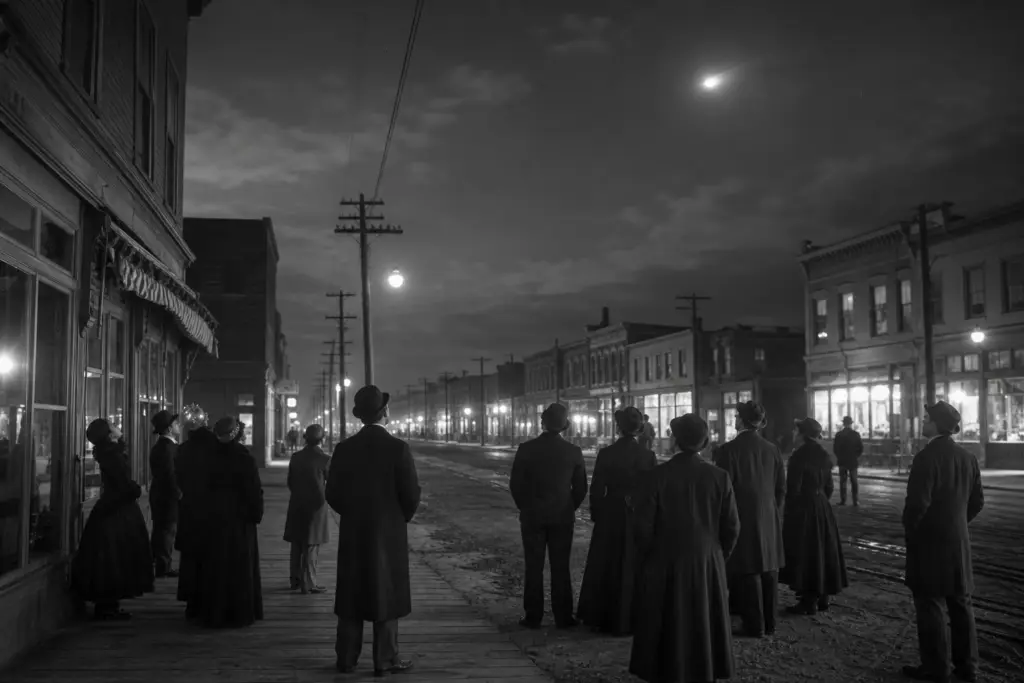
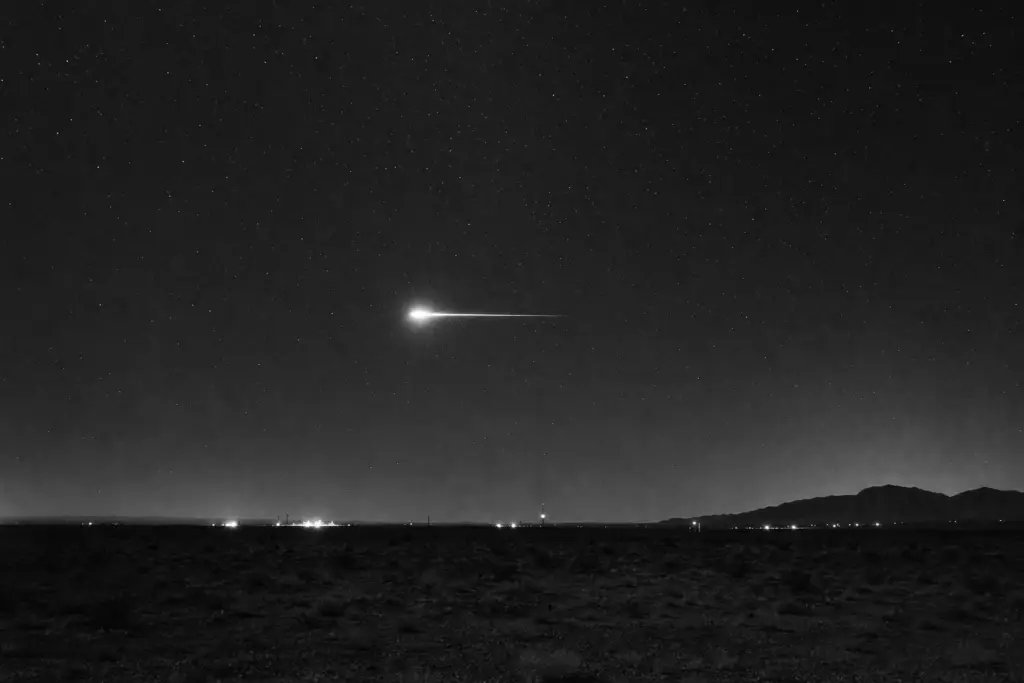
The common image in the reports was not a hovering disc or a distant, steady point of light. Witnesses described an intensely luminous green object or flare that appeared suddenly, crossed part of the sky quickly, and disappeared, often without the prolonged fading or visible fragmentation observers expected from an ordinary meteor. Many accounts also emphasized apparent level or shallow-angle travel rather than a steep plunge, and no obvious sound was reported.
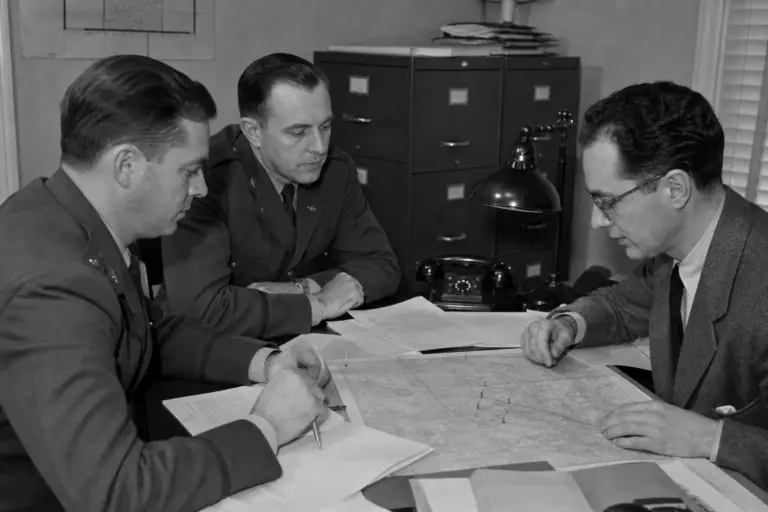
Those are observations: color, brightness, apparent direction, duration, and silence. They are not measurements. Later retellings of the green fireball sightings in New Mexico sometimes supplied precise speeds, heights, distances, or claims that the objects flew “horizontally.” Such language should be treated as an interpretation of what a person saw from one location, unless it rests on timed, multi-station, or instrumented observations.
Night viewing makes that distinction especially important. A bright light against a dark sky can look close when it is far away, large when it is small, or unusually fast when its distance is unknown. A witness can reliably recall that a green light moved across a familiar skyline; the same witness usually cannot derive its altitude or true velocity without a reference point. Likewise, an apparently flat path may reflect the observer’s viewing angle rather than an object traveling parallel to the ground.
Still, the recurrence of certain descriptive features gave the 1948 New Mexico UFO sightings their force: vivid green coloration, abrupt high-speed motion, broad visibility, and an appearance unlike routine aircraft lights. The reports established that people had seen something striking in the Southwestern night sky. By themselves, they did not establish what physical phenomenon produced it, or whether separate witnesses had seen the same kind of event.
Why the Air Force and Atomic-Energy Officials Took the Reports Seriously
For officials confronting the late-1948 reports, the immediate issue was not whether a witness had chosen the right label for a light. It was whether a fast, unidentified phenomenon reported near New Mexico’s military and atomic installations could represent foreign reconnaissance, an unannounced weapons or rocket test, an unauthorized aircraft, or another security problem requiring attention.
Those possibilities led to materially different responses. A meteor or other natural event could be scientifically puzzling without threatening an installation; an unidentified aircraft raised questions of airspace identification and military control; and a surveillance or weapons-related object raised the prospect that a strategic site was being observed or approached. The U.S. Air Force green fireball investigation thus treated “unidentified” as an operational problem awaiting attribution, not as evidence of an extraordinary craft.
The institutions had distinct stakes. Air Force command and intelligence channels received aerial reports relevant to defense and possible hostile activity. The Atomic Energy Commission oversaw the postwar atomic enterprise, while Los Alamos Scientific Laboratory personnel worked at the New Mexico laboratory associated with nuclear-weapons research and could contribute scientific knowledge of local observations. Their overlapping interests explain why an unusual light over the region could move beyond ordinary civilian curiosity.
That overlap should not be mistaken for proof of a single, fully integrated 1948 operation or a settled official verdict. The documented concern behind the green fireballs 1948 episode reflects the security climate around Los Alamos and other Southwestern defense assets. It justified collecting reports and seeking more discriminating observations; it did not establish foreign surveillance, a weapons test, an unauthorized aircraft, or an extraterrestrial origin.
Lincoln LaPaz, the Meteor Hypothesis, and Other Explanations
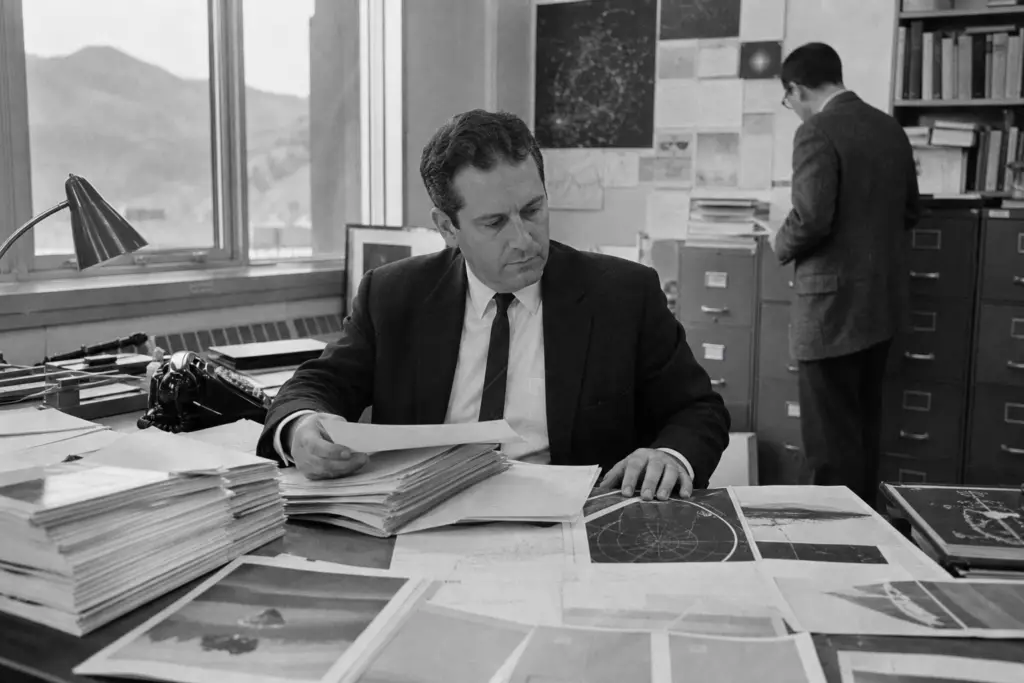
Lincoln LaPaz brought a different kind of expertise to the problem. A University of New Mexico meteoriticist, he was relevant because the reports involved apparent paths through the sky that could be compared with meteor-like phenomena. For LaPaz, a trajectory meant the object’s reported route, its apparent direction, angle, and course as reconstructed from more than one observer, not simply the impression left on a single witness.
The meteor hypothesis offered a straightforward starting point. A fireball meteor is an exceptionally bright meteor, while a bolide is commonly used for a particularly brilliant fireball, sometimes one associated with breakup or an apparent explosion. Such events can be startlingly luminous, can cross a large portion of the sky in seconds, and can show color. On that view, the reports could reflect natural objects entering the atmosphere under viewing conditions that made their speed, distance, and angle difficult to judge.
But the features that interested LaPaz and other participants were the reported green color, the apparently shallow or nearly level paths, the absence of conspicuous fragmentation in some accounts, and the impression that certain objects remained visible longer than an ordinary meteor. Those features did not automatically rule out a natural bolide: eyewitness estimates of altitude, direction, duration, and velocity are vulnerable to error, especially at night. They did, however, make a simple one-sentence identification feel unsatisfactory to investigators trying to reconcile separate reports.
Other possibilities, aircraft, rockets, flares, or an unknown artificial device, addressed different parts of the testimony but required their own supporting evidence. The useful distinction is between an observation that remains unexplained and proof of a particular cause. Lincoln LaPaz’s involvement shows that the green fireballs were examined against meteor science; it does not convert the remaining anomalies into evidence of non-human intelligence.
From Initial Reports to Project Twinkle
The next step was methodological rather than interpretive. The late-1948 reports had produced descriptions that could be compared and debated, but they could not reliably establish an object’s altitude, speed, direction, or physical nature. A 1949 follow-on, Project Twinkle, was intended to change that evidentiary position by seeking instrumented observation instead of depending solely on recollection after a brief nighttime event.
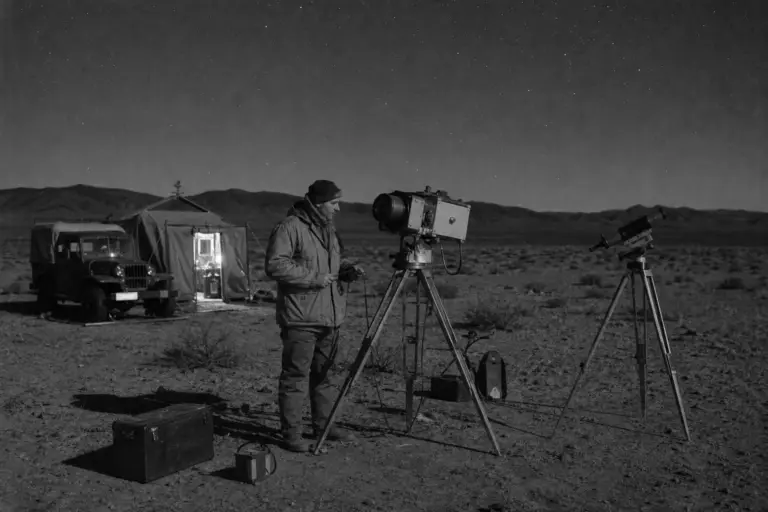
Its practical objective was to catch a recurrence with equipment capable of preserving measurements. Photographic coverage could provide a lasting record of brightness, shape, and apparent path. Observations from separated stations could be compared to triangulate a position: each station supplies a line of sight, and the intersection of those lines can estimate where the object was. That approach offered a stronger test than a single compelling account, while still depending on accurately timed, coordinated observations.
The distinction matters because photographs and triangulation answer different questions. A photograph may document that a luminous event occurred but, by itself, may not determine distance. Two or more synchronized observing points can improve distance and trajectory estimates, but only if the same event is identified at each point. Project Twinkle therefore represented an effort to turn a disputed class of reports into data that could discriminate more effectively among meteor, aircraft, rocket, flare, and other explanations.
Administratively, Project Twinkle belonged to the wider early Air Force effort to handle unidentified aerial reports, alongside the period associated with later Air Force UFO-investigation frameworks, but it was not simply another file-review exercise. Its emphasis was observational: obtain a record during the event. The surviving historical significance of the effort lies in that shift from witness narratives to attempted measurement, not in a demonstrated solution to the green-fireball reports.
What the Surviving Record Establishes, and What It Does Not
The evidentiary line is clear even if the explanation is not. The surviving record supports that multiple unusual aerial reports were made in 1948, that military and scientific personnel treated them as worth reviewing, and that the response extended to the 1949 effort to obtain better observations. It supports an investigation into unexplained aerial observations, not a finding that investigators had identified a particular object.
The strongest material is contemporaneous: reports, correspondence, and plans reveal what people described, what possibilities officials considered, and what information they lacked at the time. Later UFO literature can preserve leads and recollections, but it cannot turn an interpretation into a measured result. A good historical signal is a dated record tied to a named participant or action; a weak one is a later claim that supplies no original report, photograph, or chain of custody.
Most importantly, the available material does not provide decisive photographs, radar tracks, successful triangulation, recovered debris, or reproducible physical evidence that would establish altitude, speed, composition, or origin. That gap leaves room for competing interpretations, including unusual meteoric phenomena and an unidentified artificial object, but it does not validate either one.
Nor do declassified records establish a confirmed foreign weapon, extraterrestrial craft, a Roswell connection, or a demonstrated government UFO cover-up. Incomplete instrumentation and uneven preservation of records explain why the episode remains unresolved; they are not affirmative proof of any of those conclusions.
The Green Fireballs’ Place in Early UAP History
Its lasting value is methodological as much as mysterious. The green fireballs 1948 episode belongs to the formative history of Air Force handling of unexplained aerial reports because officials moved from witness accounts and security concern toward an attempt at instrumented observation in 1949. That progression shows an institution confronting a potentially important problem without yet possessing data sufficient to identify it.
For readers following UFO news or debates over UAP disclosure, the case offers a useful historical discipline also reflected in a later major U.S. scientific review of UFO evidence: official attention is evidence that a report was taken seriously, not evidence that its most dramatic proposed explanation was established. National-security stakes, scientific uncertainty, and an incomplete record can all be true at once.
The fireballs therefore remain significant for what is documented, the striking observations, the official concern, and the effort to improve collection, not for an answer the surviving evidence cannot supply. They are an unresolved early Cold War case, not verified proof of extraterrestrial craft, a foreign weapon, or concealment.
Sources
- AARO Historical Record Report, Volume 1
- CIA Reading Room Robertson Panel evidence list referencing Project Twinkle
Frequently Asked Questions
What were the green fireballs seen over New Mexico in 1948?
Witnesses reported intensely bright green lights that appeared suddenly, crossed the sky rapidly, and vanished without obvious sound or fragmentation. The reports clustered around New Mexico and the Southwest near military, atomic, and civilian sites.
Did the U.S. Air Force investigate the 1948 green fireballs?
Yes. The Air Force, Atomic Energy Commission-connected officials, and scientists reviewed the reports because they occurred near sensitive installations including Los Alamos, Sandia Base, and Kirtland Air Force Base. Officials considered possibilities such as meteors, unauthorized aircraft, rockets, foreign surveillance, and other security concerns.
Was Lincoln LaPaz involved in the green fireball investigation?
Yes. Lincoln LaPaz, a University of New Mexico meteoriticist, examined the reports using meteor science and attempted trajectory reconstruction from multiple observers. He focused on reported features including green color, shallow paths, long visibility, and limited apparent fragmentation.
What was Project Twinkle and why was it created?
Project Twinkle was a 1949 observation effort created to obtain instrumented evidence of recurring green fireballs. It sought photographic records and coordinated observations from separated stations, which could use triangulation to estimate an object’s position, altitude, and trajectory.
Were the 1948 green fireballs meteors or UFOs?
The surviving evidence does not conclusively identify them as either meteors or artificial craft. Bright fireball meteors and bolides can be colorful, luminous, and visible for seconds, but the record lacks decisive photographs, radar tracks, successful triangulation, recovered debris, or reproducible physical evidence to establish origin.