On an October night in 1948, North Dakota Air National Guard pilot George F. Gorman flew his small aircraft above Fargo and pursued a bright, fast-moving light he could neither identify nor outmaneuver. The episode became known as the Gorman Dogfight: a vivid pilot report, not a demonstrated encounter with an extraterrestrial craft.
Its importance lies in the record’s competing layers. Gorman described close approaches, turns, climbs, and dives; other people reported seeing a light from the ground and airport personnel had their own observations. Those accounts establish that an unusual aerial report was investigated. They do not independently confirm every maneuver Gorman experienced from the cockpit, nor do they establish what the object was.
This article follows that distinction through the 1948 Fargo encounter: Gorman’s testimony, the outside observations, and the Air Force investigators’ conclusion that a weather balloon best accounted for the light. It also places the case in sequence with Project Sign and Project Grudge, the earlier Air Force efforts that handled such reports, before Project Blue Book began in 1952. The Gorman case helped shape that investigative environment; it was not shown to be a sole, direct cause of Blue Book.
The Gorman Dogfight: A 1948 Fargo Case That Still Needs Careful Framing
The institutional chronology is essential to reading this case accurately. Project Blue Book did not investigate the Fargo report: it began in 1952, years after the October 1, 1948 encounter. The relevant early Air Force setting was Project Sign, followed by Project Grudge, not the better-known program that later inherited much of the public memory of military UFO inquiries.
That distinction changes the question the record can answer. A pilot’s account of a light moving in relation to his aircraft is evidence of what he reported experiencing; tower personnel or ground observers seeing a light can support the narrower proposition that something visible was present. Neither category, by itself, establishes an extraordinary craft, its performance, or its origin.
The Gorman Dogfight therefore deserves neither a dismissive shorthand nor a supernatural conclusion. The account that follows separates Gorman’s reported pursuit from observations available to others, then weighs the Air Force’s balloon explanation against the features it was intended to explain. Finally, it follows the institutional path from Sign through Grudge to Blue Book: a developing investigative system shaped by many reports and pressures, rather than a single Fargo incident that demonstrably caused Blue Book’s creation.
Who George F. Gorman Was and What He Reported Over Fargo
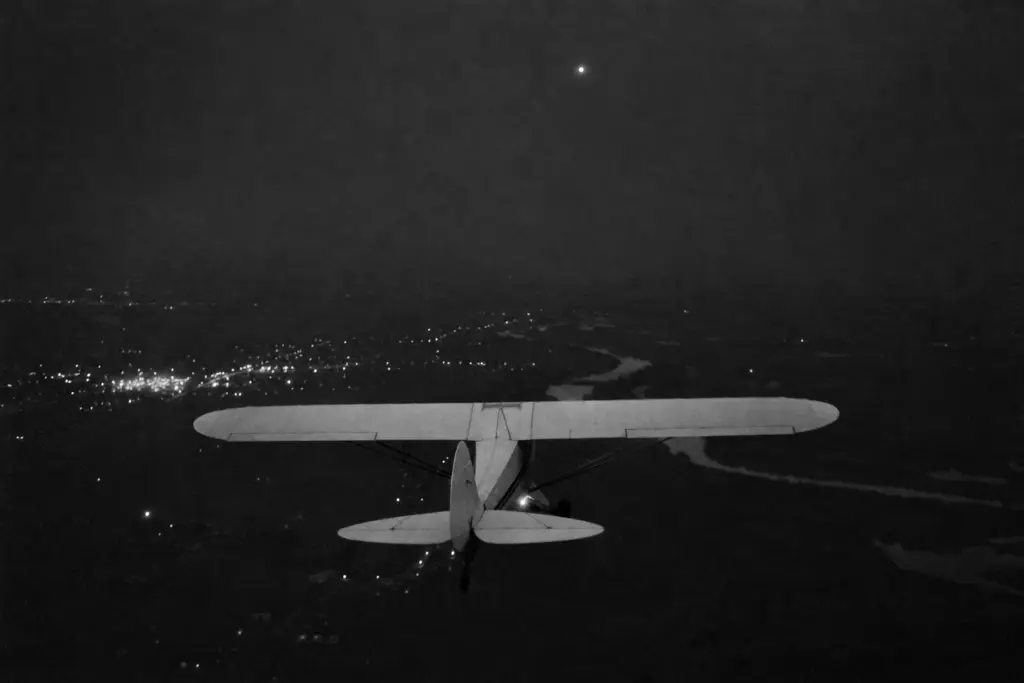
After an evening cross-country flight on October 1, 1948, George F. Gorman was returning toward Fargo in a Piper Cub. He later gave the detailed personal account on which the encounter’s aerial sequence depends; it is not a record of independently measured speed, altitude, or maneuvering by another aircraft.
Gorman served with the state’s air guard and was among military aviators who reported UFO/UAP encounters, seeing a bright, round light below and ahead of his airplane after contacting the Fargo control tower about nearby traffic. He described turning toward it to investigate. In his account, the light appeared to respond to his approach: it climbed, turned sharply, and at times seemed to close on his aircraft or pass above it. Those observations are central to the Gorman Dogfight, but they remain a pilot’s perceptions from a moving aircraft at night rather than instrument-verified performance data.
His statement portrayed repeated attempts to gain position on the light. He recalled banking and climbing toward it, only to find its apparent direction or relative height changing abruptly. At one point, he said, the light passed close over the Piper Cub before moving away. Gorman could directly describe his control inputs, visual impressions, and difficulty maintaining orientation; he could not directly determine the light’s distance, size, velocity, or whether its apparent motion reflected its movement, his own movement, or both.
Near the end of the episode, Gorman reported becoming disoriented and physically unsettled while trying to follow the light. He ended the pursuit and returned toward Fargo. His testimony supplies the dramatic sequence and his sense of an extended aerial contest, but it does not by itself establish that an independently observed craft performed the same turns or possessed the exceptional capabilities later retellings often assign to it.
Corroboration and Limits: The Tower, Ground Witnesses, and the Unidentified Light
The strongest point of outside support is narrower than the pursuit narrative: other people reportedly saw a light in the Fargo-area sky. Control tower witnesses and observers on the ground, including reports from the Moorhead side of the Red River, could corroborate that a visible nighttime phenomenon was present. That matters because it means the episode was not solely a private cockpit impression.
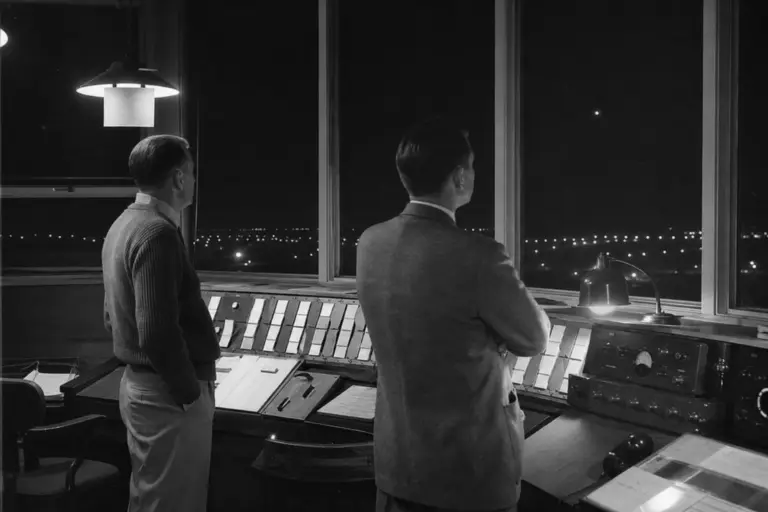
It does not, however, turn every element of Gorman’s account into a shared observation. Tower personnel viewing from a fixed location and ground witnesses looking upward had a different vantage point from a pilot banking, climbing, and changing heading. Nearby aircraft traffic could help establish that other airplanes were in the area, but it would not by itself establish that another crew tracked the same light through the sequence Gorman described.
The distinction is especially important at night. A bright point without a known distance reference can be seen clearly while still being difficult to place in three dimensions. Its apparent size may reflect brightness rather than physical dimensions; apparent acceleration may result from the observer’s own movement, a change of viewing angle, or both. A light that seems to cross an aircraft’s path can therefore be real and independently visible without yielding a reliable measurement of its range, altitude, or speed.
Corroboration of an unidentified light is consequently a good signal that an observation deserves investigation, not independent proof of an object’s extraordinary maneuvering or origin. The later inquiry had to account for both layers: the shared report of a light and Gorman’s much more detailed interpretation of its behavior.
What Air Force Investigators Concluded: The Weather Balloon Explanation
The official assessment treated the reported light as a likely weather balloon rather than as another aircraft or an unknown machine. That conclusion depended on a reconstruction: investigators compared the time and place of the sightings with balloon-release information, local weather conditions, and the way a sunlit or otherwise brightly illuminated balloon could appear against a dark sky.
A weather balloon is a small instrument-carrying balloon released to gather atmospheric observations as it rises and drifts with the wind. Its practical importance in this case is that it need not look like a conventional aircraft. At an uncertain distance, a reflective balloon can register chiefly as a bright point of light; its altitude, range, and direction of travel may be difficult for an observer to judge from appearance alone.
The Air Technical Intelligence Center’s reasoning therefore addressed the shared observation, a light visible over the Fargo area, more directly than it could test every element of Gorman’s pursuit. Balloon-release and weather information could supply a candidate object in the relevant airspace, while nighttime viewing conditions offered a mechanism by which relative motion, changing headings, and changes in illumination might create striking apparent movement. That is the evidentiary core of the weather balloon explanation: a known object, a plausible route into the observation, and perceptual conditions that limited reliable estimates of distance and speed.
It is important not to turn that finding into a caricature of Gorman’s experience. The conclusion did not create a measured flight path for the light, nor did it independently establish that each reported turn, climb, or close approach occurred exactly as it seemed from the Piper Cub. It was an investigative judgment about the most likely identity of the visible object on the information then available.
The useful distinction is between identifying a plausible stimulus and reproducing a witness’s full interpretation of its behavior. The former is what the U.S. Air Force UFO investigation sought to do here; the latter would have required instrumented tracking or other evidence the case record did not provide.
How the Case Fits the Road From Project Sign and Grudge to Project Blue Book
The Fargo investigation belonged to an emerging administrative problem for the U.S. Air Force: how to receive, assess, explain, and retain reports of aerial phenomena that witnesses, sometimes including military personnel, could not immediately identify. The issue had intensified after pilot Kenneth Arnold’s widely publicized 1947 sighting near Mount Rainier, which was followed by a broader wave of reports. An individual case could be assigned a conventional explanation and still add to the institutional demand for a consistent method of inquiry.
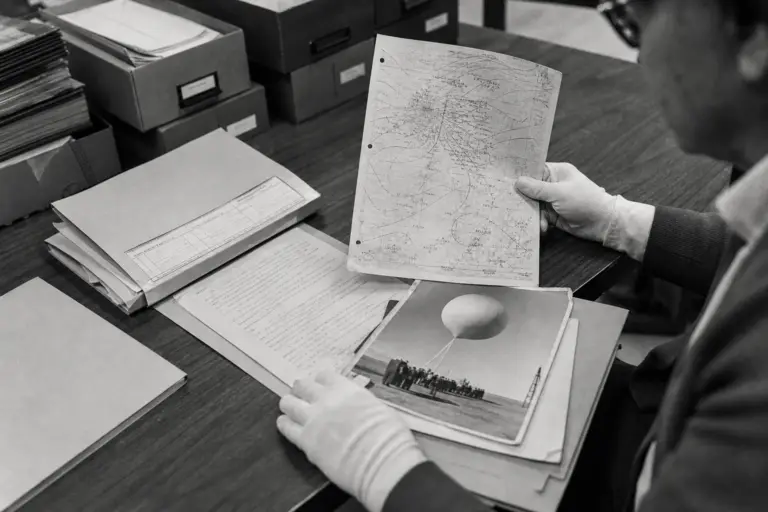
Project Sign, created in 1948, was the Air Force’s first organized effort to study such reports. Its purpose was investigative rather than merely archival: personnel gathered accounts, compared them with possible aircraft, balloons, astronomical objects, and other known causes, and considered whether any report suggested a threat or technology not yet understood. The Gorman Dogfight entered that early environment. Its combination of a trained pilot’s detailed testimony, additional reports of a light, and a proposed balloon identification made it the sort of file that tested both the possibilities and limits of the new process.
In 1949, Project Grudge succeeded Sign. The change matters because the projects were not interchangeable labels: each reflected a different phase of Air Force handling of a continuing stream of reports, with Grudge taking a more skeptical approach to many sightings while continuing to collect and evaluate them. The Fargo case was therefore part of a developing record base, not a stand-alone event whose interpretation could settle the wider question.
Project Blue Book began in 1952, so it did not investigate the October 1948 Gorman incident as a contemporary case. It inherited the broader institutional problem left by its predecessors: recurring public and military reports, pressure for explanations, and the need to distinguish identifiable objects from cases lacking enough information for a firm conclusion. It is fair to say that the Gorman Dogfight helped shape the investigative climate in which that continuing mission developed. There is no demonstrated basis, however, for claiming that this one encounter directly created Project Blue Book; its historical significance lies in its place within the larger sequence from Sign to Grudge to Blue Book.
What the Gorman Dogfight Can, and Cannot, Tell Us About UFO Disclosure Today
A durable reading of the October 1, 1948 Fargo file begins with provenance: identify who created each item, its date, and its investigative purpose. The National Archives Catalog is a practical starting point for Air Force UFO holdings; searches for “George F. Gorman,” “Fargo,” “Project Sign,” and “Project Grudge” can help readers distinguish a 1948 statement or memorandum from a later summary. Preserve the series title, originating office, and date when comparing scanned copies or quotations.
The essential archival distinction is between the Fargo material assembled during the Project Sign era and the records of Project Blue Book, which began in 1952. A contemporaneous account of Gorman’s Piper Cub flight, tower observations, balloon-release information, or an Air Technical Intelligence Center assessment bears on what investigators considered after the sighting. Digitized Blue Book collections, including material reproduced from National Archives holdings, are most useful for tracing the later program’s procedures and case-handling history, not for relabeling the 1948 inquiry as a Blue Book investigation.
Strong document-based research keeps three evidentiary layers separate: Gorman’s reported pursuit of a light; the more limited reports by Fargo-area tower personnel and ground witnesses that a light was visible; and the Air Force reconstruction that treated a weather balloon as the likely stimulus. A weak account turns those distinct records into a claim that extraordinary maneuvers were independently measured, or treats the absence of such measurements as proof of concealment.
That discipline remains useful in modern UFO disclosure and UAP records access and disclosure debates. Historical UAP records can reveal how early Cold War officials balanced a National Guard pilot’s testimony, possible physical explanations, and public attention, but the surviving file cannot create radar tracks, photographs, or instrument readings that were never collected in 1948. Its value is methodological: follow the dated record, identify what each document can establish, and leave uncertainty where the evidence ends.
Why the Gorman Dogfight Remains a Useful UFO Case Study
The case’s enduring value lies in the way its evidence resists being flattened into a single verdict. George Gorman’s account preserves a skilled pilot’s detailed perception of pursuit and evasive movement; tower and ground observers support the narrower proposition that a light was visible; neither category independently measures the light’s speed, distance, or maneuvers. That distinction is the central discipline required by the Gorman Dogfight.
The Air Force’s weather-balloon conclusion should likewise be read as an explanatory reconstruction, not as a record of every sensation Gorman described from the Piper Cub. It offered a conventional candidate for the observed light and a way to relate the report to atmospheric conditions. Its strength is that it addressed a real reported stimulus; its limit is that a nighttime reconstruction cannot fully reproduce a witness’s changing perspective, workload, and interpretation during flight.
Historically, the episode shows an early military UFO investigation working with testimony, partial corroboration, and incomplete physical evidence. Project Sign handled the 1948-era problem, Project Grudge followed in 1949, and Project Blue Book began in 1952. Fargo was not a demonstrated sole trigger for Blue Book, but it belonged to the sequence of cases that made a continuing Air Force process necessary, and illustrates why uncertainty is not, by itself, proof of either concealment or an extraordinary craft.
Frequently Asked Questions
What was the Gorman Dogfight of 1948?
The Gorman Dogfight was an October 1, 1948 aerial sighting near Fargo, North Dakota, in which Air National Guard pilot George F. Gorman pursued a bright light while flying a Piper Cub. Gorman reported that the light climbed, turned, and appeared to approach or pass over his aircraft.
Who was George Gorman and what did he report seeing over Fargo?
George F. Gorman was a North Dakota Air National Guard pilot returning to Fargo after a cross-country flight on October 1, 1948. He reported seeing a bright, round light below and ahead of his Piper Cub and trying unsuccessfully to maneuver into position behind it.
Did other witnesses see the light during the Gorman Dogfight?
Yes, Fargo control tower personnel and ground observers, including people on the Moorhead side of the Red River, reportedly saw a light in the sky. Their observations supported the presence of a visible light but did not independently verify Gorman’s reported turns, climbs, speed, or close passes.
What was the Air Force explanation for the Gorman Dogfight?
Air Force investigators concluded that the light was most likely a weather balloon. They compared balloon-release information, weather conditions, and nighttime viewing effects, finding that a reflective or illuminated balloon could appear as a bright light with difficult-to-judge distance, altitude, and motion.
Was the Gorman Dogfight investigated by Project Blue Book or Project Sign?
The 1948 Fargo case belonged to the Project Sign era, because Project Blue Book did not begin until 1952. The encounter helped shape the broader Air Force investigative environment that progressed from Project Sign in 1948 to Project Grudge in 1949 and Blue Book in 1952, but it was not the sole direct cause of Blue Book.