Gordon Cooper’s Faith 7 flight was one of the defining missions of Project Mercury. On 15 and 16 May 1963, Cooper completed 22 Earth orbits and spent more than 34 hours in space. He conducted experiments, photographed Earth, dealt with deteriorating spacecraft systems and performed a manual reentry that ended within sight of the recovery carrier.
A different story later attached itself to the mission. In popular UFO retellings, Cooper is said to have encountered a glowing green object near Australia, sometimes with a red tail and sometimes with confirmation from the Muchea tracking station. The story sounds precise because it uses a real astronaut, a real mission and a real tracking site. The surviving mission record, however, tells a materially different story.
NASA’s transcript and postflight debriefing record Cooper observing greenish particles known as ‘fireflies.’ They appeared to emanate from the spacecraft and drift behind it. The record contains no UFO or unidentified-object report, and the conversations with Muchea concern ordinary mission operations and recognizable lights on Earth. Decades later, Cooper expressly denied that he had seen a UFO during his Mercury flight.
What NASA recorded about Faith 7
Faith 7 was the final crewed mission of Project Mercury. NASA’s mission page gives the basic chronology: launch on 15 May, landing on 16 May, 22 orbits and a flight lasting roughly a day and a half. A later NASA history describes 11 experiments, the first television transmission from an American crewed spacecraft and a sequence of system problems near the end of the mission.
Those problems were real and well documented. A faulty indication appeared during the nineteenth orbit. Later, an electrical short disabled the automatic stabilization and control system. Cooper used his window markings, a wristwatch and manual controls to orient the capsule and time reentry. Faith 7 splashed down near USS Kearsarge after what NASA judged a successful mission.
The site’s broader UAP timeline separates documented mission events from claims added later. Faith 7 provides an unusually good test because NASA published both flight communications and immediate postflight recollections.
The record is more than a short radio transcript
NASA’s June 1963 postlaunch memorandum includes essentially unedited flight communications, Cooper’s self-debriefing and a formal technical debriefing conducted aboard the recovery carrier. The self-debriefing was recorded soon after the flight, when recall was fresh. NASA cautioned that later engineering data could supersede Cooper’s impressions about technical malfunctions, but the document remains a near-contemporary account of what he saw and did.
The separate composite transcript explains that it combines the onboard recording with Mercury network station tapes. It says the text is otherwise verbatim after noting limited removals of non-flight-related or repetitive material. That qualification matters. No transcript can prove that a person never had an unrecorded thought or observation. What it can show is whether the claimed event appears in the official mission communications and debriefing.
Searches of the published report find no ‘UFO’ or ‘unidentified’ report. More importantly, the passages often used to give the later story its color and location have identifiable, ordinary contexts in the record.
The greenish objects Cooper actually described
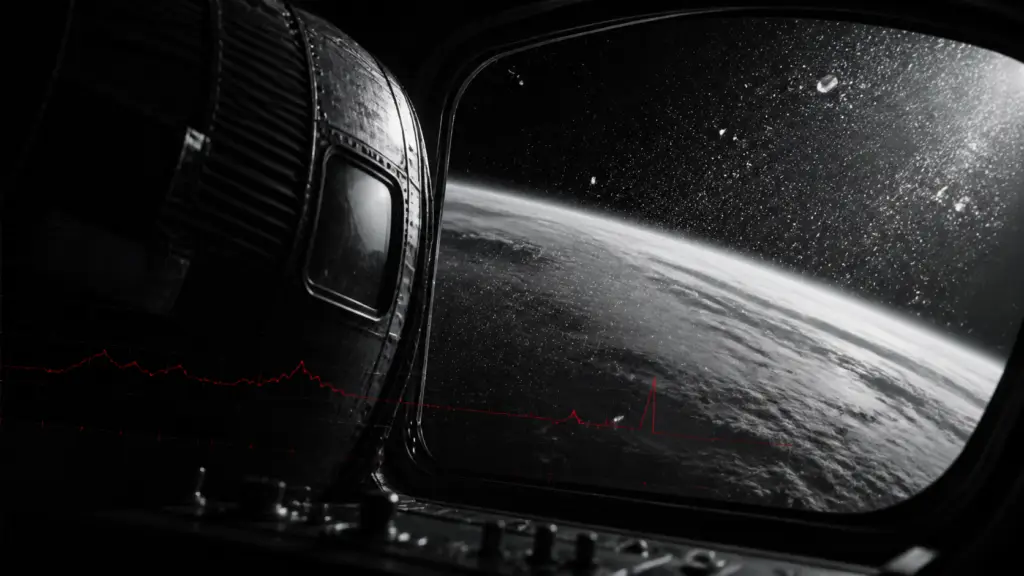
During his immediate self-debriefing, Cooper discussed the visual phenomena around orbital sunrise. He said he saw what John Glenn had called fireflies. Cooper described them as greenish at first, becoming whiter and brighter as illumination increased. He also said they appeared to emanate from the spacecraft and travel backward along its flight path.
This was not an unexplained craft approaching Faith 7. It was a known Mercury-era visual phenomenon. NASA’s history of John Glenn’s Friendship 7 mission identifies the fireflies as ice particles traveling with the spacecraft and illuminated by the rising Sun. Scott Carpenter later explained in a NASA oral history that he could produce more particles by striking the capsule wall, revealing them as frost or ice shaken loose from the exterior.
A NASA history of Faith 7 similarly says Cooper observed Glenn’s fireflies or Carpenter’s frostflies near sunrise as they drifted alongside the spacecraft. The contemporary debriefing and later technical explanation therefore agree on the core point: Cooper saw illuminated particles associated with the capsule.
This may help explain how a story about a ‘green object’ could sound plausible when detached from the full record, but that proposed genealogy is an inference, not a proven chain of copying. What is demonstrable is that the mission report’s greenish phenomenon was plural, particle-like and described by Cooper as moving away from the spacecraft.
What happened over Muchea
Muchea, north of Perth in Western Australia, was part of Mercury’s worldwide tracking network. It appears repeatedly in the transcript because Faith 7 passed within communication range on multiple orbits.
On the first pass, Cooper reported lightning and thunderstorms west of the station. The Muchea communicator requested a blood-pressure reading, checked cabin and suit temperatures, performed an emergency voice test and sent an alarm-check command. The ground then told Cooper that Perth had turned on its lights, and he reported seeing them. He separately identified a refinery flame to the south.
There is no report in that sequence of a green object, a red-tailed craft or a radar track chasing the capsule. Later Muchea passes similarly contain status reports, telemetry, recovery timing and routine conversation. At one point the station asked whether Cooper had anything further to report; he answered that everything was fine.
The mission record also contains genuine unusual-looking observations—airglow, a white haze layer, stars fading behind it, city lights and the firefly particles. Treating every unfamiliar visual effect in early spaceflight as a UFO would erase the careful identifications Cooper and NASA made.
Cooper’s own later denial
Cooper did become publicly associated with UFO claims from other periods of his life. He discussed sightings while serving as an Air Force pilot and a reported 1957 film incident at Edwards Air Force Base. The evidentiary merits of those separate stories do not answer what happened aboard Faith 7.
Crucially, Cooper rejected the claim that he had seen a UFO during Mercury-Atlas 9. Reporting published in 1999 quoted him denying the orbital UFO story and calling it untrue. A 2000 collectSPACE interview and review also distinguished his broader UFO interests from sensational claims that Mercury itself involved an alien encounter.
This produces an uncommon degree of convergence. The official mission record contains no such encounter. The potentially confusing green visual phenomenon is explicitly described as firefly-like particles from the spacecraft. The claimed tracking-site location has routine communications preserved. And the astronaut at the center of the story denied that the Mercury UFO event happened.
Cooper’s willingness to endorse other UFO ideas makes that denial especially important. It cannot reasonably be dismissed as a blanket refusal to discuss the subject. He accepted some extraordinary interpretations while rejecting this specific one.
Absence from a transcript: what it proves and what it does not
Evidence-first analysis should avoid two opposite mistakes. The first is to claim that anything missing from an official file must have been covered up. That approach makes a theory impossible to test: every missing record becomes supporting evidence. The second is to claim that an official transcript is metaphysically complete and rules out every unrecorded perception.
The defensible conclusion is narrower. The public NASA record does not substantiate the claimed Faith 7 UFO encounter. The report includes communications, immediate self-debriefing and technical discussion detailed enough to record minor visual observations. Its greenish objects have a specific particle explanation. Muchea’s recorded exchanges do not supply the alleged confirmation. Cooper later denied the story.
Anyone asserting that a separate encounter occurred therefore needs affirmative evidence independent of the story itself: a contemporaneous log, a tracking record, an audio segment, a named controller’s near-contemporary statement or another verifiable artifact. None of the primary NASA sources cited here provides that evidence.
Why names and credentials are not enough
Cooper was an accomplished test pilot and astronaut. His skill and service record establish that he was capable of careful observation. They do not make every claim attributed to him authentic, nor do they convert separate later statements into events on a particular mission.
The same rule applies to every high-profile witness. The site’s guide to evaluating a UAP claim asks whether the claim can be located in the earliest record, whether later versions add details and whether independent evidence supports those additions. Its methodology page explains why a witness’s credibility and a claim’s documentary support are related but distinct questions.
For another case in which later retellings must be compared with surviving government documentation, see the analysis of the Barry Goldwater access story. The lesson is not to distrust every participant. It is to attach each conclusion to the evidence that actually supports it.
The verdict
Faith 7’s documented story is already remarkable. Cooper flew the longest American space mission then attempted, performed experiments, observed unfamiliar orbital phenomena, overcame serious control-system failures and brought the capsule home manually.
The later Mercury-UFO claim is not part of that documented achievement. NASA records Cooper’s greenish fireflies, explains their relationship to the spacecraft and preserves normal Muchea communications. It does not record an unidentified craft tracked near Australia. Cooper later denied seeing a UFO on the mission.
The case is therefore best classified not as an unresolved Faith 7 encounter, but as a later retelling contradicted by the available mission record and by the astronaut’s specific denial. Cooper’s other UFO statements should be evaluated separately, on their own sources, dates and evidence.
Sources
- https://www.nasa.gov/history/mission-transcripts-mercury-gemini-and-apollo/
- https://www.nasa.gov/wp-content/uploads/2026/01/ma09-tec.pdf
- https://www.nasa.gov/wp-content/uploads/2026/01/ma09-te2.pdf
- https://www.nasa.gov/mission/mercury-atlas-9-faith-7/
- https://www.nasa.gov/history/fifty-five-years-ago-faith-7-closes-out-project-mercury/
- https://www.nasa.gov/history/60-years-ago-john-glenn-the-first-american-to-orbit-the-earth-aboard-friendship-7/
- https://www.nasa.gov/wp-content/uploads/2025/07/carpenterms-1-27-99.pdf
- https://www.collectspace.com/news/news-071700a.html
- https://www.isgp-studies.com/misc/UFOs/press-reports/2000-07-30-space-com-pioneering-astronaut-sees-ufo-cover-up