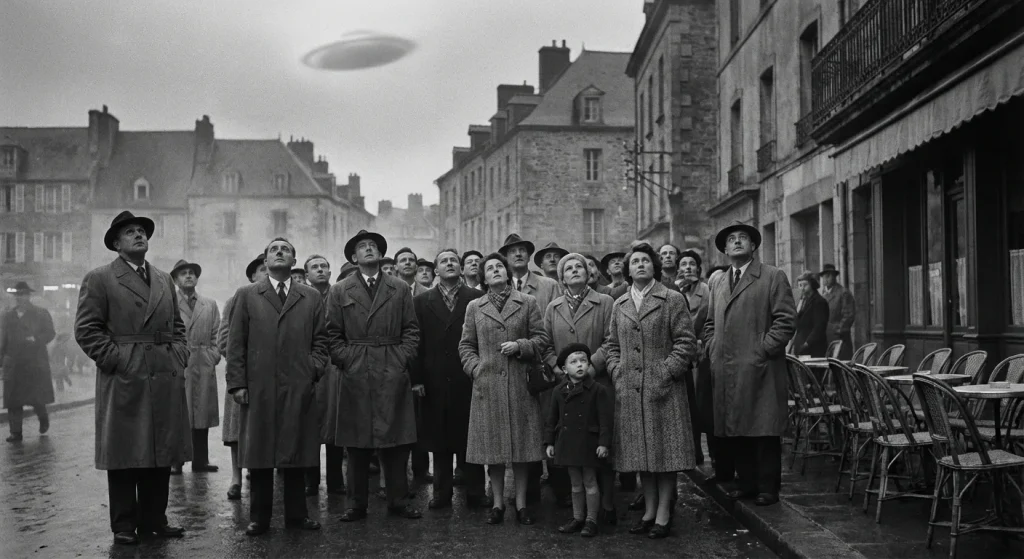
If you’re tracking UFO news and UAP news right now, the hardest part isn’t finding stories. It’s separating signal from hype while the same claims ricochet across platforms. France’s 1954 wave offers a clean stress test for that problem: at the peak, France was associated with a tally of 84 reports on a single day. Catalogs that compile midcentury reporting list two peak dates in October 1954 — October 3 and October 14 — each recorded as 84 reports in the NICAP tabulation of the 1954 worldwide wave (NICAP, “The Wave of 1954”). These are counts of reports relayed through press and cataloging channels, not counts of distinct, independently verified objects; NICAP’s published tally does not specify how duplicates or wire reprints were handled in producing the number (see NICAP report).
The frustration is predictable. Big numbers get repeated without sourcing discipline, and the frame quietly shifts from “reports” to “alien disclosure,” as if attention itself were evidence. Language drives that drift. “UFO” is a public label that invites readers to supply a story about what the object was; “UAP,” the newer official phrasing, narrows the claim to what matters for analysis: an observation that remained unidentified at the time, not a conclusion about origin.
The tradeoff the 1954 spike exposes is simple and uncomfortable: mass attention generates real data and real distortion at the same time. A high-volume day can preserve witness statements, press summaries, and investigative notes, while also amplifying rumor, copycat reporting, and retrospective embroidery.
This article separates what’s documented from what’s later mythologized by tracking reporting pipelines first, then interpretations second. Mid-century reporting spread fast through major wire services such as AP, UPI, and AFP, which meant local accounts could become national talking points within a single news cycle. Investigators and later commentators judged many individual 1954 sightings to have likely conventional explanations such as aircraft or astronomical lights; contemporary and later compilers emphasize a mixture of conventional and unresolved cases rather than a single, uniform cause (see Complete France overview and CNES GEIPAN background). Both facts can be true at once, and the point is to keep them in their proper lanes: what was claimed, what was checked, what was explained, and what remained unresolved.
A “UFO wave” is how spikes like this happen: attention creates feedback loops that pull more eyes upward, increase reporting, and raise the risk of interpretive contagion. The goal here is practical: evaluate wave headlines-whether in 1954 or in modern UAP disclosure debates-using sourcing, counting discipline, and institutional context, without defaulting to debunking or belief. To see how a single-day number like 84 becomes possible, start with the conditions that made 1954 unusually receptive to sky stories.
Why 1954 Was a Perfect Storm
The 1954 French surge was not an isolated curiosity. It was a predictable outcome of a high-attention environment colliding with fast news distribution, where tension primed people to scan the sky and repetition converted scattered anecdotes into a national wave.
By 1954, Europe was running hot on uncertainty: borders, alliances, and military posture were actively being renegotiated in public view, and ordinary life still carried the psychological residue of World War II. That matters because UFO waves are sustained by attention, not just by events. When large numbers of people expect disruption, ambiguous sights get interpreted through the most available frame, and the most available frame in 1954 was the sky as a theater of threats and secrets. High-visibility diplomatic travel and press attention around European capitals during that period added to the general atmosphere of heightened noticeability.
France in 1954 was living under a genuinely new sky: faster aircraft, brighter navigation lights, and more routine military flying made “something moving” a normal stimulus. Novelty creates miscalibration. A light that would have been dismissed in 1934 became, by 1954, a question: jet, bomber, exercise, foreign? That question alone is enough to elevate a fleeting observation into a report-worthy event, especially when the public is already sensitized to the idea that the next surprise could arrive from above.
The same mechanism also explains why waves produce sincere witnesses who nonetheless converge on similar descriptions. When a population shares the same new visual inputs, their mistakes become correlated. That helps explain why investigators could lean toward conventional drivers in many individual cases while still resisting a one-line verdict on the wave as a whole: volume, ambiguity, and amplification produce a mixed record by design.
Mid-20th-century distribution leaned hard on the wire service: a centralized news agency pipeline that could take a small-town item and syndicate it to editors nationwide within hours. That infrastructure rewarded copy that was easy to retell, easy to headline, and cheap to print, which is exactly what a short “mysterious object” report provided.
Once a few items landed in circulation, the incentives stacked up. Local papers gained a low-cost story with built-in reader curiosity. Radio bulletins gained quick fillers. Witnesses gained a socially validated reason to report what they had already seen. The result was amplification without conspiracy: a system optimized to surface similar narratives, even when the underlying stimuli ranged from ordinary aerial traffic to misperceived astronomical objects.
That is where the “84 reports” day belongs. It sits near the crest of the broader 1954 autumn surge, not as an inexplicable one-off, but as what happens when a weeks-long build of expectation meets a distribution network capable of turning local observations into national attention at speed.
The practical takeaway is simple: treat any wave as a combined product of events plus attention infrastructure. When you see a “national wave” headline, whether in 1954 or in the postwar “flying saucer” era in 2025 and 2026, the first question is not “what was it,” but “what made so many people look, talk, and share at once.”
Anatomy of the 84 Reports
What does a headline number like 84 actually represent in practice? A robust methodological breakdown shows several distinct inflation mechanisms that commonly convert a small set of events into a much larger report tally:
- Wire reprints and syndication: a single local account picked up by AFP, AP, or another wire can be reprinted unchanged in dozens of regional papers, each print giving the appearance of an independent report. Contemporary French newspaper dispatches attributed to AFP and Reuters used compact, repeatable phrases such as “bizarres soucoupes volantes” and were widely reprinted in regional and national outlets during 1954, amplifying countable items across publishers (see archived wire dispatch examples).
- Duplicated case files: the same eyewitness episode can generate multiple reports when different local agencies log it (police, gendarmerie, municipal office), when a witness gives separate statements at different times, or when the same event is summarized by several reporters. Regional case summaries from 1954 show repeated local entries about the same incident appearing in later compilations, indicating how one event can become multiple counted reports in aggregate records (examples: Quarouble and other regional listings).
- Multi-witness single events: a single visible phenomenon witnessed by many people can be recorded as many individual reports (one per witness), inflating tallies relative to distinct incidents. Period press coverage and police notes from the period sometimes list several independent-sounding statements that refer to the same object or sighting window.
- Retrospective cataloging and aggregation: later compilers and catalogs (published studies, hobbyist lists, and international tallies) sometimes merge wire reports, police notes, and press clippings into a single dataset without standardizing for duplicates or for whether entries represent separate observations or reprints of a single account. The NICAP tabulation of the 1954 worldwide wave, which lists October 3 and October 14, 1954 as peak dates with 84 reports each, is an example of a high-level tally that does not include a methodological appendix describing how duplicates were treated in its published counts.
Concrete examples from the 1954 French record illustrate these mechanisms:
- Wire reprint example: AFP and Reuters dispatches from the autumn 1954 period used vivid, repeatable phrasing and were widely syndicated; archived copies show the same short descriptions appearing across regional papers, which multiplies appearances of the same incident in press-based tallies (see archived wire examples and reprint records).
- Regional-catalog example: detailed local case pages compiled by postwar French ufologists and local reporters document incidents such as the Quarouble sighting that were entered into regional lists and later national compilations. Those regional entries show how a single geographically concentrated set of observations can be enrolled as multiple recorded reports across sources (see regional entry for Quarouble).
Putting those mechanisms together explains how a single-day headline number can plausibly reach 84 without implying 84 independently verified objects: syndication, repeated logging, and multi-witness reporting all expand an underlying set of events into a larger set of recorded reports. Catalogs like NICAP and subsequent book-length retellings commonly present tallies without fully specifying duplicate-handling rules, so the responsible reader treats headline counts as indicative of reporting volume rather than object counts.
Close Encounters and Cultural Shock
The French 1954 wave is remembered less for far off lights in the sky and more for close encounter stories that felt intrusive: alleged landings on roads or tracks, small humanoid or “strange figure” descriptions, “ray” style paralysis or forced drowsiness, and claims of marks left behind. Secondary accounts and retrospective compilations present these motifs as recurring report elements rather than as proven phenomena; that distinction matters because the shock value that made these accounts famous is the same thing that makes them easy to repeat and hard to audit.
A distant light gives you one data point: “something bright.” A close encounter gives a scene: distance, posture, gestures, sound or silence, smell, a witness’s physical reaction, and a concrete location you can point to the next day. That density creates retell value. It also creates pressure to supply missing detail. Once a story needs a “what happened next,” motifs like a sudden immobilization, a beam, or a compact figure near a landed object become plug and play narrative components because they resolve the scene quickly and cleanly.
Marius Dewilde, a railway worker whose September 1954 account is repeatedly associated with the broader French wave in retellings, is a useful illustrative case for how a named witness, a clear location, and a brief sequence of events can stabilize a story and make it portable across formats and years (see retrospective treatments and podcast retellings).
These reports spread through narrative contagion: once public expectations are set, story elements that reliably generate attention and coherence replicate across outlets and towns, so later reports converge on the same recognizable beats. You can observe the effect without assuming fraud or delusion. A witness hears that “others saw small beings,” and their own ambiguous memory gets organized around that culturally available template; a journalist learns which details make a tighter story; an investigator learns which prompts elicit a complete sequence. The result is motif standardization: humanoids, landings, paralysis rays, and “after effects” become the shared vocabulary of the wave.
Physical trace claims are where close encounter narratives either harden into evidence or dissolve into rumor. Strong support looks like measurement-grade documentation: dated photographs with scale, soil or plant samples with chain of custody, lab methods and instrument readouts, and independent replication. Published compilations and the official French GEIPAN archive releases do not present a consistent set of measurement-grade trace tests for the 1954 cases that meet contemporary forensic standards; therefore framings such as “tests proved radiation” or “analysis confirmed metal residues” should be treated as unverified unless primary documentation with methods and custody is provided (see GEIPAN and Vallee commentary).
- Find the earliest available source and quote it precisely, separating what the witness said from what a reporter or later author inferred.
- Map the chain of retellings: which motifs appear immediately, and which appear only after the story has circulated widely.
- Demand measurement-grade documentation for traces: methods, numbers, custody, and an archive you can verify, not a summary that says “tests were done.”
Those same dynamics-high-volume reporting, standardized motifs, and uneven documentation-also shaped what officials confronted in real time: not a single case to resolve, but a flood of incidents requiring triage.
Police Notes, Scientists, and Official Silence
The most consequential “official response” during France’s 1954 wave was often mundane triage: who took the report, how it was recorded, whether it was treated as a public-order issue, and whether anyone had the time or mandate to follow up beyond a brief note. That kind of administrative handling can look like “investigation” to a witness, while producing little public-facing output, especially when incidents are numerous and geographically dispersed.
Local law enforcement, particularly the Gendarmerie, commonly recorded rural incidents because of its territorial presence, and some later French government documents note that cases were alerted by teletype from local services and that GEPAN (later GEIPAN) reviewed or approved some types of consolidated reports. Contemporary releases about French government handling of UFO material and the later CNES/GEIPAN program document that national-level collection and study of cases became formalized only in later decades; parts of the paper trail for early waves are scattered or limited in public availability (see declassified French government study and CNES GEIPAN background).
Public perception of a government UFO cover-up persists because silence has multiple ordinary causes that look suspicious from the outside: limited investigative capacity, reputational incentives to downplay sensational claims, and Cold War habits of information control. Those drivers create a vacuum, and vacuums attract narratives. Without primary documents showing directives to suppress, “cover-up” remains a contested interpretation rather than an established fact.
Access to archives can be uneven. CNES’s GEIPAN opened a portion of France’s UFO case files to the public in 2007, releasing hundreds of files online, but commentators note that access, completeness, and archival organization vary across holdings and repositories. Some commentators characterize parts of defense-related archival collections as effectively restricted, even while other UFO-related material has been made public; readers should distinguish between material that was never recorded, material that exists but is restricted, and material that has been published and curated for public use (see CNES GEIPAN and related documentation).
- Separate missing records (never created or never kept) from inaccessible records (exist, but restricted) and from documented suppression (proved by directives or deletions).
- Require primary documentation: contemporaneous memos, circulars, centralized registries, or explicit instructions to withhold, reclassify, or standardize public messaging.
- Corroborate across independent holdings: local logs, departmental archives, and national repositories, plus dated press copies that match the administrative trail.
That gap between local intake and durable, auditable records is exactly what today’s UAP debate keeps circling back to, because modern systems promise structure even when the underlying cases remain contested.
From 1954 to Today’s UAP Debate
In 1954, a spike was a headline problem. In 2025 and 2026, a spike is a governance-and-data problem: who received the reports, what was captured at intake, what was audited later, and what can be released without burning sources or violating privacy. That shift is why today’s UFO disclosure and UAP disclosure arguments revolve less around any single story and more around whether the reporting system produces records that can be checked, rechecked, and responsibly summarized for the public.
A modern “84 reports in a day” scenario would not live exclusively in newspaper clippings, local police notes, or informal scientific correspondence. It would flow through structured pathways that expect consistent fields and repeatable handling, because interoperability depends on shared metadata standards, not narrative richness. The friction is real: standardization makes analysis faster, but it also forces hard choices about what gets recorded, what stays uncollected, and what cannot be shared.
That’s also where today’s UAP infrastructure changes the first hour of an 84-report day. Triage becomes categorization and prioritization: which cases include time-stamped sensor data, which include credible chain-of-custody for digital files, which can be correlated across platforms, and which are mostly narrative. AARO, the U.S. office established to coordinate UAP reporting, has produced a multi-volume historical report and congressional materials that document efforts to standardize collection and review. The AARO Historical Record Report: Volume 1 (2024) provides an official review of historical UAP-related investigatory efforts, and AARO’s Congressional Press Products page lists its formal deliverables and reports (see AARO Historical Record Report: Volume 1, 2024; AARO congressional materials).
Public scrutiny is more formal now because oversight is more formal. David Grusch testified under oath before the House Oversight Committee regarding UAP matters, a concrete marker of the current disclosure climate and why spikes immediately become political objects, not just cultural ones. That attention also feeds the louder edges of the discourse, including “alien disclosure” framing and “government UFO cover-up” claims, even when the only solid ground is process and documentation.
The U.S. National Archives released records related to UAP on April 24, 2025, providing finding aids and guidance about records collection and public access; that release is an example of how record releases now follow formal archival workflows rather than ad hoc leaks (see National Archives press release, April 24, 2025). The modern expectation is that disclosure arrives through curated releases, finding aids, and documented workflows that allow independent verification of what was actually posted.
- Insist on standardized metadata: timestamps, locations, platform type, and file provenance, not just descriptions.
- Request reproducible documentation: what sensors existed, what data was retained, and what handling steps occurred (including any AI-assisted analysis).
- Expect privacy-respecting public summaries: aggregate patterns, clear redaction rationales, and a release trail that can be audited later.
What the 1954 Wave Still Teaches
The central lesson of 1954 is blunt: information systems manufacture certainty faster than evidence does. Once the reporting pipeline got primed, wire services and fast-repeating headlines turned scattered observations into a national story with its own momentum. The same mechanism then distorted the raw count: if a single light gets re-told, re-labeled, and re-dated, the “wave” grows without the underlying signal getting clearer. On top of that, signature motifs spread because they are narratively efficient, and institutions did not reliably close the loop with sourced, checkable conclusions, leaving ambiguity to do the work of proof.
The hard boundary for any honest summary is evidentiary: available published research and archival releases do not yet provide a fully quantified, cross-catalog breakdown of 1954 France reports that separates reprints, duplicates, and multi-witness entries into a reconciled events list versus a reports list. The disciplined stance remains the one established earlier in the record: many reports likely had conventional explanations, yet no single explanation fits every surviving entry (see CNES GEIPAN overview and contemporary summaries).
If another wave hits in the AARO-era media environment, “meaningful transparency” has a practical, non-negotiable shape, drawn from modern data-quality vocabulary, real-world evidence reporting discipline, and transparency and validation recommendations:
- Document provenance: who collected what, when, with what instrument or interview method, and what qualifies as source data versus derivative summaries.
- Standardize fields: use metadata standards so time, location, uncertainty, and sensor context remain interoperable across agencies and labs.
- Validate openly: publish what was checked, how it was checked, and what failed validation, not just what passed.
- Summarize responsibly: release clear public synopses that preserve privacy while still enabling independent scrutiny.
Sources and further reading
- NICAP, “The Wave of 1954” report (tabulation of 1954 wave peaks)
- Regional case example: Quarouble, 10 September 1954 (regional compilation)
- Regional case example: Mortagne, 24 April 1954 (regional compilation)
- Archived press dispatch examples showing syndicated wire phrasing (AFP/Reuters reprints)
- Complete France, “Flying saucers in France: a history of UFO sightings” (overview of conventional explanations)
- CNES / GEIPAN project page (French national program for unidentified aerospace phenomena)
- Declassified study excerpt on French government handling and reporting channels (Gendarmerie teletype, GEPAN references)
- U.S. National Archives press release, April 24, 2025
- AARO, “Report on the Historical Record of U.S. Government Involvement with Unidentified Anomalous Phenomena,” Volume 1 (2024)
- AARO Congressional Press Products and reports
- Podcast retelling: “The French UFO Wave of 1954”
- COMETA report (background on French defense-related UFO discussion and public debate)
- Jacques Vallee, commentary and historical analysis (GEIPAN-hosted Vallee document)
Frequently Asked Questions
-
What does “84 UFO sightings in a day” mean in France’s 1954 wave?
It refers to 84 reports logged and relayed in a single day at the peak of the 1954 French wave, not 84 verified objects or craft. The article stresses counting discipline: the number is a tally of recorded reports, not proof of origin.
-
What is the difference between a UFO and a UAP in this article?
“UFO” is treated as a public label that invites a story about what the object was, while “UAP” narrows the claim to an observation that remained unidentified at the time. The article uses that distinction to keep analysis focused on what was observed versus what was concluded.
-
Why was France in 1954 so primed for a national UFO wave?
The article points to a “perfect storm” of post‑WWII uncertainty, visible Cold War-era security tension, and a “new sky” of faster aircraft and brighter navigation lights that made ambiguous lights more report-worthy. It also notes Anthony Eden’s high-visibility travel across European capitals from Sept. 11-15, 1954 as part of the broader atmosphere of unsettled security politics.
-
How did wire services help turn local sightings into a national 1954 UFO wave?
Mid-century reporting moved quickly through centralized wire services such as AP, UPI, and AFP, letting small-town items become national talking points within a single news cycle. The article argues this infrastructure rewarded short, easy-to-reprint “mysterious object” stories, amplifying volume without requiring a conspiracy.
-
What kinds of close-encounter details were repeatedly reported during France’s 1954 wave?
The article says the wave is remembered for close-encounter motifs such as alleged landings, small humanoid or “strange figure” descriptions, “ray” style paralysis or forced drowsiness, and claims of marks left behind. It cites Marius Dewilde, a railway worker in northern France, as a representative September 1954 case that became highly portable in retellings.
-
What should I look for to judge whether a modern UAP wave headline is credible?
The article recommends checking provenance and metadata first: timestamps, locations, platform type, and file provenance rather than just narratives, plus a clear chain of handling for any media or analysis. It contrasts 1954 clippings with modern structured intake (e.g., AARO) that emphasizes standardized data collection, privacy constraints, and documented handling rules, including AI-related considerations.
