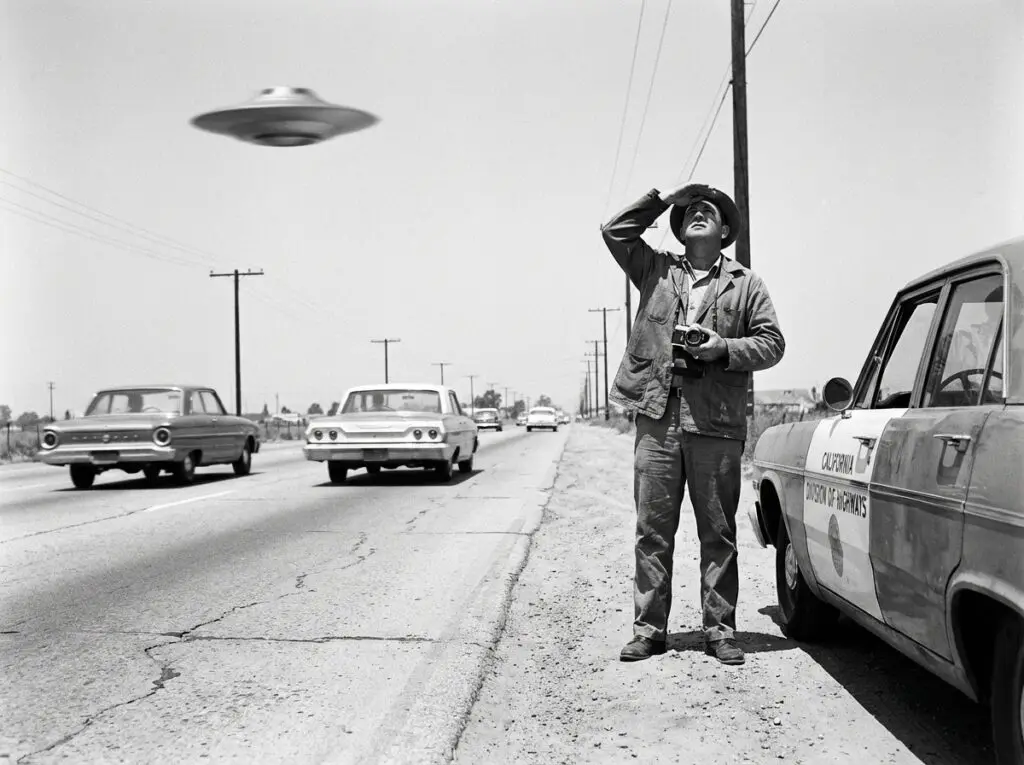
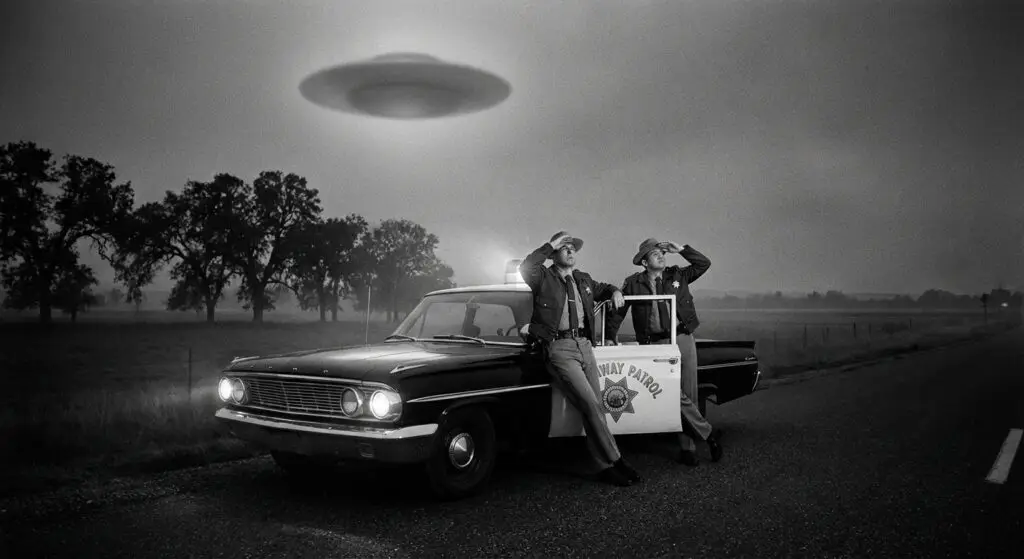
You keep seeing the same line recycled across UFO news and general news feeds: in 1960, California Highway Patrol officers in Red Bluff watched a strange craft for roughly two hours. It reads like a clean, high-status case file, repeated with the confidence of something already nailed down, yet it’s hard to tell what’s actually documented versus what’s been copied and pasted into “fact.”
And you’re making a real decision when a claim like this crosses your screen. Do you share it as a credible law-enforcement encounter, dismiss it as campfire lore with a badge stapled on, or slow down and investigate until the paper trail catches up to the story?
On its face, the Red Bluff pitch is compelling: trained patrol officers, a long-duration observation, and the implicit promise that an official agency equals official records. The friction is that witness-credibility and record-credibility are not the same thing. Police-witness stories feel self-authenticating, especially when the duration stretches into hours, but longevity in retellings does not create a surviving report in the public record.
Here is the firm finding from the provided research set: none of the provided source URLs contain a contemporaneous newspaper article, wire story, or official memo documenting a Red Bluff California Highway Patrol sighting as described. That absence is decisive for the claim’s current status, no matter how often the two-hour detail gets repeated.
Sources checked / Method
- Newspapers.com clipping, Red Bluff Tehama County Daily News
- Red Bluff Daily News retrospective (2024)
- California Digital Newspaper Collection, Red Bluff Daily News listings
- NICAP case entry for Red Bluff, Aug 13 1960
- CUFOS/UFOCAT database
- ODNI 2022 Annual Report on UAP
- FAA Order JO 8020.16E
- California Highway Patrol official about page
- Red Bluff Air Force Station (reference)
- Travis AFB heritage pamphlet and history
The same discipline applies to names that surface around the story. A California Highway Patrol officer named Don Burt Jr. appears in a U.S. Commission on Civil Rights document in the provided materials. That is a name reference only in this set, not a sighting report, not a dated narrative, and not documentation tying him to a Red Bluff incident.
Law-enforcement cases carry weight because the institution carries weight. The California Highway Patrol is described by the agency as the state’s primary highway law enforcement agency and is commonly characterized as the nation’s largest state police agency in public materials (see CHP about page), which makes “CHP officers saw it” feel like it should be immediately checkable. The deciding factor is still the evidence trail.
So treat the Red Bluff “two-hour CHP” claim as unverified until a contemporaneous record is produced. The fastest way to move it out of that bucket is to work from the ground up: what the setting makes plausible, what conventional explanations would require, and which record series would normally capture an event like this.
Red Bluff Setting And 1960 Context
Red Bluff in 1960 is not backdrop. It is the constraint set that determines both what a patrol car crew could realistically watch for a long time and where the paper trail would most likely surface later. Long, dark sightlines along major corridors make extended aerial observation plausible, but the same open horizons and sparse reference points amplify predictable misidentification traps: distance compression, low-angle “hover” illusions near the horizon, and size and speed judgments made without nearby objects for scale.
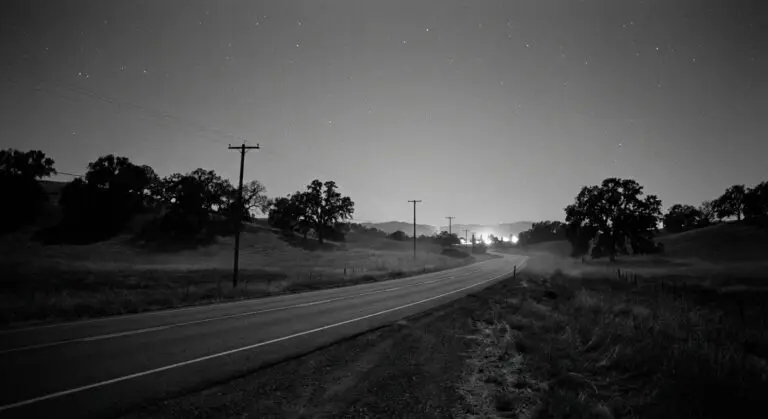
Visibility hinges on where the officers were positioned: Red Bluff sat on the Central Valley’s north to south travel spine, where witnesses concentrate because traffic concentrates. State Route 99 runs almost the entire length of the Central Valley as a major north to south state highway, and its predecessor, US Route 99, is documented in highway histories as a long north-south route through the western states (see US Route 99). Historically, US Route 99 entered Red Bluff southbound via Main Street on Legislative Route Number 3 (LRN 3), placing steady through-traffic and routine patrol attention on a straight, legible corridor where a light on the horizon can stay in view for miles (see routing history).
The tradeoff is perceptual. Rural darkness boosts contrast, so a bright source reads as “closer” than it is. Flat valley geometry creates long, uninterrupted horizons where aircraft, planets, and distant ground lights can appear to pace a moving vehicle. With few tall structures to provide scale, a steady light can look stationary, then “jump,” simply because the cruiser changes angle relative to the horizon and roadside features.
Any 1960 checklist has to include aircraft and radar presence because the region sat within overlapping civil and military air activity. Travis Air Force Base’s 1960s modernization introduced more turbine-driven transports and jet tankers into the Air Force inventory, increasing the odds of bright transit traffic at night; modern histories and base heritage materials note that the 1960s were a period of aircraft modernization at Travis (see Travis AFB history). Red Bluff Air Force Station, an Air Defense Command radar station about 4.3 miles west-southwest of Red Bluff, was close enough to intersect with reports and is recorded as remaining in operation until its deactivation around 1970 (see Red Bluff AFS). Those facts do not explain any specific sighting; they explain why aviation and radar infrastructure belongs on the verification worksheet.
In 1960, what mattered operationally was not only what an officer saw, but how it could be transmitted. The California Highway Patrol used standardized aural brevity codes to keep radio traffic clear and concise, which tends to produce short, structured descriptions rather than narrative detail. That discipline helps explain why an unusual aerial report might appear in dispatch logs, call sheets, or supervisor notifications as compact coded traffic, even if the underlying observation was lengthy.
If an event occurred, verification should target the institutions that would have generated records under normal state practices. The State Records Management Act governs executive-branch records management, and retention schedules define how records are created, transferred, and ultimately disposed of. That means the practical question is not “should records exist,” but “which record series existed for CHP communications, and how long were they kept.”
- Pinpoint the corridor and entry route (US 99 via Main Street on LRN 3) to narrow which CHP units and dispatch centers would have handled the traffic.
- Request CHP communications-adjacent records using identifying details (date, time window, beat area, unit identifiers if known).
- Cross-check local newspapers and Air Defense Command touchpoints, including Red Bluff AFS, for any contemporaneous references that align with the same time and location.
For deeper validation, retention and storage practices matter. CalRIM approves agencies’ retention schedules, and agencies must notify the Secretary of State if records are stored with a third-party vendor. In practice, those details often determine whether a 1960-era communications trail is findable at all, even when nothing remains at the local level.
Conventional Explanations And Sticking Points
Elimination is a discipline, not a vibe. If the only materials on hand do not lock down a confirmed date, time window, viewing location, and the actual words in a contemporaneous record (primary source), you cannot grade “aircraft” versus “planet” versus “balloon” on plausibility. You can only build an elimination matrix: for each hypothesis, state the feature set that must be true, then list the external records that would confirm or break it.
The friction is that “two hours” sounds like a decisive detail, but long-duration observations are still vulnerable to distance and size ambiguity, horizon-reference errors, and repeated re-acquisition of different targets that feel like one continuous event. The alleged defining features in this case narrative (law-enforcement observers, long duration, reported motion/brightness/behavior) are exactly the kind of details that must be time-anchored, and they are not documented in the provided set.
That leaves the analysis conditional by necessity: each conventional explanation below is only as testable as the date-time-location anchors you can establish from primary records.
Aircraft
Condition set that must match: sustained visible motion consistent with an aircraft track (including turns), possible altitude changes, and often periodic lighting. Sound is a discriminator, but only when distance is constrained. Testing records: FAA flight rules sit under 14 CFR Part 91, and the practical test is traffic evidence, not opinion: radar logs (if available), tower/center records, local airport movements, and any military range or training schedules.
Long-duration sticking point: an aircraft far off-axis can look stationary near the horizon, then “move” when the observer changes position. If observers re-acquire multiple aircraft over two hours, it reads like one prolonged encounter unless the times are pinned to dispatch notes or a call log.
Weather balloon
Condition set that must match: slow drift with the wind, minimal or no maneuvering, no engine sound, and brightness that tracks sun angle (after launch, near dawn/dusk) rather than “chasing” a patrol car. Testing records: once a date and local time are confirmed, check the nearest National Weather Service office launch schedule. NWS radiosonde launches are commonly performed twice daily at established synoptic times, and NOAA and NWS materials explain routine twice-daily radiosonde schedules and purposes (see NOAA radiosonde overview) and (see NWS upper air).
Long-duration sticking point: a balloon can remain in view for a long time, but observers routinely misjudge distance and size, which inflates perceived speed and intent. If “hovering then moving off” is asserted, the wind profile for the time window becomes the make-or-break record.
Astronomical objects
Condition set that must match: fixed position relative to the star field, apparent “motion” driven by the observer’s movement or intermittent obstruction, and brightness that does not behave like a moving vehicle light. Testing records: a confirmed date/time/location enables deterministic sky checks (planet and Moon azimuth/altitude). As an example of how time-anchored this is, skywatching advisories can specify “shortly after sunset, look toward the western horizon” for bright pairings, and they identify Venus as the brightest planet visible from Earth. Without the correct timestamp, none of that can be mapped to the Red Bluff report.
Long-duration sticking point: a bright object near the horizon invites auto-kinetic style misperception and stop-start “movement” when the observer looks away and back.
Optical and weather effects
Condition set that must match: strong scintillation, color shifts, apparent vertical smearing, looming, or “jumping” linked to low elevation angles and layered air. Testing records: surface observations, upper-air soundings, temperature inversions, visibility, and any pilot weather products. SIGMETs are issued as warnings of weather conditions potentially hazardous to all aircraft regardless of size or operating environment, and a timestamp lets you check whether hazards were actively being warned for the relevant airspace.
Long-duration sticking point: these effects can persist for hours, which makes the duration feel confirmatory even when it is the thing creating the illusion.
Geometry and pacing illusion
Condition set that must match: “closing distance,” “pacing,” or “following” behavior reported without any triangulation, range reference, or fixed background markers. Testing records: the scene geometry (road headings, sightlines, elevation), plus any photographs with metadata, or at minimum a map-based reconstruction using exact stops and headings.
Long-duration sticking point: patrol movement changes the frame, and a single bright point can seem to respond to the car when it is simply being re-framed against new foreground objects.
Military activity
Condition set that must match: behavior inconsistent with routine civil aviation and inconsistent with passive drift, plus corroboration from independent systems (radar, range logs, contemporaneous agency communications). Testing records: declassified training schedules, range notices, and any agency dispatch documentation that proves what was reported, when, and by whom.
Long-duration sticking point: “classified” becomes a narrative shortcut when the basic anchoring data (time, location, record text) is missing.
- Confirm a date and a tight time window (start, end, and gaps).
- Fix the viewing location(s) and road headings at each re-acquisition point.
- Retrieve any contemporaneous documentation (dispatch logs, reports, teletype, station diary).
- Capture the claimed feature list verbatim (motion, brightness changes, sound, direction, elevation above horizon).
Why This Case Resonates In Disclosure Era
Red Bluff style cases persist because they are older, multi-witness, law-enforcement narratives that function as credibility symbols in the UFO disclosure era. A badge and a patrol car read like built-in validation, so the story gets recycled as proof-by-example even when the documentary trail is thin and the surviving record is mostly retellings rather than contemporaneous, citable artifacts.
That pressure toward documentation is not abstract; it is reinforced by how modern UAP reporting is framed. Modern reporting is built around UAP, a broader umbrella than “UFO sightings” that includes anomalous objects or events observed in air, sea, space, or near sensitive sites. That scope shift matters because it comes with formal review expectations: AARO, the Department of Defense office coordinating UAP analysis and publishing directed reports, trains the public to look for traceable documentation, not just compelling narratives.
Those expectations are anchored in official timelines and scale. A 2022 Annual Report on UAP published by ODNI notes “This totals 510 UAP reports as of 30 August 2022” (see 2022 Annual Report on UAP), and AARO historical report publications are cataloged on DoD and AARO portals (see AARO Historical Record Report, Volume 1). When people scan UAP or UFO news now, they are implicitly comparing any recycled classic to an ecosystem that counts, catalogs, and briefs.
Policy proposals reinforced that documentation-first posture: the Schumer-Rounds UAP Disclosure Act proposal described an Unidentified Anomalous Phenomena Records Collection at the National Archives and aimed at expeditious disclosure processes. That framing elevated “show the record” into the core cultural demand of UAP disclosure.
Evidence standards did not relax. Old cases still rise or fall on contemporaneous records: original reports, dispatch logs, radar data, photos, chain-of-custody documents, and dates that can be independently verified. Modern disclosure activity does not retroactively authenticate a thin paper trail.
Public figures still use stories like Red Bluff rhetorically to sell a government UFO cover-up narrative or to imply non-human intelligence. Consider disclosure-era claims in terms of available documentation: what record exists, who produced it, and when.
Takeaways And Next Steps
Red Bluff 1960 is a test of documentation discipline, not a ready-made proof of non-human intelligence.

That brings the article back to the decision in the opening: whether to share, dismiss, or investigate. The outline is compelling, but the provided research set still does not supply a contemporaneous record you can cite and trace. The difference between primary records (created at the time, by the reporting agency) and secondary retellings is not academic; it determines whether you can verify timing, participants, and exact descriptions. The repositories that actually move the needle are the ones that preserve originals or indexes to originals: Blue Book indexes and microfilm pathways, same-week local newspaper archives, and agency files that can be traced from creation to storage.
The sticking point remains specificity. Decisive evaluation requires details the current sources do not provide: a locked date, start and end times, a precise location or route segment, and a stable object description. Without those timeline and object-detail anchors, you cannot do the elimination work honestly, because balloons, aviation traffic, and weather or optical artifacts are all tested against date-time-location, not against lore.
The fastest way to resolve this case is to chase the top three contemporaneous record types: (1) CHP dispatch and communications records tied to the relevant area office, plus any incident report or officer narrative; (2) local newspapers for the same date range (including police blotters and wire pickups); (3) aviation and atmosphere baselines for that date-time window, meaning any ATC facility documentation that still exists plus Weather Bureau observations and any balloon launch records.
To pursue that responsibly, use the California Public Records Act (CPRA), California’s public records law, to request identifiable CHP records through the CHP California Public Records Act page; CHP asks requesters to provide information that helps staff identify the record. Provide narrow fields, not theories: date, time range, location, unit/beat, names if known, and record types sought. Providing contact information is optional and used only if you want to be notified when the request is available. Expect retention limits: the State Records Management Act (Government Code sections 12270-12279) governs records management for the California state Executive branch, and many 1960-era operational logs were never kept permanently. Use aviation retention as a reality check, not a promise: FAA Air Traffic Organization retains data extraction recordings for accidents in accordance with FAA Order JO 8020.16 (see FAA Order JO 8020.16E), which illustrates how retention is purpose-bound and time-limited, especially outside accidents. If records are unavailable, ask for the retention schedule citation, a description of the search performed, and whether any index, microfilm, or offsite storage reference exists.
Carry one habit into every viral “two-hour police UFO” claim: treat every summary as a lead until it produces a date-time-location and a primary record you can trace. If you want a one-page CPRA request template, prepare a narrow request using the elements listed above.
Frequently Asked Questions
What is the Red Bluff UFO 1960 story about CHP officers watching a craft for two hours?
It’s a widely recycled claim that California Highway Patrol officers in Red Bluff, California observed a strange craft for roughly two hours in 1960. The article treats it as a popular narrative but stresses it lacks a verifiable contemporaneous record in the provided sources.
Is there any official or newspaper documentation confirming the Red Bluff CHP UFO sighting in 1960?
No-none of the provided source URLs contain a contemporaneous newspaper article, wire story, or official memo documenting the Red Bluff CHP sighting as described. The article says that absence is decisive for the claim’s current status.
Why does the article say police-witness credibility is not the same as record credibility?
The article argues that law-enforcement witnesses can sound self-authenticating, especially with a “two hours” duration, but credibility still depends on traceable primary records. Repetition over time does not create a surviving report in the public record.
What specific 1960-era Red Bluff details matter most for verifying a two-hour CHP UFO observation?
The article says verification requires a locked date, a tight start/end time window, and precise viewing locations/road headings-without those anchors you can’t test explanations against records. It also notes Red Bluff’s corridor context (US Route 99 entering via Main Street on LRN 3) as key for narrowing which CHP units/dispatch centers would have handled communications.
What local military or aviation infrastructure near Red Bluff could be relevant to checking the claim?
The article points to Red Bluff Air Force Station, an Air Defense Command radar site about 4.3 miles west-southwest of Red Bluff that operated until 1970. It also notes regional air activity, including 1960s modernization at Travis Air Force Base that added aircraft like the C-130, C-141, and C-135.
What conventional explanations does the article say you should test for a long-duration UFO report like this?
It lists testable categories including aircraft, weather balloons (with NWS launch schedules), planets (deterministic sky checks), and weather/optical effects like scintillation or inversions. The article says none can be evaluated honestly without confirmed date-time-location details.
What records should you request first if you want to investigate the Red Bluff 1960 CHP UFO claim?
The article prioritizes three: (1) CHP dispatch/communications records tied to the relevant area office plus any incident report, (2) local newspapers for the same date range (including police blotters and wire pickups), and (3) aviation/atmosphere baselines for that time window (ATC documentation if it exists and Weather Bureau observations/balloon records). It recommends using the California Public Records Act and providing narrow identifiers like date, time range, location, unit/beat, and record types sought.