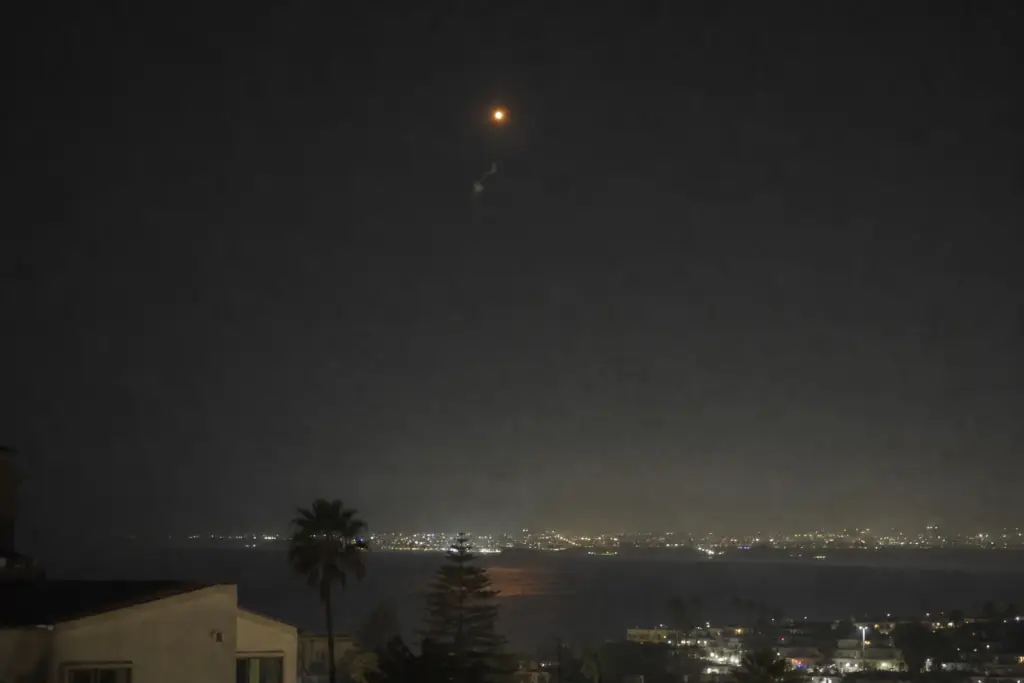
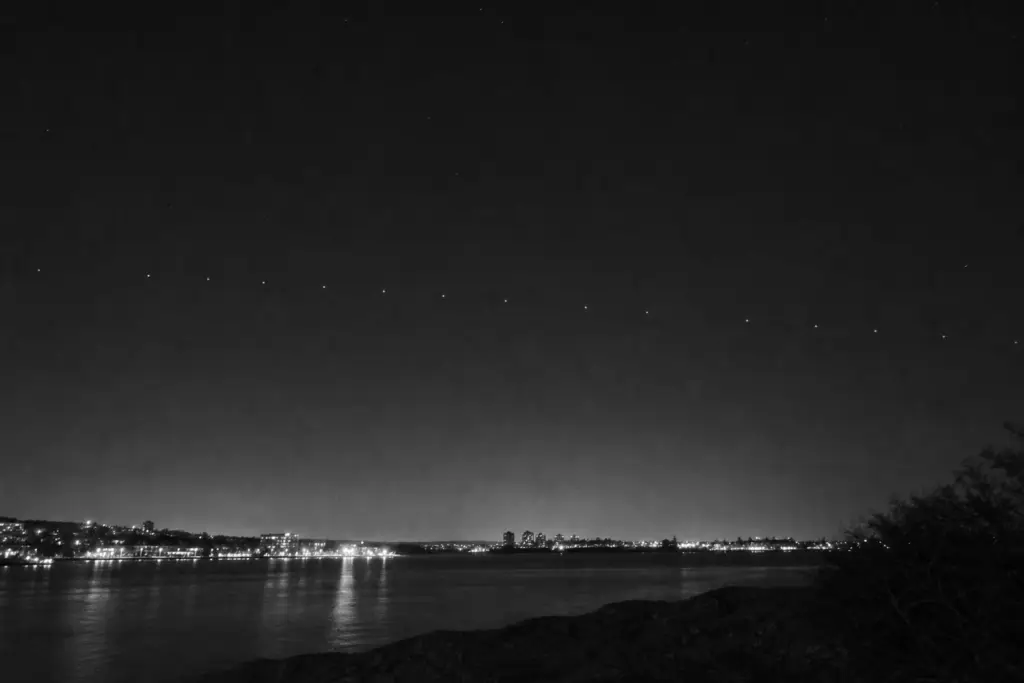
On January 24, 2020, an eyewitness account placed multiple star-like lights over Victoria, British Columbia, moving from west to east in what appeared to be a line or formation. That description is the starting point for the Victoria BC UFO sighting January 24 2020, not proof that the lights were a single craft, an unusual vehicle, or anything beyond ordinary sky traffic.
“Star-like” describes apparent appearance: small points of light with no resolved shape at the observer’s distance. “Formation” describes relative spacing and shared motion, not necessarily a physical connection. Those distinctions matter because satellites, aircraft seen from afar, and other lights can produce a similar visual impression while having very different causes.
This account therefore separates the reported observation from any interpretation of it. The useful questions are practical: how many lights were described, whether their spacing changed, how long they remained visible, whether a photograph or video preserves timing and direction, and whether independent reports or local sky records can be matched to the event.
Without that supporting material, the record may establish only that someone reported an unusual-looking sequence of lights. It does not justify an extraterrestrial, military, or official-UAP conclusion. The sections that follow assess what can be reconstructed, which conventional explanations fit the description, and where the available evidence remains genuinely unresolved.
What Was Reported Over Victoria on January 24, 2020
The surviving account is best treated as a short sighting description rather than a fully documented case file. Its reported date is January 24, 2020; it characterizes the lights as star-like, arranged in an apparent formation, and traveling from west to east.
Those are the report’s usable descriptive elements. They identify an apparent direction of travel and visual pattern, but do not establish altitude, distance, speed, size, physical arrangement, or whether every point of light came from one source. The wording also does not identify a category: an aircraft, satellite train, drone group, and UAP are competing interpretations, not reported facts.
The available record, as presented here, provides no attributable verbatim witness narrative, named first-person observer, original image or video file, precise observation time, duration, weather conditions, or independent corroboration. That distinction affects evidentiary weight: a time-stamped first-person submission retains the observer’s wording and context, whereas a later summary or repost can omit or alter both.
“Star-like lights over Victoria BC” is therefore a label for the appearance described, not a finding about what produced it. The following analysis separates each observation in this Victoria UFO report from the conclusions sometimes attached to it.
Separate the Observation From the Interpretation
A disciplined reading treats each adjective as an observation to be tested, not as an identity. “Star-like” means that the lights appeared as unresolved points; it does not reveal their shape, distance, or size. “Formation” describes an apparent grouping or spacing in the viewer’s field of view. It does not, by itself, demonstrate that the lights were physically close together or under coordinated control.
- The reported west-to-east trajectory is an estimated direction from a ground-based viewpoint, not a measured track. Without a fixed reference, time stamps, or a second viewing location, it cannot establish altitude, range, or true speed.
- The report supports an apparent grouping and common movement, but does not preserve measured spacing, changes in separation, blinking, color, brightness variation, duration, or sound. Those missing details matter because they can distinguish steady point lights from lights that flash, fade, or change relative position.
- Apparent speed is especially vulnerable to perspective: a distant light can seem slow despite rapid travel, while a nearby light can cross a familiar portion of sky quickly. A line of lights traveling along a similar sightline can also look more orderly than its physical arrangement would suggest.
Night viewing further limits interpretation. Against a dark sky, observers may lack reliable distance cues, and stars, rooftops, trees, or horizon features can provide only rough directional references. Thus, the account documents unidentified lights in the sky with an apparent formation and a reported west-to-east trajectory; it does not document a measured formation, flight path, or performance capability.
What the Available Record Can, and Cannot, Establish
The evidentiary threshold changes substantially when a sighting can be tied to material created at the time. An original photograph or video file may retain metadata such as creation time and device information; when the scene also contains identifiable landmarks, a horizon, or a compass-bearing reference, it can help test the claimed place, direction, and sequence. A reposted clip, screenshot, or compressed social-media upload is weaker: it may preserve the appearance of lights but usually cannot securely establish when, where, or which way the camera faced.
Independent corroboration means accounts originating separately, rather than several people repeating one initial post. Reports that agree on the time window, direction, number of lights, duration, and notable changes in brightness would strengthen the basic observation. Contemporaneous reporting by Victoria-area news outlets, astronomy groups, or other local observers could likewise establish that more than one person noticed an event, even if it did not identify it.
A useful reconstruction would also pair the report with local cloud, haze, and visibility observations, then compare a sufficiently precise time and viewing direction against aircraft-tracking and satellite-prediction records. Each dataset answers a different question: weather addresses what could have been visible; flight data tests aircraft candidates; satellite records test whether known objects crossed the relevant sky. None can do much without a usable time and location.
For this account, the available material does not supply original media, independently sourced witness statements, a precise observation time, or contemporaneous local corroboration. That leaves it an uncorroborated anecdotal report within the broad category of UFO or UAP sightings. The missing record proves neither a conventional cause nor an extraordinary one; it simply prevents a confident reconstruction and limits how strongly any later explanation can be matched to the report.
Plausible Conventional Explanations for a Line or Formation of Lights
Pattern is more informative than the label attached to the lights. A satellite or satellite train would be a stronger fit if the points remained steadily illuminated, kept broadly even spacing, crossed the background stars in the same direction, and faded individually or together as the geometry changed. Flashing, irregular spacing, abrupt turns, or a fixed position relative to the stars would weaken that explanation. Starlink satellites are one testable version of this hypothesis, not an automatic answer: visibility depends on the precise time, orbital pass, illumination, and observing location.
Aircraft at distance can compress into apparently star-like points, particularly when landing lights face the observer. Repeating strobes, red or green navigation lights, changing separation, or lights that brighten while seeming nearly stationary would favor aircraft. Several aircraft on approach or in a holding pattern can resemble a formation because different distances and headings alter their apparent spacing; a single straight, uniformly paced sequence would be less suggestive of that pattern.
Drones can create grouped lights and coordinated movement, but this category fits best where the lights maneuver, hover, reverse, or hold a compact shape. A long, steady west-to-east traversal with equal-looking intervals offers less support for drones, although the available account lacks the duration and maneuver detail needed to weigh that distinction.
Bright planets and stars can be mistaken for moving lights when clouds, camera motion, or an observer’s changing viewpoint is involved, but they do not independently travel across the star field in a line. Brief transient possibilities, meteors, re-entering debris, or reflections, would ordinarily be assessed through their duration, fragmentation, brightness changes, and whether the lights stayed together. None of those diagnostic details is preserved for the reported lights traveling west to east over Victoria, BC, so these remain comparison categories rather than identifications.
Could Satellites, Including Starlink, Fit the January 2020 Account?
Starlink had begun launching before January 2020, so it belongs in the candidate set for this event. That historical fact alone does not place any Starlink satellites over Victoria at the relevant moment, however. A train-like appearance depends on the particular satellites’ orbital positions, whether they were sunlit against a dark local sky, and the observer’s location and viewing direction. Without a reported clock time, the Starlink possibility cannot be promoted from a plausible category to a date-specific match.
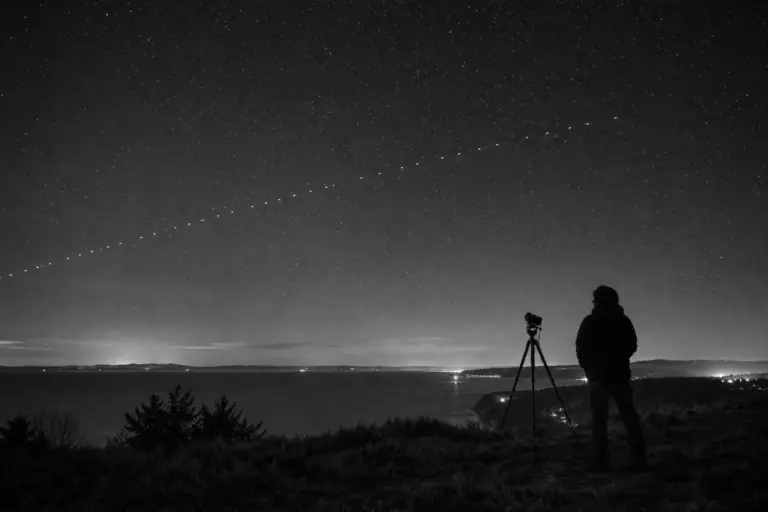
A meaningful test would use archived two-line element data, orbital-position records for individual objects, or a historical satellite-pass calculator set to Victoria, January 24, 2020, and the best available local time. The result should be compared with the reported west-to-east track: predicted direction of travel, elevation, time above the horizon, number of visible objects, and whether they would follow one another at broadly regular intervals. A good match would show several sunlit satellites crossing the same part of the sky during the witness’s stated window; a prediction for a different time, direction, or portion of the sky would weaken it.
Some reported behavior would also count against a satellite sequence. Points taking noticeably different paths, making abrupt turns, hovering, repeatedly flashing, or changing their spacing in a coordinated way are not the expected appearance of separate satellites on a shared pass. Conversely, a smooth, similarly paced progression would be compatible with satellites but still would not identify a specific group without the missing time-and-location comparison. The January 2020 UFO sighting in Victoria, British Columbia therefore remains insufficiently timed to confirm or exclude Starlink satellites.
Was It Investigated, and Is It Actually Unresolved?
An unidentified report and an officially unresolved case are not the same thing. The first label means the available description cannot support a reliable attribution; it does not mean the lights were shown to be extraordinary. An officially unresolved case requires a traceable inquiry and a recorded finding that the responsible body could not identify the event from the information available.
For the Victoria report, the material described in this article does not establish that such an inquiry occurred. Strong evidence of an investigation would include a police occurrence number or dispatch record, an aviation occurrence or air-traffic record, a Transport Canada or military reference, or a formal civilian case file that identifies the reporter, records the time and location, preserves supporting media, and explains what leads were examined. A contemporaneous agency statement would also qualify. A later reposting of the sighting does not.
That distinction changes the appropriate conclusion. The account is unresolved as documented because its limited details do not permit a dependable match to a particular satellite pass, aircraft movement, drone activity, or other cause. It should not be described as an officially unresolved government case unless a corresponding record is produced.
Likewise, the absence of a known public investigation cannot prove that no one made inquiries, and it cannot demonstrate concealment. This local historical report provides no evidentiary bridge to UAP disclosure, UFO disclosure, non-human intelligence, or a government UFO cover-up. Those claims would require independent, event-specific records, not merely an unusual description that remains insufficiently detailed to identify.
Bottom Line: A Report Worth Documenting, Not Overstating
The decisive gap is the missing observation data needed to test a match. A satellite sequence remains a plausible fit if the points were steady, evenly spaced, and followed one path; distant aircraft also remain plausible if apparent spacing changed or brightness varied. Without a precise time, duration, weather record, original media, or independent accounts, neither explanation can be identified as the cause.
For any future British Columbia UFO sightings report, follow safe reporting guidance and preserve the details that make comparison possible:
- the exact local time and observing location, compass direction, estimated elevation, duration, weather, and visible landmarks;
- unedited photos or video files, the original device files rather than screenshots or reposts; and
- separate contact details and notes from independent witnesses, so agreement can be assessed without one account shaping the others.
This is a discrete 2020 report, not evidence of a continuing pattern or a record of UFO sightings 2025 or UFO sightings 2026. Its evidence-based classification is an uncorroborated, unidentified sighting report with conventional explanations that remain plausible but unconfirmed.
What Can Be Said With Confidence
Confidence here lies chiefly in the boundary between what was observed and what can be inferred. The account preserves a claim of several point-like lights traveling west to east over Victoria on January 24, 2020; it does not preserve enough time-specific, independently corroborated material to assign those lights to a particular object or activity.
A satellite train remains a reasonable conventional possibility because separate satellites can appear as evenly spaced lights following a common track. Distant aircraft remain another because approach or navigation lights can look like stationary or grouped points until their changing angle becomes apparent. Those are pattern matches, not identifications: the surviving description lacks the timing, motion detail, and original media needed to distinguish them.
“Unidentified” is therefore the appropriate limit of the record, not evidence that the event was inherently mysterious or extraordinary. It also should not be described as an officially unresolved case without a traceable investigation and recorded outcome.
If primary material emerges, its value will depend on whether it can anchor the sighting to a place and moment: original files, an exact local time, a camera direction, visible landmarks, and separately recorded witness accounts would allow meaningful comparison with historical satellite, aviation, and weather data. Until then, the Victoria report is worth retaining as a carefully bounded historical observation, rather than enlarging into a conclusion the evidence cannot carry.
Frequently Asked Questions
What was reported over Victoria, BC on January 24, 2020?
An eyewitness account described multiple star-like points of light traveling from west to east over Victoria, British Columbia. The lights appeared to be in a line or formation, but the report did not establish their altitude, speed, size, distance, or physical connection.
Could the west-to-east formation of lights over Victoria have been satellites?
Satellites, including a satellite train, are a plausible explanation if the lights were steadily illuminated, broadly evenly spaced, and moved smoothly along the same path. The report lacks an exact time, duration, and original media, so no specific satellite pass can be confirmed.
Were Starlink satellites visible over Victoria on January 24, 2020?
Starlink had launched before January 2020, making it a possible candidate for the sighting. Confirming a Starlink pass would require an exact local observation time, viewing direction, and archived orbital data for Victoria on January 24, 2020.
How can you tell satellites from aircraft or drones at night?
Satellites usually appear as steady lights moving smoothly in one direction, often with broadly regular spacing in a train. Aircraft are more likely to show repeating strobes or red and green navigation lights, while drones are more likely to hover, reverse, turn abruptly, or hold a compact coordinated shape.
Was the Victoria January 24, 2020 UFO sighting officially investigated?
No traceable official investigation is documented for this report. An official investigation would require records such as a police occurrence number, aviation or air traffic record, Transport Canada or military reference, or a formal case file with the witness details, time, location, and evidence examined.