September 16, 1994 is the essential checkpoint: during a school break in Ruwa, Zimbabwe, children described an unusual experience that would become internationally known. The testimony remains significant not because it settles what happened, but because a group account of an extraordinary event raises separate questions about what was observed, how accounts were recorded, and what explanation the record can bear.
This article examines the Cynthia Hind Ariel School investigation at its earliest documented stage: what Hind did after the incident became known, what children and school figures told her, and which surviving materials can be tied to that initial inquiry. Hind was a Zimbabwe-based UFO researcher whose rapid involvement matters historically because accounts recorded close to an event can preserve details before later retelling, media attention, and adult memory reshape the narrative.
That advantage has limits. Preserving testimony means identifying who said or drew what, and when; assessing evidence means weighing timing, consistency, provenance, and gaps in the record; explaining the event would require stronger grounds for choosing among possible causes. The first two tasks are the subject here. Later documentaries, adult recollections, and John Mack’s subsequent interviews provide context, but they are not substitutes for Hind’s early investigative layer.
Why Cynthia Hind’s First Investigation Still Matters
The value of an early inquiry lies less in settling an explanation than in fixing a baseline. It can distinguish material created near the time of the report, interviews, drawings, notes, dates, and accounts from school adults, from narratives shaped by years of repetition, publication, and reflection.
This reconstruction therefore treats the September 16, 1994 reports at Ariel School in Ruwa, Zimbabwe, as the starting point for a record with several layers. One layer is what particular children said or drew; another is what teachers and other adults recalled or relayed; a third is what Cynthia Hind herself recorded, observed, or later described about her initial visit. Those categories can overlap, but they should not be treated as interchangeable.
The Cynthia Hind Ariel School investigation matters because proximity to the reported incident may preserve wording, disagreement, and uncertainty that later accounts smooth away. It does not convert testimony into physical proof. Neither a shared report nor a compelling interview establishes extraterrestrial visitation, non-human intelligence, or a government cover-up. The question here is narrower: what the earliest accessible record preserves, how securely it can be attributed, and where its gaps prevent firmer conclusions.
What Was Reported at Ariel School on September 16, 1994
The reported episode unfolded during a school break, not in a classroom lesson. Children later interviewed about the incident described looking toward land near the school grounds and seeing unusual aerial objects and, in some accounts, one or more humanlike figures. Those details should be kept at the level of individual testimony: descriptions differed in the objects’ number, position, movement, appearance, and the figures’ actions.
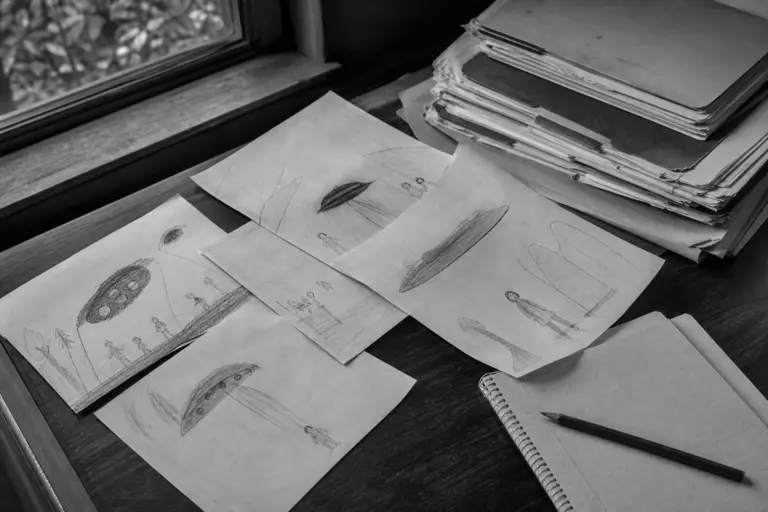
Some of the children’s earliest surviving material includes drawings made after the report became known. Student drawings are useful as dated expressions of what particular children chose to depict, rather than as a single composite image of the event. Repeated motifs can show overlap among accounts; differences matter just as much, because they indicate that the witnesses did not all recount an identical scene.
Early school accounts also draw an important line between the children’s reported observations and the adults’ experience. Teachers and staff were told that something alarming or unusual had happened during the break, but the available narrative does not establish that they independently saw the reported objects or figures. Their immediate role was chiefly as recipients of the children’s reports and as adults trying to manage a sudden disruption at Ariel School in 1994.
Thus, September 16, 1994 provides a defined starting point, but not a uniform witness statement. It is a cluster of child reports, drawings, and staff reactions whose precise sequence and content must be preserved before later interviews and interpretations are brought into view.
Who Cynthia Hind Was and How She Became Involved
Cynthia Hind was a Zimbabwe-based UFO researcher whose early involvement placed her between the school’s immediate response and the much later retellings that made Ariel internationally familiar. Her significance is chronological as well as interpretive: she approached the case while the reported incident was still recent and began preserving accounts before decades of recollection, publication, and debate accumulated around them.
The firm anchor is September 16, 1994, the date of the reported break-time episode. Available accounts place Hind’s visit to Ariel School shortly after news of the children’s reports reached her, but the surviving public record does not securely settle every step between the event, the school’s internal response, press attention, and her arrival. Nor does it support treating a single reported number of interviewees as definitive. References to her inquiry vary in whether they count children who spoke to her directly, children who supplied drawings, or the wider group said to have witnessed something.
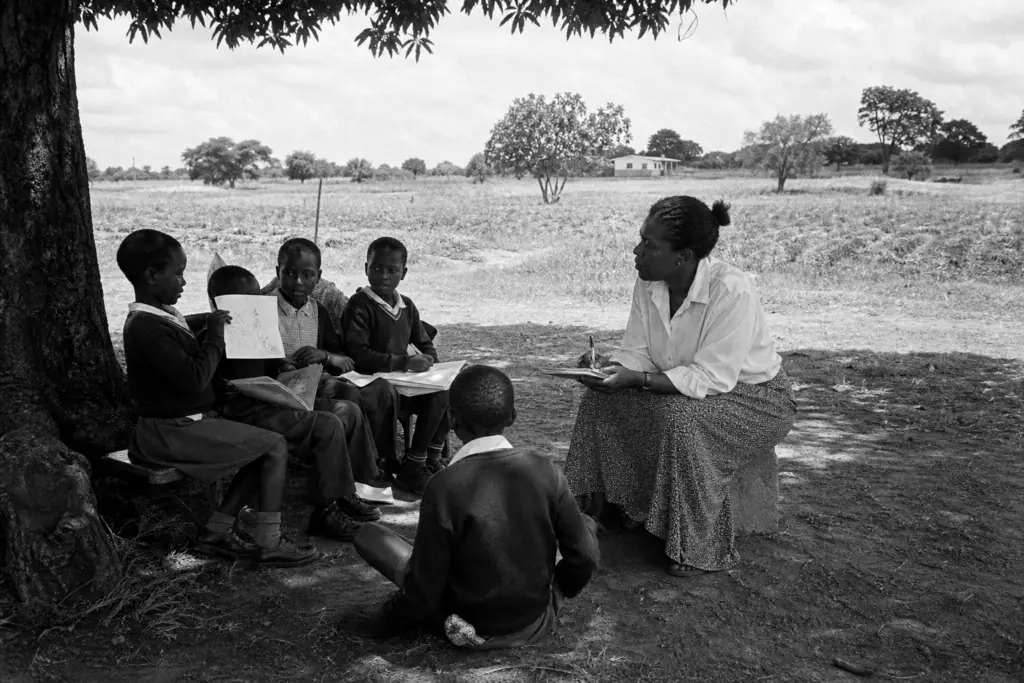
What can be separated more clearly is the character of the material. Hind’s early work concerned collecting and recording testimony: hearing children’s descriptions, retaining or discussing drawings, and speaking with adults connected to the school. That differs from an independent observation of the reported phenomenon, which she did not claim to have made. It also differs from John Mack’s later interviews, conducted after the case had already acquired public attention. The Cynthia Hind investigation of Ariel School is therefore best treated as an early documentary layer, valuable for its proximity, but incomplete in its surviving chronology and incapable, on testimony alone, of determining what caused the event.
What Children and School Figures Reported to Hind
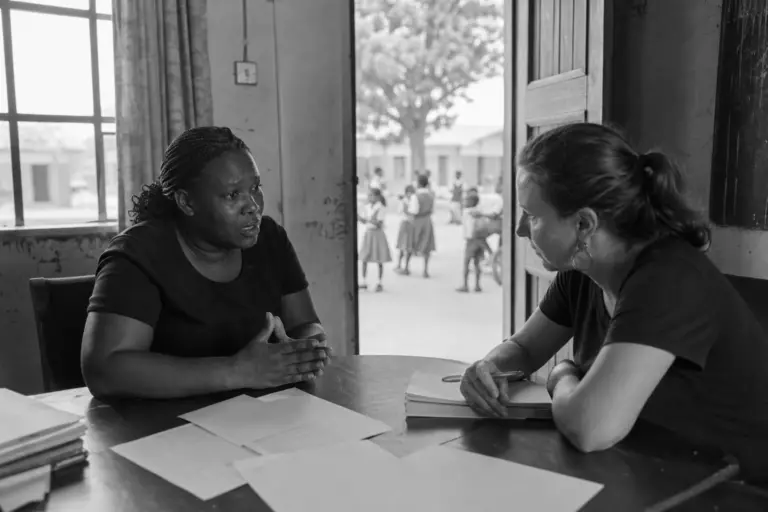
The material associated with Hind’s visit must be sorted by how it was gathered. A child speaking in a witness interview is direct testimony; a pupil’s drawing made after the September 16, 1994 break preserves a visual account; and a teacher recounting the playground’s aftermath is an adult observation of reaction. The public record does not preserve a complete, item-by-item set of Hind’s recordings, notes, drawings, and staff conversations, so it cannot reliably identify every child she questioned personally or every drawing she handled.
In summaries of the Cynthia Hind Ariel School UFO encounter inquiry, the recurring child testimony concerned unusual aerial forms beyond or near the school grounds and humanlike figures seen in that area. The points of overlap were broad rather than exact. Accounts varied over the number of aerial forms and figures, their shape and position, whether they moved, the distance from the children, and the sequence in which features were noticed. That distinction matters: a shared report of something unusual is not a single, standardized description of its details.
Drawings linked to the report offer a different kind of contemporaneous material. A drawing attributed to an identified Ariel pupil and dated close to September 16 can show whether that child chose to depict a disc-like form, figures, trees, or the school’s surrounding landscape. It cannot, by itself, establish the drawing’s intended meaning, the order in which the child described events, or that Hind personally received it. Reproductions lacking a pupil’s name, date, and documented route into Hind’s material should therefore be treated as illustrations, not as proof of a particular interview exchange.
School staff accounts concern the immediate human response rather than an independent sighting. Teachers and other adults could report that children returned from the break upset, excited, insistent, or difficult to settle; those observations help establish that a disturbance was noticed at school. They do not independently confirm the reported aerial forms or figures, because the adults did not report seeing them. Later recollections by former pupils and staff may add personal detail, but they remain retrospective and should not be merged with Hind’s early witness interviews, drawings, or conversations with school figures.
What the Early Record Supports, and What It Cannot Establish
The strongest conclusion available from this material is historical rather than explanatory: the early record can support that many Ariel School children made unusual reports and that adults at the school recognized a consequential reaction requiring attention. Interviews conducted soon after a report are valuable because they can retain uncertainty, differing emphases, and details that later retellings may compress. Drawings can likewise show what an individual child chose to depict at that point in time. Together, such materials provide corroboration of reporting and response, not corroboration of a particular external object or entity.
The quality of that conclusion depends on source provenance. A recording, note, or drawing is strongest when its date, creator, collector, and route into later publication can be traced. A tape with an identifiable interviewee and an established recording date is different from a quotation reproduced repeatedly without the underlying recording; an individually collected drawing is different from an undated image detached from its maker. The distinction matters because repetition in books, films, or online summaries can make one claim appear independently confirmed when it may derive from a single earlier account.
Interview conditions also shape what the material can show. Individual accounts allow comparisons among witnesses; group discussion can preserve a shared atmosphere but may make it harder to separate each child’s initial memory from details heard from peers. A careful interview chronology can therefore establish when testimony was recorded, but not whether every remembered element originated independently. Memory remains testimony: it can be sincere, vivid, and important while still leaving sequence, distance, perception, and interpretation unresolved.
For those reasons, the Cynthia Hind Ariel School investigation does not independently establish the identity, origin, physical reality, or cause of the reported phenomenon. “Unidentified aerial phenomenon” may describe an unresolved report without deciding what was seen. Hind’s early work is most useful as a preserved evidentiary layer, one that documents children’s statements and adult concern while leaving the central explanation open.
How Hind’s Inquiry Differed From John Mack’s Later Interviews
The comparison turns on provenance, not on choosing a more authoritative witness. Hind’s inquiry formed part of the immediate investigative response after the September 1994 reports, while John Mack’s interviews belong to a later phase in which the children had already spoken with adults, peers, journalists, and other investigators.
Those purposes and settings were different. Hind, a Zimbabwe-based UFO researcher, sought to gather accounts, drawings, and school-based reactions near the event; her material is useful for tracing what was reported early and how it was first recorded. Mack approached the children later through his professional interest in unusual human experiences, using extended interviews that invited reflection on what the witnesses believed had happened. That approach can preserve depth and emotional meaning, but it also captures memory and later recollection after intervening conversations and publicity.
Later filmed interviews are therefore a distinct evidentiary layer, not replacements for Hind’s original record. A strong chronology keeps a dated Hind interview, a contemporaneous drawing, and a later Mack conversation separate even when the same witness appears in all three. Their comparison can reveal continuity or change in an account; it cannot determine whether either version identifies the cause of the Ariel School incident.
A Significant Report With an Unresolved Explanation
What endures most securely is not an answer to the Ariel School event, but an early evidentiary trail. Cynthia Hind helped preserve a record close to the September 1994 reports: children’s individual descriptions and drawings, alongside testimony from adults who encountered the school’s response. That proximity gives the material historical value, even where surviving records are incomplete and accounts vary.
The record documents that people reported an unusual experience and that it was treated as significant at the school. It does not establish the nature, origin, or physical reality of what the children believed they saw. Neither the UFO label nor the strength of later recollection resolves that causal question.
That distinction keeps the Cynthia Hind Ariel School investigation relevant to discussions of UAP sightings. A dated interview, identifiable witness, and clear separation between direct testimony and later interpretation are stronger signals than cultural prominence or repeated retelling. Hind’s contribution was to preserve an early layer of a consequential report; the explanation remains unresolved.
Frequently Asked Questions
Who was Cynthia Hind in the Ariel School UFO case?
Cynthia Hind was a Zimbabwe-based UFO researcher who became involved shortly after the September 16, 1994 reports at Ariel School in Ruwa, Zimbabwe. Her role was to collect children’s testimony and drawings and speak with adults connected to the school’s immediate response.
When did Cynthia Hind investigate the Ariel School encounter?
Hind investigated shortly after the reported September 16, 1994 school-break incident. The surviving public record does not securely establish every step between the event, school response, press attention, and her arrival.
What did the Ariel School children report to Cynthia Hind?
Children reported unusual aerial forms near or beyond the school grounds and, in some accounts, humanlike figures. Their descriptions differed on the number, shape, position, movement, distance, and sequence of the objects and figures.
What evidence should you look for in the early Ariel School investigation record?
The strongest materials have a traceable date, identified creator or interviewee, collector, and documented route into later publication. Examples include a dated recording with an identifiable witness or a drawing linked to a named pupil and dated close to September 16, 1994.
How did Cynthia Hind’s investigation differ from John Mack’s later interviews?
Hind’s inquiry was part of the immediate 1994 response and focused on preserving early accounts, drawings, and school reactions. John Mack interviewed children later, after intervening discussions, media attention, and other investigations, using longer interviews that emphasized reflection and emotional meaning.