That distinction begins on September 16, 1994, when pupils at Ariel School near Ruwa, Zimbabwe, reported an unusual event during a school break. Their accounts became known as the Ariel School UFO encounter, but the label describes a reported experience; it does not establish what, if anything, the witnesses encountered.
Cynthia Hind matters because she was among the early civilian investigators to gather and preserve accounts while the event was still recent. Her work included recording children’s descriptions and drawings, creating an early layer of evidence that later interviews, films, and commentary can be measured against rather than treated as a substitute for it. In the Cynthia Hind Ariel School UFO encounter record, her role was investigative and archival, not conclusive: testimony can document what people said they perceived without independently identifying its cause.
Prompt notes, interviews, and drawings have historical value because memory, retelling, and public attention can reshape emphasis over time. They are not physical proof, and differences among children’s recollections should not be compressed into one perfectly uniform story. The central question is therefore narrower and more useful: what did Hind preserve close to the reports, and how does that material compare with accounts collected years later?
Who Cynthia Hind Was Before Ariel School
Before Ariel School brought her to wider attention, Cynthia Hind was already active in Zimbabwe’s UFO-research milieu as a writer and editor associated with UFO Afrinews. That background matters because it gave her a local channel for receiving sighting reports and a practical interest in gathering witness accounts rather than encountering the school story as a distant media item.
A local investigative network can improve the early record in concrete ways: it may connect an investigator quickly with witnesses, school staff, and other people who heard the first reports. It also carries a tradeoff. Hind approached unusual-sighting claims as a subject worthy of investigation, so her decision to pursue Ariel School reflects her prior interests; it cannot itself establish that the children’s reported experience had an extraordinary cause.
The useful distinction is between collection and interpretation. Her publishing work and contacts help explain how the Cynthia Hind Ariel School record began to take shape. Her notes, interviews, and later presentation of the case are evidence of what she documented and how she understood it, not independent corroboration of every reported detail. The strength of her early involvement lies in proximity and preservation; its limit is that a committed civilian investigator remains an interpreter as well as a recorder.
What the Children Reported on September 16, 1994
Object count is one of the first places where the surviving testimony resists a single script. Across early accounts of the 1994 Ariel School reports, pupils described seeing an unusual object, or, in some versions, more than one, near the edge of the school grounds during break. Many also described one or more unusual figures in that area. Those recurring elements define the reported experience; they do not settle what the object or figures were.
Drawings and recollections varied in consequential ways. Some children depicted a disc-like craft on or close to the ground, while others emphasized an object in the air, its apparent movement, or a more distant view. The figures were likewise not described identically: accounts differ on number, appearance, position, and proximity. Such variation is not a license to select the most dramatic version. It is a reason to retain each account’s wording, image, and circumstances rather than convert them into a standardized narrative.
The often-repeated total of witnesses should also be treated as a range rather than a fixed evidentiary fact. Different retellings may count pupils who directly reported seeing something, children who were present during the break, or those later interviewed about the episode. Distance from the reported object, whether it landed, and whether the figures communicated are similarly unsettled details. Some pupils later recalled a sense of communication or imagery without spoken words, often described as telepathy; others did not report that element. The careful conclusion is narrower: the schoolchildren witnesses preserved overlapping reports of something unusual near the grounds, alongside important differences that any account of the case must leave visible.
Hind’s Early Investigation: Timing, Interviews, and Documentation
Hind’s file began to take shape within days of the Friday, September 16, 1994 break-time reports at Ariel School. That short interval matters because it places her conversations closer to the event than the well-known interviews conducted years later. The strongest items in such a file are dated interview notes, children’s original drawings, and reports published under Hind’s name in UFO Afrinews; copies reproduced in later books, films, or online posts are a separate, later layer of the documentary record.
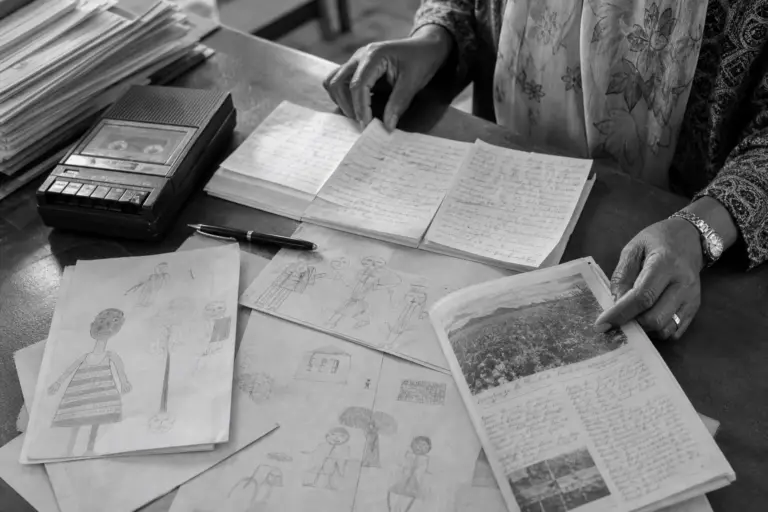
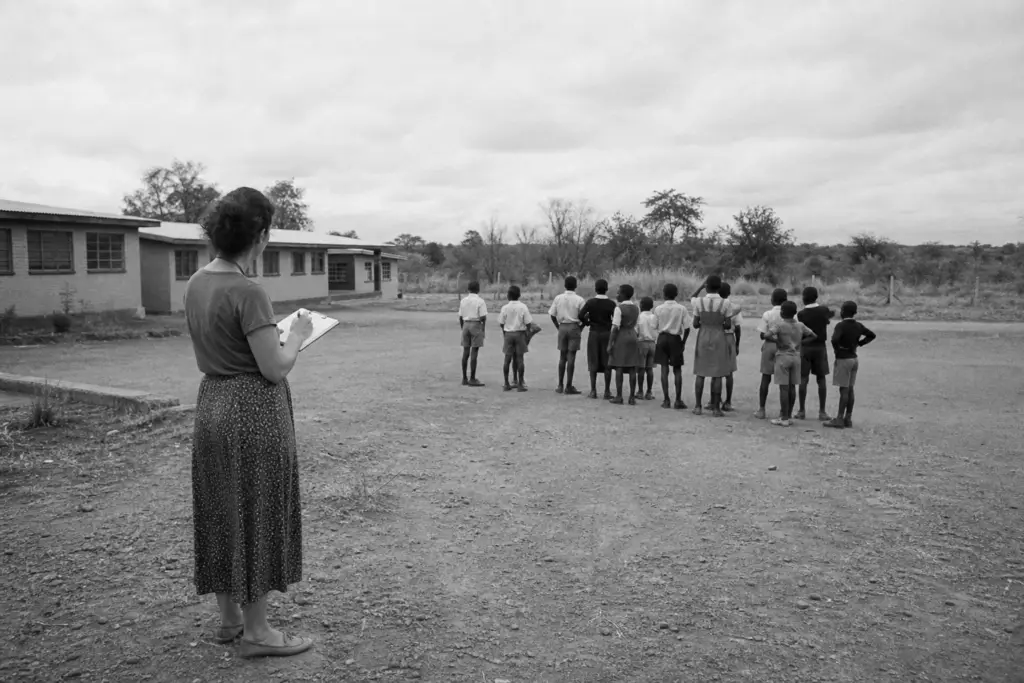
Her role was not limited to repeating a school rumour. Hind spoke with pupils and sought accounts from adults connected with the school, preserving children’s descriptions and drawings of the reported object, the figures, their location near the edge of the grounds, and the sequence in which the children said they noticed them. Those materials record what individual witnesses told or drew for an early civilian investigator. They do not independently establish that the depicted object or figures were present as described.
The questions that matter most in contemporaneous interviews are concrete ones: where a child had been standing during the break, whether the object was seen on the ground or in the air, who else was nearby, what happened first, and whether the child had discussed the experience before speaking to the interviewer. Those details help separate observation, later interpretation, and exchange among classmates. Hind’s published summaries are also evidence, but of a different kind: they show how she selected, organized, and interpreted the testimony she collected.
That proximity gives the Cynthia Hind Ariel School incident record lasting value. A drawing made near September 1994 and retained with an interview can be compared with a witness’s later recollection without assuming that either version is complete or false. Yet Hind’s inquiry was civilian fieldwork, not a controlled forensic examination: the surviving record does not provide a standardized blind-interview protocol, comprehensive scene preservation, or a complete recording of every exchange. Its proper importance is narrower and substantial, an early, traceable layer against which later retellings can be measured, rather than a final explanation for what occurred.
How to Read the Evidence: Consistency, Variation, and Limits
The strongest signal in a collection of accounts is not perfect agreement but a pattern of overlap that survives comparison. If separately recorded descriptions repeatedly place an unusual event in the same part of the grounds and during the same break, that supports the proposition that pupils shared an unusual experience worth investigating. It does not establish the identity, distance, size, or origin of what they believed they saw.
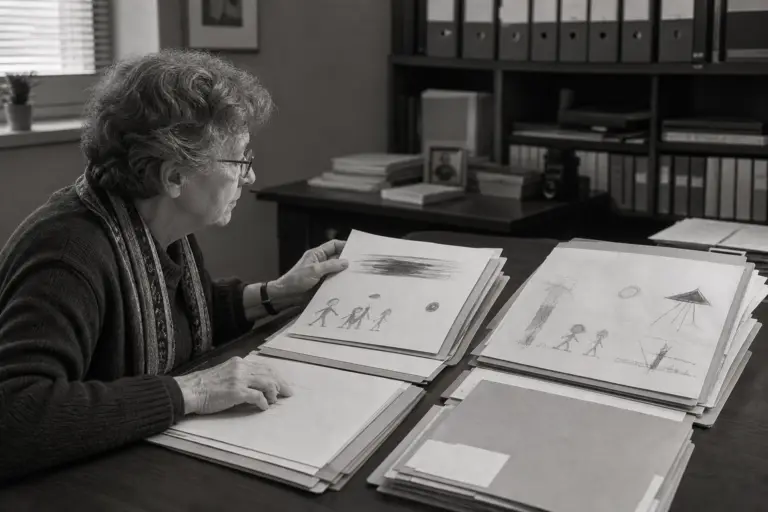
Variation is informative rather than automatically discrediting. One child may focus on an object’s movement, another on a figure, and another on fear or confusion; differences in vantage point, attention, vocabulary, and the order in which events were noticed can produce such contrasts. A stronger comparison preserves those distinctions. A weaker one selects only matching phrases and turns a set of individual reports into a single, more definite narrative.
Group discussion is an important limit. Children who talked together before or after interviews could have exchanged labels, details, or interpretations without deliberately inventing anything. Interviewer influence presents a related risk: open prompts can elicit a witness’s own sequence, while leading prompts can introduce a feature for the witness to accept, reject, or incorporate. Neither possibility means that the reports are false; both affect how much weight can be placed on particular details.
Memory and retrospective testimony add another layer. Later witnesses may honestly retain a vivid core impression while dates, sequence, wording, and interpretation change through repeated retelling and exposure to public accounts. The most useful method is to compare later recollections against Hind’s early material while keeping both versions visible.
Finally, the public record does not provide publicly established physical traces, authenticated photographs, radar data, or official findings that independently identify the reported object or figures. Testimony can document what people reported experiencing; without that separate evidentiary layer, the Ariel School episode remains an unresolved case rather than proof of a particular explanation. Such limits are central to systematic approaches to assessing close-encounter testimony.
How Hind’s Work Differs From John E. Mack and Later Retellings
Chronology changes the weight of the material. Cynthia Hind’s early fieldwork belongs to the first layer of the record: locally gathered accounts, drawings, and reporting produced while the Ariel School incident was still recent. John E. Mack’s later interviews belong to a second layer. They can illuminate how individual pupils described the experience in a more extended interview setting, but they did not recreate the conditions under which the first accounts were collected.
The difference is one of purpose as well as timing. Hind, a Zimbabwe-based UFO investigator, concentrated on assembling reports from the school community and preserving what witnesses said near the event. Mack’s interviews explored witnesses’ experiences in greater depth, including their feelings and interpretations. Those approaches can complement one another, yet an interpretation developed in a later interview should not be attributed back to a child’s earlier drawing, note, or brief statement unless that earlier item actually contains it.
Later documentaries and interviews with witnesses as adults add a third layer: retrospective testimony shaped by years of reflection, public attention, and editorial selection. They may provide names, personal context, or a clearer account of how a witness now understands the Ariel School incident in Ruwa, Zimbabwe. They are weaker evidence for exact wording, sequence, or details that appear only after decades.
A sound account therefore keeps the layers separate: Hind’s early record for near-event reporting, Mack’s interviews for later clinical exploration, and films or adult recollections for subsequent perspective. None establishes an extraterrestrial explanation; each answers a different historical question.
Why the Ariel School Encounter Remains Central, and Unresolved
A useful checkpoint is whether a detail in a later film, article, or adult recollection also appears in Hind’s near-event material. Her interviews, notes, drawings, and published reporting provide that baseline: a later addition may match the early record, differ from it, or have no identifiable place in it.
That is a stronger use of the archive than treating it as proof of a preferred answer. The available public material preserves reports of an unusual experience, but it has not publicly established its cause. It cannot, by itself, identify an extraterrestrial craft, demonstrate non-human intelligence, or substantiate a government cover-up.
Current interest in UFO disclosure and UAP disclosure makes the distinction more useful, not less. A civilian case history is not an official investigation: its value lies in transparent provenance, identifiable interview dates, and separation of observation from interpretation. Hind’s record remains central because it enables those comparisons, and because preserving and evaluating UAP records supports calibrated uncertainty over conclusions the evidence cannot bear.
What Cynthia Hind’s Early Record Means for the Ariel School Case
For readers weighing this material, the important distinction is between an archive that preserves testimony and an archive that resolves an event. Hind’s early work makes it possible to compare accounts at a relatively short remove from the reported incident: which features recur, where descriptions diverge, and whether a later version adds elements absent from the earlier record. That comparison is more informative than extracting a single, polished narrative from many children’s recollections.
The practical standard is therefore provenance. A dated interview, an attributable drawing, or a contemporaneous published account has a different evidentiary role from an adult memory presented decades later or a documentary sequence edited for a general audience. John E. Mack’s later interviews may add depth to particular witnesses’ accounts, while subsequent retellings show how the story acquired cultural reach; neither should overwrite Hind’s nearer-event material.
The Cynthia Hind Ariel School UFO encounter record remains valuable because it permits disciplined questions about testimony: what was reported early, what remained stable, and what changed. Its limits matter just as much. It records claims and responses to an unusual experience, not a demonstrated cause. The sound conclusion is neither dismissal nor certification, but a carefully preserved unresolved case.
Frequently Asked Questions
Who was Cynthia Hind and what was her role in the Ariel School UFO encounter?
Cynthia Hind was a Zimbabwe-based UFO researcher, writer, and editor associated with UFO Afrinews. She was among the earliest civilian investigators to collect pupil accounts, drawings, and reports after the September 16, 1994 incident at Ariel School near Ruwa.
What did the Ariel School children report seeing in 1994?
Pupils reported seeing an unusual object, or in some accounts more than one object, near the edge of the school grounds during a break on September 16, 1994. Many also described unusual figures, but accounts varied on the number, appearance, location, movement, and whether any communication occurred.
How soon after the Ariel School incident did Cynthia Hind interview witnesses?
Hind began assembling her file within days of the Friday, September 16, 1994 reports. Her near-event materials included interviews, children’s drawings, accounts from adults connected to the school, and reports published in UFO Afrinews.
What should you look for when comparing Ariel School witness accounts?
Look for dated interview notes, attributable original drawings, witness location, sequence of events, and whether children discussed the event before being interviewed. Compare recurring features with differences in object count, distance, movement, figures, and claimed nonverbal communication instead of merging accounts into one uniform story.
How does Cynthia Hind’s Ariel School investigation differ from John Mack’s later interviews?
Hind’s work was the early local record, preserving accounts and drawings while the 1994 event was still recent. John E. Mack’s later interviews explored witnesses’ feelings and interpretations in greater depth, while documentaries and adult recollections are later retrospective accounts that cannot replace Hind’s near-event material.