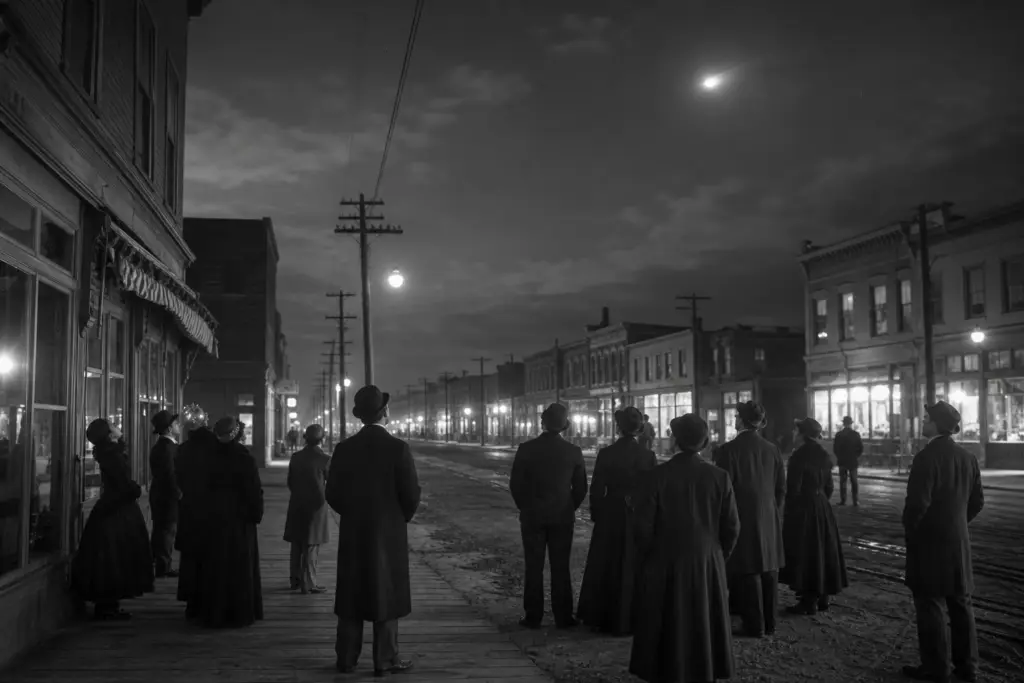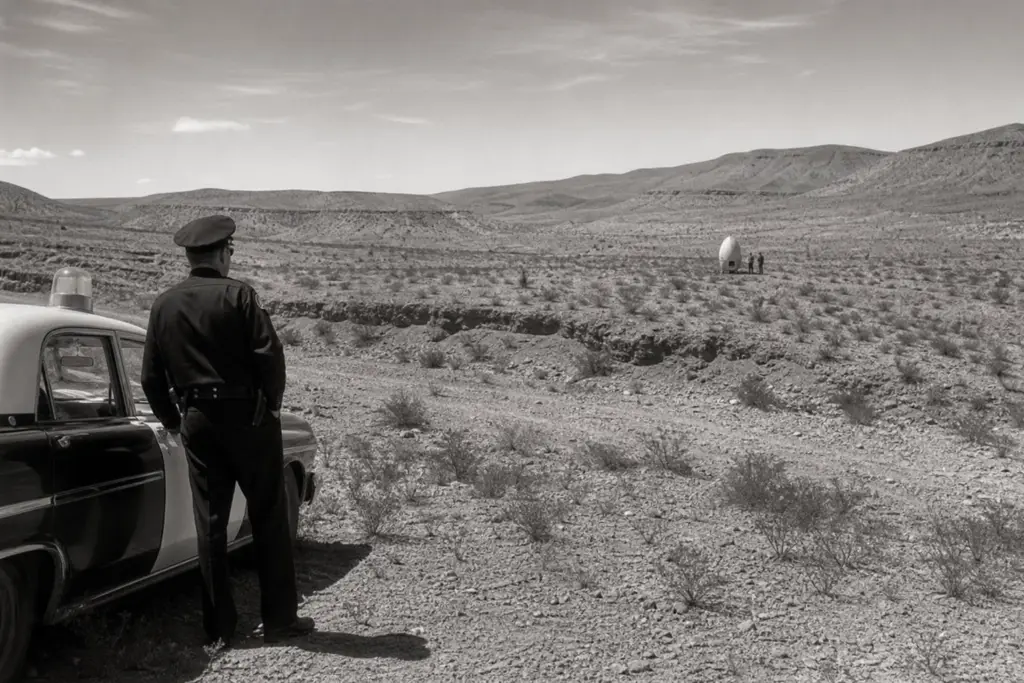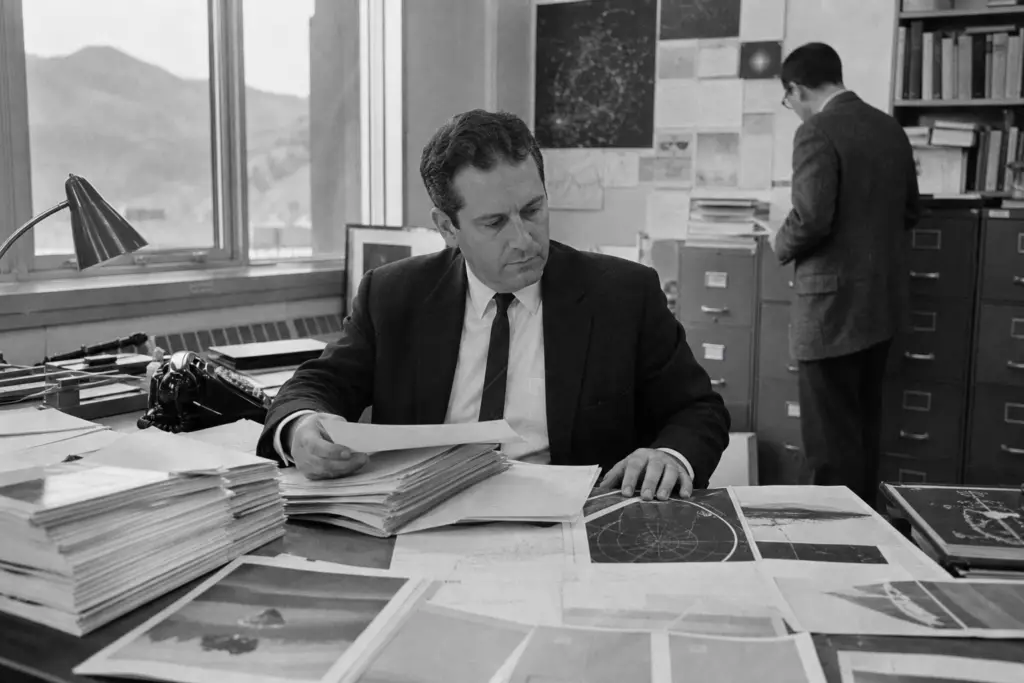
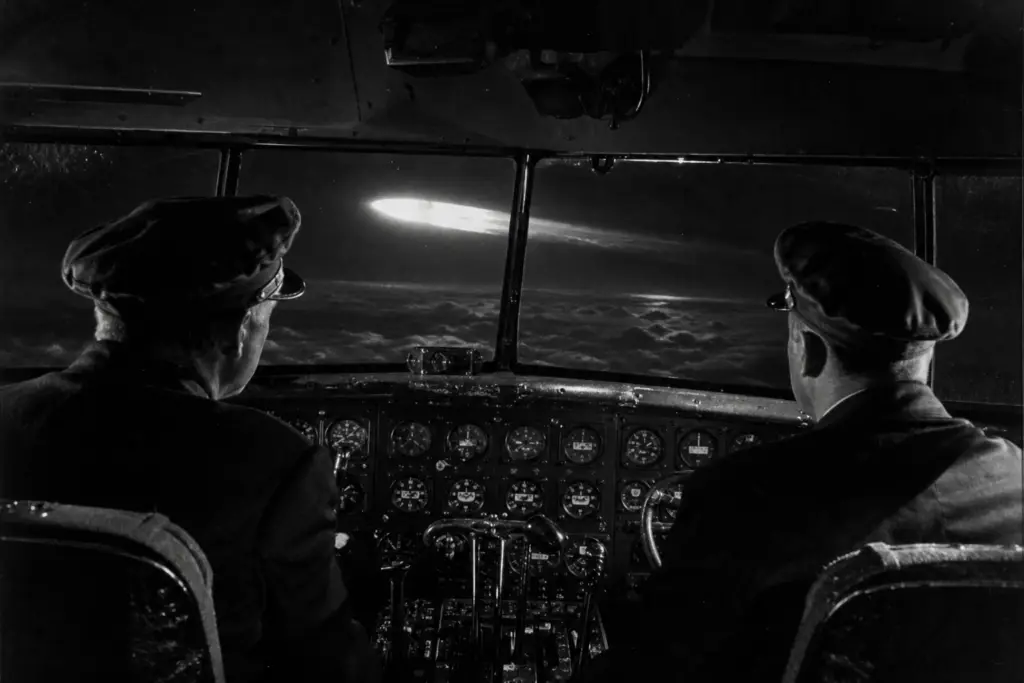
On the night of July 24, 1948, Eastern Air Lines pilots Clarence Chiles and John Whitted reported a startling encounter while flying a DC-3 over Alabama: a bright, fast-moving object that appeared to pass close to their aircraft near Montgomery. Both men were commercial aviators, and their account of an apparently wingless, fuselage-shaped object with illuminated, window-like features gave the report unusual weight in the first postwar wave of “flying saucer” claims.
The Chiles-Whitted UFO incident became a foundational aviation sighting not because its object was identified, but because the pilots described an apparent near-collision rather than a distant light. Their observations were vivid, yet they were also brief, made at night, and lacked instrument data, photographs, or a known physical trace. Those limits matter: a compelling eyewitness report is not the same thing as an independently established description of an object.
This account separates the flight crew’s testimony from the records that can be independently placed around it, follows the report into the U.S. Air Force’s early Project Sign-era inquiry, and tests proposed explanations against the details the pilots actually reported. The result is a historically important 1948 UFO sighting, serious enough to investigate, but still insufficient to establish what, if anything, the object was.
The 1948 Pilot Report That Became a Landmark UFO Case
The report’s unusual standing among 1948 UFO sightings rested on a specific checkpoint: the observers were working airline pilots who described the event while operating an Eastern Air Lines passenger flight near Montgomery, Alabama. Aviation experience does not make a fleeting nighttime perception infallible, but it makes perceived bearing, closing motion, and conflicting traffic more consequential than in a report of a distant, untethered light.
The historical record supports that Clarence S. Chiles and John B. Whitted Jr. made a report and that it attracted early U.S. Air Force attention. It does not independently establish the object’s dimensions, speed, structure, or distance from the DC-3. That distinction is central to the Chiles-Whitted UFO incident: the bright, window-like, apparently wingless form belongs to the pilots’ testimony, while the event left no photograph, recovered material, radar track, or identified aircraft to resolve its identity. The case became influential as an early pilot report, serious evidence of an unexplained observation, but not proof of a particular craft or origin.
Eastern Air Lines Flight 105: Who Was Flying and Where
The firmest identifiers are the crew, aircraft, and scheduled service: Eastern Air Lines Flight 105 was a Douglas DC-3 on its overnight Houston-to-Atlanta run. Clarence S. Chiles was the captain and John B. Whitted Jr. the first officer, placing both men in the cockpit with separate opportunities to observe traffic ahead. Their positions matter because the captain’s view, the first officer’s view, and the aircraft’s forward course are operational context, not independent measurements of an outside object’s size or range.
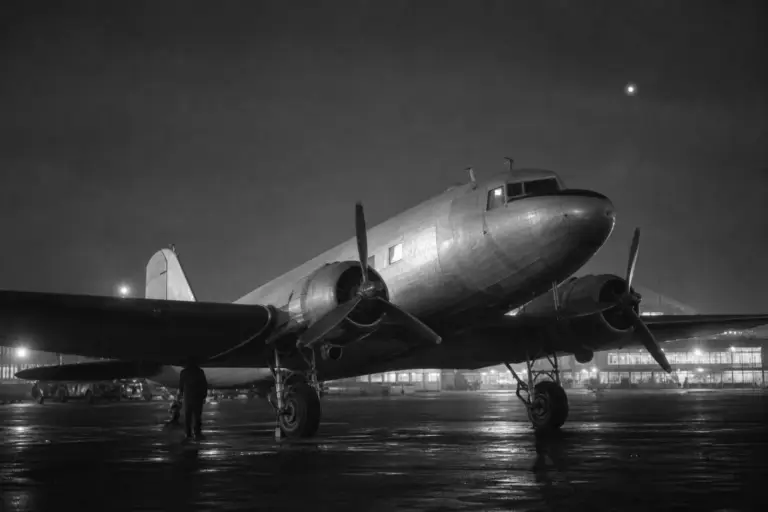
Case accounts place the encounter in the early hours of July 24, 1948, near Montgomery, Alabama, commonly at roughly 2:45 a.m. and while the DC-3 was cruising at about 5,000 feet. Those figures provide a useful geographic and flight-level frame, but the exact location, heading, and duration are reconstructed chiefly from the crew’s subsequent statements rather than from a surviving instrument track.
The pilots described nighttime conditions as sufficiently clear for them to see lights and terrain-related features below, an important distinction from a report made in cloud or heavy precipitation. Clear visibility can support that they saw a real luminous phenomenon; it cannot by itself determine its distance, altitude, or physical form. No surviving radar plot, photograph, or identified ground witness supplies a second measurement against which the cockpit impressions can be calculated.
Thus the operational setting of Eastern Air Lines Flight 105 is well enough established to anchor the report in a particular service, crew, place, and approximate time. The more dramatic geometry of what passed the DC-3 remains testimony, to be assessed separately from those basic flight facts.
What Chiles and Whitted Reported Seeing
The visual account begins with a light ahead of the DC-3 that rapidly resolved, in the pilots’ recollection, into something more substantial than a point source. Clarence Chiles described a large, bright object with a streamlined, fuselage-like body and no wings he could discern. John Whitted likewise reported an elongated luminous form rather than the round “saucer” implied by much 1948 popular language. Their overlap is important: both portrayed a bright object moving through the air ahead of them; neither supplied an instrument-based identification of a particular aircraft or natural phenomenon.
Each man also associated the body with a series of lighted, window-like features. Accounts differ in their precise wording, rows of windows, illuminated panels, or porthole-like openings, but the shared point is perceptual, not architectural: they thought they saw discrete bright areas along the object’s side. A window-like appearance can suggest a constructed vehicle to an observer, while still falling short of demonstrating that the lights were literal windows. Against a dark sky, glare, contrast, motion, and the short viewing interval can make separated lights appear joined to a solid outline, or make an outline seem more sharply defined than its distance permits.
Chiles and Whitted further described a blue flame or exhaust-like glow at the rear as the bright object moved away. That feature contributed to their impression of a self-propelled, high-speed craft, and it is one reason the Chiles-Whitted sighting has been retold as an encounter with a wingless object rather than merely an unexplained light. Yet “rear” and “exhaust” describe how the witnesses interpreted the visible glow and its apparent direction of travel. They do not establish a propulsion system.
Reported estimates of the object’s size, speed, altitude, distance, and path should be read in the same category: they were immediate visual judgments during a brief nighttime observation, not values derived from radar, photographs, or a tracked flight path. The testimony from trained aviators preserves a vivid account of a bright object seeming to approach, pass, and recede; it does not provide the independent range information needed to convert apparent form and motion into measured dimensions or velocity.
Did the Object Nearly Collide With the Airliner?
The danger in the pilots’ account lay in the object’s apparent closing motion. Chiles and Whitted perceived the bright form as coming toward the DC-3 at their level and passing close enough that Chiles reacted as though a collision was imminent. That is the basis for describing the episode as a reported near miss: the crew’s judgment was not merely that they had seen an unusual light, but that they faced conflicting traffic with too little time to assess it.
That judgment cannot, however, supply a measured separation. A light that expands rapidly in an observer’s field of view, or seems to hold a threatening bearing, can create a powerful impression of approach. To turn that impression into an established near-collision would require independent range and trajectory data: for example, radar returns tied to both tracks, timed observations from separate locations, or a positively identified aircraft whose position could be reconstructed.
None of the surviving account provides that kind of geometric proof. There is no recovered object, photograph, instrument record, or independently documented second track establishing how near the object came to Flight 105. The Chiles and Whitted UFO case therefore supports a serious perceived aviation-safety hazard reported by two pilots, not a demonstrable minimum distance or collision course. That distinction preserves the force of their testimony without treating a brief nighttime visual encounter as an air-traffic measurement.
How the Sighting Was Documented and Investigated
The paper trail is more informative about how the report was treated than about what, physically, crossed the DC-3’s path. Airline reporting gave the pilots’ account an institutional route beyond cockpit recollection: operational personnel could preserve the crew’s statements while the event was still recent, and press coverage then carried a simplified version to a far wider audience.
That distinction matters. A contemporary newspaper item can establish that the sighting was publicly reported at the time, but it may compress uncertain details, such as duration, altitude, direction, or the wording of the description. An original crew statement, dispatch-related record, or early military questionnaire is stronger evidence for what a particular witness said; it is not, by itself, independent proof that the object had the reported structure, speed, or range.
The case entered the early Air Force UFO sighting investigation associated with Project Sign, the service’s first formal effort to collect and assess reports of unexplained aerial phenomena. Project Sign’s role was investigative rather than confirmatory: it assembled accounts, compared them with potential conventional causes, and recorded whether available information permitted an identification. Its later successor, Project Blue Book, should not be treated as the agency that originally received or resolved this 1948 report.
Later Air Force case histories and UFO books preserved the Chiles-Whitted episode, often drawing on the same early account while adding interpretive detail. References to Eastern Air Lines leadership, including C. R. Smith, may help explain why the report received attention, but they do not convert the observation into instrumented evidence. The best reading therefore gives greatest weight to records closest in time to the flight and treats later retellings as historical commentary unless they identify their underlying document.
Official Explanations, Competing Theories, and the Limits of the Evidence
The meteor explanation associated with the case treats the event as a brief, exceptionally bright natural object seen under conditions that made its apparent approach seem more dramatic than its actual path. A meteor can account for intense luminosity, rapid motion, a flame-like rear glow, and a short viewing interval. It does less comfortably account for the pilots’ impression of a structured, elongated body with illuminated window-like areas, or for the perception that it held a collision course before passing away. Those features, however, were visual impressions made in seconds, not independently measured properties.
An aircraft explanation addresses the apparent fuselage, lights, and exhaust-like flame more directly. Its difficulty is the reported lack of discernible wings and the extraordinary apparent speed and closing rate. At night, though, a viewer’s estimate of size, distance, and speed depends heavily on an assumed object size; a nearer small light and a more distant large one can produce similar angular impressions. That limitation applies to both a conventional aircraft theory and to the reported near-collision geometry.
Optical misperception is not a claim that the pilots invented the encounter. It is the narrower possibility that glare, dark adaptation, rapid relative motion, and a startling light source caused separate visible features to be assembled into a more coherent craft-like form. The paired witness testimony is a strength because both pilots described a bright, fast object, but it is not independent corroboration in the strongest sense: both observed the same brief nighttime event from the same cockpit.
Extraordinary interpretations emphasize the reported windows, flame, and apparent maneuvering as signs of a technological vehicle. The surviving record does not establish those details as physical measurements, nor does it supply radar data, photographs, debris, or a confirmed outside observer. An imperfect meteor or aircraft explanation therefore leaves the Chiles-Whitted UFO incident unidentified on the available evidence; it does not bridge the evidentiary gap to non-human intelligence.
Why the Chiles-Whitted Case Still Matters, and What It Cannot Prove
July 24, 1948 gave the early flying-saucer era a case with unusually specific aviation stakes: Flight 105’s captain, Clarence Chiles, and first officer, John Whitted Jr., reported an apparent traffic conflict near Montgomery while flying Eastern’s overnight Houston-to-Atlanta DC-3 service. Chiles Whitted 1948 consequently became a reference point for taking trained aircrew testimony seriously while separating observation from identification. The documented core is the named crew’s report and its handling in the first formal Air Force inquiry, Project Sign; the disputed core is whether the brief luminous sight represented a meteor, aircraft, optical misperception, or something else.
That distinction sets a firm boundary around modern UFO disclosure and UAP disclosure debates. The 1948 record contains no radar track, photograph, recovered material, or independent physical measurement of the bright, apparently wingless object and its window-like lights. It therefore does not establish an extraterrestrial or non-human craft. Its enduring value is historical: it showed why a pilot’s report of a possible airborne hazard merited formal assessment, even when that assessment could not produce a final identification.
A Landmark Report, Not a Final Answer
The decisive checkpoint is not whether the sight looked extraordinary, but what the record can independently carry. Two cockpit witnesses gave broadly similar recollections of an apparently structured luminous object and an immediate perception of collision risk while Flight 105 crossed Alabama on July 24, 1948. Their professional experience gives the account historical weight; it does not convert rapid nighttime judgments of distance, speed, shape, or trajectory into measurements.
The early Air Force response matters for the same reason. Project Sign treated the account as one worth collecting and assessing in the first formal U.S. military inquiry into such sightings. A meteor remains a serious conventional explanation for the brightness, speed, brief duration, and flame-like appearance. Its limitation is that it does not neatly reproduce the crew’s impression of a wingless, windowed body approaching at their altitude. That mismatch preserves ambiguity, not proof of a craft.
The Chiles-Whitted UFO incident therefore endures as a credible report of an unexplained observation and a sincerely perceived near miss. The surviving record lacks independent confirmation sufficient to identify the object or support extraordinary claims about extraterrestrial or non-human intelligence.
Frequently Asked Questions
What was the Chiles-Whitted UFO incident?
The Chiles-Whitted incident was a July 24, 1948 report by Eastern Air Lines pilots Clarence Chiles and John Whitted Jr. of a bright, fast-moving object passing near their DC-3 over Alabama. The encounter occurred during Flight 105’s overnight Houston-to-Atlanta service near Montgomery.
What did Chiles and Whitted say they saw over Alabama in 1948?
Both pilots described an elongated, bright, fuselage-shaped object that appeared wingless and had illuminated window-like features. They also reported a blue flame or exhaust-like glow at its rear as it moved away.
Did the Chiles-Whitted object nearly collide with the Eastern Air Lines plane?
The pilots believed the object was approaching at their altitude and close enough to create an immediate collision risk. No radar track, photograph, instrument record, or independently documented second flight path established the actual separation distance or a confirmed collision course.
Was the Chiles-Whitted sighting investigated by the U.S. Air Force?
Yes. The report entered the early U.S. Air Force investigation associated with Project Sign, the service’s first formal program for collecting and assessing unexplained aerial phenomena reports. Project Sign investigated the account but did not independently measure the object’s size, speed, distance, or identity.
What should you look for when evaluating the meteor explanation for the Chiles-Whitted case?
Compare the explanation against the reported brightness, rapid motion, brief duration, and flame-like glow, all features a bright meteor can potentially explain. Also look for independent evidence such as radar, photographs, physical material, or outside witnesses, none of which survives for this case to verify the reported wingless, windowed structure.