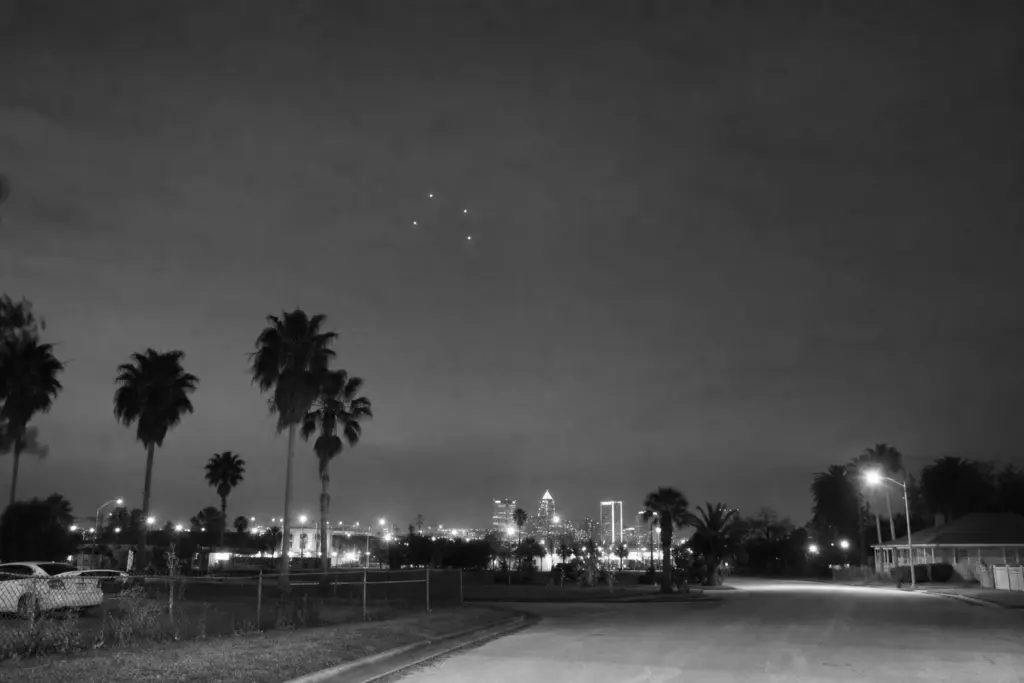
The starting point is a narrow claim: bright white orbs were reportedly seen flying in formation over Jacksonville, Florida, on January 13, 2020. This Jacksonville UFO sighting January 13 2020 is treated here as a reported observation, not as confirmation that a particular craft, technology, or phenomenon was present.
A sighting report can establish that an observer described unusual lights; it cannot, by itself, establish their distance, altitude, size, speed, or origin. “Orbs” may describe the appearance of lights to the observer rather than the physical shape of objects. Likewise, a perceived formation may reflect several objects traveling together, lights seen along a shared line of sight, or a viewing effect that cannot be resolved from a brief account.
No verifiable original submission, timestamped media file, precise observer location, viewing direction, duration, or independent witness record is available in the material examined for this opening assessment. That limitation matters: a dated Jacksonville Florida UFO report is not the same thing as a documented aerial event.
The sections that follow separate the reported details from records that can be independently tested, then compare plausible explanations against the claimed brightness, number, arrangement, motion, and observing conditions. Where the record cannot distinguish among possibilities, the uncertainty will remain explicit.
What the Original Report Says: Bright Orbs and a Formation
There is no accessible original witness narrative from which to reconstruct a fuller sequence of events. The earliest material available for this assessment preserves only the circulating case label: Jacksonville, Florida; January 13, 2020; “bright white orbs“; and an apparent formation.
Those elements should be read narrowly. “Bright white” is the reported visual description, not a measured color or intensity. “Orbs” records the lights’ apparent appearance, not a demonstrated physical shape. “In formation” indicates a claimed arrangement, but does not establish whether the lights held fixed spacing, moved together, changed position, or merely appeared aligned from the observer’s viewpoint. The phrase bright white orbs over Jacksonville, Florida therefore summarizes the allegation rather than supplying a detailed observation log.
No original wording is available to establish a reliable chronology beyond the reported date and city. In particular, the surviving claim does not document:
- the time of day or night;
- the observer’s neighborhood or precise viewing location;
- the compass direction, elevation, or travel path of the lights;
- the number of lights in the reported formation;
- whether they moved, hovered, blinked, faded, separated, or changed formation;
- the duration of the observation;
- weather and visibility as observed by the witness;
- photographs, video, file metadata, or named corroborating witnesses.
That distinction affects how much can be inferred from the white orb formation sighting in Jacksonville. A useful original report would separate observation from interpretation, for example, “three steady lights crossing west to east for two minutes” is testable in ways that “lights in formation” is not. Here, neither that level of detail nor the submission provenance needed to attribute the wording to a specific observer is available. The record preserves a concise claim, not a recoverable firsthand account.
What Can Be Verified Independently
A published case label establishes only that a claim circulated; it does not authenticate the observation or identify the lights. No traceable photograph or video is tied to the Jacksonville report. An original media file could offer a creation time, location data where available, and a route back to the recorder for comparison with other records. A reposted image or clip without that provenance might illustrate an account, but cannot reliably establish when or where it was captured.
No named, contemporaneous second-witness account is preserved. Independent accounts are most useful when they originate separately yet agree on testable particulars, such as the number of lights, direction of travel, time window, and duration, rather than repeating a circulating description. There is therefore no corroborating account against which to compare the reported formation.
There is also no local-news report, airport or aviation record, official statement, weather observation, astronomical comparison, or satellite-position result linked to a specific time and viewing location. Each depends on those missing anchors: a weather archive can describe cloud cover and visibility at a station and hour; flight data can be compared with a time and bearing; and astronomical or satellite tools can establish whether a bright object occupied a stated part of the sky.
Those absences neither establish an unusual cause for the January 13 2020 UFO sighting in Jacksonville nor disprove that someone saw lights. They prevent the surviving claim from being independently matched to a flight, celestial object, weather condition, or recorded local event. The verifiable element is the circulation of the basic date, place, and description, not the identity, motion, or physical reality of the reported formation.
Why Bright Lights in Formation Are Difficult to Identify
At night, a point of light reveals far less than a visible object against a daytime sky. Without a known distance or altitude, apparent brightness cannot be converted into physical size or power: a nearby dim light and a distant intense one can present a similar visual impression. Haze, thin cloud, humidity, and glare can also soften an outline into an “orb,” which describes appearance rather than shape.
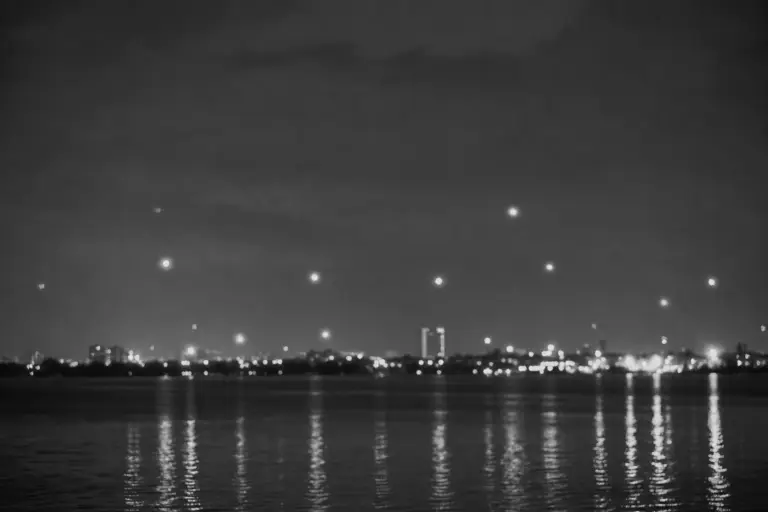
Formation is likewise an observation of angles, not a measurement of spacing. Lights on one aircraft, several aircraft moving along a shared route, or separate objects at very different distances can seem aligned from one viewing position. A head-on or receding light may appear almost stationary; an object crossing the observer’s view can seem faster. Changes in viewing angle can make a fixed arrangement look as though it is tightening, spreading, or turning.
A practical assessment therefore needs more than a count of white lights: it needs their direction, elevation above the horizon, changes in separation, color or flashing pattern, duration, and whether the arrangement held as they moved. Stronger observations preserve those particulars and, ideally, compare them from more than one location. A weakly specified orb UFO sighting remains unidentified because its observations cannot distinguish among ordinary light sources; that is not the same as showing the lights were unexplainable.
Plausible Explanations and What Evidence Would Support Each
Several familiar sources can produce a cluster of bright points, but the surviving description is too thin to rank one confidently.
Aircraft are a workable hypothesis if the lights traveled on a steady shared course, changed position slowly, or appeared near approach and departure paths. A single aircraft can present a bright forward-facing landing light while its colored navigation lights and flashing anti-collision beacon are invisible at distance; several aircraft can also appear as a loose formation from one vantage point. Repeated flashes, red or green lights, audible engine noise, a consistent direction of travel, and a precise time would strengthen this explanation. A group of lights that remained fixed relative to one another without flashing, or moved in sharply divergent directions, would weigh against it. The report preserves none of the needed timing, direction, motion, or color detail.
Satellites, including a recently deployed satellite train, would fit several steady white lights crossing the sky at a uniform pace and preserving broadly similar spacing. A satellite train should normally follow one path rather than maneuver, and its members should progress across the observer’s field of view rather than hover. A specific observing time, compass bearing, elevation, and duration could be compared with historical pass predictions; without those anchors, no January 13 match can be tested. The lack of a reported count or spacing also prevents a meaningful comparison with a train.
Drones would be more plausible if the lights were low, nearby, capable of stopping or turning, and held in a deliberate geometric arrangement. That possibility weakens if the objects crossed a large portion of the sky in one uninterrupted direction or appeared far beyond any discernible nearby setting. Useful discriminators would be changes in altitude, audible rotor sound, proximity to a launch area, and video showing maneuvering rather than a sequence of distant points.
Lanterns can resemble warm or white floating lights when several are released together, particularly if they rise and drift with the same air flow. Their spacing commonly changes as they climb or fade, rather than remaining rigid. A reported rapid lateral transit, tight maintained formation, or abrupt directional changes would fit poorly; wind conditions, duration, and the lights’ apparent climb or descent are absent here.
Astronomical objects are most useful as a comparison when the lights appeared fixed or moved only with the sky over a longer interval. They are a poor fit for multiple lights visibly traveling in formation, unless apparent motion was inferred from changing perspective or cloud. A time and viewing direction would allow a reconstruction of what was above Jacksonville. For this case, each explanation remains a testable possibility rather than an identification.
How Strong Is the Jacksonville Case on the Available Record?
The appropriate evidence grade is insufficiently documented unresolved report. That label does not elevate the Jacksonville FL UAP sighting into evidence of an extraordinary event; it identifies a case for which the surviving information cannot discriminate among ordinary possibilities.
An identified case requires a specific match between the observation and independently testable records or media, for example, a time-stamped recording whose direction and motion correspond to a known aircraft movement or satellite pass. A likely but unconfirmed case has enough reported detail to favor one explanation, even if no definitive match survives. This report reaches neither threshold.
The decisive weaknesses are not merely the absence of a preferred explanation. There is no exact observing time, street-level location, bearing, elevation, duration, object count, motion description, named corroborating witness, or original photo or video with recoverable provenance and metadata. Without those anchors, aircraft, satellites, drones, lanterns, and misperceived fixed lights cannot be meaningfully tested against the claimed formation.
Thus, the record supports only that a Jacksonville sighting claim circulated with a date, city, and brief description. It does not support an identification, a ranked conventional cause, or a conclusion about the lights’ origin.
What This Report Does, and Does Not, Show
This final classification is a limit on the record, not evidence pointing beyond it. An unresolved civilian report means the lights have not been identified from the surviving material; it does not supply affirmative evidence of non-human intelligence, alien visitation, a government UFO cover-up, UFO disclosure, or UAP disclosure. An open question and a demonstrated extraordinary claim are different evidentiary categories.
The Jacksonville claim would become more assessable if an original witness account, a contemporaneous time and precise viewing location, a description of direction and duration, or an unedited recording with provenance emerged. Independent accounts tied to the same details could also permit comparisons with flight, satellite, weather, or local-event records. Responsible UAP reporting preserves those observations, marks what remains uncertain, and leaves room for revision if stronger evidence appears.
Frequently Asked Questions
What was reported over Jacksonville, Florida, on January 13, 2020?
A claim circulated that bright white lights described as orbs were seen in a formation over Jacksonville, Florida, on January 13, 2020. The surviving report does not document the time, exact location, number of lights, direction, duration, or motion.
Were the bright white orbs over Jacksonville identified?
No identification was established. The case is classified as an insufficiently documented unresolved report because there is no exact time, viewing location, bearing, media provenance, or independent witness account.
Is there photo or video evidence of the Jacksonville January 13, 2020 sighting?
No traceable photograph or video is tied to the Jacksonville report. No original media file with recoverable creation time, location data, or metadata is available.
Could lights in formation be aircraft, satellites, drones, or lanterns?
Yes. Aircraft, satellite trains, drones, and lanterns can each produce multiple bright lights that appear aligned or grouped, but the available Jacksonville claim lacks the time, direction, movement, and spacing details needed to test any one explanation.
What details should you look for when evaluating a UFO sighting with lights in formation?
Record the exact time, precise location, compass direction, elevation, number of lights, spacing, color, flashing pattern, duration, and movement. Original unedited video or photos with metadata, plus independent witnesses reporting the same details, allow comparison with flight, satellite, weather, and local-event records.