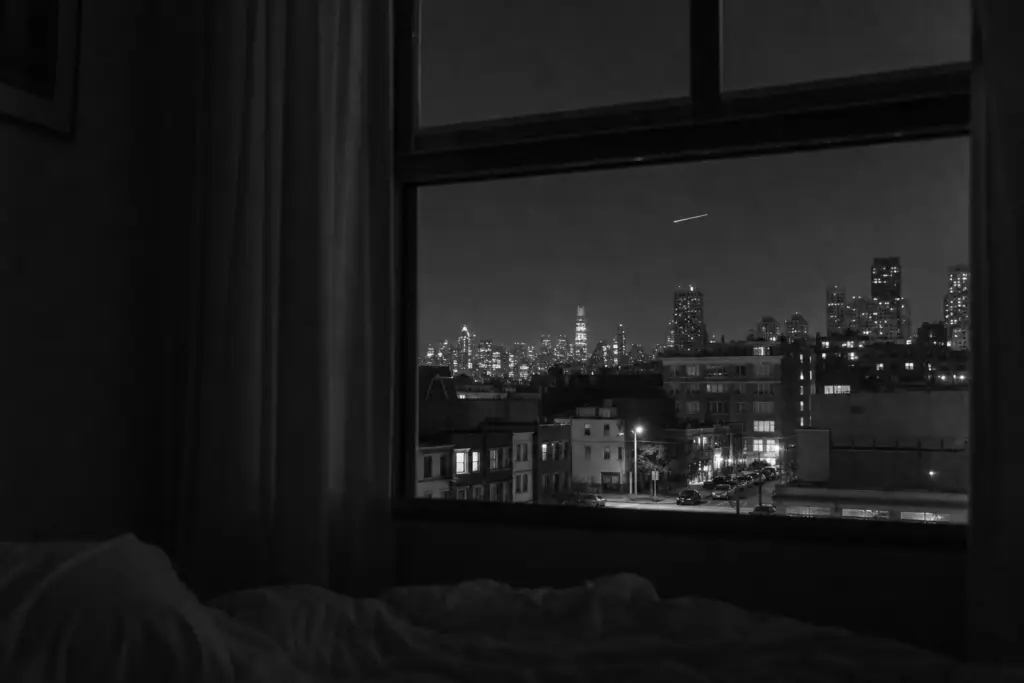
A useful first checkpoint is whether the light and sound can be tied to one event at all. The January 22, 2020 account describes a sudden bright light seen through a bedroom window in San Francisco and a high-pitched sound heard at roughly the same moment. Those details establish the subject of the inquiry, not the identity, distance, or path of an object. A brief visual event can arise from a meteor, aircraft lighting, a drone, a reflection, or something close to the window; the sound may or may not have shared the same cause.
No independently located primary record has yet been established for this account beyond the description being examined here. That limitation matters. An eyewitness report is direct evidence of what the observer perceived, whereas a confirmed identification needs supporting information that connects a particular event or object to the reported time and place.
The sections that follow separate reported features from editorial inference, examine provenance and possible corroboration, and compare ordinary explanations with the reported light, apparent motion, and sound. They also address the interpretive limits of a momentary view through glass. Unless stronger records emerge, the appropriate outcome may be a plausible but unconfirmed explanation, or an unresolved report, rather than a definitive label.
What Was Reported Over San Francisco on January 22, 2020
The usable description is deliberately short: it fixes the report to San Francisco on January 22, 2020. It attributes three linked impressions to the witness, a bright object, a rapid passage past a bedroom window, and a high-frequency noise. “Flashed past” describes apparent motion from the observer’s viewpoint; it does not establish actual speed, range, size, or trajectory.
Nor does the available account supply a recorded neighborhood, clock time, viewing direction, altitude, duration, color, shape, weather condition, photograph, video, or named second witness. Those omissions are not evidence against the eyewitness report. They set the boundary on what can responsibly be claimed from it. San Francisco and the stated date are the location and date to investigate, rather than a basis for assigning the event to a particular street, flight path, or celestial track.
The noise likewise belongs to the testimony: the witness associated a high-pitched sound with the visual event, but the surviving description does not show whether both had one source or whether either could be timed independently. A sound recording, precise timestamp, or corroborating local observation would materially strengthen that connection; none is presently part of the identified case record.
This distinction guides the analysis of the bright object over San Francisco in 2020. The witness description preserves what was perceived. Independently verifiable evidence would be a contemporaneous public observation, instrumented detection, or traceable aviation, weather, or astronomical record that matches the limited circumstances without filling gaps with assumptions.
The Record: What Is Known, and What Is Not Recorded
The provenance problem is central: no independently located original submission, civilian-database entry, archived post, or attributable witness statement has been provided for this report. The account therefore cannot presently be classified as a traceable first-hand record, a reposted anonymous submission, or a database-preserved case. It is an unverified description whose wording supplies the case’s entire evidentiary base.
| Stated in the available description | Not recorded or not presently available |
|---|---|
| San Francisco; January 22, 2020; a bright object seen from a bedroom window; an impression that it flashed past; and a high-pitched sound associated with the moment. | Exact time, neighborhood, observer identity, number of witnesses, viewing direction, elevation, duration, apparent size, color, shape, and whether the window was open or closed. |
| The description conveys perceived brightness and rapid apparent motion. | Distance, true speed, physical size, route, and whether the light was an object, a reflection, or an external light source. |
| The witness linked the sound to the visual event. | A recording, timing measurement, description of the sound’s duration or direction, and evidence that the noise and light had the same origin. |
This division matters because “bright,” “flashed,” and “high-pitched” are observations, not instrument readings. A bright appearance does not establish luminosity; a quick transit across a window does not establish high physical speed; and temporal association does not establish causation. Treating those impressions as measurements would turn missing information into false precision.
No photograph, video, physical trace, contemporaneous message, follow-up interview, or independently preserved corroborating account is presently attached to the reported observation. That absence does not disprove that something was seen or heard. It does mean that later comparison with weather, aviation, astronomical, and local reports can test only broad consistency, not reconstruct a uniquely identified event.
For that reason, this January 2020 UFO sighting in San Francisco should remain an unidentified report rather than a documented UAP case. The next evidentiary question is not what the object “must” have been, but whether independent records can supply the missing time, place, direction, or corroboration without assuming them first.
What Can Be Checked Against Independent Records
A useful records search looks for convergence: an independently dated observation whose time, direction, and location narrow the same event rather than merely resemble one feature of the account. The missing timestamp makes that standard difficult to meet, but it still provides a disciplined way to evaluate the reported San Francisco UFO sighting of January 22, 2020.
- Contemporaneous local reports: Dated posts, news items, emergency notices, and civilian UFO sightings can reveal whether multiple people reported a flash, unusual aircraft activity, or a noise in the same part of the Bay Area. Several independent accounts that agree on a short time window and a shared direction would be a meaningful lead; later recollections or reports with only a similar description would be weak corroboration.
- Meteor, fireball, and astronomical records: A candidate meteor event should have a reported time and sky path that can be compared with the likely view from San Francisco. A regional fireball entry may support the possibility of a bright atmospheric event, but it cannot identify this observation without a closer match in timing and direction. Astronomical conditions can also establish whether a bright celestial object was visible, though a fixed object does not by itself fit an apparent rapid crossing.
- Flight-tracking data: Public aircraft and helicopter tracks are most useful when a sighting has a time, viewing direction, and approximate neighborhood. A track that crosses the relevant line of sight at the relevant moment is stronger than a general finding that aircraft operated somewhere nearby. No visible match would be limited by the report’s missing time and by the scope of the available record.
- Weather and local alerts: Cloud cover, visibility, precipitation, wind, and reports of outages, fireworks, emergency activity, or unusual public events help establish viewing conditions and possible nearby sources. They provide context, not an automatic identification.
Launch and reentry notices belong in the same comparison file of independently checkable records: a precise temporal and geographic fit can strengthen a candidate, while a loose same-date coincidence cannot. Conversely, no matching meteor log, track, alert, or public report would not establish an extraordinary cause. It would show only that the surviving description is too sparse for those records to resolve it.
Could a Meteor, Aircraft, Drone, or Other Ordinary Source Fit the Description?
The best fit cannot be chosen by brightness alone, because a near, small light can cross a window’s field of view as quickly as a distant, fast-moving object. The reported flash therefore admits several ordinary categories, but each accounts for a different combination of apparent motion and sound.
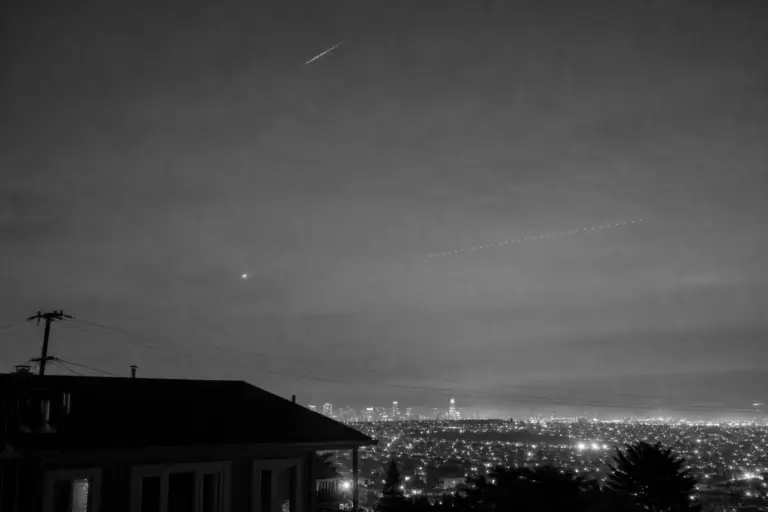
- Meteor or fireball: A meteor can produce a short, bright streak that appears to move rapidly across a limited view of sky. It fits the visual “flash” better than a sustained light, but the reported high-pitched sound is a weaker fit if it was heard at the same instant: a distant atmospheric event and an immediately perceived local noise need not share a source. Without a time, direction, duration, or corroborating fireball report, this remains plausible rather than identified.
- Aircraft or helicopter: Navigation, landing, or search lights can appear unusually bright when an aircraft is approaching, turning, or briefly passing through a gap in the view. Engines and rotor systems can supply audible noise, although the account supplies no repeated lights, recognizable aircraft shape, extended passage, or low-frequency engine or rotor description. A brief glimpse can make an ordinary flight seem faster than it is.
- Drone: A nearby drone could combine a compact bright light with an electronic whine, making it one of the more direct visual-and-auditory matches. Its limitation is range: the description does not establish that the light was close, hovering, maneuvering, or audible for long enough to distinguish it from another nearby device.
- Satellite or reentering debris: A satellite normally appears as a steady, point-like light moving across the sky and does not supply an audible local noise. Reentry can be brighter and more fragmented than a normal satellite pass, but it would require a closely matching event record before it could explain this particular report.
- Reflection or terrestrial source: Headlights, a moving indoor reflection, a security light, electrical equipment, or another nearby object can create a fast apparent sweep across glass. These possibilities also make a high-pitched sound easier to place nearby, though they cannot be selected without details of the room, street view, and timing.
Sound timing is especially important in this San Francisco UFO report with a high-pitched sound. A noise heard during a flash may have come from the object, but it may also have originated nearby, through a window, from a vehicle, appliance, alarm, or another person’s activity, while attention was fixed on the light. Human perception naturally joins near-simultaneous events, yet simultaneity does not establish a common location or cause. The sound is therefore a useful clue only if its duration, direction, change in pitch, and relation to the light can be independently described.
On the surviving account, a nearby illuminated source or drone can accommodate both reported features, while a meteor accommodates the abrupt visual impression more readily than an immediate local noise. Aircraft, helicopters, reentry, and reflected light remain viable categories with distinct missing tests. None can be elevated from an unidentified object to a specific identification from the present description.
Why a Brief View Through a Bedroom Window Is Hard to Interpret
A window frame creates a narrow visual stage. A light may enter one edge of that frame and disappear through the other before the observer can establish where it came from, where it went, or whether its apparent motion changed. In that setting, “flashed past” is a faithful description of the view from the bedroom, but not a measured flight path. It records a brief change in the observer’s line of sight rather than a known course over San Francisco.
Distance is the missing variable that most affects interpretation. A small nearby light can sweep across a restricted view quickly; a distant bright moving light can occupy the same apparent angle while travelling on a very different path. Without a known foreground landmark, such as a roofline, streetlight, building edge, or hill, there is no reliable scale for range. The description consequently cannot yield an object’s physical size, altitude, speed, or proximity to the window.
Glass adds another layer of ambiguity. Interior lamps, screens, and illuminated objects can reflect in a window, while exterior headlights or other lights can create glare, streaks, or a moving patch of light across it. Against a dark background, a compact light can seem sharper, closer, and faster than it would against a visible landscape. A reflection generally changes with the room, glass angle, or observer position; a distant outdoor light remains tied to the outside scene. The surviving account contains no such comparison, so neither pattern can be assigned here.
The high-pitched sound does not restore the missing geometry. A person looking through a fixed opening may hear a nearby noise while seeing a separate distant light, yet experience both as one sudden event. An independent viewpoint, a recorded direction, a duration, or identifiable landmarks could have tested whether the visual and auditory impressions tracked the same source. Without them, the report preserves a real-time perception, not the measurements needed to reconstruct its trajectory.
Assessment: Identified, Plausible, or Unresolved?
The appropriate final classification is unresolved because the evidence is insufficient, not identified. No available record links the January 22, 2020 San Francisco report to a specific meteor, aircraft, drone, launch-related event, reflection, or other source. At the same time, the account lacks the provenance and measurements needed to prefer any one of those explanations over the others.
The evidence grade is therefore low: the surviving material is an unverified witness description, without a traceable original account, timestamp, precise location, direction of travel, independent witness, or authenticated media. “Plausible” remains a useful category for nearby illuminated devices, aircraft activity, reflections, and a brief meteor-like event; it means a category can accommodate part of the description, not that it has been demonstrated as the answer.
The most valuable new evidence would be a contemporaneous, timestamped original post or message; a neighborhood-level location and viewing direction; a second independent observer; or video with recoverable recording time, location, and unedited provenance. Those details could be compared meaningfully with meteor reports and aviation activity. A same-date resemblance alone would remain weak; a match in time, direction, and observed behavior would materially change the assessment.
This reported UFO sighting is not, on its present record, a technically documented UAP case. Later AARO or Pentagon UAP news does not fill the missing details of an older civilian account, and missing evidence is not evidence of alien disclosure, non-human intelligence, or a government cover-up. The defensible conclusion is narrower: a bright object and high-pitched sound were reported, ordinary explanations remain open, and the available information cannot identify the source.
Frequently Asked Questions
What was reported over San Francisco on January 22, 2020?
A witness reported a bright object flashing past a bedroom window in San Francisco and a high-pitched sound heard at roughly the same time. The account does not provide an exact time, neighborhood, viewing direction, duration, color, shape, photo, video, or second witness.
Was the January 22, 2020 San Francisco UFO sighting ever identified?
No specific source has been identified. The case remains unresolved because there is no traceable original record, timestamp, precise location, independent corroboration, or authenticated media connecting it to a meteor, aircraft, drone, reflection, or other event.
Could a meteor make a high-pitched sound during a UFO sighting?
A meteor can fit a short, bright streak that appears to move rapidly, but an immediately heard high-pitched sound is a weaker match for a distant atmospheric event. The light and noise may have been separate near-simultaneous events, since no recording or timing measurement links them to one source.
How can a bright object appear to flash past a bedroom window?
A narrow window view can make a nearby small light or a distant bright light cross the visible frame very quickly. Without landmarks, distance, viewing direction, duration, or apparent size, the report cannot establish the object’s true speed, altitude, physical size, or trajectory.
What evidence would help identify the San Francisco bright-object sighting?
The most useful evidence would be a timestamped original post or video, neighborhood-level location, viewing direction, recognizable landmarks, and an independent second witness. Those details could be matched against meteor reports, aircraft tracks, weather conditions, local alerts, launch or reentry notices, and other contemporaneous Bay Area reports.