The Betty and Barney Hill abduction endures because it became far more than a strange night-drive story: it supplied a vocabulary and narrative pattern that later shaped public ideas about alien encounters. In September 1961, while travelling through New Hampshire, the Hills reported seeing an unusual aerial object and arriving home with troubling gaps and uncertainties in their recollection. That much begins with reports made close to the event; it is not the same thing as proof of an extraterrestrial encounter.
The fuller story familiar today, beings, confinement, examination, and a journey aboard a craft, emerged later, especially through memories recalled under hypnosis. That distinction matters. A contemporaneous report preserves what people said near the time; later testimony may add detail but can also be influenced by elapsed time, questioning, expectation, and the hypnotic setting. Neither category alone settles what happened, and disagreement over their weight lies at the center of this 1961 UFO case.
This account follows the chronology: the Hills’ drive and early reports, the missing-time question and claimed physical traces, the psychiatric sessions that produced the best-known narrative, and competing readings of the star map and other alleged corroboration. It then considers how an unresolved alien abduction claim became a lasting cultural landmark, without treating documentation of the Hills’ distress and reporting as verification of its proposed cause.
Why the Hill Case Remains a Landmark Claim
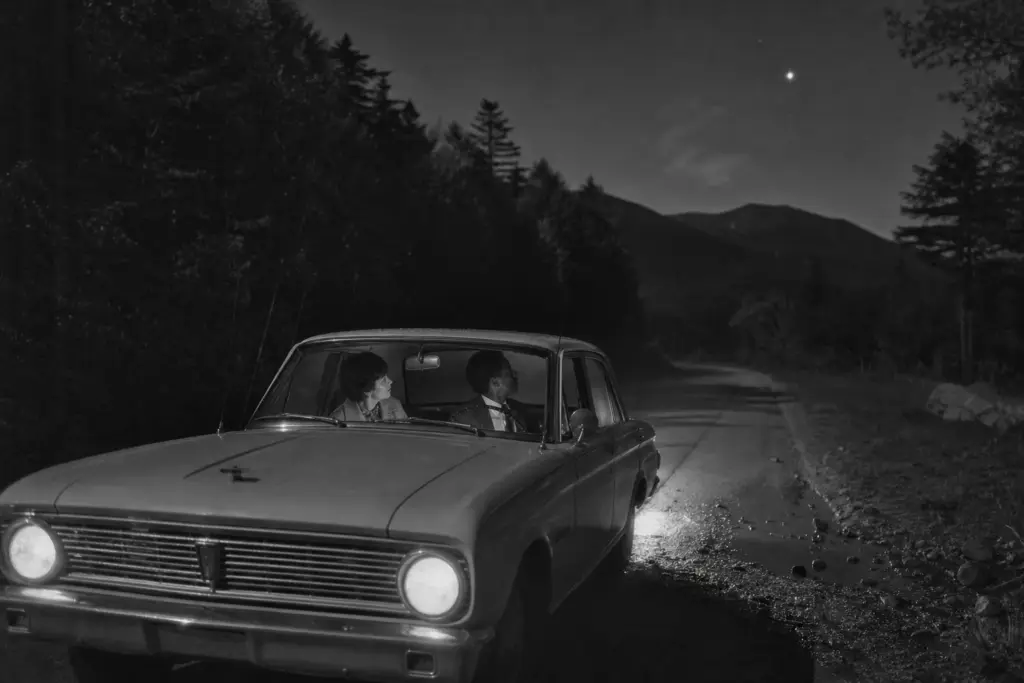
A useful checkpoint is the record’s sequence: a nighttime drive through New Hampshire’s White Mountains on September 19, 1961 came first; the detailed account of captivity came later. An interracial married couple returning from a vacation, the Hills later described seeing a strange light or object, becoming alarmed, and being unable to account for part of the trip home. These are historical reports by identifiable people about a specific journey, not findings that establish the object’s identity or cause.
The distinction becomes sharper as the record expands. Early reporting preserves an account of an unsettling roadside episode and its aftermath; later recollections, including material produced in psychiatric hypnosis sessions, supplied the elaborate sequence now associated with the Hill case. Hypnosis can produce vivid, sincerely experienced memories, but vividness is not independent corroboration: suggestion, prior beliefs, and elapsed time can affect recall. Critics therefore dispute the abduction interpretation, while supporters see continuity in the couple’s distress and testimony. Both responses help explain the claim’s place in UFO history. Its influence is undeniable; extraterrestrial causation remains unverified.
What Is Documented About the 1961 Drive and Early Reports
The journey’s basic outline is preserved in the Hills’ early accounts: while driving south on Route 3 through the White Mountains after a vacation in Canada, they noticed a light or object that seemed to move unusually. They stopped more than once to watch it. Barney later described using binoculars and becoming frightened by what he thought he saw; the couple then drove away quickly.
Those reports establish that Betty and Barney Hill described an alarming nocturnal observation during the September 1961 drive. They do not establish the object’s distance, size, origin, or whether it behaved as the Hills interpreted it. A reported sighting is evidence of what witnesses said they experienced, not independent identification of an aircraft or craft.
On reaching their Portsmouth-area home later than they expected, the Hills compared their uncertain recollections and noticed that the trip seemed to contain an unexplained interval. In the days that followed, they discussed the episode with relatives and sought information from Pease Air Force Base. Their attempts to report and understand the event are historically important: they show concern and a desire for an ordinary explanation, rather than a ready-made public abduction story.
Betty also contacted the National Investigations Committee on Aerial Phenomena (NICAP), a civilian UFO-investigation organization, and the case entered the wider UFO-reporting network. Early notes, letters, and interviews can therefore help date the reported drive, the sighting, and the couple’s immediate anxiety. They cannot independently reconstruct every mile of the route or demonstrate an encounter beyond the observation itself. The detailed captivity account belongs to a later stage of the record.
The Missing-Time Report and Other Claims: What the Record Can, and Cannot, Show
The apparent interval became consequential because the Hills could not reconcile their arrival time with their memory of the drive. Their early concern was not a measured, independently timed gap: it was an estimate based on how long they believed the remaining route should have taken and on their fragmentary recollection after fleeing the sighting. That distinction matters. It records a troubling time discrepancy in an interrupted journey, but it does not identify what filled the discrepancy.
Other details entered the early aftermath. The Hills described Barney’s shoes as scuffed, Betty’s dress as torn and stained, and shiny circular spots on the car’s trunk; they also reported fear, fatigue, and disturbed sleep. These claims are historically important because they show that the episode had a physical and emotional aftermath for them rather than being merely a later public story. Yet the reported marks and damaged clothing were not subjected to a contemporaneous examination capable of linking them to a particular cause. They remain observations by the people involved.
Betty’s recurring nightmares began soon after the September 1961 event and included a more developed scenario of being taken by figures into an enclosed space. Nightmares are contemporaneous evidence of distress and of the imagery through which she was trying to make sense of the night; they are not independent evidence that the dream events occurred. Later retellings often place these details beside the missing-time claim as though they mutually confirm one another. They instead belong to different evidentiary categories: an estimated time discrepancy, reported physical traces, and remembered or dreamed imagery.
The record can therefore show a couple trying to account for an unsettling experience and noticing details they found difficult to explain. It cannot, from those details alone, establish an abduction, the identity of any visitors, or a precise sequence during the unremembered portion of the trip.
How Hypnosis Shaped the Better-Known Abduction Narrative
The narrative most familiar to the public took shape in a clinical setting rather than in the Hills’ first reports. More than two years after the drive, psychiatrist Benjamin Simon treated Betty and Barney separately for continuing anxiety and sleep-related distress. During recorded hypnotic sessions, each described a far more elaborate sequence: being stopped, taken into a craft, encountering nonhuman figures, and undergoing examinations.
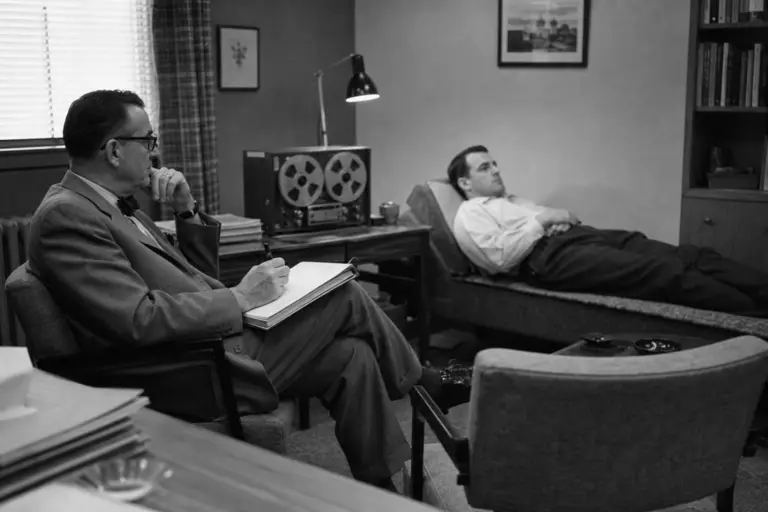
That chronology changes the evidentiary weight of the details without deciding whether the Hills were sincere. Betty’s earlier nightmares contained confinement imagery, while the later sessions produced extended accounts presented as waking recollection under hypnosis. Barney’s recalled narrative differed in particulars from Betty’s, including aspects of the beings and events aboard the craft. The tapes, transcripts, and later summaries preserve what the pair said in treatment; they do not provide an outside observation, physical record, or independent witness to the events described.
Hypnosis is a state used in some therapeutic contexts to focus attention and explore distressing material. It is not a mechanism that can determine whether an image is historically accurate. Memory recovery under hypnosis remains controversial because questioning, expectations, imagination, prior dreams, and repeated retelling can affect what a person comes to experience as a memory. Confabulation does not necessarily mean deliberate invention; it describes the mind’s capacity to form a coherent account around incomplete or uncertain recall.
Simon’s sessions therefore matter enormously to the history of the Betty and Barney Hill abduction: they are the principal route by which the examination-and-craft narrative entered the record. They are weaker, however, as independent confirmation of what occurred on the road. The careful conclusion is that hypnosis revealed the Hills’ later, emotionally powerful accounts, not that it verified their extraterrestrial interpretation.
The Star Map, Corroboration Claims, and Competing Interpretations
One especially durable image emerged from Betty Hill’s hypnosis-derived account: a drawing of a star pattern that she said had been shown to her by a figure aboard the craft. The Betty Hill star map was not part of the couple’s immediate 1961 reporting. It entered the story later, after the clinical sessions had produced the claimed encounter sequence, so it is evidence of a recalled and drawn image rather than a contemporaneous astronomical record.
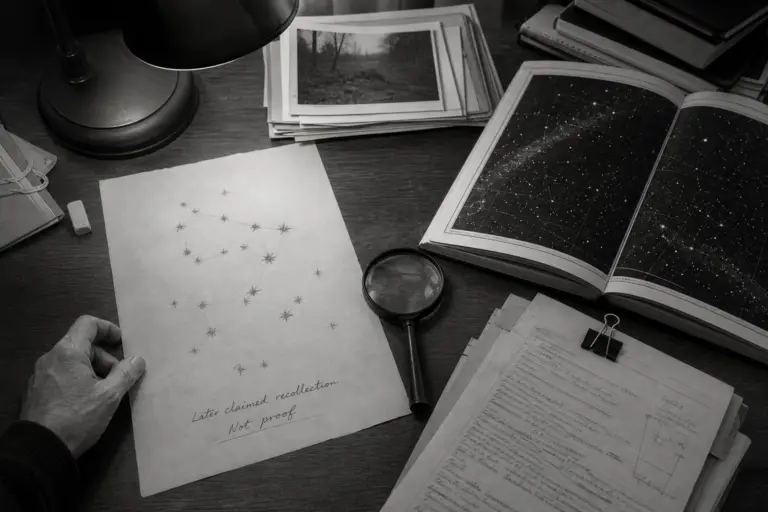
Marjorie Fish, an amateur astronomer, later used three-dimensional models of nearby stars to argue that the drawing could represent a view from the Zeta Reticuli system. Her proposal gave the case an apparently testable geographic claim: instead of an unspecified alien origin, the visitors might have come from a particular nearby stellar region. For proponents, the importance lay in the fact that Fish’s interpretation was developed after the drawing existed and involved spatial relationships that are not obvious on an ordinary sky chart.
Critics dispute whether that sequence supplies genuine corroboration. A sparse arrangement of dots, lines, and larger circles can be matched to numerous stellar groupings when the viewer may choose a viewpoint, select which stars count, and allow for imprecise drawing. Changes in stellar catalogues, distance estimates, and assumptions about the map’s orientation further affect proposed matches. The skeptical explanations therefore account for how an ambiguous sketch can acquire a persuasive resemblance without identifying an actual destination; they do not establish what Betty experienced when she made it.
Other frequently cited supports face a similar limit. Reports of unusual lights, the couple’s distress, and later-retold physical details help explain why the incident remained compelling, but none independently records a craft, its occupants, or a journey to Zeta Reticuli. The star map remains a striking cultural artifact of the Betty and Barney Hill abduction, suggestive to believers, vulnerable to retrospective fitting for critics, and unresolved as evidence.
How the Case Became a National Abduction Story
Publicity changed the scale of the story. Investigative interviews and the Hills’ own lectures moved an experience first discussed within personal, clinical, and UFO-investigation circles toward a mass audience. Newspaper attention then presented the most dramatic elements as a coherent narrative, often compressing the difference between the couple’s early reports, Betty’s nightmares, and memories recalled years later under hypnosis.
John G. Fuller’s 1966 The Interrupted Journey gave that narrative its most influential durable form. The book drew on interviews and selected material from Benjamin Simon’s sessions, making the Hills’ account accessible to readers far beyond specialist UFO groups. Selection matters here: a popular narrative favors vivid scenes, dialogue, and sequence, whereas the underlying source history consists of records made at different times and for different purposes. A clinical transcript can show what a person said in treatment; it does not independently establish that the recalled scene occurred as described.
Later retellings of the Betty and Barney Hill encounter commonly foregrounded the stopped car, small beings, examination, missing time, and star map, while giving less attention to chronology and uncertainty. That emphasis helped fix a recognizable public version of the case. It also encouraged embellishment: details repeated across books, television, lectures, and UFO lore can appear mutually corroborating even when they trace back to the same later recollections or a single popular account.
What the Hill Case Shaped, and Why It Still Comes Up
The lasting template is less a single image than a sequence: an ordinary journey interrupted, an interval felt to be missing, small figures, a bodily examination, an origin story among the stars, and memories recovered through hypnosis. Later reported abduction narratives repeatedly used those elements because they turn an ambiguous encounter into a concealed event with a beginning, middle, and explanation. The cultural influence of the Hills’ story lies in that vocabulary: “missing time” suggests a hidden duration, while an examination and star map supply purpose and identity to an otherwise unexplained sighting.
That template also changed how audiences evaluated later claims. A report limited to an unusual light could be understood as a sighting; a report involving remembered confinement, beings, and procedures was readily placed in the abduction category shaped by the Hill narrative. Books, television, film, and UFO organizations helped make those expectations familiar, but repetition is not independent corroboration. Similarity between accounts may reflect a shared experience, cultural borrowing, suggestion, or some combination of these possibilities.
Modern discussion of UAP sightings, UFO disclosure, and non-human intelligence gives the case renewed reference points, not retroactive proof. Those debates concern present-day reports and interpretations; they do not resolve what happened on a New Hampshire road in 1961. The Betty and Barney Hill abduction remains historically important because its reporting history can be traced and its later narrative became influential, while the alleged extraterrestrial explanation remains unverified.
A Case With Lasting Influence, but Unsettled Evidence
What survives is a layered historical record, not a settled verdict. The Hills made a late-night journey in September 1961, reported an alarming unusual light, and later tried to account for an experience that left them distressed and uncertain about part of the drive. Those facts establish reports and an aftermath; they do not identify the object or explain the disputed interval.
The elaborate claims carry a different evidentiary label. Confinement, nonhuman figures, examinations, and Betty Hill’s stellar image were recalled later, chiefly during hypnosis sessions years after the trip. Such recollections may be vivid and sincerely held, but their detail and emotional force are not independent corroboration. The missing-time calculation, reported physical traces, and star-map interpretation remain disputed because none provides an external contemporary record of a craft or occupants.
John G. Fuller’s The Interrupted Journey, press coverage, and public retellings made these later elements the version most audiences encountered. That process did not decide whether the account was true or false; it made a reconstructed narrative more durable than the limited early report.
In UFO history, the case matters on precisely those terms. Its unresolved evidentiary limits coexist with its influence on the modern abduction narrative: interruption, lost time, recovered memory, bodily examination, and a cosmic explanation. Its legacy is historical and cultural; the extraterrestrial interpretation remains unverified.
Frequently Asked Questions
What happened to Betty and Barney Hill in 1961?
On September 19, 1961, Betty and Barney Hill reported seeing an unusual light or object while driving south on Route 3 through New Hampshire’s White Mountains. They later arrived home later than expected, felt unable to account for part of the drive, and reported fear, fatigue, disturbed sleep, and other troubling details.
Is the Betty and Barney Hill abduction documented?
The case is documented as a reported 1961 sighting, the Hills’ early contacts with Pease Air Force Base and NICAP, and later clinical records from psychiatrist Benjamin Simon’s hypnosis sessions. These records document what the Hills reported and their distress, but do not independently verify an extraterrestrial abduction.
Did Betty and Barney Hill report missing time?
Yes. The Hills believed part of their trip home took longer than it should have, based on their expected driving time and incomplete memories after leaving the sighting. The gap was not independently measured or timed, so it does not establish what occurred during the unremembered interval.
What was Betty Hill’s star map and why is it disputed?
Betty Hill drew a pattern of dots and lines after hypnosis sessions, saying it represented a map shown to her aboard a craft. Amateur astronomer Marjorie Fish later proposed a match with Zeta Reticuli, but critics argue that an ambiguous drawing can be matched to many star groups through selective viewpoints, star choices, and orientation assumptions.
How should you evaluate the evidence in the Betty and Barney Hill case?
Separate contemporaneous reports from later hypnosis-derived memories: early records support that the Hills reported an alarming observation and distress after their September 1961 drive. Look for independent, contemporaneous evidence of a craft or occupants, because reported physical marks, missing-time estimates, nightmares, and hypnosis recollections do not independently establish an alien encounter.