The Aztec UFO hoax endures because it offers every element of an irresistible Cold War legend: a purported saucer down in the New Mexico desert, military secrecy, and extraordinary technology removed from public view. But repetition is not corroboration. The central claim is an alleged 1948 crash near Aztec, not an event established by contemporaneous, independent evidence.
This article follows the story back through the people and records that gave it force. It separates the later, often embellished crash-retrieval narrative from the narrower chain of claims circulated to writer Frank Scully, whose 1950 book brought related saucer stories to a national audience. It also examines why Silas Newton and Leo Gebauer matter: their roles were not those of disinterested eyewitnesses, and the fraud allegations and criminal proceedings surrounding their business activities bear directly on the reliability of the tale they promoted.
A verified historical event leaves sources that can be tested against one another: dated reports, identifiable witnesses, records created independently of promoters, and evidence that does not depend on a single storyteller’s access to secrets. The Aztec account instead rests heavily on a limited, promoter-centered trail, followed by decades of retelling. That distinction does not settle every question about unidentified aerial phenomena; it does explain why this particular crash story is regarded as fraudulent.
The Alleged 1948 Aztec Crash: What Was Claimed, and What Was Not Established
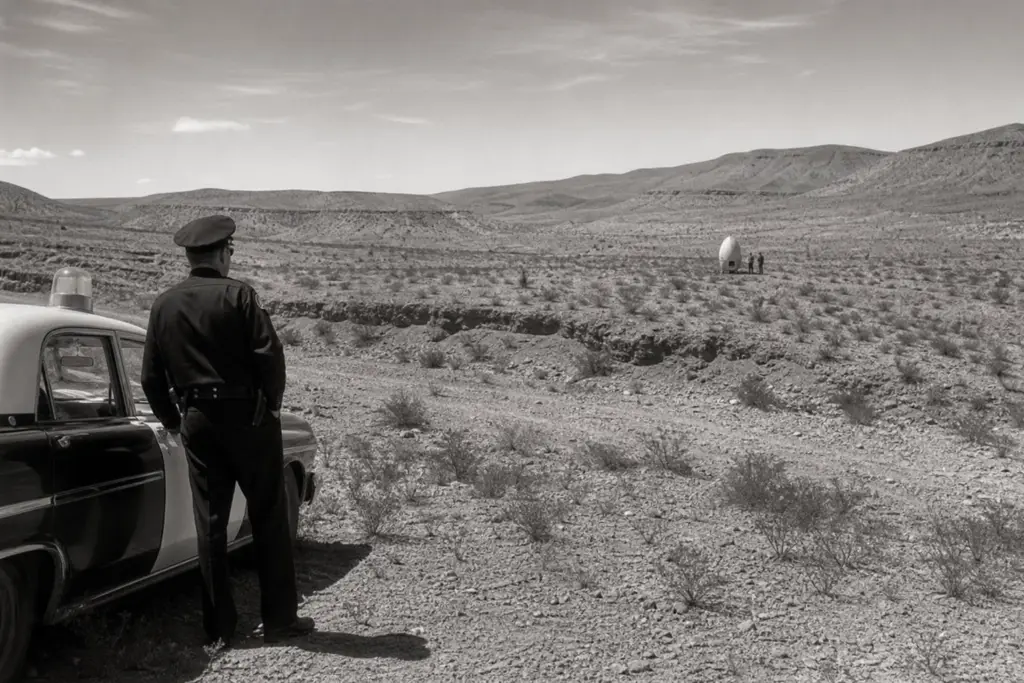
The story’s essential sequence is simple, even though later versions add detail: a flying saucer was allegedly found after coming down near Aztec, New Mexico, in 1948; military personnel supposedly secured the area, removed the craft, and recovered small humanoid occupants. Those are elements of the claim, not independently established events. No reliable contemporaneous record presented in the surviving public narrative demonstrates that a crash, recovery operation, or recovery of bodies occurred.
That distinction matters because a crash-retrieval account requires more than a vivid description. A strong historical case would connect the alleged location and date to independently created reporting, such as identifiable local witnesses recorded at the time, police or military paperwork, photographs with a traceable provenance, or physical evidence available for examination. The Aztec New Mexico UFO crash narrative is instead chiefly known through accounts that surfaced after the supposed event and were expanded through repetition.
Aztec should also be kept separate from Roswell’s 1947 reported episode. Roswell concerns a different New Mexico episode publicly reported in 1947, a year before the alleged 1948 Aztec UFO incident. Similar imagery, desert terrain, military involvement, and a claimed saucer, does not join the two cases evidentially. One disputed UFO claim cannot authenticate another.
The next question, then, is not whether later retellings are dramatic, but how this particular story entered public circulation and whose testimony carried it there.
How the Aztec Story Reached the Public Through Frank Scully
Frank Scully gave the allegation its widest early audience in Behind the Flying Saucers, published in 1950, amid the post-1947 flying-saucer climate. The book presented dramatic accounts of recovered saucers and purported occupants, placing the Aztec narrative within a broader claim that extraordinary technology had been secretly obtained and studied.
That reach mattered. A commercially successful book can move a story from private conversation and specialist circles into national popular culture; it can also fix memorable details that later writers repeat. But Frank Scully’s Behind the Flying Saucers was a work of reportage built around information presented as confidential, restricted, or relayed through intermediaries, not a collection of publicly available crash records, sworn testimony from identifiable firsthand witnesses, or physical material open to independent examination.
Source provenance is the decisive distinction. A named witness whose account can be dated, compared with contemporaneous records, and tested against independent evidence offers one kind of historical support. An unnamed insider, a friend of an insider, or a source whose identity and access cannot be independently established offers another: evidence that a claim was being made, not that its underlying event occurred.
Scully’s book therefore documents the circulation and appeal of the Aztec flying saucer hoax narrative. It does not establish that a craft fell near Aztec in 1948. Its importance to this history lies in showing how promoter-supplied assertions acquired authority through print, before readers could meaningfully assess the people supplying them.
Silas Newton and Leo Gebauer: The Promoters Behind the Story
Scully’s 1950 book identified no publicly testable witness to the alleged Aztec recovery; the names that recur in its confidential-source chain are Silas Newton and Leo Gebauer. Their asserted access to restricted technical and military knowledge supplied the story with an appearance of insider authority, while leaving readers unable to examine the original alleged sources.
That arrangement matters because an asserted credential is not the same as demonstrated access. A firsthand witness can be named, placed at the relevant location, and compared with records created at the time. An intermediary instead asks the audience to accept two propositions at once: that the event occurred and that he accurately received information about it from someone else. The Silas Newton Aztec UFO account followed the latter route. Its key details were attributed to connected or confidential sources, rather than to a publicly identified participant in the supposed recovery.
Newton and Gebauer should not be treated as interchangeable. Their respective reported roles in the information network surrounding Scully require separate scrutiny, as do the claims made about their technical or official connections. What can be said without collapsing those distinctions is that Scully’s presentation depended substantially on promoter-provided accounts, not testimony from an identified crash witness, a recoverable artifact, or a contemporaneous operational record.
This source structure is itself an evidentiary checkpoint. It establishes that dramatic allegations circulated through named intermediaries; it does not establish that those intermediaries possessed the access attributed to them or that an Aztec recovery occurred. The next question is therefore more concrete: whether the documented business conduct associated with Newton and Gebauer gave contemporaries reason to distrust the extraordinary claims attached to their names.
The Fraud Context: Oil Schemes, Investigators, and the Collapse of Credibility
In 1952, J. P. Cahn’s investigation for True magazine traced Frank Scully’s confidential flying-saucer sources to a separate commercial venture: equipment promoted as able to locate petroleum underground. Cahn connected Silas Newton and Leo Gebauer to both the saucer-source network and sales claims for the purported oil-finding device.
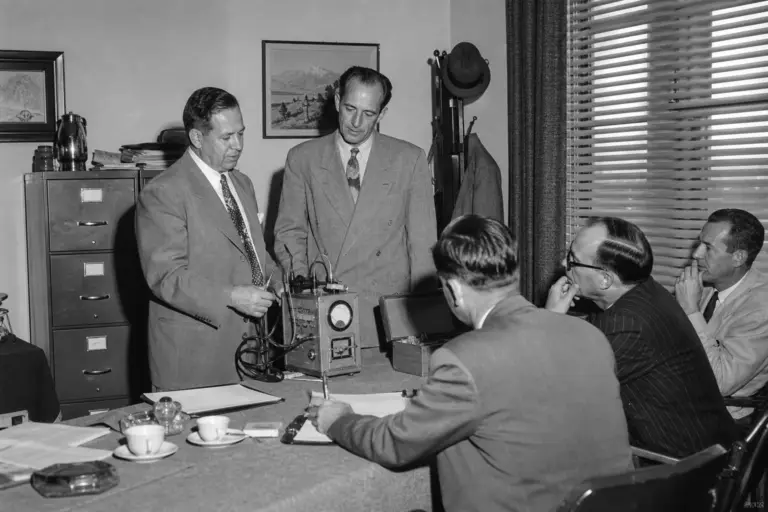
The distinction is consequential. An oil-detection machine was a product whose claimed performance could be tested on ground where drilling results were known; the alleged recovery narrative relied on inaccessible informants and supposed classified knowledge. Both, however, invoked technical expertise that customers and readers could not readily inspect. Cahn challenged the apparatus’s claimed capability and showed that its promoters overlapped with the people who had supplied material for Scully’s book.
Criminal proceedings turned that connection into more than an unfavorable press finding. Newton and Gebauer were convicted in federal court on fraud charges arising from the oil-device operation. Such a conviction addresses a charged scheme and representations used to obtain money or property; it is not a judicial finding that resolves whether a craft came down near Aztec in 1948.
That limit matters. The convictions do not identify who invented each element of the Aztec account, establish that every later reteller knew it was false, or substitute for direct evidence about the alleged site. They do establish that important conduits for a confidential-source narrative had participated in a documented fraud involving claimed technical capability. For a crash allegation dependent chiefly on those conduits, that history is central to assessing credibility.
The case for treating the Aztec UFO hoax as a fraudulent story therefore does not depend on a universal confession. It rests on Scully’s promoter-linked sourcing, Cahn’s contemporary tracing of the network, and federal fraud convictions tied to the oil-device scheme. Those facts do not answer every question about unidentified aerial phenomena; they explain why this particular crash narrative lacks a reliable evidentiary foundation.
What the Documentary Record Shows: Air Force Files and Missing Corroboration
The decisive issue is not whether every government file from 1948 survived or is publicly accessible. Archival silence alone cannot disprove an event: files can be lost, misfiled, withheld, or never created. It does, however, change the weight a historian can assign to an extraordinary recovery narrative when the narrative offers no independent trail by which to test it.
Project Blue Book Aztec is often invoked as though an Air Force index would settle the question. An index entry would establish only that an agency logged a report; it would not authenticate a crash, much less a recovery. Conversely, the absence of a known entry would not by itself prove fabrication. The stronger point is cumulative: no authenticated Project Blue Book case file, Air Force recovery order, or contemporaneous official correspondence has been produced in this record to connect the Air Force to the claimed Aztec operation.
A genuine large-scale retrieval should also create corroboration outside one promoter-linked source chain: identifiable service members whose accounts can be traced, dated photographs with a secure provenance, physical material available for examination, and contemporaneous records from local police, hospitals, newspapers, or government offices. Those categories serve different purposes. A photograph can establish what was depicted and when; a named participant permits records and testimony to be compared; an official log can place personnel and equipment at a location. None is conclusive alone, but together they can turn an allegation into a testable event.
The Aztec account supplies the opposite pattern: vivid claims of secrecy without independently authenticated recovery records or verifiable physical evidence. That gap does not rest on an assumption that the military could never conceal information. It means the crash-retrieval claims remain unsupported while their original transmission is already compromised by the credibility problems established in the preceding record.
Later Retellings: How a Discredited Claim Was Repackaged
Retelling can make an unsupported account feel more documented than it is. Later books, documentaries, and online summaries commonly add precise crash-site descriptions, military units, body counts, named local witnesses, or alleged photographs without showing that those details appeared in contemporaneous records. Precision is not proof: a useful distinction is between a detail traceable to a dated 1948 document and one first appearing decades later in a narrative built from recollection or prior UFO literature.
The key test is the citation chain. A strong chain leads outward to independent records; a weak one circles back through Frank Scully’s Behind the Flying Saucers, claims associated with Newton and Gebauer, or later authors citing one another. Retroactive links to Project Blue Book, classified programs, or familiar New Mexico crash lore likewise do not convert the Aztec allegation into an authenticated recovery case unless they supply a record tied to this event.
Modern interest in UAP crash-retrieval allegations may justify scrutiny of present-day government reporting, but it supplies no missing 1948 witness record, custody trail, or physical evidence for Aztec. Disclosure-era commentary can broaden the audience for the story; it cannot repair its provenance.
Why Historians and Investigators Classify the Aztec Case as a Hoax
The decisive checkpoint is whether the claim can stand once its promoter-linked chain is removed. It cannot. Scully’s popularization depended on confidential intermediaries; Cahn’s investigation connected that network to the oil-device scheme; and the associated fraud proceedings supplied a documented reason to distrust its representations.
Nor did an independent evidentiary record emerge to offset that problem: no authenticated physical material, contemporaneous recovery documentation, or traceable witness testimony establishes the alleged Aztec operation. Later additions made the narrative more elaborate, not more verifiable. On that combined record, historians and investigators classify the Aztec UFO hoax as a fraud-linked, unsubstantiated story rather than a demonstrated crash retrieval.
That conclusion is case-specific. It does not decide the merits of all UFO or UAP sightings; it shows the standard extraordinary historical allegations must meet: independent, traceable evidence that does not depend on compromised promoters or repetition.
The Aztec Story: A Durable Legend, Not a Verified Crash
Legends survive by accumulating narrative weight: each retelling can make an old assertion seem like a newly discovered fact. That is the central problem with the alleged 1948 Aztec crash. Its later familiarity reflects circulation, not an independently established recovery of a craft or occupants.
The evidentiary path remains the deciding issue. The account reached the public through claims associated with Silas Newton and Leo Gebauer, whose credibility was damaged by the fraud context examined here, then gained durable reach through Frank Scully and subsequent writers. What would change the assessment, a contemporaneous record created outside that source network, authenticated material with a custody history, or independently corroborated witnesses, has not emerged.
For that reason, the Aztec UFO hoax is best understood as a fraud-linked promotional story that outlasted its foundation. Careful source criticism does not require dismissing every unusual aerial report. It requires distinguishing a claim’s popularity from its proof, and refusing to let dramatic repetition substitute for records that can be traced, tested, and independently confirmed.
Frequently Asked Questions
What was the Aztec UFO incident of 1948?
The Aztec claim alleges that a flying saucer crashed near Aztec, New Mexico, in 1948, after which military personnel recovered the craft and small humanoid occupants. No reliable contemporaneous records, authenticated physical evidence, or independently verified witnesses establish that the alleged recovery occurred.
Why is the Aztec UFO crash considered a hoax?
The story relied heavily on promoter-linked confidential sources rather than identifiable firsthand witnesses or official recovery records. Silas Newton and Leo Gebauer, important conduits for the story, were later convicted in federal court on fraud charges related to an oil-finding device scheme.
Did Frank Scully’s Behind the Flying Saucers promote the Aztec story?
Yes. Frank Scully’s 1950 book, Behind the Flying Saucers, gave recovered-saucer stories a national audience and helped popularize the Aztec narrative. Its claims depended on confidential intermediaries, not publicly testable crash records, sworn eyewitness testimony, or examinable artifacts.
Was there any verified evidence of an alien spacecraft crash near Aztec, New Mexico?
No authenticated Project Blue Book case file, Air Force recovery order, contemporaneous official correspondence, traceable photograph, or physical material has been produced for the alleged Aztec operation. The claim also lacks independently corroborated local witnesses and a documented chain of custody for any supposed wreckage.
What evidence should you look for when evaluating a UFO crash-retrieval claim?
Look for independently created, dated records such as police or military documents, named witnesses who can be placed at the location, photographs with secure provenance, and physical material available for examination. A claim is weak when its citation chain leads mainly to confidential sources, promoters, or later writers repeating one another.