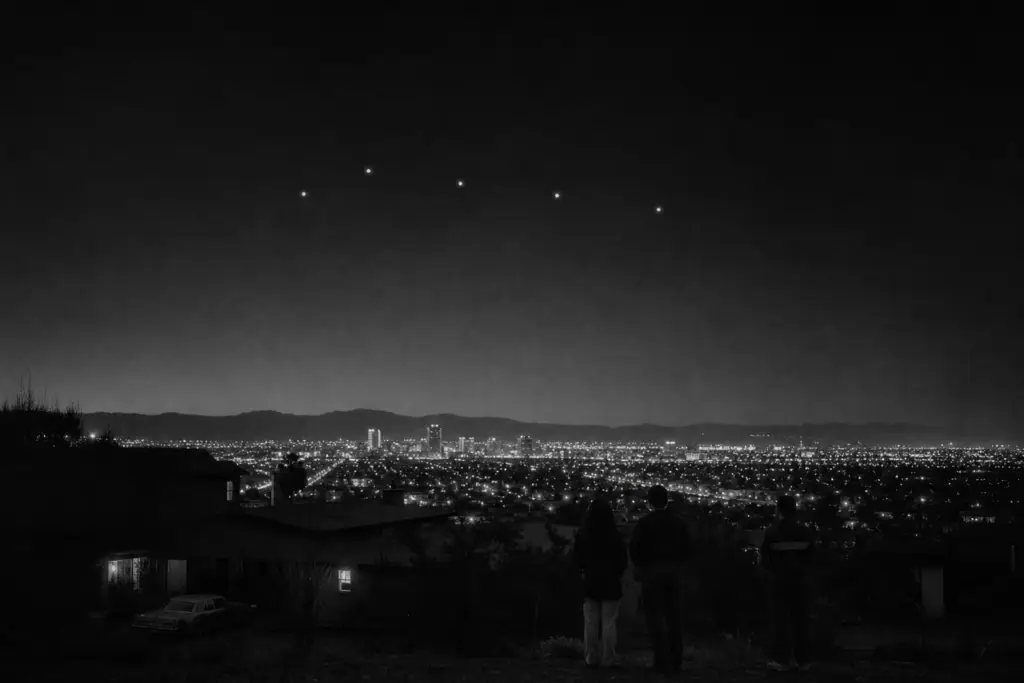
The Phoenix Lights case is inseparable from the contrast in Arizona Gov. Fife Symington’s own public posture. In 1997, he responded to the reports with a comic mock press event that treated the episode as a matter for ridicule. Years later, Symington said that he, too, had seen an object or lights over Arizona that he could not explain.
That change does not turn a witness account into proof of extraterrestrial technology, non-human intelligence, or a government cover-up. It does, however, make the governor’s earlier dismissal more consequential: the official who helped defuse public alarm later placed himself among the people reporting an anomalous observation.
This account follows the chronology and keeps separate three questions that are often blurred together. First, what did people report seeing on March 13, 1997? Second, what did officials later identify as military illumination flares? Third, which reports, particularly those differing in time, movement, and appearance, remain insufficiently resolved by that explanation? The distinction matters. A credible witness can describe something unexplained without establishing its cause, while an official explanation may fit part of a complex event without necessarily accounting for every reported sighting.
Fife Symington’s Changing Account of the 1997 Phoenix Lights
The dates are essential. Reports spread across Arizona on March 13, 1997; in June, while still governor, Symington answered the public attention with a deliberately comic press appearance. About a decade later, he gave interviews and appeared at a 2007 news conference saying he had been among those who saw an object that night and could not identify it.
His later account did not supply a physical sample, authenticated flight data, or a definitive origin for what he described. It changed the evidentiary picture in a narrower way: a prominent official who had publicly treated the episode as a joke later offered his own eyewitness testimony. Witness testimony can establish that a person reports an observation; it cannot, standing alone, establish what the object was.
That distinction keeps the Fife Symington Phoenix Lights story in proportion. The June response is evidence of a political and public-relations choice, while the later remarks are evidence of Symington’s stated recollection. Neither proves aliens, non-human intelligence, or official concealment. The remaining task is to place his shifting account beside the different sightings reported that evening and the explanation offered for some of them.
What Witnesses Reported on March 13, 1997
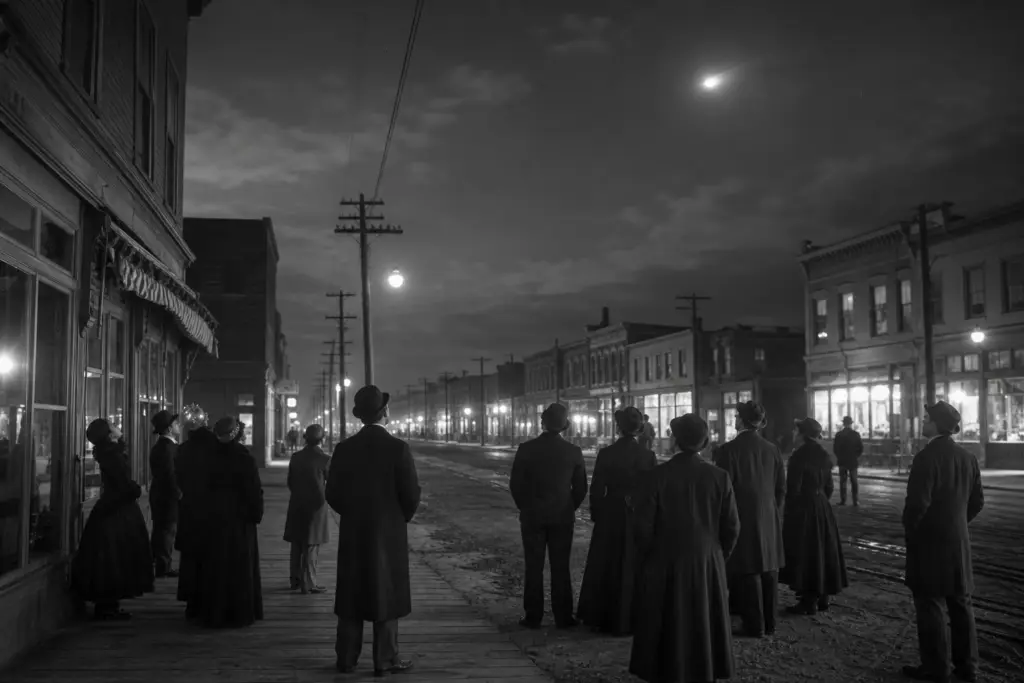
The eyewitness record is better understood as a sequence of reports than as a single, uniform sighting. On March 13, 1997, observers in multiple Arizona communities described lights over a broad stretch of the state, with accounts arriving over an extended portion of the evening. That geographic and temporal spread matters because a shared date does not, by itself, demonstrate a shared object or cause.
One cluster of accounts involved lights that appeared to move across the sky. Witnesses often described a row or formation that looked V-shaped, triangular, or boomerang-like, with the lights maintaining an apparent relationship to one another as they traveled. Such testimony can preserve features of an observation, apparent direction, shape, brightness, motion, and duration, but it does not settle distance, size, altitude, or whether separate lights belonged to one physical craft. Those uncertainties are especially important when comparing UAP sightings made from different locations.
A later set of reports centered on lights that appeared stationary over or near the Phoenix area. Video associated with this portion of the Phoenix Lights incident is frequently treated as if it depicts the same phenomenon described by witnesses of a moving formation earlier in the evening. The timing and reported behavior create a more careful evidentiary picture: moving lights and later fixed-seeming lights pose different identification questions. A persuasive explanation for one group therefore does not automatically account for every account gathered under the “Phoenix Lights 1997” label.
The essential checkpoint is to keep the reports in their reported sequence. Witness recollections establish that many people believed they saw unusual lights; they do not independently establish an extraordinary origin. The next issue is how Arizona’s governor chose to address the public attention generated by those accounts.
How Symington Initially Tried to Defuse the Story
By June, the immediate challenge for the governor’s office was not to identify every reported light, but to respond to the attention the episode had generated. At a June 19, 1997 press conference, Fife Symington turned that response into a joke: an aide, Jay Heiler, entered wearing an alien costume as the purported “guilty party.”
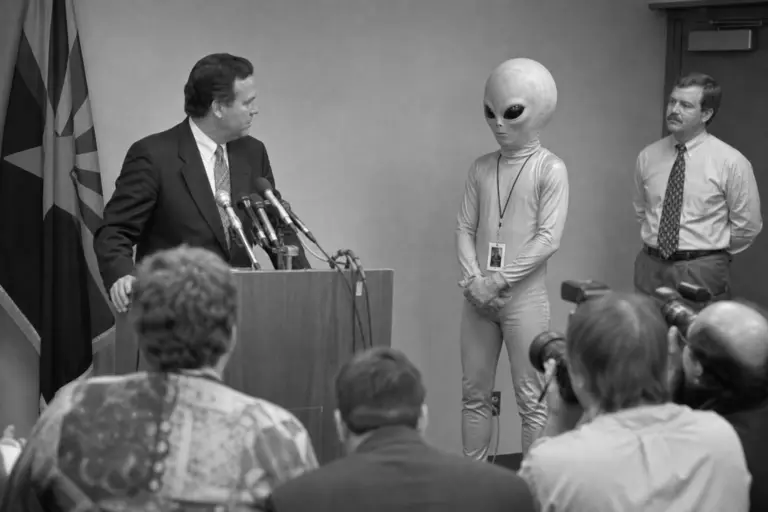
Symington played along with the reveal, treating the appearance as comic relief rather than an investigative announcement. The format mattered. A formal press conference normally signals that an office is providing material information or answering official questions; this one used the setting to puncture the escalating tone surrounding the reports. It gave television cameras a memorable image and recast a subject of public unease as a moment of political humor.
The available record supports viewing the stunt as a public-messaging decision aimed at defusing sensationalism and reassuring an audience facing intense UFO news coverage. It did not provide an account of the moving lights reported earlier in the evening, address the later lights seen near Phoenix, or present evidence identifying either set of observations.
That limitation is important. Mockery can show that an official chose not to treat a matter solemnly in public; it cannot establish what that official privately believed, what staff members knew, or whether the underlying reports had a single explanation. The alien-costume episode was therefore a documented attempt to manage attention, not evidence that the Arizona governor’s office possessed secret knowledge of what witnesses saw.
Symington’s Later Statement That He Saw Something Unexplained
In 2007, Symington changed the public record by saying that he had personally watched an unusual object on the night of March 13, 1997. At a Phoenix news conference and in subsequent interviews, he described seeing a large, triangular or delta-shaped form moving silently across the sky. He said he did not know what it was, characterizing the experience as something he found difficult to explain rather than offering an identification.
That wording is the important boundary in his witness testimony. Symington did not claim to have determined the object’s origin, to possess official intelligence about it, or to have learned that it was extraterrestrial. His statement was instead a firsthand recollection: the then-governor said he had seen an unexplained aerial phenomenon and believed the public had deserved a more serious response than the one his office gave in 1997. In retrospect, the humor of the earlier appearance looked markedly different because it came from someone who later said he had shared the basic experience of seeing something unusual.
The available public accounts still leave substantial gaps. Symington’s later descriptions do not establish a precisely documented viewing location, a minute-by-minute timeline, altitude, distance, or a corroborated physical identification. Nor do they demonstrate that the object he recalled was the same thing described in every report from that evening. Those distinctions matter: a personal observation can be sincere and remain unresolved, while an unresolved observation is not, by itself, evidence of alien technology, non-human intelligence, or a concealment operation.
His reversal therefore changes the meaning of his public posture, not the evidentiary standard for the case. It strengthens the record that a prominent witness found his own experience puzzling; it does not settle which reports concerned a moving formation, which concerned the later stationary lights, or whether all of those observations had a common cause.
The Flare Explanation, and Why It Does Not Answer Every Report
The military account applies most directly to the later lights that appeared fixed in place from the Phoenix area. The explanation identifies them as illumination flares released during an Arizona National Guard training exercise near the Barry M. Goldwater Range, southwest of the metropolitan area. Illumination flares are designed to cast light over a training area as they descend under parachutes; viewed at distance, a group of them can seem to hover in a line or slowly disappear one by one.
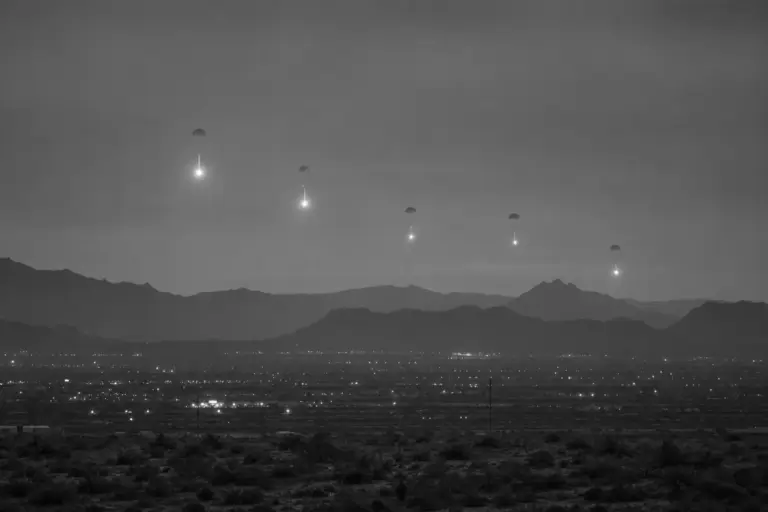
That visual pattern makes the flare account relevant rather than incidental. A distant observer may not see the parachutes or the range below, while the bright points remain visible against a dark sky. As each flare burns out or falls behind terrain, the apparent formation can change without any object visibly accelerating or departing. This is the category of report for which military flares offer a concrete, conventional explanation: the later, stationary or near-stationary points of light.
The explanation is weaker when it is applied indiscriminately to the entire evening. Earlier witnesses described lights moving across substantial distances, and some described a connected V-shaped or triangular form rather than separated points hanging in one area. Those accounts differ in reported timing, motion, and appearance from the later cluster generally associated with the range exercise. A shared date and a shared label do not make them observations of the same thing.
The sound evidentiary conclusion is therefore limited. The flare activity can account for an important portion of the Phoenix Lights sightings, especially the later lights seen toward the southwest, without resolving every report made on March 13. Conversely, differences between the reports do not establish an extraordinary cause for the remainder. They establish the need to assess each cluster by its own time, direction, movement, and visual description rather than treating a partial explanation as either a total solution or a total failure.
Why the Phoenix Lights Still Matter in UAP Disclosure Debates
Public confidence depends not only on what officials know, but on whether their response distinguishes reassurance from inquiry. The 1997 press stunt made the subject easier to dismiss, while Symington’s later description of an observation he could not identify showed why ridicule is a poor substitute for a careful public record.
The case also demonstrates the difference between testimony and corroboration. Witness accounts, including a governor’s, can establish that people reported a striking experience. Physical evidence, time-linked imagery, radar information, and independently documented flight activity serve a different purpose: they can test whether a particular explanation fits a particular sighting. Those categories should reinforce or challenge one another, not be treated as interchangeable.
That is the limited relevance of the Phoenix Lights to UAP disclosure. Present-day federal UAP review processes are designed to receive reports and assess records; they do not retroactively identify every historical observation. The episode supports neither alien involvement nor a government UFO cover-up. It instead remains a useful reminder that a partial explanation should be stated precisely, and that the unresolved remainder should remain unresolved until stronger evidence emerges.
What Symington’s Reversal Does, and Does Not, Establish
A reversal of tone is not a solution to an identification problem. Symington’s later recollection gives his June 1997 mock press event a sharper significance: an elected official who had publicly trivialized the reports later placed himself among the people who found an observation that night difficult to identify. That inconsistency is meaningful evidence about public messaging, not evidence that he knew what the object was.
The distinction matters because the reported events were not uniform. The flare account has explanatory force for the later, apparently stationary lights seen from the Phoenix area; it is not automatically a conclusive explanation for accounts of lights described as moving across Arizona earlier in the evening. Nor does a witness’s inability to identify an object establish extraterrestrial technology, non-human intelligence, or a concealed government program.
That is why the Phoenix Lights remain a documented but unresolved case rather than a settled mystery or a settled debunking. The record contains varied eyewitness reports, a military explanation that fits an important subset, and a governor whose later testimony complicated his earlier public dismissal. Its enduring lesson is straightforward: officials build trust by separating what is explained, what is reported, and what remains unknown.
Frequently Asked Questions
What did Fife Symington say about the Phoenix Lights?
Fife Symington initially mocked the Phoenix Lights at a June 19, 1997 press conference, where aide Jay Heiler appeared in an alien costume. In 2007, Symington said he had personally seen a large, silent triangular or delta-shaped object on March 13, 1997 that he could not identify.
Did Fife Symington see the Phoenix Lights himself?
Yes. About a decade after the event, Symington said he had watched an unusual object moving over Arizona on the night of March 13, 1997. He described it as large, triangular or delta-shaped, and silent, but did not claim to know its origin.
Why did Fife Symington mock the Phoenix Lights in 1997?
Symington used a comic press event in June 1997 to defuse public alarm and intense UFO media coverage. The alien-costume stunt was a public-relations response, not an official investigation or identification of the lights.
What was the official explanation for the Phoenix Lights?
The military explanation identified the later, stationary-looking lights near Phoenix as illumination flares released during an Arizona National Guard exercise near the Barry M. Goldwater Range. The flares descended under parachutes and could appear to hover or disappear one by one when viewed from a distance.
How can you tell whether a Phoenix Lights report is explained by flares?
Compare the report’s time, direction, motion, and appearance with the flare pattern. The flare explanation best fits later lights that appeared stationary toward the southwest, while earlier reports of a moving V-shaped, triangular, or boomerang-like formation require separate assessment.