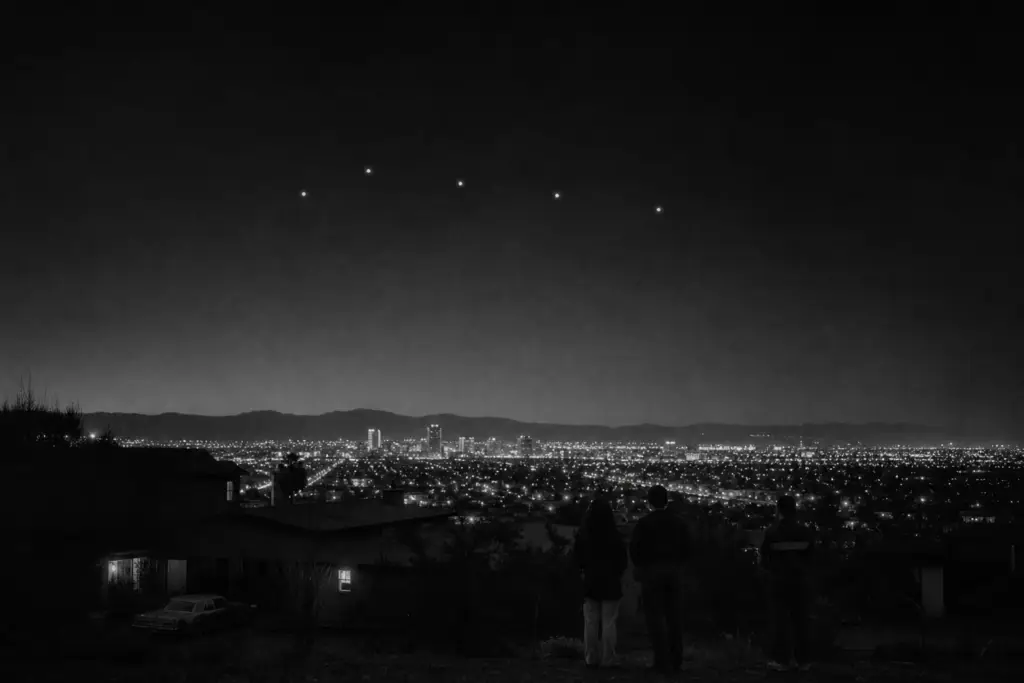
The Fife Symington Phoenix Lights story endures because its most recognizable public moment conflicts with the governor’s later personal account. In 1997, after reports of strange lights over Arizona, Symington staged a joking press appearance in which an aide appeared in an alien costume. Years later, he said he had watched an extraordinary aerial sight himself, something he could not explain.
That change does not settle what people saw on March 13, 1997, nor does it establish an extraterrestrial explanation. An eyewitness account can show what a witness recalls observing; it cannot, by itself, identify an object’s origin or physical nature. The distinction matters here because “the Phoenix Lights” covers more than one category of report, including accounts of lights moving across the state and a later stationary-looking display that received a military explanation.
This account follows the dated record: Symington’s public response, his later statements, and the evidence relevant to each reported phenomenon. It also keeps the unresolved questions in view without turning a governor’s reversal into proof of a cover-up or a final answer.
Fife Symington and the Phoenix Lights: A Public Joke, Then a Personal Mystery
On March 13, 1997, reports of unusual lights spread across Arizona; in the days that followed, Governor Fife Symington treated the public concern as a joke at a televised press event. A decade later, in 2007, he publicly placed himself among the witnesses, saying he had watched an aerial phenomenon that was “enormous and inexplicable.” The two moments are not competing accounts of the same observation: one records his official-facing response during the immediate aftermath, while the other records his later personal testimony.
That distinction sets the limits of the story. Symington said he did not know what he had seen; he did not establish that it was extraterrestrial, non-human technology, or evidence of a concealed government program. His later account is historically important because a former governor acknowledged an unexplained experience after having publicly mocked the episode. It does not independently identify the object or objects involved.
The chronology also requires care because the Arizona UFO sighting of 1997 was not a single, uniform report. Witnesses described an earlier moving formation over a broad area, while many accounts concerned later lights seen from the Phoenix region. Whether an explanation fits one set of lights is therefore a separate question from what Symington recalled seeing.
What Happened on March 13, 1997: Why the Phoenix Lights Were Not One Simple Report
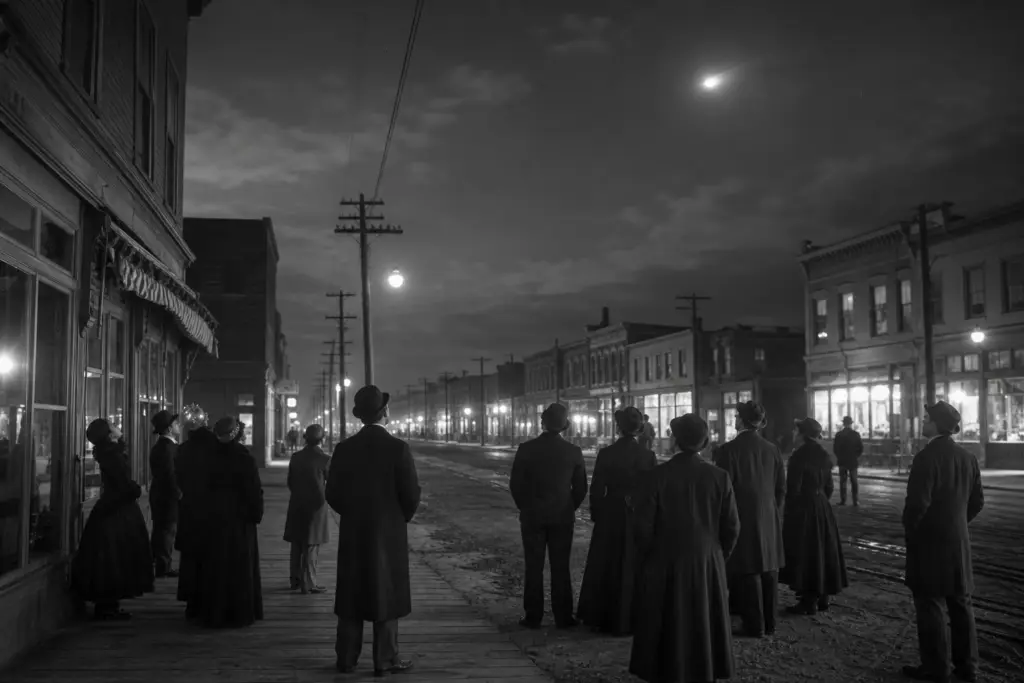
Contemporary accounts group the reports into two broad patterns rather than one continuous, identical sighting. Earlier in the evening, witnesses along a long north-to-south path across Arizona described a formation of lights moving through the sky. Some perceived a large dark shape or a structured, V-like arrangement behind or around the lights; others reported only the lights themselves. Those descriptions are witness testimony about appearance and movement, not independent measurements of an object’s size, distance, or construction.
Later, many observers in the Phoenix area saw a different-looking display: a row or arc of lights that appeared stationary for a time and then faded or descended behind the western horizon. The change matters. A moving formation reported across multiple communities and a localized sequence of apparently fixed lights do not present the same evidentiary question. They occurred at different times, were viewed from different places, and were characterized differently by the people who reported them.
That is why “the Phoenix Lights 1997” is a useful public label but an imprecise description of the underlying reports. A proposed explanation may fit the later Phoenix-area lights without resolving what earlier witnesses believed they saw moving overhead; conversely, testimony about the earlier formation does not by itself identify the later lights. For evaluating Fife Symington’s Phoenix Lights remarks, the essential checkpoint is the scope of his own recollection: which part of the night he meant, what he personally observed, and what he did, and did not, claim to know about it.
The 1997 Phoenix Lights Press Conference: How Symington Downplayed Public Concern
At the governor’s televised press appearance after the March 13 sightings, the response was theatrical rather than investigative. Fife Symington brought an aide before reporters wearing an alien costume and presented him as the supposed person responsible for the episode. The visual gag became the enduring image of the Phoenix Lights press conference.
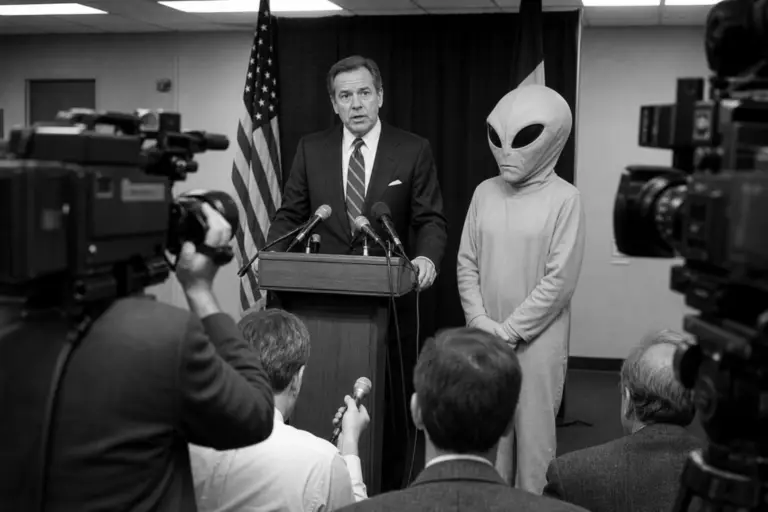
Symington’s remarks followed the same comic premise. He told the assembled press that Arizona had identified “the culprit,” then used the costumed aide to puncture the atmosphere of alarm and fascination surrounding the reports. The presentation made the subject fit the conventions of a political joke: an extraordinary claim answered with an intentionally absurd reveal.
That distinction matters when assessing the Phoenix Lights governor response. A mock press event can show how an officeholder chose to address public attention, by defusing it, ridiculing it, or both. It does not, by itself, establish what Symington privately believed about the witnesses’ accounts, whether he had personally observed anything, or what information he possessed at the time. The stunt is evidence of public posture, not a reliable window into his internal view.
Nor did the joke identify the reported lights. It offered no account separating the earlier moving formation described across Arizona from the later Phoenix-area display, and it did not test competing explanations for either category. Its immediate effect was rhetorical: to shift a heavily covered and unsettling subject into comedy.
For that reason, the alien-costume moment should not be treated as proof of either a hidden official conclusion or a dismissive factual finding. Its historical importance lies in the contrast it created. When Symington later described his own observation as unexplained, the earlier performance gave that later statement far greater public resonance, but the two episodes must still be evaluated as different kinds of evidence.
What Symington Later Said He Saw, and What He Did Not Claim
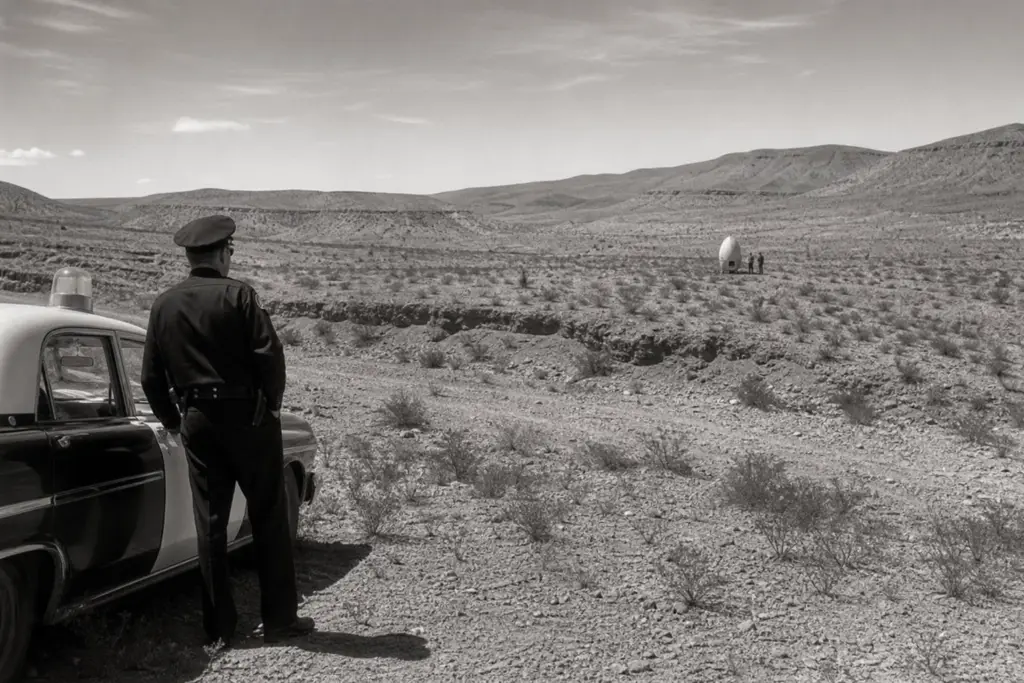
A decade after the sightings, Symington gave the public account that made the contrast enduring. In a 2007 interview, he said that he, too, had watched the event over Phoenix and described what he remembered as “enormous and inexplicable.” He placed himself near Squaw Peak and said he saw a large, delta-shaped object moving silently across the sky.
That is the essential scope of the later Fife Symington Phoenix Lights statement: a former governor reporting a personal observation that he could not identify. His wording matters because “inexplicable” described the limit of his own identification, not a demonstrated conclusion about the phenomenon’s origin. An eyewitness can establish that he recalls seeing something; that testimony cannot independently determine an object’s distance, dimensions, construction, or source.
Symington did not say he had proved the object was extraterrestrial, identified it as a physical craft, or obtained official evidence showing that authorities concealed its nature. Nor did his account resolve the different reports associated with March 13, particularly the distinction between the earlier moving formation and the later lights observed from the Phoenix area. His recollection belongs to the evidence about what a witness believed he saw, not to a final identification of every light reported that night.
The claim was also not a recent disclosure. It entered public reporting in 2007 and was repeated in subsequent appearances and retrospective coverage, including Symington’s 2017 CNN essay marking the twentieth anniversary of the incident. There he again characterized the sight as extraordinary while stopping short of asserting an alien explanation.
For readers assessing the record, the strong signal is the consistency of the limited claim: Fife Symington saw the Phoenix Lights, in his own account, and found the sight unexplained. The weak inference is to treat that account as proof of what the phenomenon was, or as evidence that his earlier public response reflected knowledge of a hidden answer.
Were the Phoenix Lights Military Flares? The Explanation Applies to Some Reports, Not Necessarily All
The military account is most closely associated with the later cluster of lights seen from the Phoenix area, rather than with every report made on March 13. The explanation identifies the lights as illumination flares released during a training exercise over the Barry Goldwater Range west of Phoenix, an area used in connection with Luke Air Force Base. Illumination flares are designed to hang beneath parachutes and light terrain below; viewed at distance after dark, several can resemble a fixed row or arc of bright lights.
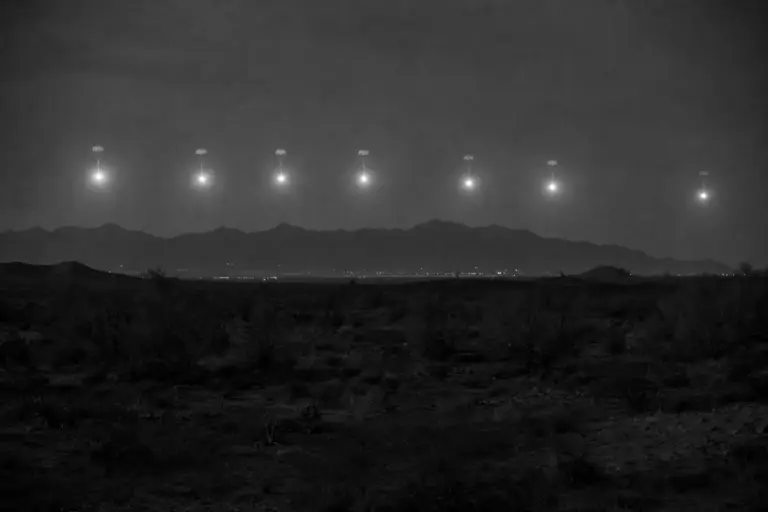
That mechanism fits important features of the later observations. Flares can appear to remain in roughly the same part of the sky while descending slowly, then seem to wink out as they burn out or pass behind a ridge from a particular viewer’s perspective. A separated cluster of lights over the western horizon is therefore not the same visual problem as a single object traveling across the state. In that limited sense, military flares offer a specific Phoenix Lights explanation for the later display: they account for why lights could appear suspended, stationary, and gradually vanish without requiring one structured craft.
The scope is the crucial point. The flare account concerns a defined set of later reports, not necessarily the earlier witness descriptions of a moving V-shaped formation. Those earlier accounts involved lights reported along a broad path and, in some cases, a perceived dark form associated with them. A flare explanation does not automatically disprove those witnesses’ observations; neither does their testimony independently establish what they saw. The responsible conclusion is narrower: the evidence supports separating the flare-related explanation from the unresolved question of how to identify every earlier report.
Why Symington’s Reversal Still Matters in Phoenix Lights History
Its historical value lies less in identifying an object than in preserving a clear contrast in the public record. In 1997, Symington’s office answered a widely discussed event with a comic performance; in 2007, Symington personally described an observation he could not explain. That sequence in Fife Symington’s Phoenix Lights account shows that an official response made amid public pressure is not necessarily the same thing as an official’s private assessment or later recollection.
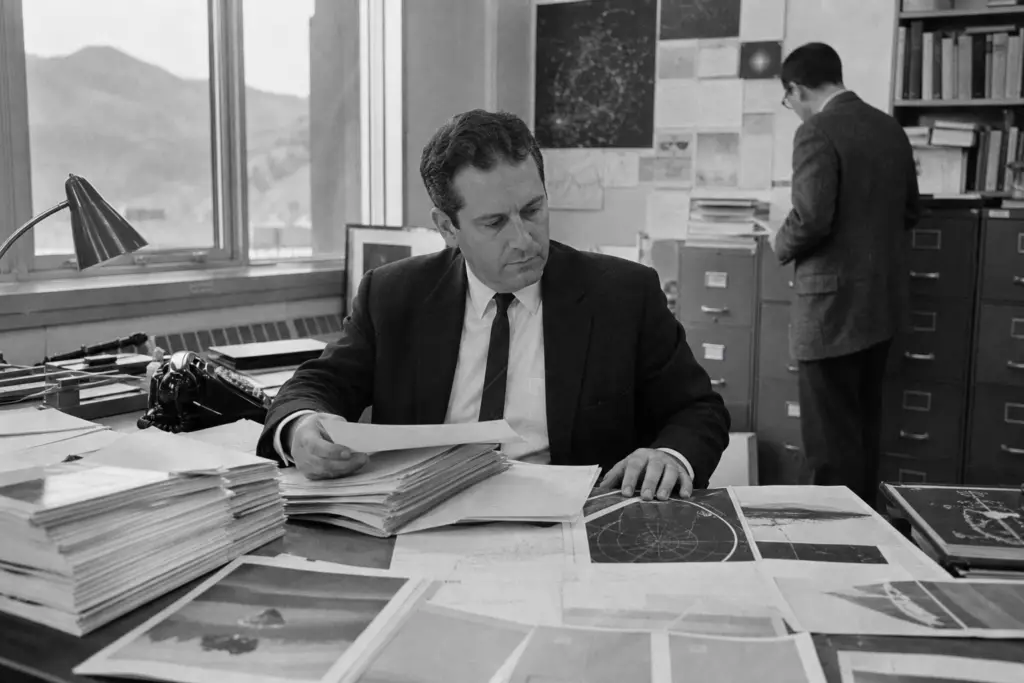
It also supplies a useful standard for UFO news and UAP news coverage. A strong account separates three kinds of material: what a witness recalls seeing, what a proposed explanation can account for, and what remains an inference. Symington’s later statement is notable firsthand testimony from a former governor. It is not physical evidence, a determination of the phenomenon’s identity, or proof that authorities possessed and withheld a definitive answer.
The durable conclusion is therefore limited but meaningful: the Fife Symington Phoenix Lights reversal complicates the familiar image of dismissal, while leaving the larger event divided among reports that require separate evaluation. It does not validate claims of alien disclosure, non-human intelligence, or a government cover-up.
A Reversal That Did Not Settle the Phoenix Lights
The most careful reading preserves two records at once: the governor’s 1997 performance and his 2007 recollection. The first shows how Arizona’s highest office publicly handled immediate anxiety; the second adds Symington’s own account to the witnesses who regarded part of the night’s display as unexplained. Neither record can be substituted for the other.
Nor can Symington’s account merge all March 13 reports into one object. The later Phoenix-area lights are the reports for which military flares offer a specific, time- and location-bound explanation. Earlier accounts of lights moving across a wider route, and, for some observers, an accompanying dark V-like form, are a different evidentiary question. A solution proposed for the stationary-looking later display does not automatically identify the earlier moving formation.
That is the lasting importance of the Fife Symington Phoenix Lights reversal. It corrects the incomplete impression that he simply dismissed the event, but it does not turn eyewitness recollection into an independent identification of an aircraft, craft, or other phenomenon. The historical record supports a narrower conclusion: Symington later said he saw something he could not explain, while the broader set of widely witnessed sightings still requires claim-by-claim assessment.
Frequently Asked Questions
What happened during the Phoenix Lights sighting in 1997?
On March 13, 1997, witnesses reported two broad patterns of lights over Arizona: an earlier moving formation seen across a long north-to-south path and later stationary-looking lights seen near Phoenix. Some witnesses described a V-shaped arrangement or a dark shape, while others reported lights only.
Did Governor Fife Symington actually see the Phoenix Lights?
Yes. In a 2007 interview, Fife Symington said he watched an enormous, inexplicable, delta-shaped object moving silently over Phoenix near Squaw Peak. He did not identify it as extraterrestrial or claim to know what it was.
Why did Fife Symington hold the Phoenix Lights press conference?
After the March 13 sightings, Symington used a televised press event to defuse public concern with humor. He presented an aide wearing an alien costume as the supposed culprit, turning the reports into a political joke rather than offering an investigation or identification.
Were the Phoenix Lights explained as military flares?
Military illumination flares released during a training exercise over the Barry Goldwater Range west of Phoenix provide an explanation for the later Phoenix-area lights. Flares hanging from parachutes can look like a stationary row of lights and appear to fade as they burn out or pass behind the horizon.
How should you evaluate the flare explanation against reports of the moving Phoenix Lights formation?
Separate the sightings by time, location, and behavior. The flare explanation fits the later stationary-looking lights near Phoenix, but it does not automatically identify the earlier moving formation reported across Arizona as a V-shaped pattern or dark object.