The 1946 Scandinavian Ghost Rockets: What U.S. Intelligence Records Show
Declassified U.S. records show that the 1946 Scandinavian 'ghost rocket' reports were treated as a serious guided-missile intelligence problem. They also show why the episode cannot honestly be reduced to either a confirmed Soviet weapon or an extraterrestrial visitation.
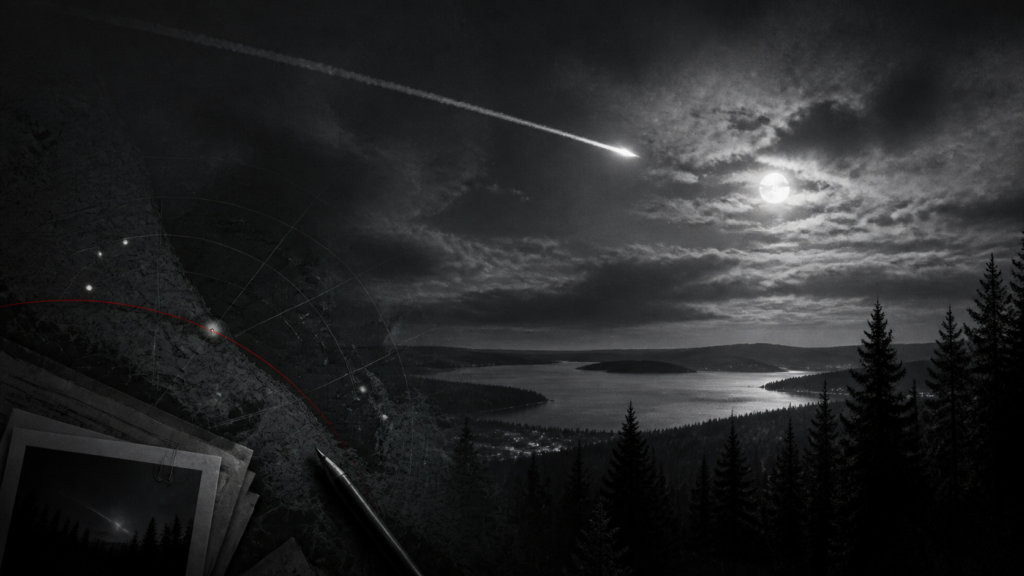
Months before Kenneth Arnold’s 1947 sighting made the phrase flying saucer famous, Scandinavian newspapers and radio broadcasts were already describing puzzling objects in the sky. The English-language label was ghost rockets. In 1946 it did not mean extraterrestrial spacecraft. It captured a Cold War fear: that someone, probably the Soviet Union, was testing advanced German-derived missiles across neutral Scandinavian territory.
The most useful surviving evidence is not a single spectacular photograph or a recovered machine. It is a set of contemporary U.S. intelligence records. Those documents show officials collecting reports, changing hypotheses and looking for launch sites. They also preserve reports that pointed toward ordinary meteors and weather effects. Read together, the files establish a real intelligence inquiry into heterogeneous observations. They do not establish that every report described one technology, that the Soviet Union launched the objects, or that anything nonhuman was involved.
What people were reporting
A declassified Foreign Broadcast Information Service compilation brings together Scandinavian and European broadcasts from July through October 1946. Its value is breadth, but that breadth is also a warning. The descriptions do not form a consistent aircraft specification.
One Stockholm broadcast described a small round object producing a strong blue-green light without sound. Another described a winged object at low altitude accompanied by a noise like an outboard motor. Three workers near Dunsovik reportedly saw a shiny cylinder move silently at an estimated 200 to 300 metres. Other reports concerned bright lights, loud detonations, smoke, or supposed projectiles. Reports also spread beyond Sweden to Norway, Denmark, Greece and elsewhere.
These were reports relayed through broadcast monitoring, not measurements made by the U.S. officers who compiled them. Estimated altitudes and speeds depended on witnesses who generally did not know an object’s size or range. A bright point without a reliable distance can appear to move in ways that are difficult to quantify. The compilation is therefore evidence that reports existed and attracted official attention, not proof that every description was physically accurate.
The same file preserves skeptical contemporary explanations. After an apparent projectile exploded during a hailstorm in southern Sweden, meteorological experts consulted by the Swedish Air Defense Division reportedly considered a tornado associated with strong lightning a probable explanation. Following another light and explosion, some observers believed the event was an ordinary meteor. Those passages matter because the archive did not contain only one preferred answer. Natural events were being considered in real time.
The August intelligence assessment
On 22 August 1946, the office of the Director of Central Intelligence sent President Harry Truman a memorandum about the reports. The organization involved was the Central Intelligence Group, a predecessor of the CIA; the Central Intelligence Agency itself would not be created until 1947.
The memorandum said new intelligence had modified an earlier tentative assessment. It judged that the weight of evidence then pointed toward Peenemunde, the former German rocket-development centre on the Baltic, rather than the Gulf of Finland as the probable source of most of the alleged rockets. Among the reasons recorded were a report that Peenemunde remained operational and secondhand information that Swedish radar course plotting associated many reported tracks with that area.
The memo then advanced a broader inference: the Soviet Union was probably conducting large-scale guided-missile tests around the Baltic, with missiles crossing Sweden toward the Gulf of Bothnia. It treated scientific experimentation as the primary Soviet purpose and political signalling as secondary.
That is a historically significant assessment, but its wording must be respected. The document described a probable launch area and an analytical conclusion based on intelligence available at the time. It was not a launch log, a Soviet admission, a recovered guidance system or a forensic examination of wreckage. Intelligence assessments are attempts to explain incomplete reporting. Their presence proves concern and analysis, not the truth of every premise.
This distinction is similar to the one needed when reading the Twining memorandum of 1947: an official document can show what officers considered worthy of study without settling the ultimate identity of the phenomena.
The inquiry remained active in September
Internal memoranda dated 18 and 19 September show that the inquiry did not end with the August assessment. One official noted a decline in fresh intelligence and discussed whether to send a scientific consultant to Stockholm. The Director of Central Intelligence decided against direct action at that point, partly because of operational and diplomatic complications reflected in the redacted record.
The following day’s memorandum stated that available sources had been exploited and reports were being sent onward as they arrived. It also mentioned a promised photo-interpretation study of three possible launch sites. This is evidence of an organized collection effort. It also demonstrates that officials were still seeking better evidence rather than recording a closed solution.
A Central Intelligence Group daily summary from 30 August adds another piece: a British scientific mission was helping Sweden investigate the so-called phantom rockets using radar and other devices. Again, the importance lies in the institutional response. Governments treated the possibility of missile testing seriously in the tense first year after the Second World War.
Why the Cold War missile hypothesis made sense
In 1946, German V-weapon expertise was a major intelligence prize. The war had shown that long-range rockets were no longer speculative. Allied governments knew German facilities, personnel and documents were being absorbed into rival postwar programs. Reports of projectile-like objects over the Baltic therefore had an obvious national-security interpretation.
That context explains why U.S. analysts focused on launch geography and Soviet capability rather than visitors from space. It does not retroactively identify each sighting as a rocket. A collection containing silent cylinders, luminous points, explosions, meteor-like events and possible weather phenomena may represent several causes joined by a popular label.
The episode is a useful prehistory to Project Sign and the later American investigative system described in the site’s Project Blue Book overview. It shows the same recurring problem: officials must decide whether unusual reports indicate adversary technology, natural phenomena, misidentification or something not yet resolved.
What the documents do and do not establish
The declassified record supports four careful conclusions. First, numerous Scandinavian and European reports circulated during 1946 under the ghost-rocket label. Second, U.S. intelligence considered the reports potentially important to guided-missile analysis. Third, analysts provisionally favored Soviet testing connected with Peenemunde. Fourth, the inquiry was still collecting information and evaluating launch sites in September.
The record does not supply a verified Soviet firing schedule that matches the reports. It does not demonstrate that the widely varying observations all had one cause. It does not provide instrument data for every witness account. And it contains no evidence that U.S. officials interpreted the episode as extraterrestrial.
It is also not sound to reverse the uncertainty and declare that every case was a meteor. Some broadcasts offered meteor or weather explanations; others described observations not resolved in the surviving compilation. The evidence supports a mixed, uncertain case file rather than a single universal verdict.
Readers evaluating this or any historic case can use the site’s claim-evaluation framework and primary-source directory. The key question is always the same: what does a document directly show, and what has a later narrator asked it to prove?
Why the ghost rockets still matter
The Scandinavian wave deserves a place in the modern UAP timeline because it predates the American flying-saucer era and exposes the intelligence logic that would shape later investigations. The reports were filtered through a rapidly changing security environment. Analysts worried about a terrestrial breakthrough, collected imperfect observations and issued a provisional explanation.
The most defensible historical statement is therefore narrower—and more interesting—than either mythology at the extremes. In 1946, unusual aerial reports over Scandinavia prompted a serious multinational intelligence response. U.S. officials leaned toward Soviet guided-missile tests, while their own files preserved natural explanations for some events and showed that the search for firmer evidence continued. The archive documents an unresolved intelligence problem, not a confirmed alien incursion.