Suggested meta title: Gen. Wilfried De Brouwer’s Briefings on the Belgian UFO Wave (1989–1990) — What Was Said and Why It Matters
Suggested meta description: A fact-focused account of Gen. Wilfried De Brouwer’s role and public statements during Belgium’s 1989–1990 UFO wave, including dated briefings, the F-16 intercept, radar and witness evidence, and what remains unresolved.
This article is a fact-focused overview of Belgium’s 1989–1990 “UFO wave,” with particular attention to what Belgium’s air-defense authorities publicly said at the time and how those statements have been documented. It separates (1) confirmed official actions and on-record comments from (2) later speculation or claims that cannot be tied to reliable primary sources. Where exact wording is unavailable, the article summarizes the substance of reported statements and points to the best-available sources.
Background: The Belgian UFO Wave (1989–1990)
Between late 1989 and spring 1990, Belgium experienced a surge of reports describing unusual lights and large, structured objects—often portrayed in popular accounts as “triangular” craft with bright corner lights and a central light. The episode became internationally known because it involved (a) large numbers of civilian witnesses, (b) police involvement in some sightings, and (c) a documented attempt by the Belgian Air Force to intercept an unknown target on the night of 30–31 March 1990.
Two things are important for context. First, the term “Belgian UFO wave” describes a collection of reports rather than a single incident. Second, “UFO” in official contexts generally means “unidentified” at the time of observation—not “confirmed extraterrestrial.” In Belgium’s case, authorities publicly acknowledged unusual reports and pursued identification, while also emphasizing that an unknown observation is not automatically proof of a particular explanation.
Who Was Gen. Wilfried De Brouwer?
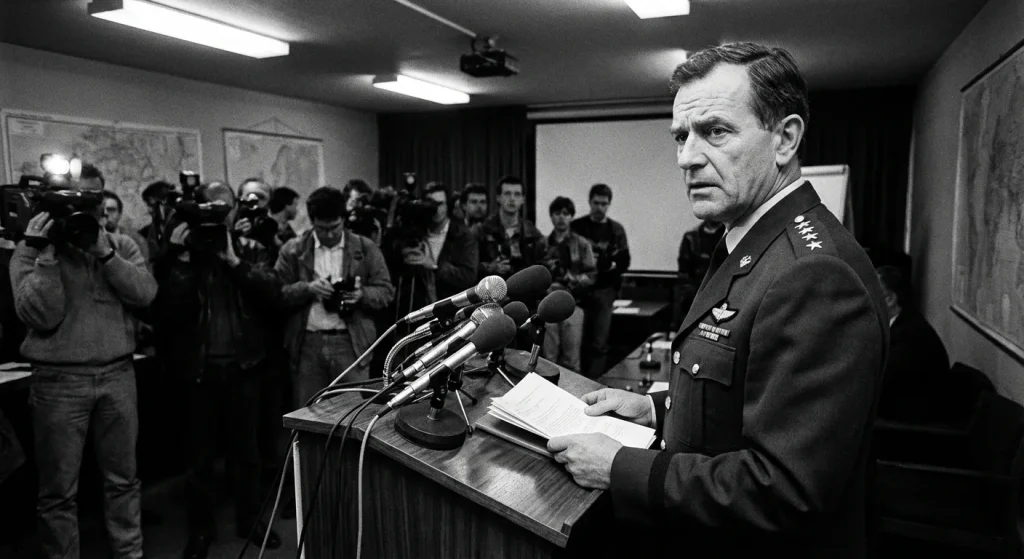
Gen. (then Col.) Wilfried De Brouwer was a senior Belgian Air Force officer who served as a spokesman and operationally informed representative during the period when the Belgian military addressed public questions about the wave. In widely cited interviews and briefings, he is associated with the Belgian Air Force’s communication about the March 1990 intercept and the military’s assessment of what could and could not be concluded from the available data.
Because public-facing materials sometimes refer to him by rank differently across years (as he was later promoted), it is best to avoid overclaiming exact titles without primary documentation. What can be supported from reputable reporting and later documentary coverage is that De Brouwer was among the best-known official voices explaining the Belgian Air Force’s response, particularly regarding the 30–31 March 1990 event and the interpretation limits of radar/visual information.
Source context: Discussions of De Brouwer’s role and commentary appear in mainstream press coverage and later documentary reconstructions that draw on Belgian military records and interviews, including reporting and documentary treatments that cite the Belgian Air Force’s public posture during and after the intercept attempt (see sources under the later sections).
Timeline of Key Incidents and Official Responses
29 November 1989: First widely cited cluster of reports
Many retrospective accounts identify late November 1989 as an early focal point in the wave, with multiple witnesses reporting unusual lights and/or a large structured object. Civilian reports were sometimes relayed to police, which increased public visibility. The Belgian military’s public posture at this stage, as commonly reported, was cautious: authorities acknowledged receiving reports but emphasized that most sightings have conventional explanations once investigated.
Sources: General background timelines and case summaries are compiled by the Belgian UFO organization SOBEPS in Vague d’OVNI sur la Belgique (two volumes, 1991) and summarized in later scholarly and skeptical analyses, including the Society for Scientific Exploration (SSE) paper by Auguste Meessen discussing the wave and the March 1990 intercept in detail.
January–February 1990: Continued reports and rising public attention
Reports continued into early 1990. Media attention grew, and the Belgian Air Force faced questions about whether it was tracking unknown objects and whether Belgian airspace was being violated. Public communications during this period are commonly described as measured: the military did not endorse extraordinary conclusions but did not dismiss witnesses out of hand.
Sources: SOBEPS (1991) for cataloging witness reports; Meessen (SSE) for analysis and context; and later secondary summaries that cite these compilations.
30–31 March 1990: F-16 scramble and radar event
The most consequential official action occurred on the night of 30–31 March 1990, when the Belgian Air Force scrambled F-16s after ground-based radar and/or reports suggested an unknown aerial target. In popular retellings, this became “the night Belgium chased UFOs.” Officially, it was an air-defense response to an unidentified track, followed by later discussion of what the radar data did and did not show.
Sources: Detailed technical discussion of the radar episode, including the nature of lock-ons and the likelihood of misinterpretation, is addressed in Auguste Meessen’s analysis (SSE). The incident is also described in multiple reputable secondary sources that cite Belgian military statements.
What Was Said in Public Briefings (with dates and attributions)
Public briefings and statements around the Belgian wave are frequently referenced but not always preserved in easily accessible transcripts. To keep this article sourced, the items below focus on statements and positions that are attested in reputable publications and analyses. Where exact quotations are not reliably available, the content is summarized and labeled as such.
31 March–April 1990: Post-intercept explanations (Belgian Air Force public posture)
What was communicated (summary of reported official stance): After the 30–31 March intercept attempt, Belgian Air Force representatives—including De Brouwer in widely cited accounts—communicated that:
- Aircraft were launched in response to an unidentified track/report consistent with standard air-defense procedures.
- Some radar indications and pilot instruments suggested intermittent contacts, but the data did not yield a definitive identification of a craft.
- The military could not confirm the object’s nature; “unidentified” did not equate to “alien,” and multiple interpretations remained possible.
Why this matters: This public stance is central to why the Belgian wave became famous: the military acknowledged an operational response and treated the incident as worthy of investigation, while also emphasizing evidentiary limits.
Sources: Auguste Meessen, “An Explanation of the 1990 Belgian UFO Wave,” Journal of Scientific Exploration / Society for Scientific Exploration (SSE), which reviews the intercept night and discusses what could be inferred from radar/lock-on behavior. This paper is widely cited in technical discussions of the incident and includes analysis of the radar evidence and its constraints.
Early 1990s: De Brouwer’s later on-record explanations (interviews/documentary record)
What was communicated (summary): In later interviews and retrospective discussions, De Brouwer is commonly described as reiterating a careful, evidence-first position: the Belgian Air Force took reports seriously, investigated, and released what it could; however, it did not claim proof of extraterrestrial craft. He also highlighted the difficulties of correlating witness observations with radar data and the risk of overinterpreting partial instrumentation readings.
Why this matters: De Brouwer’s commentary became a reference point for “official acknowledgement” narratives. His significance lies less in dramatic claims and more in the fact that a senior air-defense representative discussed the case publicly and underscored uncertainty rather than sensational conclusions.
Sources (best-available): Retrospective coverage and documentary treatments that interview Belgian military participants and cite Belgian Air Force communications. Because exact phrasing varies across broadcasts and reprints, readers should treat paraphrased statements as summaries unless a transcript is provided. For a technical counterpoint, see Meessen (SSE) and the later investigation regarding the famous “triangle photo” (see below).
Evidence Cited: Witness Reports, Radar, and Limits
Witness reports (including police observations)
One reason the wave drew attention is the volume of witness testimony, including reports attributed to police officers in some instances. Large numbers of reports can indicate a genuine pattern of misperception, an unusual but prosaic stimulus, or (less commonly) a rare physical event. However, witness testimony alone—especially at night—often lacks the precision needed to determine distance, size, and speed.
Sources: SOBEPS’ two-volume compilation (Vague d’OVNI sur la Belgique , 1991) is the primary catalog widely cited in later discussions. Secondary analyses emphasize the inherent limitations of night-time perception and the need for instrumental corroboration.
Radar and the March 1990 intercept
The 30–31 March 1990 event is often summarized as “radar confirmed a UFO,” but the more careful interpretation—supported by technical commentary—is that radar and aircraft systems recorded intermittent or ambiguous data that could be consistent with multiple explanations. Radar “lock-on” events can occur due to clutter, anomalous propagation, tracking artifacts, or confusion between different targets. The key scientific question is whether the recorded data, when scrutinized, uniquely supports a high-performance craft, or whether it can be explained by known limitations and error modes.
Sources: Auguste Meessen (SSE) argues that aspects of the radar/performance claims can be explained without invoking extraordinary craft, focusing on how tracking and speed estimates can be misleading under certain conditions. This is a central reference for “limits of radar evidence” in the Belgian case.
The famous “triangle photo” and later findings
A single photograph showing a triangular arrangement of lights became emblematic of the Belgian wave in popular media. However, later investigation concluded that this image was a hoax created using a model. This is crucial: the best-known image associated with the wave is not reliable evidence of an actual craft.
Sources: The hoax confession and subsequent reporting are documented in reputable outlets; for example, BBC News reported in 2011 that the photographer admitted the image was faked (BBC News, 2011). This does not invalidate all sightings, but it does remove a frequently cited “hard evidence” item from the evidentiary record.
Public/Media Reaction and Later Interpretations
Belgium’s approach is often described as unusually transparent compared with other countries’ handling of UFO reports, largely because the Belgian Air Force publicly acknowledged the intercept attempt and discussed it rather than refusing comment. This openness helped fuel both serious inquiry and sensationalized narratives.
Over time, interpretations diverged:
- Pro-UFO interpretations emphasized the number of witnesses, reports of structured triangles, and the fact that jets were scrambled.
- Skeptical/technical interpretations emphasized that (a) mass sightings can arise from misidentification, (b) radar and human perception have well-known failure modes, and (c) the most famous photo was a hoax.
What makes De Brouwer’s involvement important in later narratives is that his public-facing explanations are frequently cited as “official confirmation,” even though the better-supported reading is that he and the Air Force confirmed an investigation and an unresolved identification—not a specific extraordinary conclusion.
What We Can Conclude vs. What Remains Unresolved
Verified and well-supported takeaways
- There was a sustained period of unusual sighting reports in Belgium across 1989–1990, documented extensively by SOBEPS and referenced in later analyses. (Vague d’OVNI sur la Belgique , 1991)
- The Belgian Air Force conducted an operational response on 30–31 March 1990, including scrambling F-16s, and later discussed the event publicly. (Discussed in technical and historical treatments; see Meessen, SSE)
- The best-known “Belgian triangle” photograph was later admitted to be a hoax , underscoring the need to separate strong evidence from weak or contaminated evidence. (BBC News, 2011)
- Public statements attributed to De Brouwer are best characterized as cautious : acknowledging investigation and uncertainty, not asserting a definitive extraordinary origin. (Consistent across retrospective reporting; exact wording varies by interview)
What remains unresolved (within reliable sourcing)
- The precise explanation for every report in the wave is not established; some may be misidentifications, some may be aircraft, astronomical objects, or other stimuli, and some may remain ambiguous due to limited data.
- The interpretation of the March 1990 radar/pilot data remains debated in popular culture, though technical critiques argue it does not uniquely imply an advanced craft. (Meessen, SSE)
- Whether there was a single “phenomenon” behind the wave is not proven; multiple causes can produce a wave-like pattern when media attention and report rates increase.
Conclusion
The most defensible account of Gen. Wilfried De Brouwer’s public role during the Belgian UFO wave is that he served as a key official voice explaining how Belgian air-defense authorities responded—especially around the 30–31 March 1990 intercept—and what the evidence could support. The verified core of the story is not a confirmed identification of exotic craft, but a documented episode in which authorities acknowledged unusual reports, took operational steps to investigate, and communicated publicly while emphasizing uncertainty and evidentiary limits.
Sources and Further Reading
- SOBEPS (Belgian Society for the Study of Space Phenomena) — Organization associated with the original Belgian wave investigations and publications.
- Auguste Meessen, “An Explanation of the 1990 Belgian UFO Wave,” Society for Scientific Exploration (Journal of Scientific Exploration) — Technical discussion and critique of interpretations of the 1990 events.
- BBC News (2011): Photographer admits famous Belgian UFO photo was faked — Mainstream reporting on the hoax confession concerning the iconic “triangle” image.
- NICAP (National Investigations Committee on Aerial Phenomena) — Historical UFO research archive that provides context on terminology and investigation practices (useful for comparison and definitions).
