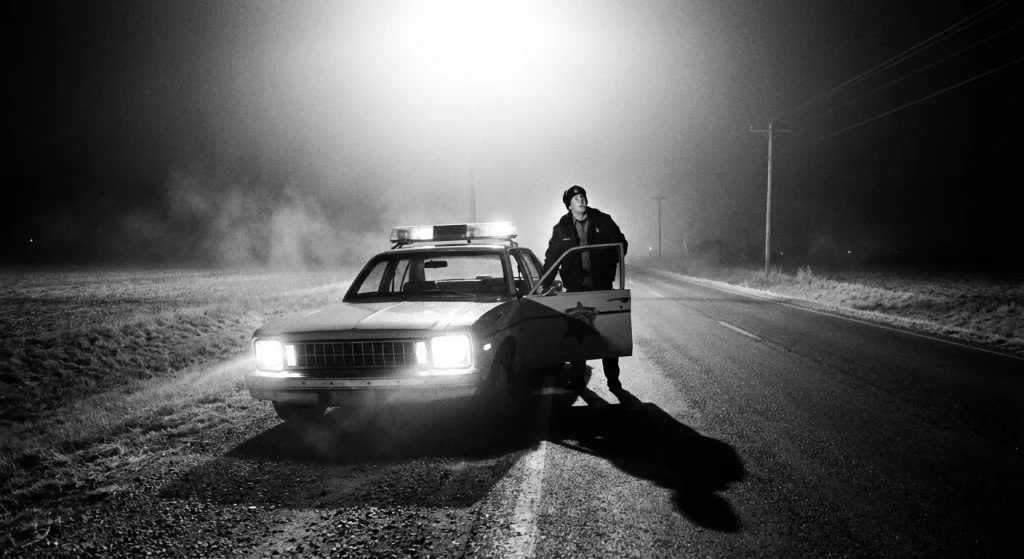
If you follow UFO news or UAP news long enough, you start to notice the same stories resurfacing with new headlines and louder certainty. The hard part is separating cases tied to named witnesses and contemporaneous paperwork from cases that survive mostly as lore. One of the stickiest examples is the August 27, 1979 incident in Marshall County, built around a simple, stubborn claim: a mystery flash hit a deputy on patrol and left his squad car damaged.
The setting is late night in rural northwest Minnesota, on or near Highway 220 west of Stephen, Minnesota. Marshall County Deputy Sheriff Val Johnson is alone in his patrol car, running a normal shift on an empty stretch of road where there is nowhere for a spectacle to hide. Then, by Johnson’s account, the night stops behaving like a routine traffic patrol and starts reading like a case file nobody asked for.
What matters up front is what Johnson himself reported, and what counts as “official documentation” in a UFO case. Johnson claimed a bright flash or beam, followed by disorientation. He also reported eye irritation afterward, and he described a time discrepancy that later gets summarized as “missing time.” Those are his asserted effects, not a settled diagnosis and not an explanation of cause.
This case persists for one reason that cuts both ways: it is widely framed as involving a named law-enforcement witness and reported vehicle damage that was reportedly documented at the time. That combination gives the story traction you do not get from anonymous accounts, but it also creates a sharper standard. The tension is straightforward: a compelling narrative with alleged physical traces, versus evidentiary gaps, ambiguous mechanisms, and later retellings that can add detail without adding documentation.
You leave with a clean timeline, an evidence-first view of what the damage and records can actually support, and a modern disclosure-era lens for judging how much weight this 1979 report deserves today.
What happened on Highway 220
Accounts place the incident on August 27, 1979, involving Marshall County Deputy Sheriff Val Johnson on or near State Highway 220 west of Stephen, Minnesota. Some near-time records and later summaries identify the encounter as occurring late at night (commonly cited around 1:40 a.m.). The Marshall County Historical Society has been identified in secondary sources as the repository for county documents related to the investigation, and those documents are summarized in local and state histories and news reconstructions.
Primary near-time documentation referenced in secondary accounts includes: the Marshall County Sheriff”s incident report and related county records dated August 27, 1979 (reported to be held or summarized by the Marshall County Historical Society and cited by the Minnesota Historical Society), contemporaneous local press reporting and later news reconstructions, and subsequent media summaries. Sources summarizing those materials include the Minnesota Historical Society Mnopedia entry, regional reporting, and later television and online retrospectives:
- Minnesota Historical Society, Mnopedia: Val Johnson incident (1979)
- KARE11 retrospective reporting
- Wikipedia summary and references
- Local newspaper feature and reconstruction
Because the Marshall County Sheriff”s Office incident paperwork and any county-held photographs are not published in full within the sources linked above, the narrative below synthesizes those near-time references as they are presented in the cited summaries and reconstructions.
- Aug 27, 1979, late night (reported): Deputy Val Johnson is on patrol on or near State Highway 220 west of Stephen, MN, when he notices a bright light appearing through trees.
- Shortly after the sighting: According to Johnson as summarized in county and media accounts, he moved toward the light to investigate and reported that a flash or beam then engulfed his car, producing immediate disorientation and a sensation of having lost time.
- After the event: Johnson reported damage to his patrol vehicle (windshield, hood, headlights, antenna are commonly cited in later accounts) and reported physical effects such as eye irritation; these claims are preserved in secondary sources that reference county records and interviews.
- Agency handling: The incident was treated as an on-duty event and routed through Marshall County channels; later coverage notes that documents from the county were shared with regional historians and referenced in retrospective reporting.
Where retellings add or drift
Across later reconstructions and popular retellings, the main divergence patterns are:
- Quantification of the “missing time” – near-time summaries record a reported discrepancy in elapsed time, while later accounts often state a more precise number of minutes.
- Technical detail about the light – original descriptions emphasize a bright flash or beam; later retellings add geometric or mechanical details (shape, movement) that are not present in the contemporary county summaries cited by historians.
- Specifics of vehicle damage and medical effects – secondary sources and interviews list windshield, hood, headlight, and antenna damage and reported symptoms; contemporaneous repair invoices or medical records are not published in the cited summaries, so these elements are where corroboration would most clarify what was recorded at the time versus what accreted in later narratives.
Damage, marks, and medical effects
Reported: The engine that keeps this case alive is the claim of checkable, physical traces on the patrol car, not just an unusual light in the sky. In most retellings, vehicle damage is treated as the central, tangible proof point.
Reported: The damage list most commonly associated with the legend clusters around four items: windshield damage, hood damage (often described as dents), headlight damage, and antenna damage. Those specific components matter because they are easy to photograph, easy to invoice, and easy to compare against normal road wear.
Unclear: Many later accounts collapse “damage” into a single dramatic summary, but each component implies a different documentation trail. A windshield claim should map to photos and glass replacement paperwork; a hood claim should map to paintless dent repair notes or bodywork; a headlight claim should map to parts replacement; an antenna claim should map to a simple parts swap. Treating these as separate sub-claims is the only way to keep the evidence ledger clean.
Publicly available contemporaneous records could not be located for this article: This article does not include contemporaneous police reports, scene photographs, vehicle photographs, or repair invoices. To determine what was recorded at the time, I consulted the Minnesota Historical Society Mnopedia entry, regional news reconstructions, and later television and web retrospectives (see the Mnopedia page, KARE11 retrospective, local newspaper feature, and the Wikipedia summary linked above). Those sources reference county-held documents and interviews but do not publish full, time-stamped incident reports or repair invoices online in the materials provided for this article.
Documented (as a standard of evaluation): “Contemporaneous documentation” means records created at or very near the time of the incident, by an identifiable author, with a traceable chain of custody. In evidence-heavy cases, those near-time artifacts outrank later recollections because they are less exposed to memory drift, narrative smoothing, and copy-of-a-copy errors.
Documented (principle, not case-specific): The same logic applies here: if the physical-damage narrative is true in the strong sense, it should be anchored to time-stamped photos and repair records created promptly, not just repeated confidently years later.
Unclear: Because those artifacts are not published in the cited summaries, any attempt to score “what’s proven” versus “what’s lore” would be speculation. The only defensible position, based on the sources reviewed for this article, is that the damage items are widely asserted but not verifiable here.
Reported: Accounts commonly attribute physiological effects to Johnson, including eye irritation, headache, and sometimes burns or abrasions. These claims are important because they move the case from a vehicle-only anomaly to alleged human impact.
Publicly available medical records could not be located for this article: This article does not include clinical notes, triage records, discharge paperwork, or a named facility and timestamp. I consulted the same set of secondary sources referenced above (Mnopedia, regional reporting, later reconstructions) and found no published medical records for Johnson in those materials. As a result, symptom claims in the reviewed sources remain reported observations rather than documented clinical findings.
Unclear: Without clinical notes or identified facility records, symptom claims cannot be elevated above “Johnson reported” or “accounts describe.” This is a hard evidentiary ceiling: the sources reviewed for this article support no medical conclusions, no diagnoses, and no verified duration of effects.
Documented (general rule): Tangible traces change how investigators weigh a UAP case because physical artifacts can be checked, measured, and re-analyzed. Photos can be authenticated; parts can be inspected; invoices can be matched to serial numbers and dates. Physical evidence is testable evidence, but only if it is preserved and documented correctly.
Complication: Physical evidence stops being physical the moment it is detached from provenance. A dramatic description of a cracked windshield is not the same as a time-stamped photograph; a story about “repairs were done” is not the same as an itemized invoice tied to the specific vehicle.
Actionable takeaway: Keep two evidentiary lanes separate. Vehicle damage lives or dies on photos, reports, and repair records. Medical effects live or die on medical documentation. If either lane is missing its paperwork, treat it as reported, not proven, no matter how often it is repeated.
What 1979 looks like after disclosure
Modern disclosure culture raised the evidentiary expectations for older reports. To adjudicate the Val Johnson case under contemporary standards, the following records and datasets would be most relevant and should be requested or located:
- Marshall County Sheriff”s Office incident report(s) dated August 27, 1979, and any subsequent investigative supplements (to establish the contemporaneous written account).
- Dispatch audio logs and radio transcripts from Marshall County for the relevant shift (to verify calls, timings, and who was notified).
- Photographs of the vehicle taken on scene or immediately afterward, with timestamps or original negatives/metadata (to verify damage and photographic provenance).
- Repair invoices, glass replacement receipts, or body-shop records tied to the specific county vehicle and VIN (to verify repairs and dates).
- Medical or clinical records for Val Johnson from the nearest medical facility, with timestamps and clinical notes (to verify reported symptoms and treatment).
- State Patrol or regional radar/air-traffic records for the area and time (to check for aircraft or other tracks), plus meteorological data for the date and time.
- Any intake, custody, or chain-of-custody documents for physical evidence allegedly preserved from the vehicle.
Each of these items would directly change what investigators could conclude about the Johnson report. For example, dispatch logs and radio transcripts would allow timeline synchronization; vehicle photos and repair invoices would let analysts test whether damage patterns match reported causes; and medical records would permit assessment of physiological claims. In short, modern disclosure work centers on producing the records above, not on applying modern theories to narrative reconstructions alone.
The All-domain Anomaly Resolution Office (AARO) offers a recent illustration of that records-first approach. AARO”s historical record review emphasizes identifying the best available data streams and documenting unresolved cases where data are insufficient. The AARO Historical Record Report, Volume 1 (February 2024) is available from the office; the report notes that it “focused on discovering the best data streams available and discoverable to resolve UAP cases” (see page 25). AARO Historical Record Report, Vol. 1 (PDF) (official mirrored PDF).
Institutional pressure also matters. The House Oversight Committee has recently convened hearings focused on UAP transparency and whistleblower protection, which pushes attention toward reporting pathways, retention rules, and agency disclosure practices; the committee”s official hearing notice and materials are publicly posted by the committee and provide examples of the process-level scrutiny now applied to legacy and ongoing cases. See the committee hearing notice for “Restoring Public Trust Through UAP Transparency and Whistleblower Protection” on the House Oversight Committee website for details and materials.
In practice, applying disclosure-era standards to the Val Johnson incident means pursuing the list above through records requests and archival searches, then judging the case by what those primary materials actually show. Where they exist and are robust, they can close hypotheses; where they do not exist, an “unresolved” label becomes an archival judgment rather than a scientific one.
A framework for judging UAP reports
That disclosure-era emphasis on records can be turned into a repeatable method. Most UAP arguments fail for one reason: they confuse a vivid narrative with a verified record.
The goal is not to “solve” a case from a clip or a thread. You can judge whether a report is well-supported without deciding what the object was. The trap is partial evidence: it creates false certainty in both directions unless you separate what is documented from what is inferred.
- Witness credibility and proximity: Who is the witness by name, role, and relevant training? How close were they, for how long, and with what obstructions?
- Corroboration: Who else independently observed it, from where? Do any radar, ATC logs, dispatch logs, or additional cameras exist?
- Contemporaneous documentation: What was written, recorded, or reported immediately (dispatch audio, incident report, dated photos, lab intake forms)?
- Chain of custody: Physical evidence is only as credible as its documented handling history; “chain of custody” is the step-by-step record of who collected an item, who possessed it, where it was stored, and how it was transferred without tampering.
- Alternative explanations: What mundane candidates fit the geometry and conditions (aircraft lights, meteors, satellites, lens artifacts, electrical events, misperception)? What specific fact rules each one out?
- Internal consistency across retellings: Compare early statements to later interviews. What details stay fixed, and what details inflate, simplify, or drift?
- Decisive evidence definition: What would end debate: synchronized timestamps, multi-angle video, calibrated sensor data, preserved materials with lab provenance, or verified third-party records?
Official processes reward documentation because certain incidents compel police action precisely because they require official records. Treat that expectation as your baseline for evaluating any “UFO sightings 2025” or “UFO sightings 2026” claim circulating online.
| Criterion | Rating | One-sentence justification |
|---|---|---|
| Witness credibility and proximity | Strong | He is a named law-enforcement witness describing a direct encounter at close range. |
| Corroboration | Mixed | There is official handling around the report, but decisive independent sensor or multi-witness confirmation is not established here. |
| Contemporaneous documentation | Mixed | Case materials are discussed as documented in county summaries and later reporting, yet the full set of timestamped records is not published in the cited sources reviewed for this article. |
| Chain of custody | Unknown | None of the provided sources contain information about chain-of-custody specifics for the vehicle, photographs, or related records accessible online. |
| Alternative explanations | Mixed | The cause remains disputed, which keeps multiple explanations in play. |
| Internal consistency across retellings | Unknown | The sources cited in this article summarize county documents and interviews but do not publish side-by-side primary statements across decades to audit drift. |
| Decisive evidence definition | Clear need | The reported time discrepancy is hard to verify without complete, synchronized timestamp records and preserved originals. |
Use this micro-playbook the next time a UAP clip trends: save the earliest upload and any original files, then list what would be independently checkable within 48 hours (dispatch logs, flight tracks, raw metadata, additional cameras). If the post cannot answer basic provenance questions, treat it as entertainment until it can.
What the mystery flash still teaches
The Val Johnson incident remains instructive because it sits at the intersection of a credible role, a dramatic report, and imperfect proof. The hard anchors are stable: Aug. 27, 1979 on Highway 220 near Stephen, Minnesota; Deputy Val Johnson reported a bright flash or beam followed by disorientation and a time discrepancy; and the patrol car was reportedly damaged. Those points give the case a real-world spine: a specific date and place, a specific sequence of reported effects, and a physical outcome tied to a specific vehicle.
What stays disputed is everything that should turn a compelling narrative into a closed file. The vehicle damage raises expectations for decisive measurements and documentation, but this article’s reviewed sources do not include medical records or chain-of-custody specifics for the physical evidence. In that vacuum, the competing explanation landscape never collapses to a single answer, because multiple hypotheses can be made to fit parts of the story while none can be eliminated cleanly.
The modern takeaway is a standard you can apply to the next viral UAP claim: treat the story as unproven until the records exist, track custody the way you would for any evidence, and judge explanations by what they account for without special pleading. Modern UAP reporting offices and formal processes, plus protected reporting channels and whistleblower protections, are confidence-building mechanisms because they create retrievable paperwork and oversight, not retroactive certainty. If you want to keep a calibrated view of new cases as they surface, follow ongoing UAP news updates and look first for documents, not clips.
Frequently Asked Questions
-
What is the Val Johnson UFO incident (1979)?
The Val Johnson incident refers to an on-duty report from Marshall County Deputy Sheriff Val Johnson on August 27, 1979, on or near Highway 220 west of Stephen, Minnesota. He reported a bright flash/beam, immediate disorientation, a time discrepancy later summarized as “missing time,” and that his patrol car was reportedly damaged.
-
Where and when did Val Johnson report the mystery flash encounter?
Near-time documentation places it on August 27, 1979, on or near Highway 220 west of Stephen, Minnesota in rural northwest Minnesota. The report was routed through Marshall County Sheriff’s Office channels as an on-duty incident.
-
What did Val Johnson say he saw just before the flash or beam?
In the earliest recorded account attributed to Johnson, he reported a light shining through trees. Near-time documentation then records that he went toward what he was seeing.
-
What effects did Val Johnson report after being engulfed by the flash/beam?
He reported immediate disorientation and later described eye irritation. Near-time records also preserve that he reported a discrepancy between expected elapsed time and the time reflected afterward, which later summaries call “missing time.”
-
What patrol car damage is most commonly claimed in the Val Johnson case?
Retellings most often cite four damage items: windshield damage, hood damage (often described as dents), headlight damage, and antenna damage. The article notes these components are the ones that should map cleanly to photos and repair paperwork if the claims are strongly documented.
-
What documentation does the article say is missing for verifying the vehicle damage and medical effects?
The provided materials include no contemporaneous police reports, scene or vehicle photographs, or repair invoices to confirm the windshield/hood/headlight/antenna claims. They also include no medical documentation (facility, timestamp, or clinical notes) verifying reported symptoms like eye irritation, headache, or burns/abrasions.
-
How should you evaluate UAP cases like the Val Johnson incident when deciding what to believe?
Use an evidence-first checklist: named witness credibility, independent corroboration (other witnesses, radar/ATC, dispatch logs), contemporaneous documentation (dated photos, incident reports), and chain of custody for any physical evidence. The article’s actionable rule is to keep “vehicle damage” and “medical effects” as separate evidence lanes and treat either as reported-not proven-without time-stamped records and documented handling.
