You have seen the “Solway Firth spaceman” photo repackaged as fresh “UFO news” so many times that the boundary between established fact and internet accumulation starts to blur. The reason it keeps returning is simple: modern distribution systems reward unresolved, visually punchy anomalies, and this frame is engineered for replay, screenshotting, and debate.
The real decision you are trying to make is also simple. Is the image evidence of something extraordinary, or is it a familiar photographic illusion that looks stranger than it is? Until you separate what the record actually says from what the pixels can support, every repost feels like a new revelation.
Media economics make this recurrence inevitable. Documentary demand has surged in recent years, expanding the available slots for ready-made mysteries that already come with a hook, a single iconic visual, and decades of name recognition. Late-20th-century television formats also evolved significantly, and each format shift created fresh “rediscovery” moments for legacy cases, first through new packaging, then through reruns, clip shows, and themed programming blocks. Add the business model: historical programming is driven by commercial incentives plus public fascination with “real history,” so older anomalies get re-popularized because they are cheap to summarize, easy to dramatize, and reliably clickable.
That same machinery now runs at streaming and social speed, and the current “disclosure” conversation primes people to treat old images as live evidence instead of archived curiosities.
This post gives you a disciplined way to separate (1) what is known from contemporaneous reporting, (2) what the photograph itself can support, and (3) what later culture layers on top. The sequence matters: establish the case file first, then read the image on its own terms, and only then weigh competing explanations against what the evidence can actually carry.
Case file and primary claims
Most of the Solway Firth “Spaceman” controversy survives for one simple reason: people skip the baseline record and jump straight to interpretation. Once you separate the case-file anchors from decades of retelling, the shape of the story tightens fast. You still have a puzzling image, but you stop arguing from rumor and start arguing from a shared set of facts.
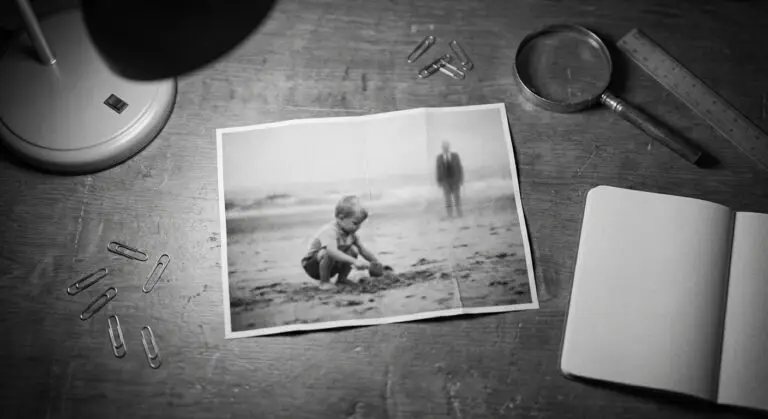
The stable starting points are straightforward. The photograph was taken on 23 May 1964 (BBC) by Jim Templeton. Templeton is described in sources as a firefighter (often characterized as a Cumberland or Carlisle firefighter) and an amateur photographer; some accounts also tag him as a “local historian” (James A. Conrad, BBC). The location is consistently reported as the Solway Firth area in Cumberland, with later summaries commonly specifying the Burgh Marsh near Burgh (James A. Conrad, Wikipedia). These references are reputable secondary and local-press accounts and archival summaries; contemporary primary items such as the original negative or a digitized copy of the Cumberland News front page are not available at the linked primary archives online.
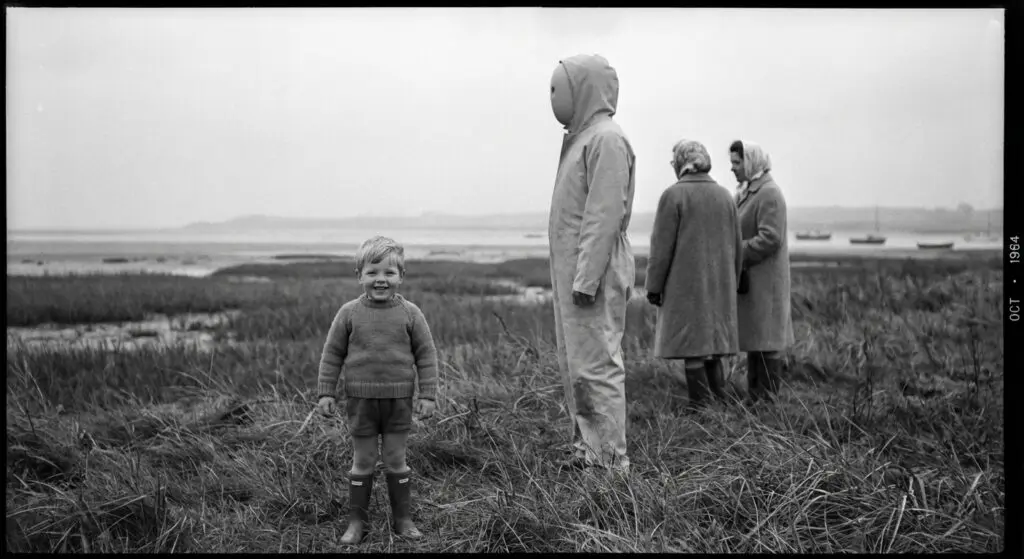
In baseline tellings, the “event” is not an encounter on the marsh. It is the moment a developed print appeared to show an unexpected suited figure in the background of a family photograph. What matters at this stage is not what the figure is, but what was reportedly noticed and reported: an ordinary outing, a roll of film, and a surprise detail recognized after the photo was processed and shared.
The other hard anchor is publication history. The first newspaper to report and publish the story was The Cumberland News, and that first coverage coined the label “Spaceman.” That naming decision matters because it fixed the frame early: readers were primed to see a character, not just a photographic anomaly. This publication-history claim is drawn from local-press reporting and archival summaries where available (see the News and Star retrospective and local archival summaries linked above).
Early press packaging emphasized novelty: a local firefighter, a family picture, and a startling figure that “shouldn’t” be there. The story becomes less stable as later retellings broaden the cast and raise the implied stakes. Over time, summaries commonly add claims of “official interest,” heightened media attention, and visits or inquiries attributed to authorities. Those additions are part of the case’s cultural footprint, but they are not the same thing as the original baseline: who took the photo, when it was taken, where it was taken, and which outlet first framed it for the public.
The practical friction is that the image stays constant while the narrative inflates. As soon as you treat later amplification as if it were part of the initial record, you end up debating conclusions before you agree on the file.
- Write the date: 23 May 1964.
- Name the photographer: Jim Templeton, firefighter and amateur photographer.
- Record the first press frame: The Cumberland News, which coined “Spaceman.”
Lock those anchors first. Then, and only then, you can examine what the pixels and the print actually support, versus what later storytelling asks you to assume.
Those anchors also act as a constraint: they tell you what cannot be inferred from the record alone. The next step is to look at the image as an image, because most of the “spaceman” certainty is built from reproduction behavior, not from anything a viewer can reliably recover from the photograph itself.
What the photograph actually shows
The photograph’s staying power comes from low-information ambiguity, not from crisp, recoverable detail. Most people do not react to a clean first-generation print or scan; they react to a simplified silhouette that their visual system fills in. Once the edge information gets soft enough, the mind stops seeing “a person-shaped form in the background” and starts seeing a “helmet and suit” because that is the most available pattern that fits the outline.
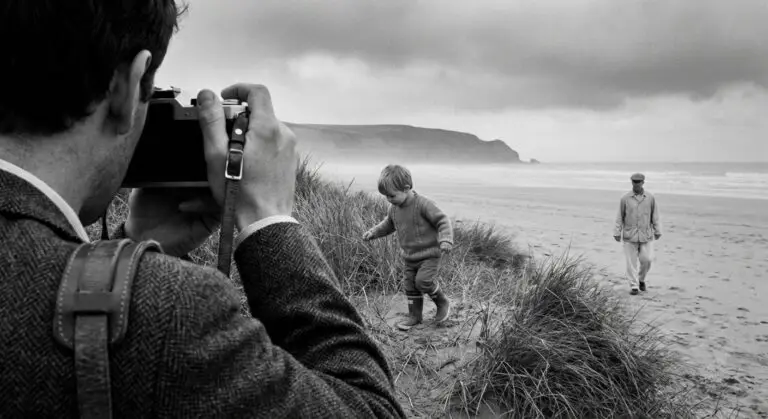
The frame is built around a child in the foreground, rendered relatively bright against darker ground. Behind her, a human-sized vertical form occupies the background, darker than the surrounding sky and field, with a rounded top and broader shoulders that read as a “helmet/suit” silhouette at typical web resolution. The strongest visual anchors are the high-contrast zones: the child’s light clothing against the mid-tone field, the background figure’s dark mass against a bright sky, and the thin boundary where land meets sky.
What you cannot responsibly extract from common reproductions is equally specific. Seams, fasteners, fabric texture, glove edges, a visor boundary, and any “equipment pack” lines are not reliably resolvable in most circulated versions because those features live in fine tonal transitions, not in the coarse outline. When people argue about hard-edged components on the figure, they are usually arguing from appearance, meaning what the silhouette suggests, not recoverable detail, meaning what the source actually supports at the pixel or grain level.
Most online versions are multiple generations removed from the original, and that generational loss (each save, scan, repost, or screenshot removing real detail and adding artifacts) changes what viewers think they see. Cropping pushes attention onto the figure and strips away context that stabilizes scale. Recompression flattens mid-tones, turning subtle gradients into blocky steps. Scanning and resampling can introduce aliasing and edge halos that look like “hard suit boundaries” even when the underlying transition was soft.
Multi-step reposting is the worst case because every step encourages the same failure mode: simplify textures, exaggerate outlines, and amplify contrast. A background form that should be read as a low-detail, distant subject becomes a graphic icon. The result is a false sense of specificity, where the viewer feels entitled to name components (helmet rim, faceplate, rigid suit) that the reproduction cannot actually support.
Lighting direction. Any serious comparison or attempted replication has to match lighting direction and film grain, because those two attributes lock the figure into the same physical scene as the child. If the child’s highlights and shadows indicate illumination from one side, the background figure must show compatible shading and shadow behavior on the ground plane. When reproductions are contrast-boosted, shadows clip to black and highlights clip to white, erasing the very gradient cues that let you check whether both subjects are lit the same way.
Grain and edge detail. Film grain is not “noise to remove”; it is part of the recording medium, and it carries boundary information. With generational loss (copying a copy), grain structure smears and the finest edges disappear first, precisely the edges that would settle disputes about clothing versus equipment, or hair versus a helmet contour. If the only surviving information is a dark mass against a bright background, the silhouette will look more “armored” than the source ever recorded, because soft boundaries default to the simplest, most rigid reading.
Horizon line placement. Horizon line placement is a key scale cue; it strongly affects whether a background figure reads as “giant” or plausibly distant. If the horizon sits low in frame, a standing figure that rises far above it can feel enormous, even when it is merely closer to camera or on slightly higher ground. If the horizon is higher, the same apparent height can read as a normal adult farther away. Small shifts in camera position also matter: parallax (the way near and far objects shift relative to each other when the camera moves) can change how the figure aligns with the child and the horizon, which changes perceived distance and size without changing the subject at all.
The disciplined takeaway is simple: treat “helmet/suit” as an appearance claim until you have an earliest-generation image in hand. Before asserting specific features, insist on the best available scan or print and evaluate lighting direction, film grain (generational loss), and horizon placement. Once you know what the photograph can and cannot support, mundane scene-based explanations become testable instead of rhetorical.
That set of limits also clarifies why arguments about the figure spiral: multiple ordinary mechanisms can yield the same broad silhouette, especially once copies have been contrast-pushed and cropped. The question is not which story sounds best, but which mechanism matches the constraints the image and record actually impose.
Leading explanations and counterarguments
The “spaceman” silhouette persists for a simple reason: several ordinary mechanisms can create a similar bright, human-shaped form, and each mechanism demands a different kind of confirming evidence. A person caught at the edge of frame, two exposures layered onto one piece of film, or darkroom and reproduction artifacts can all push the same handful of tones into a crisp “helmet and suit” read. Without the original materials and adjacent frames to discriminate between them, debates drift into certainty theater instead of verifiable evidence.
1) A nearby person in the background (often retold as Templeton’s wife) is the cleanest scene-based explanation: a human figure is already the right size and carries the right anatomy, and a slight turn of the torso can hide facial detail while leaving a head-shaped “helmet” outline. Overexposure can bleach midtones into a bright “suit,” especially if clothing is light, reflective, or sunlit. The friction is that proponents point to apparent structural details that read non-human: the sharpness of the head boundary, the dark “visor” zone, and the impression that the figure sits farther away than a nearby adult should, given the background geometry. The decisive evidence here is not a better zoomed crop; it is a consistent series of adjacent frames from the same roll that shows the same adult repositioning near the child, plus an original negative that preserves edge detail and tonal gradation well enough to see fabric folds, hairline, or footwear.
2) Double exposure treats the figure as an overlap artifact rather than a person standing there: a double exposure is two separate images recorded onto one frame when the shutter fires twice without the film advancing, producing two scenes on the same negative; it can also be simulated later during scanning or editing. What it explains cleanly is the “wrongness” that some viewers report: a figure-like form that looks well-bounded yet oddly disconnected from the scene, and tonal relationships that feel inconsistent with the lighting on the day. The best counterargument from proponents is practical and forensic: if the overlap were substantial, you would expect collateral doubling elsewhere, faint ghosting of background elements, or exposure interactions that affect more than a single humanoid shape. The decisive evidence is direct access to the original negative (not a contrasty reproduction) and a careful inspection for exposure layering signatures: repeated edges, non-physical transparency relationships, and density patterns consistent with two exposures. If the negative shows a single, coherent exposure with continuous grain structure and no doubled contours where they should appear, the double exposure (two images, one frame) narrative collapses.
3) Printing and scanning artifacts, especially contrast effects, focus on the fact that most people argue from reproductions rather than from the negative. Halation, vignetting, and related darkroom or printing artifacts are standard photographic phenomena cataloged in reference works such as The Visual Dictionary of Photography. In this case, halation, the bright halo that forms when intense highlights spread and glow in film or during printing, can harden a soft highlight into a “helmet rim” and turn blown clothing into a smooth, suit-like block. Vignetting, the darkening toward frame edges, can simultaneously deepen nearby tones, increasing local contrast and making the bright figure pop harder than it “should.” The strongest argument for artifacts is that they explain why different scans and prints seem to show different “details”: push contrast and you manufacture edges; compress tones and you erase them. The strongest counterargument is that artifacts rarely invent a fully articulated person-shape out of nothing; they exaggerate what is already there. The decisive evidence is a controlled reproduction chain: multiple high-bit-depth scans from the original negative (and any surviving original prints) with documented settings, allowing investigators to separate genuine scene information from halation (highlight glow), paper contrast, and scanner clipping.
Human perception is the accelerant that turns these ordinary mechanisms into a long-running fight. Visual systems do not passively “read pixels”; they infer surfaces and lighting, and they do it aggressively when information is ambiguous. Perception research shows viewers can disagree dramatically about clothing color under uncertain illumination, as demonstrated by the viral “dress” effect where the same image was sincerely seen as different color combinations depending on assumptions about light and shadow. That same machinery drives “white suit vs blue dress” retellings here: decide the figure is in shade and you mentally subtract blue daylight, making light fabric read white; decide it is sunlit and you keep the blue cast, making fabric read blue. Once a viewer locks onto an illumination story, edge cues and contrast artifacts get recruited as “details” supporting that story.
Each hypothesis makes a different prediction, so the settling tests are straightforward even if the materials are hard to obtain.
- Audit the originals: locate and document the original negative and any first-generation prints, then scan the negative at high bit depth with a neutral workflow. This directly tests for exposure layering signatures and minimizes reproduction-driven “detail.”
- Check adjacent frames: examine the frames immediately before and after on the same roll. A nearby person hypothesis predicts consistent presence, movement, or partial intrusions; a one-off artifact or overlap is less likely to repeat coherently.
- Compare reproduction variants: align multiple known prints and scans and measure whether the “helmet,” “visor,” and “suit seams” appear only when contrast is pushed. If details track processing choices, artifacts are doing the work.
- Reconstruction with constraints: attempt a reenactment that matches camera position and exposure conditions, then see whether ordinary pose, clothing, and mild overexposure reproduce the silhouette without special pleading about geometry.
The practical takeaway is to treat every explanation as a model with predictions. “It’s obviously a person” and “it’s obviously not” are both empty claims unless they come with the specific missing evidence that would force the conclusion: original materials, adjacent frames, and documented reproduction behavior. Until that evidence is on the table, confidence is just a louder version of a guess.
Even when nothing new is added to the case file, the surrounding culture can still change how the image is interpreted and circulated. That is why the Solway photo keeps reappearing in moments of heightened UAP attention: the content is old, but the argument it is drafted into is newly urgent.
Why it resurged in the disclosure era
The Solway Firth Spaceman photo resurges for a simple reason: modern disclosure culture converts old anomalies into present-tense arguments. In an attention economy built around UAP (Unidentified Anomalous Phenomena, the institutional umbrella for incidents that are unexplained without asserting what they are), legacy images stop being curiosities and start functioning like courtroom exhibits. The underlying record can stay exactly the same, but the framing changes, and the photo gets re-litigated as if it just entered the news cycle.
The institutional side moves in predictable beats: hearings, briefings, and periodic reporting. A clear example is the July 26, 2023 House Oversight Committee hearing titled “Unidentified Anomalous Phenomena: Implications on National Security, Public Safety, and Government Transparency” (transcript and hearing materials are available at the official record transcript PDF). That title signals the official posture: treat the topic as a governance problem, anchored to risk, public safety, and oversight, not as a verdict about aliens.
Social media runs a different clock. Official events create a clean news hook, then online platforms backfill that hook with “supporting evidence” pulled from the archive: photos, newspaper clippings, and half-remembered anecdotes that are already familiar and instantly shareable. UFO disclosure, meaning the expectation that governments will release or acknowledge concealed UFO information, gives those reposts a purpose. An old image is no longer “an odd photograph”; it becomes “a datapoint they don’t want you to see,” regardless of whether any new documentation has surfaced.
This recycling is also fueled by the same commercial demand and programming capacity that keep legacy mysteries in circulation: more slots to fill means more incentive to repackage unresolved, visually simple cases that can be summarized quickly and argued about endlessly.
Official language narrows interpretation by design. Terms like “national security,” “public safety,” and “transparency” frame UAP (unidentified, not explained) as an information-management and accountability problem. Popular language widens it. Online phrasing routinely jumps straight to “alien disclosure,” “government UFO cover-up,” and “non-human intelligence,” which treats ambiguity as confirmation and turns “unidentified” into “identified, but hidden.”
That gap shows up in how people summarize institutions. Online discourse often repeats the claim that the Pentagon’s UAP office has found “no evidence” of extraterrestrial beings. The Department of Defense and AARO historical-record reporting have been summarized in public-facing accounts as finding no verifiable evidence of extraterrestrial technology in the records reviewed (AARO historical record report, DOD), a conclusion that applies to the records and cases examined in that study rather than an absolute statement about all possible explanations or all historical reports.
Online attention is easily reactivated. For example, a single reference in a DefenseScoop item about AARO reporting and activities is often enough to trigger fresh waves of “new disclosures,” even when the public-facing content is procedural or analytical rather than revelatory.
The practical check is blunt: renewed attention is not new evidence. When the Solway case file gets dragged into “UFO sightings 2025” or “UFO sightings 2026” threads, ask what was added to the original record. If the answer is “nothing,” treat it as reframing, not discovery.
Because that reframing is predictable, the useful response is also predictable: a repeatable method for judging what an image can support, independent of the current cycle. The point is not to be unimpressed by mysteries; it is to stop letting distribution dynamics and rhetoric substitute for documentation.
A practical framework for judging UAP photos
Most UAP-photo arguments stall because they start at the conclusion: “real craft” versus “hoax” versus “artifact.” The faster path to clarity is evidence discipline: audit how the image was created, preserved, copied, and remembered before you debate what it “is.” That approach handles both old cases like Solway and this week’s viral reposts, because the failure modes are the same: missing originals and contaminated recollections.
Start by ranking what can actually be examined. A first-generation negative, contact print, or camera-original file outranks any scan, screenshot, or “enhanced” repost because each copy adds opportunities for cropping, contrast shifts, retouching, and context loss.
Next, force a handling narrative into the open: chain of custody is the recorded path of who possessed the material, when they possessed it, and how it moved, and it is the minimum standard in forensic contexts for authenticating evidence. For a 1960s negative or print, that means names, dates, storage conditions, lab/processing details if known, and any documentation that proves the artifact you’re seeing is the earliest-generation item, not a later reproduction.
Apply this briefly to Solway: the most productive questions are not interpretive (“spaceman or not”), but administrative: where is the earliest-generation material now, what can be physically inspected, and what documentation exists for each transfer (custody log).
Do a fast triage before anyone spends hours on “analysis.”
- Generational loss: if edges are mushy, contrast is crushed, or grain/pixels look “re-sampled,” you’re evaluating the scan, not the scene.
- Scale cues: check depth-of-field consistency, occlusion (what overlaps what), and whether the “object” shares the same sharpness regime as nearby subjects.
- Optics cues: look for symmetry around bright sources, repeated shapes, and edge glow that tracks high-contrast boundaries.
- Motion cues: subject blur should agree with camera movement and shutter timing, not selectively blur one convenient element.
These are one-pass eliminators. If a photo fails them, you don’t have “mystery,” you have an artifact problem and you go back to originals and handling.
Eyewitness-memory research shows a hard constraint: exposure to misinformation changes what people later report, even for details they genuinely experienced (Loftus review; Loftus and Palmer 1974). Experimental work also shows misinformation reduces the reliability of identification evidence in lineup-style tasks and related paradigms (recent review/meta-analytic work), which is the same reliability failure you see when witnesses are asked to “identify” what a photo shows after they’ve been primed by commentary.
Social media makes this worse because searching, re-checking, and retelling act like repeated retrieval. Some research finds that retrieval before later misinformation exposure can increase suggestibility—a phenomenon called retrieval-enhanced suggestibility—though effects vary with testing procedure, timing, and context (research on retrieval-enhanced suggestibility).
Add emotion and personal meaning and recall becomes even less stable: emotional and psychological factors measurably shape what is encoded and what is later reconstructed. That is why single-artifact cases harden into folklore while the underlying evidentiary base stays thin.
- Request the earliest-generation material available (negative/print/camera-original file), not a repost or “enhancement.”
- Document who handled it and when, with any receipts, correspondence, lab notes, or storage history (chain of custody).
- Triage the image for generational loss, scale consistency, optics symmetry, and motion consistency.
- Separate independent witnesses from narrative followers; log who reported what before online discussion versus after.
- Reconstruct the environment at a high level: time window, sun angle, sightlines, and plausible positions.
| Decision output | What evidence must exist | What it rules out |
|---|---|---|
| Confirmed | Earliest-generation material is available; handling is documented (chain of custody); independent corroboration exists; reconstruction is consistent. | Most hoax and artifact pathways. |
| Plausible | Good-quality early copy exists with partial handling history; triage checks pass; some corroboration or reconstruction support, but gaps remain. | Obvious artifacts, not subtle ones. |
| Unsubstantiated | No originals; unclear handling history; no independent corroboration; story depends on reposts and late-formed memories. | Nothing. Treat as a claim, not evidence. |
Read back into the Solway case through this lens and the shape of the problem becomes clear: the story is famous, the silhouette is strong, and the most decisive materials are the ones least often available in public debate. That gap between cultural confidence and evidentiary access is the engine that keeps the argument alive.
What the Solway mystery teaches us
The Solway image endures for a simple reason: the photograph is ambiguous, but the modern attention cycle rewards certainty. A low-information picture gets re-posted, re-cropped, and re-captioned until the story feels newer than the underlying evidence. The methodological lesson is blunt: attention is not evidence, and repetition is not corroboration.
What’s solidly known from the case file is narrow and stable: a specific family photograph from 1964, taken at Solway Firth, later became famous because a suited-looking figure appears in the background. What the image itself can support visually is also narrow: a human-shaped form, limited environmental context, and only rough cues for horizon and scale. The limits matter more than the headline. Once you are working from later-generation copies, generational loss strips away the fine detail that would decide basic questions like edges, seams, and distance, and it makes confident size and depth judgments unreliable.
The most credible mundane explanation cluster stays mundane because it explains both the figure and the persistence: a person in ordinary clothing captured at an awkward angle, combined with cropping, contrast boosting, and story-first retellings. That cluster doesn’t need exotic assumptions; it needs only ordinary photographic ambiguity. The single biggest missing piece of evidence is access to the earliest-generation material and documented handling, so modern scanning and analysis can be tied to a clear provenance instead of to unknown reproduction steps.
People exhibit confirmation bias: they often test hypotheses one-sidedly by seeking evidence consistent with their current hypothesis. Readers also examine figures first; image presentation quality and accessibility meaningfully shape interpretation, especially with low-quality reposts. Expert image-comparison evidence can be useful, but method rigor varies, so conclusions must track evidence quality and transparency. Treat every recycled “UFO news” image as an evidence-audit task: demand source quality, handling history, and methods you can interrogate. That standard is the practical way to keep the boundary clear between what the contemporaneous record says, what the photograph can support, and what later culture adds on top.
Frequently Asked Questions
What is the Solway Firth spaceman photo?
It’s a 1964 family photograph that became famous because a human-sized, suited-looking figure appears in the background after the film was developed. The case is known for its ambiguity and for being repeatedly reposted as “UFO news.”
When was the Solway Firth spaceman photo taken and who took it?
The photo was taken on 23 May 1964 by Jim Templeton. Templeton is described as a firefighter and amateur photographer.
Where was the Solway Firth spaceman photo taken?
It was taken in the Solway Firth area in Cumberland, with later summaries commonly specifying the Burgh Marsh near Burgh. The location is consistently reported as the Solway Firth region.
Which newspaper first published the Solway Firth spaceman story and coined the name?
The first newspaper to report and publish the story was The Cumberland News. That initial coverage coined the label “Spaceman,” shaping how readers interpreted the figure.
What does the Solway Firth spaceman photo actually show in the image?
It shows a child in the foreground and a darker, human-sized vertical form in the background with a rounded top and broader shoulders that can read like a “helmet/suit” silhouette. The article notes that fine details like seams, visor boundaries, or equipment lines are not reliably recoverable from most circulated reproductions.
What are the main explanations for the Solway Firth spaceman figure?
The article highlights three leading explanations: a nearby person in the background (often retold as Templeton’s wife), a double exposure (two images on one frame), or printing/scanning artifacts such as contrast effects and halation. It emphasizes that deciding between them requires original materials and adjacent frames, not zoomed reposts.
What should you look for to judge whether a UAP photo like Solway Firth is credible?
Request the earliest-generation material (original negative or first-generation print), document chain of custody, and triage for generational loss, scale cues (including horizon placement), optics cues, and motion consistency. The article also recommends checking adjacent frames from the same roll and comparing multiple reproduction variants to see if “details” appear only when contrast is pushed.