Every UAP news surge and every disclosure spike brings the McMinnville UFO photographs back into view: two grainy frames from 1950 that refuse to stay filed under “settled.” They keep resurfacing because the case is often cited as a serious data point, not just a curiosity, and that is exactly why it deserves disciplined review rather than intuition. (Hynek, regional history).
The decision point is straightforward: do you treat McMinnville as credible evidence, as propaganda, or as a distraction that hijacks attention from better-documented incidents? The photos force that choice because they are iconic enough to feel decisive, yet thin enough to punish overconfidence in either direction.
McMinnville endures as a durable edge case for one reason: it is unusually simple, just two photographs taken on a farm near McMinnville, Oregon, in 1950, and still disputed because interpretation hinges on assumptions rather than a single knockout detail. With so little to work with, people don’t argue over a definitive measurement, they argue over what must have been true off-camera for the images to look the way they do.
It also never stayed local. The images were reprinted in Life magazine, which gave them national circulation and permanent cultural weight. After that, the case became a reference point in the legacy-case canon and is frequently cited in major UFO summaries and overviews (see summary and Hynek).
This article resolves the central tension: high visibility and cultural authority versus limited, non-repeatable evidence. The lens to use is simple and strict: treat McMinnville as a test of evidentiary standards, not a shortcut to a worldview, and you’ll leave with a clear, evidence-first way to understand what the images can and can’t support, how debunking attempts are structured, and why legacy UFO photo cases still shape UAP news cycles in the current UAP disclosure climate.
To keep that standard consistent, it helps to start with what the record actually gives us: the people involved, the date, and the sequence of events as it is typically reported.
The Trents and the 1950 Timeline
McMinnville’s staying power starts with an unusually clean origin story: two frames, one rural evening, paired with immediate documentation gaps that matter as soon as the images leave the camera.
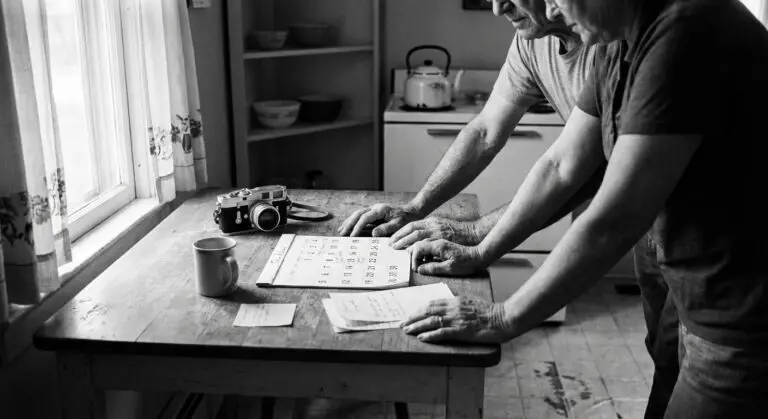
The people at the center were Paul and Evelyn Trent, a farming couple living on a farm near McMinnville, Oregon, described as being between Sheridan and McMinnville in the post World War II years. That specific setting matters because it anchors the report to a particular household and piece of ground, not a roadside encounter that is harder to place and revisit.
By 1950, newspapers already had an established appetite for UFO sightings and other unusual aerial reports, which made it plausible for a small town item to move quickly once a printable photograph existed.
The reported date is May 11, 1950 (Wikipedia, regional account).
Paul Trent was described as a 43-year-old farmer, and he took two photographs of the object that evening. The core strength of the case, as a timeline, is that it begins with two exposures made during the claimed sighting rather than a later reconstruction (newspaper history, summary).
Those two photos were taken within about 30 seconds of one another. That tight interval becomes an organizing fact for everything that follows, because it frames the images as a brief sequence rather than independent, widely separated opportunities to stage or re-stage a scene (regional reporting, case summary).
The first friction point is also the earliest paperwork problem: Paul Trent reportedly developed the roll of film about a month after the photographs were taken. Treated strictly as documentation, that delay creates an immediate gap in the photo’s provenance, meaning the record of how the original film was handled, stored, and transmitted is thin during the period that would otherwise be easiest to document (reported, regional account).
Once the images entered print, the story’s center of gravity shifted from the Trents’ private timeline to the public distribution timeline. Contemporary accounts note the photographs first appeared in the local McMinnville newspaper, the Telephone-Register, before being picked up more widely and reprinted nationally, including in Life magazine (Telephone-Register archive, summary, regional history).
The pathway described in later summaries runs from local newspaper publication to broader reprint channels that carried the photos well beyond Yamhill County, including the national magazine reprint noted earlier (see summary and the regional account).
The takeaway for reading the record cleanly is simple: the May 11, 1950 sequence (Evelyn’s report, Paul’s two exposures roughly 30 seconds apart) is the part you can state in a straightforward chronology, while the month-later development and the subsequent media handoffs are where the documentation immediately goes thin and later debates try to fill the gaps with assumptions.
That split-clean chronology followed by thin provenance sets up the core analytical problem. The next question is not what people later claimed the object was, but what the two frames themselves clearly show, and what they cannot support.
What the Photos Show and Don’t
The Trent photos are analyzable, but only within strict boundaries set by what the images themselves show and what their sourcing can actually support. The temptation is to treat familiar reference cues in the scene as built-in rulers. In practice, those cues only become measurement anchors after you can confirm what they are, how far they are from the camera, and whether you are looking at original material or a later reproduction.
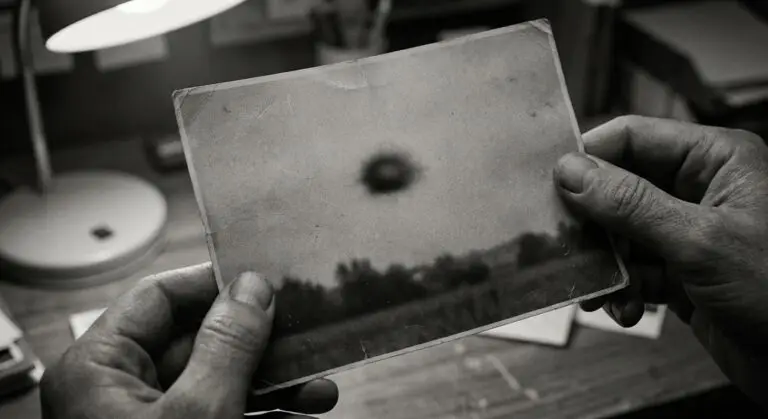
Across the two widely circulated frames, the dominant repeated element is a single, compact object isolated against a bright sky. In both images the object reads as a flattened, rounded form with a strong outline and a tonal split: a brighter upper surface and a darker underside or lower band. That tonal pattern is exactly the kind of feature analysts latch onto because it suggests curvature and a consistent lighting direction, but it is still an image-level observation, not proof of a specific material or structure.
The rest of each frame functions as context and reference cues. One view includes prominent man-made lines and edges such as a roofline and nearby structures; the other view includes more open ground features such as a fence-line and vegetation with a broader slice of horizon. Those cues matter because they provide straight lines, repeated intervals, and planar surfaces that can be used to constrain perspective. They also introduce the core friction: the same cue can be interpreted multiple ways (near vs far, level vs sloped, square-on vs oblique), and those interpretations drive any reconstruction.
What changes from one frame to the other is the camera’s viewpoint relative to the scene. The object’s position shifts against the background cues, and the apparent orientation of those cues changes as well. That change is useful because two viewpoints can, in principle, tighten geometric constraints compared to a single snapshot. It also raises the standard for what you have to verify: if the two images in circulation are not matched originals (same generation, same cropping, same contrast handling), apparent “differences” can be artifacts of reproduction rather than evidence of true motion or geometry.
Photogrammetry is the point where analysis often starts to diverge, because it can reliably recover spatial directions and angles from images and infer shape relationships, but it cannot produce absolute distance or size without at least one known absolute scale reference. In other words, geometry-from-images can tell you whether lines converge consistently, whether an object’s projected contour matches a hypothesized 3D shape, and how rays from the camera intersect in space. It cannot, by itself, lock “how big” or “how far” in real units.
This is where reference cues both help and fail. Roof edges, fence lines, and the apparent horizon provide perspective cues: they let you test whether the camera was tilted, whether the scene can be treated as approximately level, and whether two frames are consistent with a single physical setup. But scale cues break the moment you cannot assign a verified real-world dimension to at least one element in the same plane as the object or to a calibrated camera baseline. A fence post that looks “standard” is not a standard unless you can prove its size and placement in that specific scene.
A common failure mode in photo-based estimates is treating the scene as effectively planar and distant, then relying on image scaling while ignoring perspective effects. That shortcut can generate clean-looking numbers, but it bakes in strong assumptions about depth that the photos do not inherently justify. For UAP sightings evaluated from photographs, that is the difference between an angle-based constraint (defensible) and a distance claim (only defensible with verified scale).
The strongest technical claims depend on whether an analyst is working from original prints or negatives versus reproductions, meaning prints made by copying an original work. That distinction is not academic: every copy step can change edge transitions, compress tonal gradients, and alter the apparent “crispness” of grain or blur. Once you are looking at a later-generation reproduction, you are no longer reading just the scene; you are reading the entire reproduction pipeline.
Even when the source is photographic, printing choices and systems matter for what survives into the final image. Contrast, exposure during printing, and subsequent re-photographing or scanning can all change the visibility of faint detail. That means arguments that hinge on ultra-fine properties (micro-contrast at the edge of the object, subtle internal texture, very small blur differences) become unreliable unless the material lineage is clearly established.
Compounding the problem, photographers do not consistently use or agree on terms like “first generation copy,” and the phrase is often unclear about what, exactly, was copied and how. An analyst has to pin down what physical object is being examined (negative, contact print, enlargement, reprint, publication halftone, scan of a scan) before treating any observed artifact as evidence about the original scene.
Process identification also has limits from reproductions. Reference guides can help analysts recognize broad photographic processes and eras, but once images are several steps removed from the originating material, those process cues can be distorted or erased, and confident process-level conclusions become harder to justify.
Any geometry-based reconstruction stands or falls on explicit assumptions, and readers should be shown exactly where those assumptions enter: the placement of the horizon line, the camera height above ground, and the real dimensions of any chosen reference feature. Change any one of those inputs and the reconstruction can still look “reasonable” while producing a different size or distance.
Two assumptions are especially easy to smuggle in unnoticed. First, treating the apparent horizon as a true level reference: if the terrain slopes or the camera is rolled, the “horizon” cue stops being a reliable level line. Second, treating a reference cue as co-planar with the object: a roofline can be close while the object is far, or vice versa, and the photos alone do not certify depth ordering. Responsible analysis makes these choices visible, then tests how sensitive conclusions are to each one.
The practical takeaway is simple: any firm size or distance claim needs two things in hand. One is at least one verified absolute scale reference in the scene (a measured baseline, a known-dimension target, or a calibrated camera setup). The other is original-generation material, ideally the negative or a well-documented original print, so edges, grain, and fine tonal transitions are attributes of the photograph, not artifacts of reproduction.
Those constraints are also why the interpretive battle tends to narrow to two broad positions. Either the object is something small and staged in the foreground, or the case remains unresolved because the surviving materials do not allow a decisive reconstruction.
Hoax Theory vs Persistent Anomalies
McMinnville is where a plausible debunk collides with evidence that never quite closes the door. The skeptical story is straightforward: a small suspended object or miniature model, photographed at the right distance and angle, can read as something far larger in mid-century photography. The friction is that a simple story still has to satisfy every constraint visible in both frames, and the existing public record rarely preserves the original materials and measurements needed to lock those constraints down. “Not decisive” is not “confirmed,” but it is enough to keep serious analysts arguing about what the photos do and do not allow.
The strongest skeptical hypothesis is not exotic: a small object close to the camera, suspended from a line or otherwise supported, produces an apparent “craft” with ambiguous scale because the photo does not come with verified camera position, focal length, subject distance, and a fully documented chain of custody for the best originals. That approach is plausible on first principles, but it only works if it clears specific hurdles that the images impose.
- Two-frame consistency: the model has to match the object’s apparent change in position, orientation, and size across both frames without inventing camera movements or timing claims that are not documented.
- Perspective geometry: the object’s placement must be consistent with horizon line, camera height, and the perspective cues established by the rest of the scene, not just a single-frame “looks about right” overlay.
- Interaction with background cues: edges, occlusion relationships, and any visible contrast boundaries must behave like a nearby suspended object would, given the lighting and the background detail actually recorded on the prints.
- Optical constraints: depth-of-field, focus falloff, motion blur, and grain structure must be consistent with an object that is close to the lens rather than far away, and those checks require access to the highest-quality originals available.
- Documentation fit: the hoax method must fit the era’s materials and handling realities, including what is known, and not known, about the photographic workflow and preservation of originals.
The takeaway is concrete: a hoax model is only as strong as its ability to satisfy all constraints across both frames using verifiable assumptions.
The suspended-object theory persuades because it is parsimonious. It explains an extraordinary-looking result without requiring extraordinary technology, and it exploits a known vulnerability of single-camera stills: scale collapses when distance is unknown and when the image does not come with contemporaneous measurement notes. Mid-century consumer photography also leaves room for uncertainty because exposure, focus, and print reproduction can mask or exaggerate cues that analysts want to treat as definitive.
The catch is that plausibility is not closure. A story that feels mechanically easy can still be wrong if it cannot be reconciled with the full set of constraints, especially the relationship between the two frames. The actionable standard is simple: treat intuitive simplicity as a reason to test harder, not as a substitute for documentation.
The strongest non-conclusive position does not claim proof of a craft. It argues that the hoax model, as commonly summarized, is not decisive because the public-facing evidence set is incomplete: analysts are often forced to reason from reproduced prints, partial provenance, and secondhand descriptions of originals rather than a fully auditable package of materials. Under those conditions, internal consistency across two frames can cut both ways: it can be consistent with a controlled hoax setup, and it can also be consistent with a single real scene if you cannot independently validate the distances and angles that would separate the two.
The other complication is evidentiary asymmetry. A debunk typically needs to demonstrate a specific mechanism with a constrained reconstruction, while an “unresolved” conclusion can persist simply because key items are missing. That gap is where some audiences jump to a government UFO cover-up, but that leap is also an evidentiary claim: it requires documentation of suppression or alteration, not just the existence of ambiguity.
A practical limit matters here: the provided research set does not identify who first proposed a suspended-object model for the McMinnville photos, and it does not supply named investigators, quotes, or specific technical rebuttals (lighting consistency, edge detail, depth-of-field, or two-frame arguments) defending a “non-conclusive” stance. Additional sourcing is required before assigning credit, blame, or technical claims to specific people.
Institutional handling in the period set the tone for what counted as “good evidence.” Project Blue Book, the United States Air Force program that investigated UFO reports from 1947 to 1969, treated cases as investigations that rose or fell on documentation, traceable materials, and conventional explanations that could be tested. That framing did not require a hoax finding; it required that extraordinary interpretations clear a higher bar than intriguing photos.
The Condon Report, a 1968 Colorado-led review often cited for its skeptical bottom line, is widely summarized as concluding there was no verified, fully satisfactory evidence of any case that clearly demonstrated extraordinary claims. Used responsibly, that conclusion functions as a standard-setting context: still photographs without complete provenance and measurement data routinely fail to reach decisive evidentiary thresholds, even when they remain interesting.
A debunk earns authority by documenting how it meets constraints, not by telling the most satisfying story. If you want to evaluate a suspended-object claim like an evidence reviewer, require a reconstruction that is both technically constrained and transparently documented.
- Lock the constraints: demand a model that matches both frames simultaneously, including perspective cues and background relationships, without hand-waving about unknown camera moves.
- Document the assumptions: require explicit inputs (camera position, distances, focal length or best-supported estimates) and show how sensitive the conclusion is to each input.
- Audit the materials: verify what originals were examined (prints, first-generation prints, negatives) and preserve a chain-of-custody narrative that can be independently checked.
- Publish the reconstruction: insist on reproducible visuals and methods so another analyst can rerun the same test and see if the match holds.
If a debunk cannot meet those requirements, it can still be suggestive. It just cannot close the file.
That unresolved status is precisely why the photos remain useful in modern argument, even when they add little new information about the object itself.
Why It Matters in the Disclosure Era
McMinnville’s modern relevance is rhetorical, not evidentiary. Legacy photo cases like McMinnville function as rhetorical ammunition in today’s UFO disclosure and UAP disclosure debate precisely because they are unresolved and visually simple: two frames, a clean silhouette, and no official closure that definitively ends the argument.
That simplicity makes the images easy to recirculate in modern UFO news and UAP news cycles. When congressional activity spikes, “classic cases” get recirculated as shorthand for bigger narratives. Pro-disclosure advocates use them to argue a long pattern of secrecy, claiming the lack of definitive resolution is itself institutional behavior. Skeptics use the same images to argue a long pattern of misinterpretation, pointing out that repeated circulation is not the same thing as verification. The friction is that both sides can sound plausible to casual readers because the photos are not complex enough to self-refute at a glance.
The media-politics feedback loop is predictable: hearings, new reporting requirements, or a high-profile claim hits the calendar, and legacy images resurface as “context.” In the louder corners of alien disclosure and non-human intelligence rhetoric, the photos become exhibits for debates about institutions, not fresh data about the object in the frame. If you follow “UFO sightings 2026” discussion, you have seen this cycle: attention rises, old visuals fill the feed, and the unresolved case gets treated like a new development.
The gap between proposed transparency and enacted requirements is where modern “disclosure” rhetoric usually breaks from the record. The legislative vehicle that enacted the most recent, broadly cited UAP-related changes is the National Defense Authorization Act for Fiscal Year 2024, H.R. 2670, which was enacted as Public Law 118-31 (H.R. 2670, P.L. 118-31 enrolled/public law).
The Schumer-Rounds amendment and related Senate amendment text (for example S.Amdt.2610) proposed establishing an “Unidentified Anomalous Phenomena Records Collection” at the National Archives and included explicit language about public access and centralized recordkeeping (S.Amdt.2610 text, Senate Democrats press release).
In final conference and enactment, some of the more expansive public-release requirements and oversight mechanisms proposed in House and Senate drafts were narrowed or altered before becoming law. For example, House drafting around H.R. 8070 included a proposal for an Unidentified Anomalous Phenomena Records Review Board and language that touched on materials control, while the Senate amendment emphasized a records collection at the National Archives; the enrolled FY24 NDAA reflects a compromise that retained an archival focus but did not preserve every public-release or eminent-domain-style provision that appeared in earlier amendment drafts (H.R. 8070 text summary, P.L. 118-31 enrolled/public law, S.Amdt.2610). Analyses of the amendment implications provide additional context on which elements were altered versus retained (analysis).
The practical reading is straightforward: Congress did create or authorize structures to centralize UAP records and improve reporting, but the final statutory language in the FY24 NDAA narrowed or clarified how and when records would be transferred or released publicly. That distinction matters because centralized collecting is not identical to automatic public declassification or instantaneous public access.
Recirculation is a distribution event, not an evidentiary event. A legacy image going viral tells you what the internet is arguing about, not what the government has verified.
- Identify the claim being made: is the post arguing “secrecy,” “debunked,” or “newly revealed,” and what would actually qualify as new information?
- Separate imagery from policy: what does current law require to be transferred, reviewed, or reported, and what does it require to be released publicly?
- Demand a primary source: a docketed document, an official letter, or a statute section, not a montage of classic cases.
Ask one question every time a legacy photo spikes again: what, specifically, is new here-a new record, a new legal obligation, or just an old image being used to win a modern argument?
That question also clarifies what meaningful progress would look like. It would not come from another round of reposting; it would come from evidence handling and analysis that can be audited and repeated.
How This Case Would Be Tested Today
Today’s tools would not magically identify a “craft”; they would sharply narrow what can be argued by locking down evidence integrity and enabling repeatable analysis, not better speculation. The failure mode in most viral imagery is basic: the original file disappears, a compressed copy gets shared, metadata is stripped, and the best questions become unanswerable. A modern workflow starts at the moment of capture: obtain the original digital files (RAW when possible), preserve embedded metadata (EXIF), record device identifiers, and capture context that can be checked later (exact location, a time reference, additional frames or video showing the scene before and after, and notes on viewing direction and weather). Separate witnesses early and record their statements independently so later “alignment” does not contaminate timeline and vantage details.
Chain of custody is the organizing principle that turns a striking image into credible evidence: it is a chronological log documenting the lifecycle of evidence from collection onward, including custody, control, transfer, analysis, and disposition, and it is decisive because it prevents later disputes about what changed, who touched it, and when. That log must cover everything, not just cameras and memory cards: exported files, cloud uploads, emailed copies, printed photos, and any storage media. In practice, credibility improves when you can show a clean timeline of collection, write-protection, duplication, secure storage, and controlled access, with every handoff recorded.
Modern image authentication workflows prioritize original files (RAW when possible), embedded metadata (EXIF), device identifiers, calibration context, and repeatable analytic methods; the tests have defined limits on what they can and cannot prove. After capture and logging, analysts can run consistency checks across metadata, compression history, lighting cues, and camera-specific signatures, then document methods so an independent reviewer can reproduce results. Photogrammetry (measurement from images) fits here, not up front: it can constrain size, distance, and geometry if you have enough frames, stable reference points, and known camera parameters. It cannot manufacture missing viewpoints, recover stripped metadata, or resolve identity when the underlying data is too thin.
Standardized reporting has tightened under congressional pressure for consistent intake and review of UAP sightings, and one modern pathway is the All-domain Anomaly Resolution Office (AARO), introduced as a formal intake channel rather than an endorsement of any single case. AARO’s public reporting guidance accepts reports from current or former U.S. Government employees, service members, and contractor personnel; the public portal and submission guidance are available from AARO’s site, though intake guidance and eligibility language can change as the office updates procedures (AARO Submit-A-Report, AARO user guide).
- Keep the original file exactly as captured, and export copies only for sharing.
- Record time, location, viewing direction, and a quick calibration clip that includes landmarks and the full sky.
- Preserve metadata by avoiding apps that strip EXIF, and retain the memory card and device details.
- Log every transfer and analysis step in a simple chain-of-custody note, including who handled what and when.
- Share copies for review, but escrow the originals so independent analysis stays possible.
Applied back to McMinnville, that contrast is the point: modern standards would not guarantee an answer, but they would remove many of the gaps that let thin evidence carry oversized conclusions.
What We Can Say With Confidence
This is what can be said with confidence, and what cannot: the McMinnville case remains durable because it contains hard facts that will not go away, and it also contains gaps that cannot be responsibly filled from what survives. The result is a paradox the public tends to flatten into certainty: a culturally “settled” UFO story resting on evidence that is thin, non-repeatable, and easy to over-interpret.
The hard knowns are compact. There are two photos, taken near McMinnville, Oregon, on the reported date of May 11, 1950. The images were taken within about 30 seconds. They circulated widely and entered mass culture through publication and reprints, including the national magazine reprint described earlier. Those points hold regardless of what anyone thinks the object was (summary, regional account).
What does not hold is the connective tissue that would let the photos carry measurement-grade conclusions. The record still lacks camera and settings documentation, clear negative provenance and present-day availability, and the kind of scene reconstruction that supports exact distances, angles, and scale. Independent corroboration remains limited in degree, which keeps “everyone saw it” and “it was independently verified” from being treated as established facts.
The value of McMinnville is methodological, which brings the article back to the decision point in the introduction: credible evidence, propaganda, or distraction. The photos do not justify certainty in any of those directions on their own, because the case’s high visibility still collides with limited, non-repeatable evidence. Photo-analysis only works as far as its assumptions and reproduction quality allow, and this case makes those constraints unavoidable. Debunking only closes the case when a plausible hoax narrative matches every constraint and arrives with documentation, not when it merely sounds workable. Modern-investigation standards show what would change today: disciplined chain-of-custody and preservation of original files would turn arguments into tests, reducing ambiguity in future UAP sightings by raising the quality of evidence instead of the temperature of the debate.
Frequently Asked Questions
What are the McMinnville UFO photographs?
They are two photographs of an unidentified object taken on a farm near McMinnville, Oregon. The images became nationally known after being reprinted in Life magazine and repeatedly cited in legacy UFO/UAP catalogs.
Who took the McMinnville UFO photos and when were they taken?
Paul Trent took the two photos after Evelyn Trent spotted the object on May 11, 1950. The pictures were taken on the Trents’ farm near McMinnville, Oregon.
How far apart in time were the two Trent photos taken?
The two exposures were taken within about 30 seconds of one another. That short interval is central because it makes the photos a brief sequence rather than widely separated shots.
Why does the month-later film development matter for the Trent photos?
Paul Trent reportedly developed the roll about a month after May 11, 1950, creating an early provenance gap. That weakens chain-of-custody documentation during the period when handling and storage would be easiest to verify.
What do the McMinnville photos clearly show in the frames?
They show a compact, flattened rounded object against a bright sky with a tonal split: a brighter upper surface and a darker underside or lower band. Background cues like a roofline, fence-line, vegetation, and horizon appear but do not supply verified scale by themselves.
What can photogrammetry actually determine from the McMinnville photos?
Photogrammetry can constrain angles, perspective consistency, and whether a proposed 3D shape fits the projected outline across both frames. It cannot determine absolute size or distance in real units without at least one verified scale reference and well-documented original-generation material.
What should you look for to judge whether the McMinnville photos are credible evidence or a hoax?
Require a reconstruction that matches both frames simultaneously and makes assumptions explicit (camera position, distances, focal length estimates, horizon/camera height), then shows sensitivity to those inputs. Also verify what originals were examined (negatives or documented first-generation prints) and demand a chain-of-custody narrative plus reproducible methods.