UK UFO Files: What’s Been Released
Explore UK UFO files released by the Ministry of Defence, what they contain, where to find them, and how to assess the evidence.


“UK UFO files” is a useful label, but it can obscure what the public record contains: Ministry of Defence (MOD) correspondence and sighting material, internal policy and handling papers, and intelligence assessments such as the later-released Project Condign report. These are records of how officials received, considered, stored, or assessed reports. An unexplained sighting means no settled identification was recorded at that point; it is not, by itself, official verification of an extraordinary cause.
This guide follows the evidence back to the underlying record, focusing on MOD material transferred to The National Archives as well as documents made public through MOD publication or Freedom of Information requests. It separates a witness account from an official assessment, and an assessment from a final evidenced conclusion. It also distinguishes archival transfer, catalogue listing, digitisation, publication, redaction, and FOI disclosure: a catalogue entry can identify a file that is not viewable online, while a released page can still omit information.
The practical question is not whether every report has one explanation, but what each document can establish. The sections ahead identify the principal releases, explain who created them and for what purpose, show how to find the original files, and mark the boundaries, closed or redacted passages, incomplete series, disputed requests, and material that has not entered the public record. That context is what prevents an isolated report or memorandum from being made to say more than it does.
What Has Actually Been Released in the UK?
The public material falls into distinct routes, and they do not carry the same evidential weight. The core collection is historical Ministry of Defence material made accessible through The National Archives: files created during the handling of correspondence, reported sightings, policy questions, and internal assessment. Some records are available as digitised pages; others are represented by catalogue entries or require access through the archive’s normal services.
Additional public records appear in MOD publications, written parliamentary answers and debates, and correspondence released in response to Freedom of Information requests. These routes matter because they identify different things: an archived file preserves material from its original administrative context, while an FOI response answers a later, narrowly framed request and may not reproduce every underlying record.
“Release” therefore describes access to a government document, not endorsement of the interpretation attached to it. A report can record an unusual observation; a departmental letter can explain how it was handled; an intelligence paper can offer a working assessment. None automatically establishes an extraordinary cause.
Alleged leaks, tabloid extracts, unattributed scans, and contemporary UFO news sit outside this release inventory unless they can be matched to an identifiable official record. In this archival sense, UFO disclosure is a transparency process: locating what a public body created, retained, transferred, published, or disclosed, and preserving the limits of what those documents actually show.
Where to Read the Official UK UFO Records
Begin with The National Archives catalogue rather than a reposted PDF or a quoted extract. Search broad terms, UFO, unidentified flying object, and aerial phenomena, then narrow the results by date, creator, and file title. Department and series codes are useful filters: DEFE identifies Ministry of Defence records, while AIR can surface Air Ministry and Royal Air Force material. A precise file reference is stronger than a screenshot because it preserves the record’s title, date range, creating body, and access note.
- Use title words as well as acronyms. Older files may use “flying saucers”, “unidentified aerial phenomena”, “reports”, or “public correspondence” rather than UFO.
- Read the catalogue entry before treating a result as available. An entry establishes that a record is described in the catalogue; it does not necessarily mean every page is digitised or fully open.
- Follow the access information attached to that entry. A digitised document may be viewable online, whereas a copy order, reading-room visit, closure note, or charge may apply to another file or to related material.
The MOD’s Freedom of Information pages provide a separate route for later disclosures and published responses. Search by subject, request wording, and response date, then distinguish the department’s reply from any underlying attachment it reproduces. For ministerial statements, use Hansard and Parliament’s written-question search: these records can identify a policy position, a date, or a responsible minister, but they are not substitutes for the archival file itself.
Keep a short research trail for each item: catalogue reference or URL, title, covering dates, creator, access status, and the page number of any passage quoted. That makes it possible to return to the original UK UFO files when a summary omits context.
What the Released Files Contain
A single file may contain several layers of paper trail rather than one authoritative account. In the Ministry of Defence UFO files, public correspondence often includes letters from witnesses, replies drafted by officials, follow-up questions, and enclosures such as sketches, photographs, or newspaper clippings. These papers show what was reported to government and how the correspondence was handled; they do not turn the writer’s description into an established fact.
- Sighting reports and summaries preserve an observation, usually with a time, place, direction, appearance, and duration. A report can be detailed yet remain a claim awaiting identification; “unidentified” may describe the information available at the time, not a confirmed unidentified craft.
- Internal policy and handling papers explain who received reports, which ones were passed on, how replies were worded, and what threshold mattered to officials. They are useful for understanding procedure, but are different from an assessment of a particular event.
- Press and public-relations material includes cuttings, media enquiries, and proposed responses. It records public attention and the department’s communications problem, not independent corroboration of UFO sightings.
- Parliamentary correspondence, ministerial letters, written answers, and briefing material, can clarify the position officials were prepared to state publicly. Its purpose is accountability and explanation, rather than a complete case file.
- Defence-significance records matter most for interpretation. They indicate whether an incident was considered relevant to air defence, security, or another operational concern. A file that records no such significance should not be recast as a positive finding about the cause of a UAP sighting.
Read the sender, recipient, date, and document purpose before drawing a conclusion from any striking passage. A witness letter is strongest as evidence that someone made a report; an internal minute or assessment is stronger evidence of what the department decided to do with it. Those are distinct evidential questions, and the released record often answers only one of them.
Project Condign: The UK’s Best-Known Defence Intelligence Study
Project Condign is different from routine UFO-desk correspondence because it was a Defence Intelligence Staff assessment rather than a collection of incoming reports. Its released final report, Unidentified Aerial Phenomena in the UK Air Defence Region, was completed in 2000 and later made public by the Ministry of Defence. The report examines unidentified aerial phenomena as a possible intelligence and air-defence issue: what might produce such observations, whether they presented a threat, and what information could reasonably be inferred from the available cases.

Its central working hypothesis was natural rather than extraterrestrial. The assessment considered whether a proportion of reports could arise from poorly understood atmospheric effects, especially electrically charged or plasma-like phenomena formed under particular meteorological conditions. That proposition was offered as an explanatory model for some observed lights, movements, and reported physical effects; it was not a finding that every unresolved report had one cause.
The report’s language and method matter. An intelligence assessment weighs incomplete reporting, competing explanations, and possible implications; it does not convert uncertain observations into established events. Project Condign discusses limitations in the underlying evidence and treats the available data as insufficient for firm conclusions about many individual incidents. Its analysis of atmospheric plasma was consequently a hypothesis framed around uncertainty, not a demonstrated identification of a specific object.
Readers should also keep its scope in view. The released study does not establish alien craft, non-human intelligence, crash-retrieval activity, or reverse-engineering programmes. Those claims require records that directly document the alleged activity, not an inference drawn from a report about unidentified aerial phenomena and possible atmospheric mechanisms. In the wider UK UFO files, Project Condign is significant because it shows that defence intelligence considered the subject in a structured way; its significance should not be enlarged beyond what its cautious conclusions support.
What Remains Unavailable, Redacted, Disputed, or Outside the Public Record
Not every gap in an archival trail has the same meaning. A catalogue entry marked closed identifies a record whose access is restricted; a retained record has not yet entered the archive’s public holdings; and a digitised file with blacked-out passages is available only in part. Redactions commonly protect personal information or material judged relevant to national security or defence. A search that returns nothing is weaker evidence still: it may reflect indexing language, an untransferred file, a different record series, or material that was never retained. Records-management practices can affect what is retained, transferred, released, or unavailable.
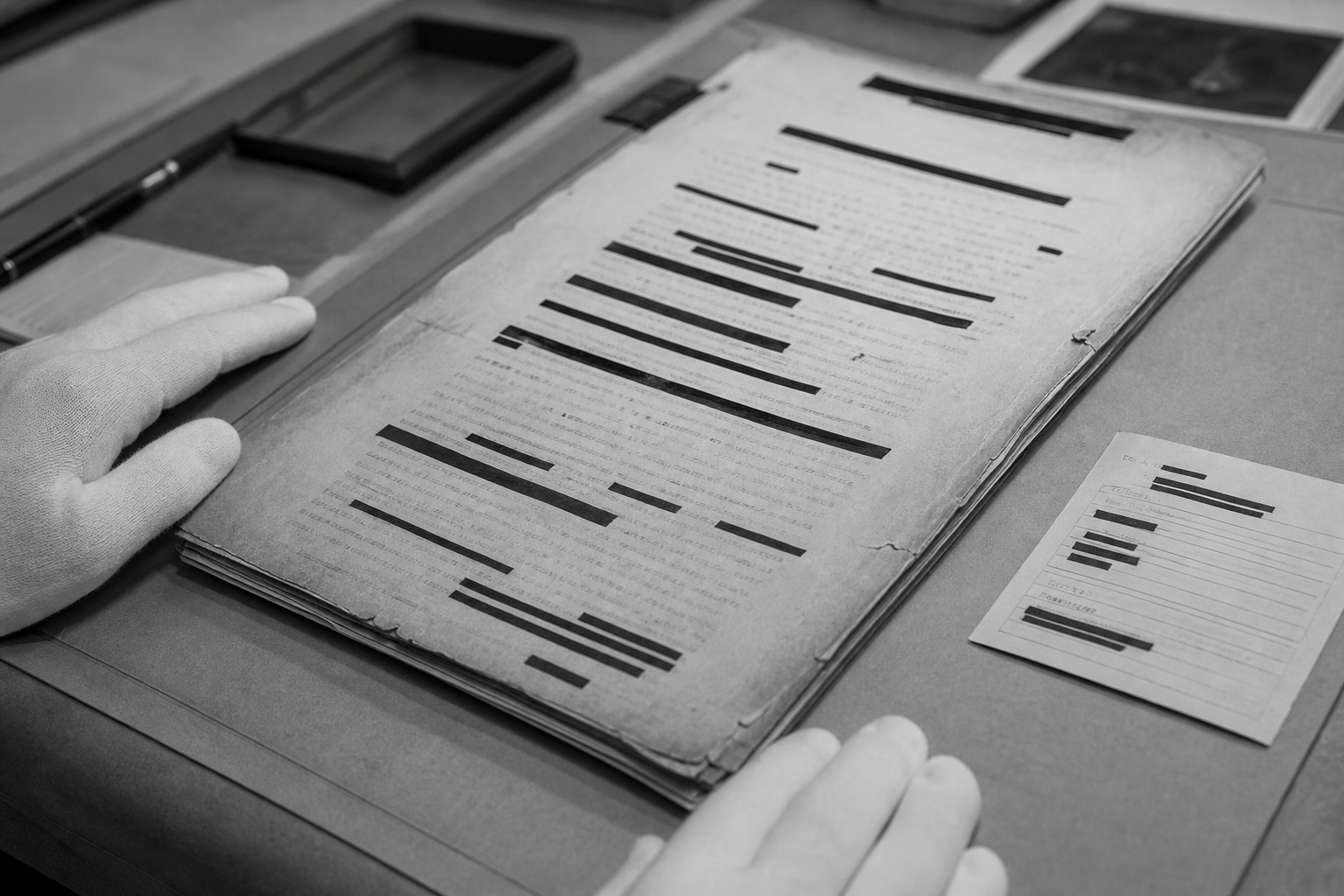
The Freedom of Information Act 2000 provides a route to request records held by a public authority, but it does not guarantee release of every document or every line. An MOD response that names an exemption is a documented withholding decision: it tells the reader the legal basis relied upon and the scope of what was withheld. It is not, by itself, evidence of the motive sometimes alleged in a government UFO cover-up claim. Equally, a released response may omit information outside the request’s wording or material no longer held.
- Strong signal: an access note, exemption citation, or visible redaction identifies a specific restriction that can be described precisely.
- Weak signal: a missing search result or an incomplete scan cannot establish either that a concealed record exists or that no relevant record ever existed.
For disputed claims, preserve the catalogue reference, request wording, response date, and any appeal outcome. That separates a demonstrable limit in the public record from speculation about what might lie beyond it.
How UK UFO File Releases Differ From US UAP Disclosure
A US congressional hearing or AARO report is not a finding about a British record. US UAP activity belongs to a separate record system, even when the language used in news coverage sounds familiar. In the United States, the Pentagon UFO office, now associated with the All-domain Anomaly Resolution Office (AARO), produces assessments within a current US UAP transparency framework, while congressional hearings and disclosure measures concern US oversight and records.
The US National Archives’ UAP Records Collection is likewise a US statutory collection effort, not an index to British files. It may help a reader locate American agency material, but it does not change the provenance, date, completeness, or meaning of an MOD file held at The National Archives.
- Strong comparison: identify the creating body, country, date, and record series before linking two documents.
- Weak comparison: treating a US hearing, allegation, or AARO UAP report as corroboration for an unrelated British sighting file or internal MOD minute.
Current UAP disclosure news, including the US legislative declassification debate, can make an older British release appear newly significant, but publicity is not new evidence. A UK document should stand or fall on its own text, authorship, and archival context; claims about it require a direct connection within the UK record.
How to Read UK UFO Files Without Overclaiming
The safest unit of interpretation is the individual document, not the story built around it. Before drawing a conclusion from UK UFO files, record the file reference, creating department, author or sender, date, and access status. Those details establish who was making a statement, when, and for what purpose.
- Separate report from assessment. A witness account supports the fact that a person reported an observation; an official minute or intelligence assessment supports the fact that officials considered, classified, or acted on it. Neither automatically establishes the reported cause.
- Read the whole available item. Note missing pages, blacked-out passages, attachments, and covering dates. A partial page cannot bear the same interpretation as a complete file.
- Follow references. File numbers, enclosures, and cross-references may lead to the reply, policy decision, or later assessment that gives an isolated passage its meaning.
- Test headlines against the wording. A dramatic summary is weak unless the original document uses equally definite language and supports the claimed scope.
These records remain valuable evidence of British reporting, administration, and official assessment. Taken together, however, they do not settle claims of alien disclosure or extraordinary secret programmes; such claims require direct, complete, and attributable evidence.
The Key Takeaway From the UK UFO Record
The enduring value of this material lies in the trail it leaves: what was reported, how officials recorded it, and how particular questions were assessed at a particular time. A report of UFO sightings establishes that an observation was made and communicated; an internal assessment establishes that an office considered the information. A confirmed finding requires a document that actually reaches and supports that conclusion. Treating those levels as interchangeable is where most overstatement begins.
Read the UK UFO files as a bounded public archive, not a complete answer to every claim attached to the subject. Provenance identifies whose words appear on the page; dates prevent later interpretations being read back into earlier records; and redactions, closed items, or absent attachments mark limits on what can responsibly be inferred. The strongest conclusion is usually the narrowest one the complete, attributable record can bear.
Keep the original catalogue entry, scan, or formal release alongside any summary you encounter. That habit preserves the distinction between documented fact and speculation, and leaves room for the public record to be corrected, supplemented, or challenged without turning uncertainty into evidence of its own.
Sources
Frequently Asked Questions
-
Where can I read the official UK UFO files?
Start with The National Archives catalogue, using searches for “UFO,” “unidentified flying object,” and “aerial phenomena.” Filter results by date, creator, and record series such as DEFE for Ministry of Defence files and AIR for Air Ministry or RAF material.
-
Are all UK UFO files declassified and available online?
No. Some Ministry of Defence files have been transferred to The National Archives and digitised, while others are catalogue-only, require a copy order or reading-room access, remain closed, or contain redactions.
-
What did the Ministry of Defence say about UFO sightings?
MOD files include witness reports, official correspondence, policy papers, and internal assessments showing how sightings were received and handled. An unexplained report meant no settled identification was recorded at the time, not that officials verified an extraordinary cause.
-
What was Project Condign and what did it conclude?
Project Condign was a Defence Intelligence Staff assessment titled “Unidentified Aerial Phenomena in the UK Air Defence Region,” completed in 2000 and later released by the MOD. It considered natural atmospheric and plasma-like phenomena as a possible explanation for some reports and found the available evidence insufficient for firm conclusions about many individual incidents.
-
How do UK UFO files differ from US UAP disclosure records?
UK UFO records mainly consist of MOD, Air Ministry, RAF, parliamentary, and FOI materials, while US UAP records come from separate bodies such as AARO, Congress, and the US National Archives UAP Records Collection. A US hearing or AARO report does not corroborate a British sighting file unless there is a direct documented connection between the records.