Nonstop UFO news and “disclosure” claims create a specific frustration: the loudest stories are rarely the ones with checkable anchors. If you want cases you can actually pin to a date, a time window, and a place on a map, you have to separate what was recorded from what was retold.
The choice you’re making with the Robert Taylor case is simple: does it hold up as evidence you can scrutinize, or has it drifted into folklore powered by repetition? The only way to answer that is to start with what’s fixed, then build outward.
This incident stays relevant because it’s one of Scotland’s most-cited “official attention plus physical traces” UFO reports: a close-range claim that’s routinely described as leaving marks on the ground and drawing police attention. The verified identifiers that frame the entire discussion are straightforward: 9 November 1979; described in contemporary accounts as occurring in the morning; and located at Dechmont Law, also referred to as Dechmont Woods, near Livingston in West Lothian, Scotland.
The friction is that the public record you can access today is uneven. Many specifics circulate as if they’re settled, including confident-sounding claims about exactly what authorities documented and how the case was categorized, but those details are often repeated without a clean, publicly viewable paper trail attached. In the disclosure-era debates, even the label you use shapes the argument; calling older “UFO” reports UAP (Unidentified Anomalous Phenomena) pushes people to treat legacy cases like data points in an ongoing program instead of local incidents with messy documentation.
Use one standard throughout: treat dates, times, locations, and directly attributable records as “verified,” and treat everything else as “reported,” no matter how famous the story is.
What Robert Taylor reported that morning
Taylor’s account is a close-encounter narrative with a clear sequence: a work visit to Dechmont Woods, an unexpected sighting, and an encounter that later retellings describe as turning physical. The problem is that the widely circulated versions often blend what Taylor reported with added, secondhand details. The timeline below sticks to what Taylor is reported to have said in publicly available reporting, and it flags where later accounts go beyond that record.
-
Enter Dechmont Woods (work context). Taylor is described as a forestry worker, and he reported that he went into Dechmont Woods to check for stray sheep and cattle. This is the grounding context for the encounter as he reported it: he was in the woods on a routine work task, not on a recreational outing.
Credibility marker: This step is anchored to Taylor’s stated purpose and role in publicly available reporting. It does not rely on later narrative embellishment. -
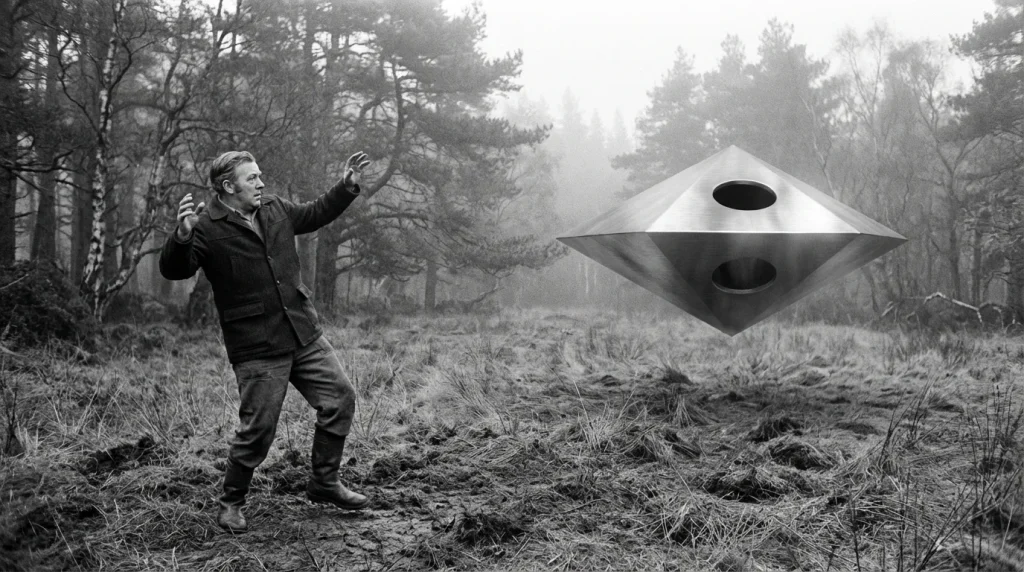
Observe a craft (initial sighting). On 9 November 1979, Taylor reported discovering a large circular craft in Dechmont Woods. In publicly available reporting, that is the key observational claim: an object described as a large, circular craft, encountered in that location on that date.
Credibility marker: Many retellings supply precise dimensions, surface features, sounds, smells, and lighting conditions. Those sensory specifics are not established in the accessible public record for this section, so they should not be treated as part of the documented core claim here. -
Describe an escalation (reported physical element). Beyond the initial sighting, later and secondary accounts contemporaneous to the broader story report that Taylor claimed he was attacked after first seeing the object. In other words, the narrative does not stop at observation in those retellings; it turns into an encounter where Taylor is acted upon.
Credibility marker: The often-repeated mechanics of the physical encounter, including exactly what made contact, what it felt like, and how movement occurred, are not established in publicly available reporting. Where those details appear in popular summaries, treat them as later layering unless you can tie them to near-primary documentation. - Account for what happened next (aftermath and recovery). A common storyline in retellings is that Taylor lost consciousness, later came to, and then sought assistance. However, publicly available reporting does not establish the timing, duration, or precise sequence of those aftermath elements as a near-primary record. If you see a specific minute-by-minute breakdown in other write-ups, that level of precision should be treated as secondary unless it is explicitly sourced to an early statement or contemporaneous record.
- Report the incident (help-seeking and notifications). Public reporting for this section does not supply verified anchors for who Taylor contacted first, when police were notified, whether he sought medical attention, or any reliably recorded time estimates. Those are legitimate timeline questions, but they cannot be answered from the accessible public record here without stepping into unsupported detail.
As reflected in publicly available reporting, the most defensible reconstruction is narrow and specific: Taylor, described as a forestry worker, went into Dechmont Woods to check for stray sheep and cattle; on 9 November 1979 he reported discovering a large circular craft there; and later retellings add that he claimed the encounter became physical. Treat everything beyond those points, especially sensory descriptions and finely grained “what happened next” timing, as unverified within the accessible public record for this section.
The practical takeaway is simple: this is a witness-claim sequence, not a fully corroborated event log. It defines what investigators could try to corroborate on the ground, and it also highlights what cannot be verified from the earliest account material included here. That limitation puts the weight on what can be demonstrated independently at the site and in any official records, rather than on narrative completeness.
The police inquiry and trace evidence
“Physical traces” only strengthen a UAP case when they’re documented to a standard that survives scrutiny. In practical terms, a reported sequence like Taylor’s only becomes testable if the follow-on record-statements, scene observations, and any materials handling-can be tied to contemporaneous documentation.
The Robert Taylor incident keeps its staying power because two claims repeat in almost every retelling: that police were involved and that there were physical effects at the site. The credibility of both claims rises or falls on documentation quality, not on how often the story is cited.
The commonly reported version is straightforward: Taylor gives an account, police take statements, and someone examines the location in Dechmont Woods for physical effects consistent with his report. Those effects are typically described in broad categories, not hard measurements: ground impressions, disturbed vegetation, and other site marks offered as corroboration.
That framing matters because “police inquiry” can mean a wide range of activity even in ordinary incidents. In this context, the most responsible interpretation, based on what is typically claimed and what is actually checkable, is limited to two components: statements were taken and some form of site examination was reportedly conducted. Anything beyond that, such as specific forensic testing, casts, or lab analyses, requires contemporaneous records to move from “reported” to “demonstrably supported.”
Site effects are often treated as the hinge of credibility because they look like trace evidence: physical effects or materials at a location that can be evaluated for documentation quality and alternative causes, not just for how well they match a narrative. The friction is that trace evidence is only as strong as the context around it. A scuffed patch of ground can be meaningful, or it can be a product of routine forestry activity, wildlife, weather, or later foot traffic. Without precise recording of what was found, where it was found, and what else could plausibly explain it, the “trace” becomes a prop rather than a test.
The same logic applies if any samples were collected. Even compelling material becomes suspect when handling is undocumented, because chain of custody is the mechanism that preserves integrity: the OEWRI Chain of Custody SOP defines it as tracking possession of a set of samples from field collection until delivery. If you cannot show who collected what, how it was packaged and labeled, where it was stored, and who received it, you cannot separate genuine evidence from contamination, mix-ups, or later substitution.
A credible field record is not a single “we checked the area” note. The minimum bar is a package of contemporaneous documentation that lets an outsider reconstruct what happened without trusting anyone’s memory. Field documentation norms emphasize maps, sketches, photographs, profiles, and field notes, and they require the methods and techniques used during the examination to be recorded. That bundle does two jobs at once: it pins the observations to specific locations and it shows how the observations were produced, which is what allows scrutiny.
Applied to reported UAP site effects, the benchmark is concrete:
- Maps that fix the examined area, access routes, and reference points.
- Sketches that show the layout of any impressions or disturbed zones relative to each other.
- Photographs with scale and orientation, taken before anything is touched or walked through further.
- Profiles that capture depth, edges, and stratigraphy of any impressions or excavations.
- Field notes that time-stamp observations, weather, ground conditions, and who observed what.
- Recorded methods and techniques describing exactly how measurements were taken and how any sampling was performed.
When that standard is met, “physical evidence” becomes something you can audit. When it is not met, the case relies on authority cues, such as “police were involved,” instead of verifiable records.
The accessible public record flags a problem that directly limits certainty: it does not identify the specific 1979 police force jurisdiction responsible for Livingston or West Lothian, and it does not provide a publicly accessible incident log, officer notes, or photographs from the inquiry. That is not a small administrative detail. Without a jurisdiction anchor, you cannot target a records request with confidence, and without incident logs or primary notes, you cannot confirm scope, timing, or what was actually documented at the scene.
This gap changes what can be claimed responsibly. You can say the inquiry is widely reported and that site effects are part of the story’s durability. You cannot treat the existence of “trace evidence” (site effects) as independently established in the way it would be if contemporaneous photos, sketches, and notes were available for inspection. And you cannot treat any alleged samples as credible physical evidence unless a chain of custody (documented sample handling) can be demonstrated.
- Ask for contemporaneous records: incident log entry, attending officers’ notes, and dated scene photographs.
- Demand the field documentation set: maps, sketches, profiles, and field notes plus the recorded methods used.
- Verify whether any samples exist and, if so, whether a chain of custody can be shown from collection to delivery.
- Test every claimed site effect against alternative causes that the documentation can either rule out or leave open.
Evaluate this case’s “evidence” by asking what was documented contemporaneously and whether any sample handling can be proven, then weigh how different explanations perform against that limited record. When the documentation is thin, the case inevitably shifts from a record-driven reconstruction to a comparison of hypotheses under uncertainty.
Competing explanations and sticking points
Every serious hypothesis has to carry more weight than the sighting narrative. It also has to explain two things at once: (a) Taylor’s reported encounter sequence as reconstructed earlier in this article, and (b) why “physical traces” recur in retellings despite documentation gaps. Using a verified vs reported vs disputed frame keeps that pressure on the explanations instead of on the story’s vividness, and it matches how evidence is treated in other domains where accuracy is the stated goal.
Start with basic fit against the reconstructed sequence and setting details already established. Misidentification maps cleanly onto a working landscape because the verified part of that setting is “forestry,” and ecological forestry is explicitly concerned with forestry impacts on water, soil, and habitat, meaning the ground and vegetation are routinely altered by ordinary work. The complication is that “ordinary disturbance” does not automatically explain the reported sequence, it only explains why unusual silhouettes and confusing spatial cues can be reported. The actionable takeaway is to treat misidentification as a strong fit for the sequence’s observation portions, but a weaker fit as soon as the report shifts from seeing to being acted upon.
Environmental or industrial causes also fit the setting because they predict common, non-anomalous disturbances without needing a rare trigger. The friction is that the open record does not include legitimately documented contemporaneous medical or psychological findings about Taylor, and those missing clinical anchors matter because health conditions and disability correlate with downstream costs and complications in real-world care systems, not just storytelling. The takeaway is simple: psychological or medical factors can be discussed only as general classes that affect perception, stress response, and recall, and this article does not support diagnosing Taylor or treating a specific condition as verified.
Hoax theories and non-human intelligence (NHI) interpretations both “fit” the reported sequence in different ways, but the burden shifts immediately to evidence handling. Pattern recognition is a real forensic skill used in professional education, but sequence-fit is not a win condition by itself: under a verified vs reported vs disputed standard, the best explanation is the one that survives disciplined evidentiary sorting, not the one that reads most complete.
The dragging element is the pivot because it is reported as force or incapacitation, not just observation, and it is not verified in the materials available in the open record. Misidentification strains here unless you add a secondary, mundane mechanism (a fall, entanglement, or loss of footing) that can plausibly be misremembered or re-narrated as external force. Environmental or industrial causes can supply that secondary mechanism through terrain hazards, but the complication is the same: “hazard exists” is not the same thing as “hazard matches the reported directionality and persistence of dragging.” The actionable way to read this is to separate the dragging claim as reported from what is verified, and to notice that the provided record does not supply contemporaneous adjudicative linkage tying injuries to an event.
Psychological or medical factors can, in general, explain felt compulsion, time gaps, or fragmented memory, but the open record contains no legitimately documented contemporaneous findings about Taylor’s condition, so this cannot be treated as established causation and it cannot be personalized into diagnosis. Hoax theories can explain dragging as staged injury or embellished description, but they inherit a documentation problem: staging requires actions that typically generate clearer artifacts than a disputed retelling. NHI interpretations accept dragging at face value, but under a verified vs reported vs disputed framework that move resembles an evidentiary shortcut, and the standard you would apply in other structured decision contexts is higher. The takeaway is that “dragging” is the element most likely to collapse an explanation that leans on narrative completeness instead of evidence.
This anchor is where explanations separate because traces only matter to the extent they are documented in a way that can be checked. Environmental or industrial causes often predict ordinary traces because ordinary activities already exist in the setting, which makes them resilient when trace documentation is thin or disputed. Misidentification paired with an accident mechanism remains viable if the site record does not conclusively tie traces to a singular anomalous event. The complication is that the difference between verified and disputed traces often comes down to whether you can independently locate and contextualize the site, and some forestry agencies make historical land-use data available for public download, which is what a verifiable site record can look like even if the case at hand does not provide it.
Hoax theories and NHI interpretations both depend heavily on trace integrity because they rely on “something happened here” more than “someone perceived something.” The friction is that even in well-managed public lands, documentation can be structurally hard. The actionable takeaway is to keep “physical traces” in the verified vs reported vs disputed lanes: without location, timing, and chain of custody (documented sample handling), trace claims remain rhetorically powerful but analytically soft, and they should not be used to launder disputed assertions into “verified.”
- The dragging claim is difficult to reconcile with mundane explanations unless a specific, well-supported mechanism is established, and the claim remains reported rather than verified in the accessible public record.
- Trace talk outruns trace documentation in many retellings, blurring what is verified versus merely reported versus actively disputed.
- Psychological or medical hypotheses cannot be responsibly personalized here because publicly available reporting does not supply legitimately documented contemporaneous findings about Taylor, and this article does not diagnose.
- Hoax explanations need a documented motive and execution trail that is often asserted more than demonstrated, which keeps them in the disputed lane even when they feel narratively satisfying.
The disciplined way to read the case is to rank explanations by two scores: explanatory fit to the reported sequence, and evidentiary support for the dragging and trace claims. On that rubric, misidentification and environmental or industrial explanations typically rate highest on evidentiary compatibility, psychological or medical stays non-specific by necessity, and hoax and NHI rise or fall almost entirely on trace integrity rather than narrative vividness. Narrative vividness never substitutes for documentation, and the cultural afterlife is the point: landscapes get revisited, re-used, and reinterpreted over time, which is exactly the kind of everyday reuse that keeps local legends alive even when the documentation record stays contested.
Those pressures-limited sightlines, common ground disturbance, and a public record that is hard to audit-aren’t abstract. They come directly from the kind of landscape Dechmont Law is, which is why the setting deserves its own look.
Scotland’s UAP landscape and parallels
Dechmont Woods persists as a Scottish close-encounter motif for a simple reason: working landscapes generate ambiguity on demand. In a woodland setting, a brief sighting can be sliced into fragments by trees and terrain, and ordinary ground disturbance can read as “trace evidence” when nobody documents the baseline condition. Once UFO culture and local storytelling lock onto a single dramatic version, that ambiguity gets edited out and replaced with certainty.
Geography matters here because Dechmont Woods sits in West Lothian near Livingston, close enough to urban edges that you get a mix of managed woodland, paths, and everyday human activity. Over time, the setting becomes part of the story’s persuasive power: a place that feels secluded, yet is still shaped by routine land use.
Woodlands sabotage reliable observation. Sightlines are short, objects are partially occluded, and scale estimation collapses when the only reference points are trunks, branches, and uneven ground. A dark shape between trees can appear to “move” as the viewer moves; a slope can hide the true size of a clearing; a sudden opening in canopy can make a mundane light source look isolated and aerial.
Ground marks are equally context-dependent. Forestry and land management generate impressions, scuffs, and vegetation disturbance through normal work and normal recreation: vehicle turning points, dragged material, informal paths, maintenance activity, and animal movement. Ecological forestry treats soil, water, and habitat impacts as core variables precisely because forests record disturbance so readily, and ecological forestry’s focus on impacts to water, soil, and habitat is documented as a discipline-wide priority. That framework exists as a general tool for interpreting land-use effects, not as proof of what happened at Dechmont in 1979.
Forestry GIS is another modern tool: many forestry agencies now publish large portions of their data for download, making it possible to reconstruct land-use patterns, track compartments, and compare historical conditions when the datasets exist.
Dechmont also has a built memory. A local memorial and trail commemorate the incident and frame it as significant in local storytelling, which reinforces a “canonical” version for visitors and later writers.
That’s how retellings work: nuance compresses, dramatic elements amplify, and what was uncertain in contemporaneous documentation becomes a fixed script. The environment’s built-in ambiguity gets replaced by a clean narrative that feels more evidential with every repetition.
The practical takeaway for evaluating modern UAP claims is environmental: ask what the landscape makes likely. Demand documentation that separates unusual traces from ordinary forestry and everyday disturbance, including photos with scale, location context, and a clear chain of custody. Older cases resurface during disclosure pushes for the same reason Dechmont endures: a hardened story travels faster than unresolved uncertainty, and that same dynamic is driving fresh attention in recent UAP reporting.
When that attention shifts from local history to national politics, the case is often used as a ready-made example, less as an evidentiary file and more as a rhetorical shorthand.
Why the case resurfaces in disclosure debates
In the disclosure era, older police-involved cases like Robert Taylor’s 1979 report near Dechmont Law in West Lothian keep resurfacing for a simple reason: “official attention plus alleged traces” is rhetorically powerful. It reads like built-in credibility in UFO disclosure and UAP disclosure debates. Oversight, however, is built to evaluate evidence with provenance and repeatable handling, not to canonize legends that entered the public record unevenly.
Today’s UAP news runs through formal reporting lanes and structured briefings, which changes what “credible” is supposed to look like. ODNI and DOD published the Fiscal Year 2024 Consolidated Annual Report on UAP under AARO, explicitly treating UAP as a reporting and analytic problem to be logged, triaged, and briefed (ODNI FY2024 UAP report). On the legislative side, the conferenced version of the FY2026 NDAA added provisions that give the Pentagon UAP office additional briefings and oversight touchpoints, raising expectations that relevant data will be captured and surfaced through official mechanisms (FY2026 NDAA conference report summary). DefenseScoop reported on 2026-02-25 that “Pentagon officials said they welcome the Trump administration’s plan to supercharge UAP transparency.” None of this authenticates any specific historical incident; it tightens the funnel for how new incidents are supposed to be handled.
Legacy cases are reusable because they compress a whole argument into a slogan: police involvement, a claim of physical traces, and the implication that “someone official took it seriously.” That shorthand is then welded to broader claims about a government UFO cover-up or even non-human intelligence, especially after high-profile statements entered the record. David Grusch testified to Congress on July 26, 2023, during a House Oversight hearing titled “Unidentified Anomalous Phenomena: Implications on National Security, Public Safety, and Government Transparency” (House Oversight hearing page). Luis Elizondo has written that he resigned in protest and believes public disclosure was the only way forward. Those are disclosure claims and testimony, not case-specific proof about 1979.
Use a clean separation: policy momentum increases reporting pressure and improves forward data quality, but it does not retroactively certify older narratives where the public documentary record is incomplete. If you are tracking contemporary UAP reporting, apply one rule before sharing: demand contemporaneous records, clear provenance for photos or video, and transparent investigative handling that survives oversight, not just a compelling story.
What we can say with confidence
This incident stays compelling for one reason: it sits at the intersection of a dramatic report and an incomplete public documentary trail. The story is vivid, the alleged traces are specific, and the official involvement is central, but the open record still does not let a reader independently verify every step from report to documentation.
The cleanest way to keep extraordinary claims tethered to what can actually be checked is the same framework used throughout this article: verified vs reported vs disputed, where each label reflects the documentation level behind it. That is the same separation-between what can be pinned to time and place and what has been retold-that the introduction set as the standard.
- Verified: the case anchors used from the start: the morning of 9 November 1979, at Dechmont Law near Livingston in West Lothian, Scotland.
- Reported: the encounter narrative remains Taylor’s account as presented in the timeline section, with strict attribution language of the form “Taylor reported X,” including the close-range interaction and the claimed physical effects.
- Disputed/unknown: the evidence section’s standard still applies: without publicly accessible police records tied to the correct jurisdiction, key points about what was formally recorded, by whom, and in what format cannot be confirmed from open materials.
This is where primary source literacy matters. A primary source is an original, contemporaneous record created close to the event, and contemporaneous police notes, dated scene photos, or medical records (if they exist) carry more weight than later UFO literature. Library subject guides routinely steer researchers toward primary materials like letters, reports, newspapers, and archival collections because originals beat retellings.
The explanations section lands on the only responsible summary: multiple hypotheses remain live because the documentation that would discriminate between them is limited. The modern disclosure-era oversight angle only adds a modest reminder that process and recordkeeping are the point, not the personalities.
- Prioritize dated photos with scale and clear chain-of-custody notes for any alleged trace.
- Demand soil and plant analysis reports tied to exact sampling locations and methods.
- Obtain contemporaneous medical exam notes when injuries are claimed.
- Corroborate with independent witness statements recorded close to the event.
When a case claims official attention and trace effects, credibility rises or falls on primary sources and documented handling, not on repetition.
Frequently Asked Questions
-
When and where did the Robert Taylor UFO incident happen?
The article’s verified anchors are the morning of 9 November 1979 at Dechmont Law (Dechmont Woods) near Livingston in West Lothian, Scotland. Everything else is treated as “reported” or “disputed/unknown” depending on documentation.
-
What did Robert Taylor report seeing in Dechmont Woods in 1979?
He reported that, while in Dechmont Woods on a work task checking for stray sheep and cattle, he encountered a large circular craft. Later retellings add further sensory details, but the article does not treat those added specifics as established in its provided record.
-
Was Robert Taylor really dragged toward a UFO in Scotland?
The “dragging/physical attack” element is treated as reported in later and secondary accounts, not verified in the article’s accessible documentation. The article emphasizes that the mechanics, timing, and minute-by-minute sequence of the physical encounter are not established in the provided excerpts.
-
Did police investigate the Robert Taylor incident and find physical traces?
The case is widely retold as involving police statements and a site examination with effects like ground impressions and disturbed vegetation. The article says it cannot confirm the scope, timing, or specific documentation because it does not provide publicly accessible incident logs, officer notes, or dated scene photographs tied to the correct 1979 police jurisdiction.
-
What documentation would make the Dechmont Woods trace evidence testable?
The article’s minimum field-record “spec” is a contemporaneous bundle: maps, sketches, photographs with scale and orientation, profiles showing depth/edges/stratigraphy, time-stamped field notes (including weather and ground conditions), and recorded methods/techniques used. Any collected samples also need a documented chain of custody from collection through delivery.
-
What records should you request to verify the Robert Taylor 1979 case?
The article recommends asking for a contemporaneous incident log entry, attending officers’ notes, and dated scene photographs, plus the full field documentation set (maps, sketches, profiles, field notes, and recorded methods). It also says to verify whether any samples exist and require chain-of-custody documentation if they do.
-
How should you evaluate competing explanations for the Robert Taylor incident?
The article says to rank hypotheses by (1) fit to the reported sequence and (2) evidentiary support for the dragging and trace claims under a verified vs reported vs disputed standard. It concludes that misidentification and environmental/industrial causes usually align best with thin documentation, while hoax and non-human intelligence interpretations rise or fall on trace integrity and primary-source records.
