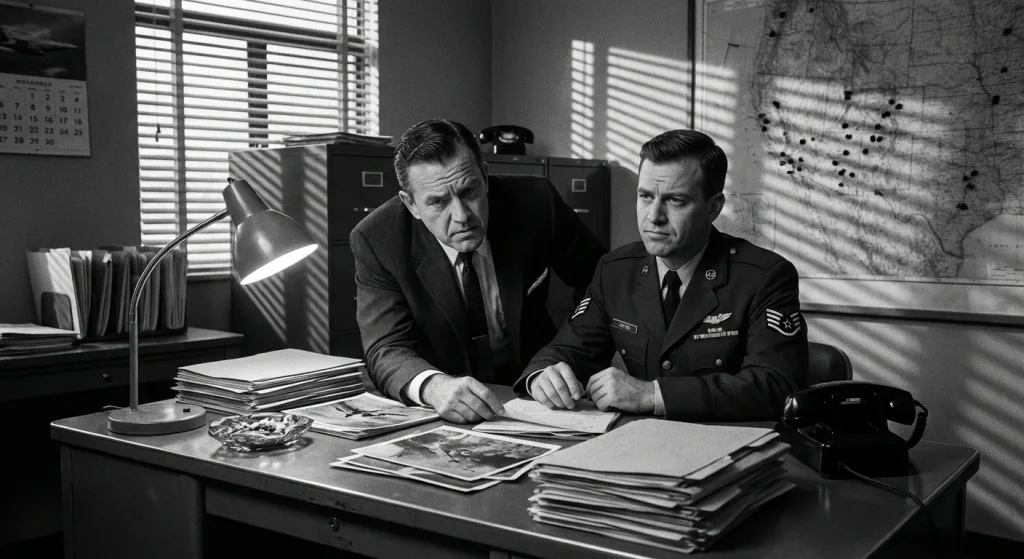
UFO news and UAP news now run on a loop: hearings, leaked clips, confident claims, and official non-answers. The frustration is predictable because the signal is mixed on purpose. You are told something is being “disclosed,” but you cannot tell if the subject is new evidence or a plan for managing public reaction to uncertainty.
That leaves you with a practical decision, not a philosophical one: what to believe, how to read official statements, and how to treat “debunking.” In this topic, “debunking” is read two ways, either as the responsible clearing of mistakes or as the fingerprint of a cover-up. The record only makes sense once you track why institutions choose one posture over the other.
The key historical hinge sits in the late-1940s surge of reports. The U.S. Air Force treated sightings first as an intelligence and air-safety problem: identify what is in the air, what it could be, and whether it signals a threat. Then the posture shifted. Project Grudge marked the pivot toward reassurance, culminating in a Project Grudge report dated Dec 27, 1949 stating: “No reports of unidentified flying objects have been withheld.”
Language drives the modern trust fight because the public quietly rewrites the terms. An Unidentified Flying Object (UFO) is a report about something not yet identified, but many people hear the “U” as “unexplained,” which raises expectations that someone must already know the answer. Unidentified Anomalous Phenomena (UAP) broadens the government’s umbrella label across domains, but the broadened label also expands what counts as “something to explain,” and that magnifies the demand for closure.
Keep the timeline straight and the pattern sharpens: Project Sign (1948) to Project Grudge (1949) to Project Blue Book (launched March 1952; ended Dec 17, 1969). By the end, an open-ended investigation track had become a credibility problem under institutional pressure to reduce alarm. You will leave able to spot when officials are reporting uncertainty, when they are trying to contain it, and why that choice predicts the next wave of “disclosure” arguments.
Cold War context and early UFO studies
By the late 1940s, a surge of UFO reports (unidentified at the time) created a problem the Air Force could not treat as mere curiosity. Every unknown track and every pilot sighting forced the same operational question: if you cannot identify what is in controlled airspace, you cannot guarantee warning, interception, or deconfliction. In a Cold War posture, identification failures read as national-security failures and flight-safety failures, not campfire stories.
The environment practically manufactured misidentification. Cold War threat perception pushed decision-makers toward worst-case interpretation, because surprise attack was a planning assumption, not a remote hypothetical. At the same time, radar and air-defense identification were still maturing: coverage was uneven, track quality was limited, and correlating radar returns with visual sightings and friendly flights was often imperfect. Add rapid aviation growth, more civilian pilots, more military flying, and more observers on the ground, and the number of “unknowns” naturally rose. Then media amplification did the rest. Newspapers and radio took scattered reports and welded them into a single “wave,” which in turn primed more people to report unusual lights, reflections, formations, and speeds as discrete incidents instead of background anomalies.
On June 24, 1947, private pilot Kenneth Arnold reported seeing nine unidentified objects near Mount Rainier. He described them as glowing bright blue-white and flying in a “V” formation. That report is widely cited as the seminal trigger for the 1947 “flying saucer” wave because it arrived with specific details, a named witness, and immediate press pickup, creating a template the public could reuse. After Arnold, “I saw something I could not identify” became a socially legible kind of story, and reporting volume followed.
Volume alone did not justify an intelligence program; the operational cost of not sorting reports did. The Air Force’s shift into Project Sign in 1948 signaled formalization: ambiguous sightings were treated as an intelligence triage problem, where the job was to separate misperception and conventional aircraft from anything that suggested adversary technology or a gap in detection and response.
Internal records from the period underline the institutional posture. The Twining memo is referenced as being held at the U.S. National Archives, anchoring early Air Force thinking in a verifiable paper trail rather than retrospective storytelling.
By contrast, “Estimate of the Situation” needs disciplined handling. Brad Sparks and Barry Greenwood authored a 2007 work titled “An Estimate of the Situation,” and secondary discussion associates the phrase with early Air Force deliberations, but the document itself is best treated as disputed and unconfirmed rather than an established artifact.
When air defense is the frame, early programs predictably prioritize sorting signal from noise. Expect procedures that reward identification, corroboration, and elimination of ordinary explanations first, because false negatives risk intrusion and false positives waste scarce readiness and attention. That is not cynicism; it is how warning systems stay functional under uncertainty.
Project Grudge and the debunking pivot
After the early period where the Air Force was still trying to characterize the phenomenon, Project Grudge institutionalized a shift away from open-ended inquiry and toward a debunking posture that prioritized reducing public concern. In practice, the success metric stops being “improve understanding” and becomes “drive cases to closure,” because closure produces reassurance, frees time for higher-priority missions, and reduces the operational drag of recurring public attention.
A debunking posture is not a single memo or a single talking point; it is an incentive structure that reliably favors conventional explanations and treats residual uncertainty as an administrative problem to be minimized. You see it in three recurring workflow moves.
First is investigative triage: reports are routed toward the fastest conventional account that fits the available information, because that path clears the docket. Second is narrowing acceptable explanation categories: instead of expanding hypotheses when data is thin, the system constrains outcomes to a short list of familiar buckets that can be written up cleanly. Third is witness-credibility handling as a filtering mechanism: credibility becomes a gate that determines how much effort a case receives, not just a variable to be assessed alongside physical evidence.
This approach closes files efficiently. The tradeoff is predictable: the more the system rewards “resolved” labels over “insufficient data,” the more the public reads the program as performative even when analysts are acting in good faith.
Project Grudge produced a report dated Dec 27, 1949, and it includes the categorical statement: “No reports of unidentified flying objects have been withheld.” (Project Grudge report, Dec 27, 1949.) That line matters because it functions as a reassurance cue: it invites the reader to interpret the file as complete and the process as fully candid. It is messaging posture, not proof of completeness. A declaration of non-withholding does not, by itself, document what intake channels existed, what was considered “a report,” how exclusions were handled, or how internal uncertainty was recorded.
The institutional impact is straightforward: when an official report emphasizes completeness and closure, the public naturally expects the remaining unknowns to be rare or unimportant. Any later contradiction, omission, or reclassification then lands as a credibility problem, not a routine recordkeeping limitation.
Project Grudge terminated in March 1952 and was superseded by Project Blue Book, launched in March 1952. Across the broader era, between 1948 and 1969 the Air Force investigated 12,618 reported sightings. That 12,618 figure is an overall-era total across programs, not a Grudge-only count, but it provides the scale of the institutional workload that makes “closure-first” incentives attractive.
The sourcing boundary is also clear: the provided excerpts do not supply Grudge’s start directive, staffing, budget, or precise mission language. The pivot is identifiable from the program’s observable behavior pattern and its public-facing framing, not from missing administrative details.
- Track whether case narratives push quickly to conventional explanations even when the data described is thin.
- Count how often “insufficient information” is treated as a stable endpoint versus being reframed into a conventional category.
- Watch how witness credibility is used: as context for evidence, or as the main reason to downgrade a case.
- Compare what is emphasized publicly (completeness, reassurance, closure) against what is preserved analytically (ambiguity, competing hypotheses, unresolved items).
When a system rewards closure over residual uncertainty, it can look orderly on paper while steadily accumulating the one liability it cannot file away: mistrust.
Messaging, media, and the credibility gap
The credibility problem starts with a hard constraint: the evidence packet provided for this revision contains five sources, and each one is explicitly unrelated to Grudge-era UFO messaging or declassified Air Force press guidance. That gap matters because once an institution adopts a reassurance-first, debunking posture, the public judges the posture as much as the conclusion. The practical takeaway is simple: when primary messaging artifacts are missing, you have to treat confidence as a variable in the story, not a given.
The research brief for this section identifies a specific, recurring official characterization: that many UFO reports were “misidentifications” of known objects such as planets, aircraft, and weather, and that at least one excerpt links that assessment to “mass psychology” advice. The non-obvious friction is that a label like “misidentification” is an endpoint, not a reconstruction; it tells the public what bucket a report landed in, not what observation details drove that result. The actionable fix is messaging discipline: treat “planet,” “aircraft,” or “weather” as the start of an explanation that walks through time, direction, apparent motion, and the particular cues that produced the error, because that is what converts closure into comprehension.
The research prompt explicitly calls for 1 to 2 documented cases where official explanations changed over time, but the provided evidence packet contains no official Grudge-era statements to test for reversals, revisions, or internal contradictions. In real-world trust dynamics, that absence functions like selective transparency: audiences see conclusions without the chain of reasoning, then assume the missing links are being withheld rather than simply not preserved or not shared. The practical takeaway is that institutional tone cannot substitute for evidentiary scaffolding; a calm, dismissive voice reads like “managed perception” when the supporting record is not accessible.
The research brief also flags a documented recommendation theme: consulting psychologists familiar with “mass psychology,” including a reported panel suggestion that “the government hire psychologists familiar with mass psychology as consultants.” The catch is reputational, not technical; shifting attention from objects to observers re-frames the dispute as a diagnosis of people rather than an audit of data, even if the original intent was to understand rumor dynamics and public alarm. The operational takeaway is to separate functions in public: if analysts want behavioral expertise to understand report cascades, say so while still showing how individual cases were investigated, because otherwise “mass psychology” reads as a pretext to discredit witnesses.
The modern information environment adds a distinct accelerant that cannot be backdated into Grudge-era documentation: the research notes a news snippet asserting an allegation that the Pentagon spread UFO disinformation to protect classified projects, and separately notes a Facebook post claiming that “a series of classified files were exposed” at “the first public hearing on UFO sightings in 50 years.” Treated as claims rather than established fact, they still shape how audiences interpret older reassurance-first messaging, because they supply a ready-made motive structure that people apply retroactively. The practical takeaway is to keep eras clean: evaluate Grudge-era messaging on what the record shows, and evaluate modern disinformation allegations on their own evidentiary merits, not on vibes transferred across decades.
Use a three-part checklist, in prose, every time an institution offers reassurance: (1) Explanation quality: does it move past a label like “misidentification” and specify the proposed source (for example, a planet, an aircraft, or a weather effect) plus the observation details that make that identification testable; (2) Evidentiary transparency: does it show what data it relied on (timing, location, sensor type, witness count) and clearly mark what is withheld and why, instead of leaving the boundary implicit; (3) Institutional tone: does it treat witnesses as good-faith reporters and uncertainty as normal investigative residue, or does it adopt a verdict-first voice that sounds like it is managing people. If an explanation fails any one axis, downgrade the conclusion and demand the missing inputs; if it clears all three, give it weight without turning it into a blanket rule.
From Grudge to Blue Book to AARO
Grudge mattered less for its conclusions than for what it triggered: a permanent-seeming administrative posture where the government did not just evaluate reports, it normalized how reports enter the system, how they are categorized, and how the public is told to interpret the running totals. That shift is the real hinge in “disclosure” debates, because arguments stop being about single sightings and start being about the integrity of intake rules, summary language, and what the archive implies.
Project Grudge ended in March 1952; Project Blue Book launched in March 1952.
Project Blue Book, the long-running 1952 to 1969 official program succeeding Grudge, expanded the funnel: it accepted sighting reports from the public as well as the military. That sounds like openness, but it also creates a classification problem. Broader intake multiplies weak reports alongside strong ones, and the program’s public reputation becomes inseparable from how it bins noisy data.
The archival footprint makes that institutionalization tangible. The Project Blue Book files include 61 feet of case files, 20 reels of motion pictures, 23 sound recordings, and 8,360 photographs. A system that produces feet of paperwork and thousands of images is not a one-off reaction; it is a standing pipeline with storage, indexing, and retrieval decisions baked in. Those decisions are where “what the government knows” debates usually live.
Blue Book concluded on Dec 17, 1969. When it ended, the Air Force regulation establishing and controlling the program was rescinded, a reminder that the bureaucracy was formal enough to be governed by regulation, not just habit.
Project Blue Book Special Report No. 14 is the template for how a technical synthesis becomes a public weapon. It is a widely publicized report described as 315 pages, released in 1955, and it was issued in a new and enlarged edition due to continued public demand. A document like that does two things at once: it compresses a messy case universe into digestible claims, and it gives both skeptics and believers a single citation to repeat for decades.
The report’s own framing illustrates the dynamic: it stated that a critical examination of the figures showed no trends, patterns, or correlations, with an exception noted for specific figures. That kind of conclusion is catnip for argument because it depends on what counts as a “trend,” what variables were captured, and what was excluded.
A contemporary office like AARO functions in the same category: centralized data intake paired with threat assessment and public-facing summaries. The provided sources here do not contain verifiable information about AARO’s founding directive, statutory reporting requirements, or current official case numbers, so claims that hinge on those specifics do not clear an evidence bar.
- Inspect the data standard: what fields are required (time, location, sensor type), and what counts as “unidentified” versus “insufficient data.”
- Interrogate the categories: do bins explain phenomena, or merely sort reports by confidence and completeness.
- Track the denominators: tallies without total intake, exclusions, and reclassification rules are rhetoric, not measurement.
- Map the disclosure boundary: what gets summarized publicly, what stays in case files, and what access rules govern the archive.
Disclosure politics and today’s legislative push
Modern UFO or UAP disclosure is not a courtroom trial about aliens. It is a governance response to a long-running trust deficit: Congress is trying to force the government to locate what it has, decide who gets to review it, and standardize how release decisions are made. The practical outcome is administrative control over records and oversight leverage, not a guaranteed public reveal of definitive proof.
After decades of public messaging that trained audiences to expect minimization, lawmakers built disclosure proposals around process safeguards instead of reassurance. That creates a non-obvious reality for 2025 and 2026: a stronger legal framework can produce more official paperwork and more structured declassifications, while still leaving the most sensitive material classified under existing exemptions.
On the public legislative record, the Schumer UAP Disclosure Act appears as S.2226 (118th Congress).
At a high level, the architecture is records-first: it pushes every government office to identify records related to UAP, “technologies of unknown origin,” and “non-human intelligence,” then route them into a formal review and release pipeline.
The bill also centers a UAP Records Review Board and, critically, requires that material relating to “non-human intelligence” that may be controlled by private persons or entities be made available to the Board. That clause does not prove the underlying claim. It establishes jurisdiction for the review process if such material is alleged to exist outside direct government custody.
The quoted excerpts use terms like “UAP” and “non-human intelligence” without providing formal definitions in that text, which is exactly why the mechanism matters more than the headlines: process can be evaluated even when terminology stays contested.
Advocacy posts tie Rep. Tim Burchett to a “UAP Transparency Act,” identified as H.R. 8424, and fold it into claims about an “amendment 154.” Treat that ecosystem as political pressure, not as a substitute for statutory language. Before repeating specifics, confirm the official title, sponsor, and operative requirements in the primary text on Congress.gov.
Separate reporting says lawmakers are considering new whistleblower protections in the fiscal 2026 NDAA, and that a government UAP records repository is near becoming law or being opened for public viewing. Until those items are confirmed in enacted text, treat them as reported, not settled.
- Confirm the vehicle by checking the bill number, version, and whether the language is actually enacted.
- Look for record-identification duties that force agencies to inventory and surface responsive files, not just “report” conclusions.
- Find the decision-maker by identifying whether a review board, an agency head, or an interagency process controls release calls.
- Track the constraints by locating timelines, exemptions, and the standard used to justify continued classification.
That is the filter for the 2025 and 2026 waves: expect progress to show up as centralized records, auditable review steps, and clearer release rationales, not as viral promises of instant certainty.
Whistleblowers, claims, and recurring patterns
Modern UAP disclosure fights are fights over what can be evidenced publicly. The loudest claims often originate from people who had access to classified systems, where the rules explicitly separate “what can be reported to oversight” from “what can be shown to the public.” That design creates a predictable gap: headline-level allegations arrive first, while the underlying documentation and physical evidence, if it exists, stays inside secure channels.
David Grusch, described as a former Pentagon employee, is a clean case study in how this works in practice: he made high-impact statements under oath while keeping the sourcing largely behind classification walls. In his testimony, Grusch told Congress that UFOs are real and that the U.S. government has been withholding knowledge of non-human life, but those statements function as his claims and testimony, not as publicly verified conclusions. He also stated he has not personally seen any alien vehicles or alien bodies, and he framed his assertions as based on accounts from more than 40 witnesses. That combination is the recurring pattern: strong allegations, indirect sourcing, and limited public inspection.
The friction point is structural. If the relevant material sits in compartmentalized programs, a witness can describe what they reported through authorized channels, yet still be unable to release the primary evidence without violating security law. Oversight can exist and still produce little that the public can audit, because the oversight audience is cleared and the public audience is not. The result is an evidentiary inversion: credibility debates hinge on process signals (oaths, clearances, letters, referrals) instead of the artifacts that would normally settle factual disputes.
When the public cannot see the underlying evidence, documentation disputes become proxy wars for the truth. Luis (Lue) Elizondo illustrates the dynamic: some sources describe him as a manager or director of AATIP, while a DoD-related FOIA document (a Black Vault copy) includes questions about whether his AATIP involvement was part of his official duties and how his job related to AATIP. That kind of ambiguity is rocket fuel for disclosure narratives, because a contested paper trail is easier to argue over than a classified program record nobody outside the cleared space can read.
A lawful whistleblower who makes a Protected Disclosure through authorized channels triggers reprisal protections under the ICIG process, but that same lawful pathway does not grant permission to publish classified supporting materials. Presidential Policy Directive 19 (PPD-19) adds reprisal protections for intelligence community personnel who make protected disclosures involving classified information, which reinforces the same practical outcome: oversight can receive detail long before the public sees documentation.
- Separate what is alleged from what is confirmed by records you can actually inspect.
- Demand corroboration pathways: multiple independent witnesses, consistent timelines, and clear jurisdiction over the alleged programs.
- Audit documentation carefully: contested roles and ambiguous tasking memos are not trivial; they change what “I ran X program” means.
- Interpret “cannot be shown publicly” narrowly: it explains missing artifacts; it does not, by itself, prove the underlying claim.
Media amplification turns a small set of public-facing personalities, including Grusch, Elizondo, Christopher Mellon, and George Knapp, into the de facto “disclosure” story. Readers get better outcomes by grading claims on documentation, corroboration, and process constraints, not on confidence, repetition, or prominence.
What Grudge still teaches us
Project Grudge’s real legacy isn’t what it explained, but the trust architecture it built: reassurance-first investigations create long-term trust debt, and later transparency has to pay interest on that debt.
The pattern is visible in two dates that anchor the arc. The Grudge report dated Dec 27, 1949 adopted an institutional posture of certainty, crystallized in the line “No reports…withheld,” a claim designed to close the loop for the public rather than hold it open for scrutiny. In March 1952, the handoff from Grudge to Blue Book didn’t just change a program name; it institutionalized the same underlying incentive structure: manage the topic as much as investigate it.
The enduring consequence is the credibility gap. When official communication trains an audience to expect tidy reassurance, any later admission of limits reads like backtracking, not normal scientific constraint. That’s why “more disclosure” never automatically translates into “more certainty”: official systems don’t eliminate uncertainty, they classify it, and the public’s trust hinges on whether those classifications feel honest or strategic.
Use the next UAP news cycle as a methodology test, not a belief test. Start with the category language. Treat outcomes like “unresolved” and “insufficient data” as signals about the record, not as conclusions about the world. “Unresolved” should mean the case remains open because the available data cannot support a confident identification, not that an extraordinary claim has been established. “Insufficient data” should tell you exactly what failed: missing sensor context, incomplete chain-of-custody, low-quality imagery, absent corroboration, or gaps in timing and geometry.
Then look for accountability signals that reduce trust debt instead of compounding it: audit trails (what was collected, by whom, and when), a consistent taxonomy applied across releases, and clear rationales for what gets released, what gets withheld, and the timing of both. Legislation and whistleblower channels shape what the public can see and when; your job is to check whether the system is making those boundaries legible.
Read every headline like an evaluation drill: demand data quality, transparent limits, and traceable decision-making, and you’ll stay anchored in method instead of hype.
Frequently Asked Questions
-
What was Project Grudge in the Air Force UFO investigations timeline?
Project Grudge was the 1949 Air Force program that marked a pivot from open-ended UFO study toward a debunking and reassurance posture. It followed Project Sign (1948) and preceded Project Blue Book, which launched in March 1952 and ended Dec 17, 1969.
-
When did Project Grudge end and what program replaced it?
Project Grudge terminated in March 1952. It was superseded by Project Blue Book, which launched in March 1952.
-
What did the 1949 Project Grudge report say about withholding UFO reports?
The Project Grudge report dated Dec 27, 1949 stated: “No reports of unidentified flying objects have been withheld.” The article notes that this is a reassurance cue and does not, by itself, document intake channels, exclusions, or how uncertainty was recorded.
-
How many UFO sightings did the Air Force investigate from 1948 to 1969?
Across the broader era from 1948 to 1969, the Air Force investigated 12,618 reported sightings. The article specifies this total spans programs and is not a Grudge-only count.
-
What are the main differences between UFO and UAP in government usage?
A UFO is a report of something not yet identified, while UAP (Unidentified Anomalous Phenomena) is a broader umbrella label that extends across domains. The article argues the broader UAP label expands what counts as “something to explain,” increasing public demand for closure.
-
What are the typical “debunking posture” workflow moves described for Project Grudge?
The article describes three recurring moves: routing cases to the fastest conventional explanation, narrowing acceptable explanation categories to familiar buckets, and using witness credibility as a gate for how much effort a case receives. These incentives prioritize “closure” over preserving residual uncertainty.
-
What should you look for when officials say a UFO/UAP case was a “misidentification”?
Use the article’s three-part checklist: demand explanation quality (a specific source like a planet/aircraft/weather plus testable observation details), evidentiary transparency (what data was used and what was withheld), and an institutional tone that treats witnesses as good-faith reporters. If any axis is missing, the article says to downgrade the conclusion and request the missing inputs.
