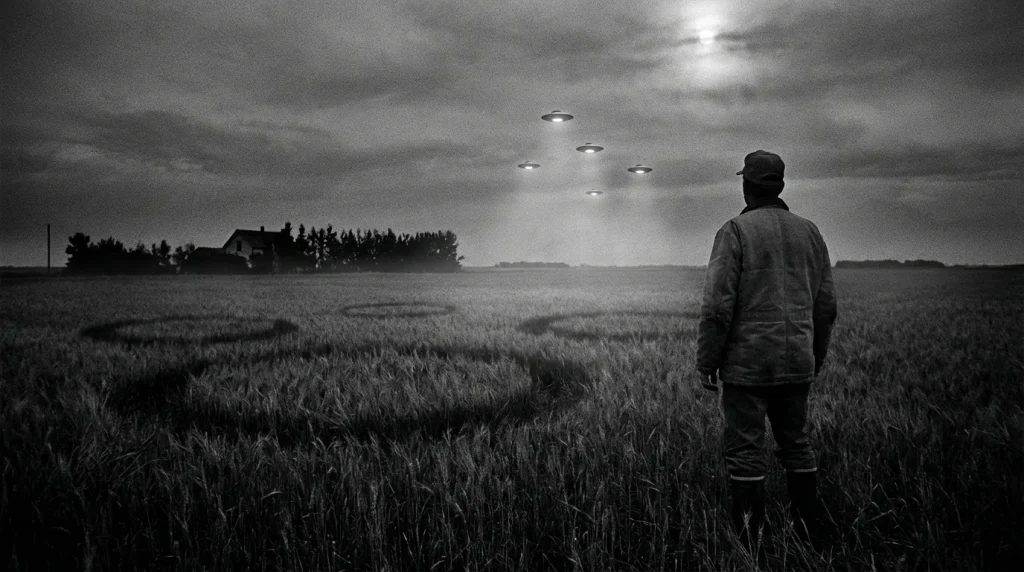
You keep seeing “UFO sightings 2025/2026” headlines and disclosure chatter, then you stumble into older rural cases where the details do not line up and the paper trail is thin. The frustration is real: the story sounds vivid, but the documentation feels like it belongs to somebody else’s memory.
With the Langenburg “saucer nests” report, you have the same choice every reader faces: treat it as folklore and move on, or slow down and evaluate it like a dated claim with checkable parts. Belief and dismissal are both easy; disciplined reading is harder.
The reason this case still gets cited is specific. It is framed as a pre-internet, working-farm observation involving farmer Edwin Fuhr near Langenburg, Saskatchewan, reported in RCMP and press accounts, paired with alleged ground changes in a crop field. That combination, a named witness doing routine agricultural work plus physical traces on the land, is exactly what keeps it in circulation long after flashier stories burn out. See contemporary and retrospective coverage for this case and its documentation trail: CBC (retrospective coverage) Cbc and the Leader-Post feature on the farmer and the Mountie who investigated Leaderpost.
To be explicit about the evidence base: the sources reviewed for this article include secondary case catalogs and local history summaries, contemporary and retrospective press coverage and feature articles, government report compilations released to the public, and archival finding aids and compilations hosted in digital repositories. Representative items reviewed for sourcing here include a Canadian-U.S. compiled report archived at the University of North Texas Digital Library Digital Library Unt, the CBC retrospective on the Langenburg event Cbc, and a local history summary that aggregates case details Langenburg. Where primary investigator notes, RCMP case files, or contemporaneous negatives were cited by later summaries, those underlying items were actively sought but not located in full in the public archives accessed for this article (see Sources / Documentation status below).
The key nuance is the work context. Earliest available sourcing places the incident on September 1, 1974, and frames it as occurring in the morning while Fuhr was swathing his canola field Leaderpost and is summarized in several case listings and retrospective articles Langenburg and the CBC retrospective Cbc. Swathing, a harvesting step where crops are cut and laid in rows (swaths) to dry before collection, puts a farmer close to the crop, moving methodically, and primed to notice fresh flattening, disturbed soil, or changes that do not match yesterday’s field conditions.
The friction is that retellings are messy, and even the basic framing slides around. Some versions casually talk about “night” despite early framing that points to a morning farmwork setting, and the farther a summary gets from its first publication, the more it tends to sand down times, wording, and who documented what. This is a predictable failure mode when primary materials are incomplete or not all underlying investigative notes are available, so the responsible approach is simple: anchor to the earliest available sourcing, then label any uncertainty instead of laundering it into a cleaner narrative.
What follows is a grounded walkthrough of what was reported, what was found in the field, and how to think about it now as a specific claim about who, when, where, and what changed, not as a viral “crop circle” story.
Case file and location context
Langenburg 1974 reads like a classic Canadian trace report because it ties a named farmer, an agricultural work setting, and alleged circular ground effects into one package. The location, however, has to be handled conservatively. The material commonly circulated in UFO case summaries places the event near Langenburg, Saskatchewan, on farm land associated with Edwin Fuhr, but I did not surface a precise legal land description or coordinates from a primary source in-hand. “Near Langenburg” is the accurate level of specificity available here. See local summaries and retrospective reporting for the basic location framing Langenburg and the CBC retrospective Cbc.
That imprecision matters because rural sites are exactly where physical traces can persist long enough to be photographed, inspected, or measured by others. Agricultural ground also creates a built-in control surface: crops, stubble, and soil conditions make disturbances easier to notice than they would be in pavement-heavy settings. The tradeoff is that without a defensible land description, later retellings are harder to audit against maps, ownership records, and contemporaneous reporting.
Mid-20th-century Canadian reporting used “saucer nest” (a reported circular impression or flattened area in vegetation historically discussed in UFO reports as a possible landing trace) to frame ground marks as physical aftermath, not as performance art. In that period usage, the term pointed to a claimed contact effect in a field, swamp, or cane stand, usually discussed alongside witness testimony or local investigation notes.
The model case that popularized the phrase was the Tully “saucer nest” case: it is widely described as heralding the start of the worldwide modern crop circle phenomenon, and it involved circular formations in swamp reeds and sugar cane. Contemporary accounts link UFOs being seen near the formations, which is why “saucer nest” became shorthand in Canadian UFO literature for “circular trace plus aerial report,” rather than the later pop-culture idea of intricate, symbolic crop-circle artwork. For background on the Tully incident and its influence, see ABC coverage of the historical case Abc Net.
- Named witness: Edwin Fuhr, a farmer associated with the Langenburg-area report.
- Setting: An agricultural work context on rural farmland near Langenburg, Saskatchewan.
- Core allegation: Multiple objects are commonly reported in summaries, along with circular impressions or circular ground effects in a field.
- Documentation often claimed in retellings: RCMP and press documentation are frequently mentioned, but those materials are not confirmed in the sources reviewed for this article to the level of original investigator notes or a full RCMP file in public holdings.
Known (supported by consistent case framing): The Langenburg report is tied to Edwin Fuhr and is commonly summarized as involving multiple objects and circular impressions in a field, with RCMP and press documentation mentioned in retellings. See the compiled DOD/Canadian report and later summaries for the consistent framing Digital Library Unt and the CBC retrospective Cbc.
Reported (present in secondary summaries, not verified here): The specific count and arrangement of the impressions, the exact number of objects observed, and the degree of official involvement beyond being “mentioned” in later accounts. Many summaries attribute five objects to Fuhr; see a government compilation and local summaries that record the “five” count Digital Library Unt and Langenburg.
Unknown (cannot be responsibly asserted from the material in-hand): A precise legal land description, coordinates, or a mapped reference point that would let a reader independently locate the site beyond “near Langenburg, Saskatchewan.” Treat this as a case file with hard boundaries: separate what is known, what is reported, and what remains unknown, and do not let the vocabulary of “saucer nests” do the evidentiary work.
Those boundaries set the stage for the next question: what, exactly, did Fuhr claim to observe in the sky at the time the field changes were attributed to the event?
What the farmer said he saw
The ground traces are what get photographed and argued over. The witness narrative matters for a different reason: it does not “prove” anything, it supplies descriptors you can test later against both mundane and extraordinary explanations. Lock onto what can be checked, the number of objects, apparent shape and light, motion, any sound or explicit silence, and how close the witness believed the activity was to the field.
The earliest framing in the sources reviewed for this article puts Edwin Fuhr outside, working, and looking up from the job in progress: he was swathing canola when something in the sky pulled his attention away from the header and up toward the horizon. That context matters because it anchors the report in a routine, task-focused moment, not a staged watch or a social retelling. It also constrains what he plausibly noticed first: broad visual cues like brightness, position, and movement, not fine detail. See Leader-Post coverage and the compiled report summary for context on the work setting and date Leaderpost and Digital Library Unt.
The identification of Fuhr as the named witness and the general date framing (September 1974) appears in secondary listings and retrospective reporting, which is enough to treat “Fuhr, September 1974” as the baseline reference point while still demanding better primary sourcing for the details that follow.
Most retellings converge on a simple, testable count: five objects. The same summaries commonly describe at least one as a glowing, disc-shaped object that appeared to hover. Treat those phrases as reported descriptors, not conclusions. See the compiled report and later summaries noting five objects Digital Library Unt and the local aggregation Langenburg.
The friction here is that retellings tend to compress the description into a slogan, “five hovering discs,” and then let the slogan do the evidentiary work. Do the opposite. Separate the elements: how many, what apparent shape, what apparent luminosity, and whether the account actually says “hovered” versus “moved slowly” or “held position.” The more you keep those elements unblended, the more the narrative stays testable.
Read the motion claims as a sequence, not a snapshot. The common narrative arc is: Fuhr notices objects aloft, they hold position long enough to be counted, then they depart. That is the part of a single-witness timeline that usually holds up best, because sequence is easier to remember than measurements. Distance and altitude estimates, by contrast, are where memory and inference creep in fast, especially over open farmland with few reference points.
What is notably thin in the sources reviewed for this article is sensory detail beyond the visual. Many UFO/UAP (unidentified report) stories include explicit sound or explicit silence; here, the retellings available to these sources do not provide a consistent, quotable sound claim. Log that absence as data. If a later source suddenly introduces loud noise, engine notes, heat shimmer, or other “extra” cues, treat it as a potential embellishment unless it can be traced to an early, direct statement.
This body of sources contains a discrepancy that should not be papered over because it directly affects interpretability: the earliest-source note frames the observation as a morning sighting during farm work, specifically while swathing canola, while other retellings describe night conditions. Those are not cosmetic differences. “Morning during swathing” implies daylight tasks, different visibility conditions, and a work-driven attention pattern. “Night” implies a darkness-based contrast effect where brightness and shape are easier to misread.
The only honest reconciliation attempt, given what is in hand, is narrow: one of the framings is wrong, or two separate moments have been conflated into one story, or later retellings substituted “night” because the field change reads like an overnight event. The sources reviewed for this article do not contain a primary, time-stamped, verbatim statement that resolves which. Until that document surfaces, treat “morning vs night” as an evidentiary fault line and avoid building certainty on either lighting condition.
Corroboration is unclear in the sources reviewed. No confirmed additional named witnesses surfaced in the materials accessed here, and no primary document in the reviewed set supplies a clean list of who else was present, who else saw the objects, or who was interviewed. As a result, the responsible posture is to handle the sky report as a single-witness narrative with a later reputation, not as a multi-witness event.
It is also true, as a matter of records practice, that witness identities and investigator materials are not always fully released. Those realities explain why a “missing witness list” is not proof that no one else existed, but they do not create corroboration. The actionable takeaway is simple: trust the sequence and direct descriptors that appear early and consistently (count, shape, light, basic motion), and treat timing, distance, and late-added “details” as provisional until you can tie them to an early, direct statement.
Once you isolate the witness claims that are actually in the record, the next step is to ask what kind of field evidence and documentation would be required to support or undercut each competing explanation.
Investigation and competing explanations
A case like Langenburg is not a fight between “belief” and “disbelief.” It is a fit-check between competing explanations and the record you actually have. The record here is strong enough to justify scrutiny, but thin enough that several alternatives remain live because the documentation needed to eliminate them is incomplete in the materials reviewed for this article.
That framing matches the only disciplined way to handle physical-trace reports. The All-domain Anomaly Resolution Office’s public posture is methodological, not rhetorical: many UAP cases resolve to mundane causes once timelines, observations, and supporting data are pinned down. For official statements and historical reporting from AARO, see the AARO historical record report (Volume 1, 2024) Department of Defense and the unclassified FY23 Consolidated Annual Report on UAP (Oct 25, 2023) that records case totals and resolution categories Aaro. That does not mean any specific case is mundane, and it does not mean AARO assessed Langenburg. It means your baseline assumption should be: ordinary mechanisms can mimic “high strangeness” until the timeline, measurements, and chain of custody are nailed down.
On a trace case, the key question is not “what do I prefer,” it is “what would this hypothesis have to match.” The fit-check hinges on a small set of constraints that any explanation must satisfy: timing (when the marks appeared versus when they were discovered), multiplicity (why more than one circular effect), geometry (symmetry, spacing, edge sharpness), and witness proximity (what was observed at what distance, for how long, under what lighting).
Agricultural machinery patterns. Turning arcs, overlaps, and repeated passes can produce circles, partial circles, and paired curves, especially where operators loop at field edges or around obstacles. The friction is that machinery typically leaves additional signatures beyond crop flattening: tire ruts, directional stem lay consistent with travel, and a pattern that “makes sense” as a path. The decisive check is granular documentation: mapped measurements of each circle’s diameter and spacing, close photos of stem lay direction, and a search for tire impressions at consistent track widths.
Wind flattening and microbursts. Gusts can lodge crops in circular or semi-circular swirls, and localized downdrafts can make “clean-looking” patches from a distance. The catch is multiplicity: producing several discrete circles with similar geometry in one area is harder to reconcile with a single chaotic gust without a documented storm footprint. The fit-check is meteorological: radar archives, local station data, and neighbor reports for the relevant hours, plus stem-lay analysis that should show a coherent vortex direction if wind-driven.
Animal bedding or congregation. Wildlife can flatten vegetation into beds and resting areas. The friction is scale and edge definition: bedding areas tend to be irregular, with scat, hair, tracks, and entry paths. If the Langenburg marks present as notably symmetric and repeated, an animal-only explanation has to account for why multiple near-circular patches formed with similar boundaries. The practical test is unglamorous: ground-level photography, track casting (if impressions exist), and a search for biological indicators documented immediately, not recollected later.
Fungal “fairy rings” and plant pathology. Some fungi create ring-shaped growth effects, including greener bands or altered yield. The catch is that fungal rings are primarily growth and vigor patterns over time, not sudden, time-specific flattening tied to one night. If the reported circles were discovered as fresh mechanical lodging, fungal explanations only fit if the “ring” is actually a longer-term vegetation change misread as a discrete event. The way to sort this is sampling with lab methods that are written down: where samples were taken, how they were stored, what assays were run, and what controls were used.
Hoaxing or deliberate flattening. People can create circles with boards, ropes, or vehicles. The friction is effort and risk: multiple marks raise the labor cost and increase the chance of footprints, tool marks, and inconsistent geometry. The fit-check is forensic: shoe impressions, entry routes, and whether the geometry repeats in a way that indicates measurement tools rather than an “event.” Hoaxing stays on the table only until the site documentation is good enough to rule it out.
Misidentified aircraft. Night aircraft can look stationary or “hovering” when flying toward the observer, and multiple lights can read as multiple objects at unknown distance. The constraint is timing and direction: an aircraft explanation must line up with the reported sequence, bearings, and any sound delay (or lack of it) given wind conditions. The necessary check is an aviation reconstruction for Sept 1, 1974 near Langenburg using flight records where available, local airport operations, and any preserved logs.
Astronomical sources. Bright planets, stars near the horizon, and meteors can drive misperception, especially with fatigue and poor reference points. The sources reviewed for this article do not include a completed astronomy cross-check for Sept 1, 1974 near Langenburg (planet positions, meteor activity, satellite passes). Until that is done, “bright object in the sky” categories cannot be responsibly eliminated.
Aurora and other atmospheric lights. Aurora can produce structured, shifting light that witnesses describe as luminous objects, and atmospheric conditions can distort apparent motion and size. This is not a conclusion, it is a category that must be tested against geomagnetic indices and regional aurora reports for the night in question, then compared to the witness description’s timing and motion cues.
The documentation constraints identified earlier show up here as well: records can exist without the underlying notes, drafts, measurement sheets, and lab worksheets that would let you reconstruct how conclusions were reached. When those materials are missing or withheld, the hypothesis space stays wide because you cannot reliably tie timing, geometry, and handling history to a dated, checkable record.
What is missing in the sources reviewed for this article is the kind of closure documentation that collapses the hypothesis space: an instrumented weather and aviation reconstruction for the relevant hours, lab methods and chain of custody for any samples, and a complete photo set with scale, compass orientation, and contemporaneous notes.
- Reconstruct the night’s sky and traffic: planet positions, satellite passes, aurora indices, and aviation activity for Sept 1, 1974 near Langenburg (explicitly absent from the sources reviewed for this article).
- Recover primary documentation: original investigator notes, draft sketches, measurement sheets, negatives or slides, and any lab worksheets, then log what is missing and why.
- Standardize the trace record: site map with coordinates, diameters, spacing, orientation, and stem-lay direction, plus photo metadata (time, lens, distance, scale).
- Cross-check independent sources: local weather archives, nearby station logs, and contemporaneous press or authority records, prioritized by time-stamped entries over recollections.
- Document provenance: who handled samples, where they were stored, and what methods were used, because without chain of custody and lab methods, multiple explanations remain plausible by default.
That gap between what a trace case needs and what the sources reviewed for this article contain is also why older reports get pulled into modern disclosure arguments: they sit right at the boundary between a vivid narrative and an incomplete file. For the Langenburg case specifically, contemporary reporting and later summaries point to RCMP involvement in initial inquiries and an investigating Mountie who took the report seriously; for a journalist feature on the farmer and the Mountie, see the Leader-Post piece Leaderpost and the CBC retrospective Cbc. Public releases of compilations of Canadian government UFO reports are available in document collections released online Documentcloud.
Why a 1974 case matters now
Legacy trace stories like Langenburg keep resurfacing because today’s disclosure debate is not driven only by dramatic testimony. It is driven by a tougher question: did any reported event leave checkable traces, and can institutions record those traces consistently enough that investigators can compare cases instead of trading anecdotes.
Modern “UFO news” and “UAP news” amplifies old narratives, but amplification is not validation; the productive link is methodological. “UAP” is the current umbrella term governments use to capture anything anomalous in the air, sea, or space without pre-judging what it is, which makes classification and follow-up the actual battleground. “AARO” is the Defense Department office tasked with taking in UAP reports, analyzing them, and publishing public updates. For official AARO reporting and context see the AARO homepage and its UAP cases page Aaro and Aaro, and see the AARO Historical Record Report (Volume 1, 2024) Department of Defense and the FY23 Consolidated Annual Report on UAP (Oct 25, 2023) for totals and resolution categories Aaro.
High-profile disclosure coverage changes attention and oversight, not the truth status of any 1970s case. David Grusch, a former U.S. Air Force intelligence officer who served with the Pentagon’s UAP Task Force, testified under oath alleging retrieved craft and “non-human” biological remains; those are sworn claims, not independently established findings. For the House Oversight hearing materials and transcript, see the Committee hearing page and published transcript U.S. House and the official transcript on Congress.gov Congress.gov. Use those touchpoints as context for how allegations enter official channels and how uncertainty gets communicated, not as retroactive proof that older trace reports were caused by something exotic.
What to take from Langenburg
Langenburg’s enduring value is evidentiary, not mythical: one named witness, a specific 1974 date, and alleged ground effects, paired with documentation gaps that prevent closure. Its strongest elements are the multi-object report and the ground marks treated as trace evidence rather than pure storytelling; its weakest are the morning-versus-night timing discrepancy and the lack of instrumented measurements that would lock down dimensions, compaction, and radiological or chemical baselines.
That is why the most responsible way to hold the story is the approach laid out at the start: anchor to the earliest available sourcing, keep “known / reported / unknown” separate, and treat the timing fault line as a real limitation rather than something to smooth over in retelling.
Preserve the case by doing four things immediately: take time-stamped photos from multiple angles with a ruler or known object for scale, record measurements and a simple site sketch before anyone walks the area, separate witnesses and capture independent statements verbatim, and keep a single, dated log of every action, file, and handoff. MUFON-style guidance also stresses chain of custody, a written record of who collected, stored, transported, and accessed each item and when, because handling history is what makes physical material credible, and it cautions against impulsively sending evidence to an organization without clear intake instructions.
For archival leads, start with public compilations and archived reports such as the UNT-hosted compiled report Digital Library Unt, public media retrospectives like the CBC piece Cbc, and local aggregations of case history Langenburg. Careful casework and transparent documentation are how the next Langenburg becomes testable instead of perpetually arguable.
Sources / Documentation status
- Primary documents confirmed located: A compiled 1976-era report held in a public digital repository that summarizes Canadian case reports and includes the Langenburg entry Digital Library Unt; public media retrospectives and local case aggregations that summarize the event are available (CBC retrospective Cbc, local aggregation Langenburg), and a journalist feature discusses the farmer and the Mountie who investigated Leaderpost.
- Documents and materials only referenced by later summaries: RCMP investigator notes, the original signed witness statement by Edwin Fuhr, contemporaneous color slides or negatives of the field marks, and any lab worksheets for samples are cited in retrospective and compiled accounts but not located in full in the public files reviewed here. See public compilations of Canadian releases Documentcloud and retrospective reporting Cbc.
- What was sought but not found in public holdings accessed: an RCMP case file with investigator notes and file identifier (href=”[URL NOT FOUND]”), the original signed witness statement by Edwin Fuhr (href=”[URL NOT FOUND]”), contemporaneous photographic negatives or slides with metadata (href=”[URL NOT FOUND]”), and any lab chain-of-custody records for physical samples (href=”[URL NOT FOUND]”). Researchers seeking those items should pursue RCMP access pathways and provincial archives finding aids; see the public compilations and archival finding aids referenced above for starting points.
Frequently Asked Questions
-
What are the “Langenburg saucer nests” from 1974?
They refer to a 1974 report near Langenburg, Saskatchewan, tied to farmer Edwin Fuhr and alleged circular ground effects (“saucer nests”) in a field. The story is commonly summarized as a UFO sighting paired with physical traces on farmland.
-
Who was the witness in the Langenburg 1974 UFO case?
The named witness is Edwin Fuhr, a farmer associated with the Langenburg-area report. The case is repeatedly framed as a working-farm observation rather than a staged viewing.
-
When did the Langenburg saucer nests incident happen, and why is the time disputed?
The earliest available sourcing in the article places it on September 1, 1974, during the morning while Fuhr was swathing canola. Later retellings sometimes shift it to “night,” which the article flags as a major unresolved discrepancy.
-
How many UFOs did Edwin Fuhr report seeing near Langenburg in 1974?
Most retellings converge on five objects. Summaries commonly describe at least one as glowing and disc-shaped and claim the objects hovered before departing.
-
Where exactly were the Langenburg crop circles/saucer nests found?
The location is only supported to the level of “near Langenburg, Saskatchewan,” on farmland associated with Edwin Fuhr. The article states it did not surface a precise legal land description or coordinates from a primary source.
-
What measurements and documentation would investigators need to evaluate the Langenburg field marks?
The article says a proper trace record would include a site map with coordinates, diameters, spacing, orientation, and stem-lay direction, plus photos with scale and metadata. It also calls for chain-of-custody documentation for any samples and recovery of original notes, sketches, negatives/slides, and lab worksheets.
-
If you find fresh crop circles today, what should you do to document them properly?
Take time-stamped photos from multiple angles with a ruler or known object for scale, and record measurements and a site sketch before the area is walked. Separate witnesses to capture independent verbatim statements and keep a single dated log tracking every action, file, and handoff for chain of custody.
