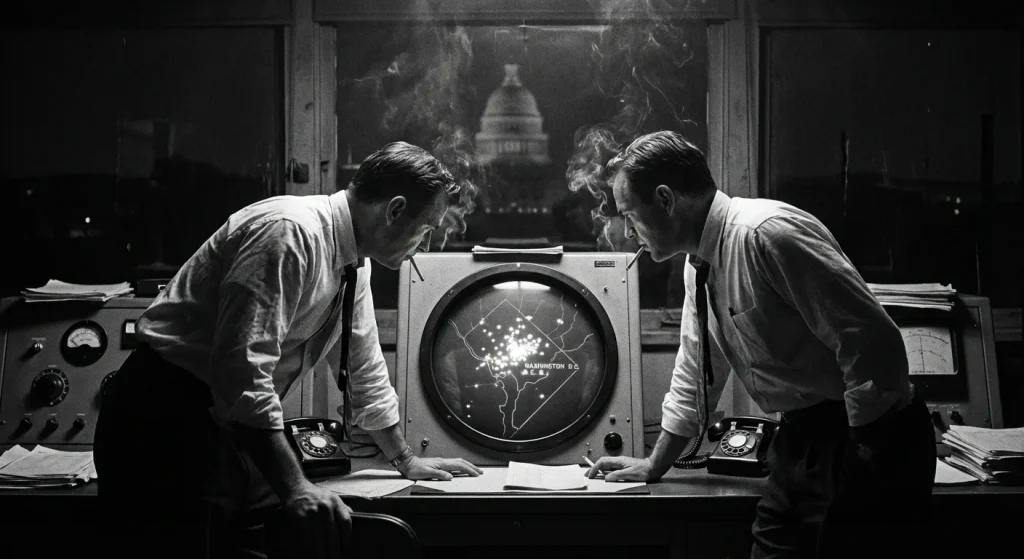
Washington, D.C., is winding down on the night of July 19-20, 1952, when the city’s air picture stops behaving like routine traffic control. A few minutes before midnight on July 19, 1952, controllers at Washington National Airport notice unusual radar returns and start doing what professionals do when something does not fit the expected pattern: verify, cross-check, and escalate. Reports in the Washington area that month put air-defense, aviation, and the press into the same frame fast, which is why “1952” keeps resurfacing whenever UFO disclosure or UAP disclosure hits the headlines.
If you have read enough UFO news and UAP news, you already know the frustration: the story is drowned in confident hot takes about a “government UFO cover-up,” while the underlying documentation is uneven and often secondhand. The result is a case everyone cites and few people can describe cleanly without drifting into interpretation.
The Washington incident is still the template because it sits on a hard boundary line: ambiguous sensor reports with immediate real-world consequences. Radar indications around the capital triggered urgent attention, including rapid coordination between civilian controllers and military tracking in the same airspace, with Andrews Air Force Base radar also involved in tracking during the first night. At the same time, the public impact was outsized, with the Washington-area report series commonly placed within roughly July 12-29, 1952, and two highly publicized weekends that locked the episode into national memory. That mix creates three durable readings of the same events: a national-security radar mystery, a media-fueled panic cycle, or evidence of something beyond known aircraft, all competing inside an incomplete record.
This article aims to leave the reader with a fact-checked, evidence-tiered understanding of what happened that July night and why it still shapes today’s disclosure debate. The place to start is the timeline-because most later arguments, pro and con, turn on how the two key weekends are stitched together.
What Happened Across Two Weekends
The Washington flap is best understood as two high-profile weekends inside a wider July cluster. The cluster matters because the story is built from multiple reporting channels that do not always line up: controllers described unusual tracks on airport scopes, some observers reported lights with their eyes, and air-defense units treated enough of it as real-time traffic to launch interception attempts. Later retellings often compress those strands into a single, overly clean narrative that the contemporaneous record does not support.
Archival summaries and many historical overviews place the Washington-area series in a roughly July 12-29, 1952 window, rather than treating the flap as one isolated night.
That framing tracks with how the underlying paper trail is organized: official U.S. Air Force UFO materials and related records exist as compilations held in federal custody, including holdings referenced by the National Archives (archives.gov/research/military/air-force/ufos), and they collect multiple reports and investigative notes across days.
Practically, treating July 12-29 as a cluster prevents a common reading error: assuming every later headline detail must trace back to the first dramatic night. The contemporaneous documentation is a braid. Airport controllers and military watch officers recorded what they were seeing and doing. Separately, civilian and aviation witnesses reported what they believed they saw from the ground or cockpit. Those streams sometimes corroborate each other, and sometimes they run in parallel without a clean join.
The two most publicized nights of the Washington flap were July 19-20 and July 26-27, 1952.
Accounts anchored to Washington National Airport place the first major night’s radar activity beginning shortly before midnight, when controllers reported multiple unknown returns on airport radar.
From there, the reports fall into three contemporaneous categories that get blended in later summaries: (1) what Washington National Airport personnel said they observed on their equipment, (2) what people said they saw visually in the same general hours, and (3) what communications and operational reactions followed when the air-defense system treated the situation as potentially actionable.
On the visual side, at least one report commonly cited in connection with the first weekend is from an airline pilot who described seeing objects while waiting for authorization to take off, around 3 a.m. That kind of account is time-anchored but not automatically coextensive with the controller observations; it is one witness perspective inside a wider night of activity.
The friction is that “same night” does not equal “same event.” A controller can be describing unusual tracks within a defined patch of airspace while a pilot describes lights from a different vantage point, at a different moment, under different viewing conditions. The disciplined way to read weekend one is to keep those channels distinct: radar observations at Washington National Airport as one documented stream, visual reports as another stream, and the coordination between civil and military agencies as a third stream that indicates seriousness but does not, by itself, validate any single interpretation.
Contemporary reporting and many later accounts also describe U.S. Air Force jets being launched in response and failing to make a decisive interception. The reliable, document-grounded takeaway is narrow: interception attempts were part of the reaction story, and the outcome in many summaries is “no confirmed capture,” not a clean, logged aerial encounter with an identified target.
Weekend second, July 26-27, 1952, mattered because it was a recurrence within the same July cluster, not a one-off that could be written off as an isolated scare.
Chronology is the key point here. The second weekend is consistently treated in archival descriptions and responsible histories as the “return” because it re-ignited public and official attention: reports again centered on what was being tracked and reported in the Washington area, and the response posture again included an air-defense dimension. In timeline terms, July 26-27 is not “more of the same” as a narrative flourish; it is the reason the month is remembered as a wave rather than a single night.
The nuance is that recurrence increases pressure on everyone involved. Controllers are aware of prior incidents and public scrutiny. Military units are aware that their actions will be examined. Witnesses are primed by news and rumor. That does not invalidate the reports, but it does change the informational environment in which reports get made and later retold. When you see a claim about what happened on weekend two, the first question is whether it is tied to an identifiable contemporaneous log, message, or report, or whether it is a retrospective reconstruction stitched together from headlines.
This is also where the “interceptors were scrambled again” line becomes a timeline hinge. It is widely repeated because it is simple, dramatic, and operationally legible. It still needs to be read with the same restraint as weekend one: a scramble indicates a real response to perceived unknowns, but it does not automatically establish what those unknowns were.
Documented claims (best supported by contemporaneous records): Treat as strongest when they are anchored to controller reporting and official investigative files. At the broad level, the flap is consistently treated as a late-July cluster, with the two most publicized nights on July 19-20 and July 26-27. On weekend one, accounts tied to Washington National Airport place multiple unknown radar returns appearing shortly before midnight. Interception attempts are part of the response narrative, and many summaries converge on the limited outcome: aircraft were launched, but there is no single, universally documented “got one” conclusion.
Widely repeated claims (common in secondary summaries, unevenly sourced): Many retellings compress both weekends into a single continuous “battle,” or imply that every visual report cleanly matched a radar track. Unless a specific claim is tied to a dated log, a contemporaneous report, or a clearly cited Project Blue Book case files entry, treat it as a repetition of the public story rather than an extract from the record.
Claims not verifiable in the currently accessible documentation: Some later commentary includes hard-sounding physical specifics, such as a calculation that certain UFOs were nearly 50 feet in diameter attributed to Wilkins in a CIA reading-room document. That is a documented piece of later paper, but it is not the same thing as a contemporaneous measurement recorded by the controllers on the nights in question. In a strict timeline, it belongs in the “later analytical or journalistic layer,” not in the core midnight-to-dawn operational backbone.
Reader takeaway: Treat any 1952 timeline claim as a source-checking exercise. Prefer contemporaneous records (controller logs, official investigative files, dated communications) over reconstructed narratives. Separate radar reports, visual reports, and interception actions into parallel lanes, then look for explicit time anchors and named reporters. If a detail is vivid but floats free of who recorded it and when, it is almost always later narrative, not backbone chronology.
Radar, F-94s, and False Targets
The two-weekend structure explains why the episode became famous; the harder question is what the radar and intercept attempts can actually support. Once you separate the reporting lanes, the center of gravity shifts to a technical problem: how convincing radar tracks can form, and why fighters can be vectored toward “targets” that never resolve into confirmed aircraft.
1952-style radar intercepts can generate convincing tracks without delivering confirmable objects. A “radar return” is an operational cue, not a photographed aircraft: it is the spot or blip the controller treats as a target because the radar energy came back strong enough, often consistently enough, to plot position and motion. On paper that becomes a clean sequence of fixes that looks like performance. In practice, the return is only as trustworthy as the propagation conditions, the set’s filtering and display logic, and the operator’s ability to separate real targets from clutter while working fast.
The friction is that radar imposes a geometry that feels objective: bearing, range, sometimes an inferred track. But 1950s controllers and aircrews were still working with speed and altitude uncertainty, limited target identity tools, and procedures built around best-available plots rather than high-confidence object classification. That gap between “plot looks real” and “object is verified” is where a single episode can read as extraordinary or routine.
“Anomalous propagation (AP)” is the radar problem that makes false targets look most like true ones, because it bends or ducts the beam so ground returns, distant coastlines, or weather-related reflections arrive as if they were airborne objects. The reason AP can be so persuasive is persistence: when the refractive structure is stable, the scope can show clusters of returns that hold position, drift slowly, or march along in ways that resemble tracks, especially near the edges of coverage where geometry and clutter are already messy.
The non-obvious part is that AP does not require incompetence to fool people. A controller can do everything “right” and still build a coherent picture from coherent-looking returns. If multiple scopes share the same propagation environment, several stations can see similarly placed false targets, creating apparent corroboration that is real at the sensor level while still being misleading about airborne craft. Within the available record, any claim that AP was present over Washington in July 1952 remains a hypothesis, because the specific meteorological context required to confirm inversion-driven ducting is not provided in the currently accessible documentation.
“Vectoring” is the intercept practice where ground control issues headings, altitudes, and timing to place a fighter where the target should be, and that workflow can fail even when everyone is acting competently. At night, the pilot’s visual acquisition window is narrow, closing speed is easy to misjudge, and even a small error in the target’s true altitude or speed turns a “painted” target into empty sky when the fighter arrives at the predicted intercept point.
The Lockheed F-94 Starfire has been described in authoritative USAF museum fact sheets as among the first operational jet-powered all-weather interceptors for the USAF, and that label matters for both sides of the argument (nationalmuseum.af.mil fact sheet). It guarantees a real capability: getting a radar-equipped jet airborne in weather and darkness to chase radar-directed intercepts. It does not guarantee that a ground radar track corresponds to a physical aircraft, that the target’s altitude is known with precision, or that communications and timing friction will not break the intercept. In a 1952 command-and-control stack, voice radios, manual plotting, and imperfect altitude solutions can turn a legitimate intercept attempt into a missed merge without implying anything exotic about the “target.”
The available record leaves three hard gaps that keep the 1952 radar picture ambiguous. First, no Washington, D.C. hourly surface or upper-air meteorological data are provided here, and there are no explicit anomalous propagation reports included, so inversion or AP claims cannot be confirmed from the currently accessible documentation. Second, the provided excerpts do not include verified technical specifications for the specific Washington National or Andrews radar sets, so scope-level certainty about range resolution, clutter suppression, antenna behavior, or known failure modes must be framed cautiously. Third, without those two inputs together, any precise explanation that depends on exact beam behavior at a particular hour is not a settled conclusion in the available record; it is a testable hypothesis.
- Demand multi-sensor corroboration: independent radar plus visual, or radar plus another radar with clearly separate error sources.
- Check the meteorological context: hourly surface and upper-air data, plus any contemporaneous AP/inversion advisories.
- Identify the exact radar set specs: frequency band, display type, filtering, and documented clutter and AP susceptibility.
- Weight pilot visuals realistically: distance, lighting, closure rate, and whether the intercept geometry actually allowed a merge.
The Press Conference That Set the Tone
Those technical uncertainties did not stay inside radar rooms and command posts. Once the episode became a national story, ambiguity itself turned into the central political and cultural fact-and that is where the press conference era begins.
The enduring controversy around the 1952 Washington events, widely referred to as the “Washington flap” and the “Washington National Airport sightings,” is largely a narrative artifact created by the collision of uncertainty and publicity. It was not just an incident; it was a messaging blueprint. Once ambiguous observations entered a national news cycle hungry for a simple story, every later official explanation was judged less like an evidence update and more like a trust test, the exact setup that modern “government UFO cover-up” narratives still rely on.
The public did not first encounter the episode as a technical dispute about incomplete data; they encountered it as a named object. Contemporary wire coverage used “flying saucers” language early on: an Associated Press dispatch ran under headlines such as “Objects Fitting Description of Flying Saucers Spotted by Radar, Pilots in Washington Area” (Jack Rutledge, AP), and major outlets including The New York Times and The Washington Post covered the events with similar sensational phrasing (sacred-texts.com reproduction of AP wire text, nytimes.com, washingtonpost.com).
That frame collapses a messy evidentiary situation into a crisp, culturally loaded category: craft, intent, and mystery. Once “flying saucers” is the label, later statements that sound procedural or probabilistic land as evasions, even if they are simply the honest shape of the evidence. The headline becomes the public’s default fact pattern, and every subsequent update gets compared to that simplified template rather than to the original, ambiguous record.
The Air Force had two incentives that any national-security organization would prioritize in a high-visibility moment: keep the public calm and protect the credibility of air-defense readiness. Public panic is a real operational risk, but so is the perception that protected airspace is routinely penetrated without control. In that incentive structure, the communications goal is reassurance and order, not satisfying open-ended curiosity.
This is the key analytical distinction: crisis communications are designed to explain away, meaning to reduce fear and reduce the probability of social disruption, without necessarily resolving the underlying evidentiary ambiguity. “We have a non-threatening explanation” functions as a stabilizer, even when the data cannot fully close every question a captivated audience now demands answered.
Project Blue Book, run by the U.S. Air Force, investigated thousands of UFO reports in the early 1950s. That institutional fact mattered as much as any single conclusion, because it trained the public to expect that if there’s a file, there must be an answer, and if there isn’t an answer, someone must be withholding it.
Blue Book’s public-facing posture turned open cases into a standing referendum on credibility: unresolved does not read as “insufficient evidence,” it reads as “unshared evidence.” That is how ambiguity becomes fuel for cover-up suspicion.
- Separate reassurance claims from evidentiary claims: “no threat” is not the same statement as “identified.”
- List what the statement explicitly rules out versus what it leaves untouched (intent, origin, persistence, repeatability).
- Ask what data is missing: raw sensor records, chain-of-custody details, and contemporaneous logs matter more than the confidence of the podium.
- Track whether the explanation closes the ambiguity or merely reduces anxiety. If it’s the latter, the controversy is narrative, not proof of a hidden truth.
Why 1952 Still Shapes UAP Disclosure
The same trust-versus-data dynamic that formed in 1952 is visible in today’s disclosure arguments, only with a more formal vocabulary. Modern disclosure debates keep returning to Washington because “unresolved” is now an official category, not just public speculation.
Today’s language, UAP (Unidentified Anomalous Phenomena), assumes the hard part is correlation across imperfect sources, not a single dramatic sighting. Modern reporting treats each incident as a data problem: radar tracks, pilot observations, electro-optical video, and other sensors that may not line up cleanly, or may not exist at all, especially in older records.
AARO (All-domain Anomaly Resolution Office) exists to centralize that workflow, but its public outputs also show the constraint: an office can standardize intake, triage, and historical review without being able to deliver definitive closure on every headline-grabbing case. AARO’s Historical Record Report Volume I (2024) is a signal of process, not a promise that the historical file will be “solved” in the way the public expects (AARO Historical Record Report: Volume I (DoD PDF)).
Modern DoD reporting has explicitly described some UAP cases as unresolved due to insufficient sensor data. That phrasing matters because it narrows the claim to a documentation gap, not an extraordinary conclusion. The complication is structural: institutions can receive reports, publish summaries, and still be left with cases where the best evidence is incomplete, classified, or not collected in the first place.
The scale makes the contrast with 1952 unavoidable. Pentagon and AARO-related reporting has said AARO has received or investigated more than 800 UAP reports, a volume that forces categorization rules and reinforces why “unresolved” persists as a bucket across decades.
Reader rule for 2025 and 2026 UAP headlines: treat “unresolved” as “insufficient data to close,” then ask what sensors exist, whether multiple sources corroborate, and whether the underlying data is available for independent scrutiny. If those answers are thin, the story is about evidence limits, not confirmed extraordinary origin.
Congress, Laws, and the Transparency Push
As “unresolved” becomes a standing category, the next pressure point is access: what can be released, what can be reviewed, and what can be compelled into an official record. That is why modern UAP debate routinely shifts from sightings to oversight mechanisms.
Congressional oversight is a pressure system for records, not a truth machine. It can increase the flow of documents, testimony, and audit trails into official channels, but it cannot manufacture evidence that was never captured or no longer exists. That limitation matters for legacy events like 1952: even a serious modern transparency push can still end with partial files, heavy redactions, and permanent gaps where logs, raw sensor data, or historical meteorological archives were never retained.
Mandatory Declassification Review (MDR) exists so the public can request declassification review of classified information, and Department of Defense components are required to process MDR requests for records that originated within DoD. That is leverage, because it forces a formal review decision instead of relying on voluntary releases or informal briefings.
The friction is structural. MDR is a review pipeline, not instant disclosure, and it operates inside the same classification regime designed to protect intelligence sources and methods, including radar and air defense capabilities. MDR and FOIA are distinct processes, and some security-classified records are exempt from automatic declassification and can remain controlled at installations or federal records centers. Even when review happens, the outcome is constrained by the reviewer’s legal authorities and the underlying classification basis, which is why “released” often means “released in part.”
MDR can also collide with special categories such as Restricted Data (RD), Formerly Restricted Data (FRD), or Transclassified Foreign Nuclear Information (TFNI), where separate rules apply to declassification challenges. The practical takeaway is simple: MDR can surface what exists and is releasable, but it cannot force missing 1952-era source material into existence.
Whistleblower pathways are built to move sensitive claims into accountable oversight, not to publish them. The Intelligence Community Inspector General (ICIG) provides protections for lawful whistleblowers making a protected disclosure, and the DoD Office of Inspector General (DoD OIG) publishes guidance for investigating military whistleblower reprisal or restriction complaints. Those mechanisms lower the personal risk of reporting, while preserving the security controls that keep classified details out of the open record.
That design creates a predictable public-facing outcome: you might see confirmation that a complaint was received, deemed credible, or referred, while the underlying evidence remains classified or compartmented. Protected disclosure can advance oversight, but it does not automatically yield public, independently checkable artifacts like unredacted logs, full sensor tapes, or complete technical evaluations.
Reported legislative efforts around UAP have included proposals to establish an “Unidentified Anomalous Phenomena Records” repository intended for eventual public access, with the explicit caveat that bill language and status can change. The logic is to centralize scattered records, standardize what agencies must search for, and create a governed path from classified holdings to public release.
A repository still inherits the limits of the underlying record. It can aggregate what agencies actually have, document provenance, and compel consistent review. It cannot fill holes where data was never recorded, was purged under legacy retention rules, or cannot be released without exposing sensitive capabilities.
- Prioritize primary documents over narratives: original memos, release letters, declassification decisions, and official report annexes with clear provenance.
- Check release notes and redaction logic: what authority was applied, what exemptions were cited, and whether the same document appears in multiple repositories with different cuts.
- Track oversight artifacts you can verify: IG notifications, committee correspondence, hearing transcripts, and dated directives that show durable process, not rumor velocity.
What We Can and Cannot Conclude
The Washington flap endures because the best-known facts are real, and the decisive data is incomplete. That is also why the episode still functions as a template case: it forces the same discipline the introduction promised-separating what is checkable from what is inferred.
The core scaffolding is checkable: the Air Force ran Project Blue Book, and Blue Book’s files were declassified after the project closed in 1969. That declassification boundary matters because it defines what is officially accessible versus what remains dependent on fragmentary holdings or later retellings. It also happened in a year that was already noisy with reports worldwide: 1952 produced prominent “flying saucer” claims internationally, including incidents reported in East Germany and Spain that appear in declassified intelligence archives (CIA FOIA: East Germany, CIA FOIA: Spain). The Washington incidents persist inside that broader 1952 surge because they sit in an air-defense context, were amplified by official messaging, and still rest on sensor-era ambiguity that invites competing readings.
No responsible synthesis can end in a single, definitive technical verdict here. The available record lacks two settling inputs: Washington D.C. meteorological archives for the relevant windows and verified specifications and configurations for the specific radar sets and their operating conditions. Without those, you cannot bound propagation conditions, performance limits, and failure modes tightly enough to move from plausible interpretation to proof. Given these research limitations in the currently accessible documentation (missing DC met data; missing verified radar-set specs), technical certainty must be stated probabilistically rather than conclusively.
The analysis would change materially with primary records that tie sensors, weather, and command decisions together in time: contemporaneous radar logs and track summaries (not just narrative summaries), archived meteorological observations and forecasts for the exact hours, unit histories and mission reports for the scrambled F-94s, and communications transcripts linking ATC, intercept controllers, and command posts. A short, targeted transparency push through existing mechanisms like FOIA or MDR can be useful, but only if it is aimed at these record types.
Treat any new claim about 1952 as credible progress only if it brings primary documentation, sensor context, and a documented chain of reporting. If the headline offers a conclusion without the underlying logs, weather data, and system specifics, it is narrative momentum, not resolution. AARO updates, press briefings, and viral “disclosure” threads are secondary; the confidence jump comes from dated, contemporaneous records you can audit.
Sources / Further reading
- AARO Historical Record Report: Volume I (2024) (Department of Defense PDF)
- National Archives: Air Force UFO records and research guidance
- National Archives: Unidentified Anomalous Phenomena (UAP) research topic
- Project Blue Book archival compilation (microfilm/pdf)
- Project Blue Book appendix and USAF summary materials (DocTeach)
- “Saucers over Washington”: National Archives history of Project Blue Book
- History.com: coverage and context for the 1952 Washington, D.C. sightings
- Contemporary New York Times coverage (July 1952)
Frequently Asked Questions
-
What was the 1952 Washington D.C. UFO wave (the “Washington flap”)?
It was a late-July 1952 cluster of unusual reports over the Washington area involving radar returns at Washington National Airport, some visual sightings, and air-defense reactions. The two most publicized nights were July 19-20 and July 26-27, 1952.
-
What dates were the main Washington National Airport UFO incidents in 1952?
The article identifies two key weekends: July 19-20 and July 26-27, 1952. It also notes many summaries treat the broader reporting window as roughly July 12-29, 1952.
-
What did Washington National Airport controllers report on July 19-20, 1952?
Accounts anchored to Washington National Airport place multiple unknown radar returns appearing shortly before midnight. The article emphasizes these radar observations are one documented reporting lane separate from visual reports and military response actions.
-
Were U.S. Air Force F-94 jets scrambled during the Washington D.C. 1952 incidents, and did they intercept anything?
Yes-contemporary reporting and later accounts describe Air Force jets being launched in response, including repeated “scrambles” across the two weekends. Many summaries converge on the limited outcome: aircraft were launched but there is no single, universally documented confirmed interception or “capture.”
-
What is anomalous propagation (AP), and how could it create false UFO radar targets in 1952?
AP is a radar effect where the beam bends or ducts so ground returns, distant coastlines, or weather-related reflections appear as airborne targets. The article says AP can produce persistent clusters of convincing returns, but also notes this packet does not include the meteorological data needed to confirm AP over Washington in July 1952.
-
What was the Lockheed F-94 Starfire’s role in the Washington D.C. 1952 events?
The article describes the F-94 Starfire as the first USAF jet-powered day/night all-weather interceptor, relevant because it could be launched at night and in weather for radar-directed intercepts. It also stresses that having an all-weather interceptor does not guarantee the ground radar track was a physical aircraft or that a night intercept would achieve visual identification.
-
What should you look for to judge whether a new claim about the 1952 Washington UFO wave is credible?
The article says to prioritize contemporaneous records such as controller logs, official investigative files, dated communications, and to keep radar reports, visual reports, and interception actions in separate lanes. It specifically recommends checking for multi-sensor corroboration, the exact meteorological context, and verified radar-set specifications before accepting strong conclusions.
