Most UAP stories collapse at the evidence step. They start with a dramatic sighting, then hit the same wall: no site documentation, no chain of custody, no measurements that an independent lab could even attempt to evaluate.
If you are scanning “UFO news” and “UAP disclosure” headlines, you are making a simple decision: treat the next viral case as credible disclosure material, or file it with the rest of the anecdotes. The fastest way to decide is to start where rumors usually end, at the physical record.
Trans-en-Provence, reported on January 8, 1981, still matters because it is source-led: investigators documented an alleged landing site, and scientific analyses were performed on physical traces under the oversight of CNES-affiliated investigators (GEPAN at the time). That puts it in a small category of UAP (unidentified aerial phenomena) cases where the discussion is forced onto evidence standards rather than assumptions about what the witness “must have seen.” See CNES/GEIPAN background and case files for institutional context and available dossier materials.
The same strength creates the real tension. Measurable anomalies can be real and repeatable without establishing what caused them. Physical traces do not automatically identify a craft, and they do not, by themselves, prove non-human intelligence, “alien disclosure,” or a government UFO cover-up. A disciplined read of this case has to hold both truths at once: documented effects on the ground, and no definitive attribution.
France is central to why this file exists in the first place. CNES created its UAP research and archiving unit in 1977, building a formal pathway for collecting reports, documenting sites, and preserving case files for analysis. Today that CNES-affiliated unit is known as GEIPAN; the program history and rationale for using the term UAP rather than “UFO” are described on CNES/GEIPAN pages that explain mission and methods.
You will leave this record with a clean method you can reuse: separate (1) what was reported, (2) what was documented on-site, (3) what labs reported, and (4) what none of the evidence establishes. That structure is what the sections below follow – starting with what can and cannot be responsibly reconstructed about the witness account, then moving to the site traces, the lab comparisons, and the remaining gaps that keep attribution unresolved.
What happened on the farm
The witness timeline is the catalyst in Trans-en-Provence, but it is not the proof. The hinge is the immediacy and specificity of the initial account as it was first recorded, because that is the version least exposed to retelling, interpretation, and hindsight. Once a story is repeated across conversations, articles, and online summaries, it accumulates confident-sounding details that can be impossible to trace back to a dated, signed, contemporaneous record.
The provided research set for this section does not contain the earliest witness statement, a Gendarmerie report excerpt, or an official-style incident form for the farm event. It also contains no object-description fields such as shape, size, color, sound, distance estimates, or the stated duration of the observation. Without those primary records, a blow-by-blow reconstruction would require inventing specifics, and this article will not do that.
What can be reconstructed responsibly here is the required sequence a primary record must capture, and the exact points where this research set has gaps:
Before the event (setting and witness activity): An official-style narrative anchors the witness to a specific place on the property and a specific activity at the moment the event begins, because that context controls what could realistically be seen or heard. In a properly documented account, this is where you expect date, time, and location to be stated clearly, alongside witness identifying information recorded by authorities.
Observation (what was allegedly seen and heard): The initial statement is where the witness’s sensory claims belong, stated in the simplest possible terms: what was seen, what was heard, how long it lasted as described, and what changed moment-to-moment. A clean record distinguishes direct observation from inference, because investigators can only test the first category.
Departure (motion and the leave-taking moment): The event’s pivot point is the described motion or departure, because it defines where to look, what directionality might matter, and what immediate physical context the witness associates with the end of the sighting. This is also where later retellings often grow dramatic language, which is precisely why the earliest phrasing matters.
Immediate aftermath (what the witness did next): The strongest timelines document first actions taken right after the observation, including who was contacted, what was said, and what the witness did at the location in the minutes that followed. Those actions are not trivia. They determine whether there is any contemporaneous corroboration, such as a prompt report, a contemporaneous note, or a rapidly secured scene.
Memory can shift through retellings. Even honest witnesses tend to update narratives as they talk, get questioned, hear interpretations, or read summaries. The procedural fix is simple: prioritize the earliest available statement and any official-style documentation over later interviews and internet-era recaps, and treat discrepancies as a signal to return to the source record rather than “average” the versions together.
There is also a hard limit in this research set that must be stated plainly: it does not verify (a) when the report went to the Gendarmerie, (b) when GEPAN/CNES was contacted, or (c) the elapsed time between the event and the first on-site examination. Any timeline that assigns dates, intervals, or same-day claims for those steps without primary documentation is speculation, and it is excluded here.
In official documentation, date, time, and location are recorded because they let investigators align the account with independent records and preserve chain-of-events clarity. Authorities also document identifying information for the witness, typically name or initials and other relevant identifiers, so the statement is attributable and can be re-contacted, clarified, and evaluated in context.
Witness identifying information commonly includes name, age, occupation, and address-level living arrangements or comparable contact information, because credibility assessment and follow-up depend on being able to anchor the account to a real person with a stable identity.
A well-run investigation moves from the witness narrative to structured case development and a documented activity log, because the evidentiary weight concentrates where observations can be checked, documented, and preserved. In this case, the witness account is the trigger that points attention to the site. The reader takeaway is straightforward: in any UAP report, look for an earliest, time-and-place-specific statement tied to an identifiable witness, and then look for immediate pathways to corroboration rather than story accumulation.
The landing traces investigators measured
The gaps in the witness-side record make the site work even more consequential. If a case is going to stand on more than testimony, it has to stand on what was documented on the ground.
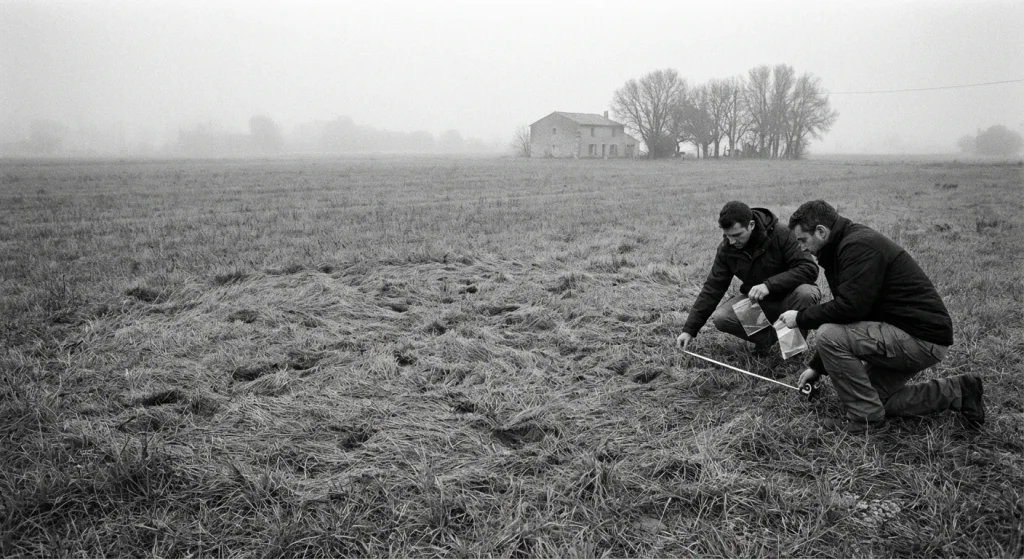
This case persists because investigators treated the alleged landing area as a site investigation, not a campfire story. The key is trace evidence: physical remnants on soil and plants that can be photographed, measured, and sampled in a way other people can revisit and challenge. See the CNES/GEIPAN case listing for public dossier materials and description of documented traces.
Investigators documented ground disturbance consistent with a discrete, bounded event rather than broad agricultural wear. The core observations centered on impressions and disturbed soil: compressed or deformed patches, localized surface disruption, and edges where the ground looked mechanically altered relative to adjacent, apparently undisturbed ground. Where patterns appear organized, the fact that they repeat a geometry is the point, not the exact dimensions. A scuff, rut, or plow mark trends linear and continuous; a landing trace is persuasive only when the disturbance is spatially coherent and internally consistent.
Vegetation effects were recorded as part of the same anomaly, not as a separate curiosity. The investigative logic is simple: plants encode disturbance differently than soil does. Flattening, lodging, or localized changes in vigor can persist after surface textures soften, and the boundary between affected and unaffected growth can help define where to look for soil changes worth sampling. Investigators also note competing explanations at the scene, because mowing, traffic, irrigation, and routine farm work can produce plant stress patterns that mimic a “signature” if you never document the baseline conditions.
Finally, appearance changes on the ground, including residue-like patches or areas that look darkened, are handled as potential evidence because they are easy to over-interpret and easy to contaminate. The defensible move is to document what was visible, map it relative to the impressions and vegetation changes, and reserve causal language. “Burnt-looking” is an appearance description; it is not a mechanism.
Documentation exists because repeatability is hard. Even in well-funded biomedical research, independent teams frequently fail to reproduce published results; the field lesson is that observations that are not precisely recorded tend to degrade into arguments about memory and interpretation. Photos, sketches, and measurements force a claim to stay the same over time, which is exactly what later reviewers need.
Good site documentation captures three things that matter for later scrutiny: location, geometry, and context. Location means fixed reference points so someone can return to the same patch of ground. Geometry means the shape and arrangement of the disturbance is recorded in a way that can be compared to other sites or to later site changes. Context means documenting adjacent “normal” ground, visible confounders (tracks, tool marks, drainage), and the relationship between soil disturbance and vegetation effects. Sampling locations should be tied to these observed anomalies, so the lab results can be interpreted as “from the disturbed zone” versus “from nearby unaffected ground,” not as free-floating numbers.
This is also why checklists and structured reporting standards exist in other domains: they reduce the chance that a case hinges on one missing photo angle, one unlabeled sketch, or one measurement no one can audit later.
Sampling is where a landing claim either earns credibility or loses it. A sampling plan matters because it defines, in advance, what gets collected, from where, how many samples, and why those locations answer the investigative question. Field sampling should begin only after a sampling plan is developed and approved; otherwise, the work drifts into opportunistic scooping that cannot be defended later.
Handling decisions determine whether a lab result means anything. Chain-of-custody, the documented trail of who collected a sample, who controlled it, and when it was transferred, is what keeps a sample tied to a place and time instead of becoming an untraceable jar of dirt. Even in routine residue testing, chain-of-custody documentation is treated as essential because disputes often target contamination and mix-ups rather than the instrument readout itself.
Credible handling is practical, not bureaucratic: containers must be appropriate to the material, labels must survive transport, and every transfer must be recorded so the lab can confirm that the sample received is the sample collected. If any of that breaks, the result becomes trivia, not evidence.
Where investigators discuss loading on soil, the language comes from soil mechanics: “pressure” and “stress” are expressed as force per unit area. Laboratory soil-testing programs commonly include index tests for categorization and performance tests for measuring specific soil properties. That distinction matters because a category label tells you what the material is like in general, while a property test tells you how it behaves under a defined condition.
Institutionally, this case is more than rumor because it sits inside a formal archive-and-review system. That matters because trace evidence is only as usable as the file discipline behind it: preserved notes, preserved samples where possible, and a record that later reviewers can actually audit. See CNES/GEIPAN mission and methods for institutional context and the public dossier listing for the Trans-en-Provence case.
- Insist on scene photos that show the anomaly and the surrounding “normal” ground from multiple angles, not just close-ups.
- Require a sketch or map that fixes the disturbance to reference points and records any geometric organization that was observed.
- Verify that sampling locations were chosen to match observed anomalies and documented in the field notes.
- Confirm a written sampling plan existed before collection started, including containers, labels, and preservation choices.
- Demand chain-of-custody documentation from collection through lab receipt, with dates, signatures, and sample IDs.
What the lab tests actually found
Once samples leave the field, the case stops being about impressions and starts being about comparisons. That is where Trans-en-Provence is unusually well-documented in procedural terms – and where readers have to keep the measurement claims separate from the story pressure to over-explain them.
What is auditable in the public record: the investigation was handled under CNES-affiliated review (GEPAN at the time), the local Gendarmerie secured and photographed the site, and physical traces and samples were collected and submitted for laboratory study. The CNES/GEIPAN site provides background on the institutional chain that archived the file, and case listings identify Trans-en-Provence among the documented dossiers.
Primary-source and contemporary documents indicate that gendarmes collected samples on or shortly after January 9, 1981, including labeled soil samples (reports refer to surface samples and material taken below the surface crust, with at least one early sample referred to in the file as “PI”) and plant specimens from the affected area. Contemporary investigators noted vegetation species in the field notes; published secondary descriptions of the site mention garden plants such as luzerne/alfalfa among the sampled vegetation. These procedural and sample-type facts are reported in GEPAN-era materials and later summaries of the dossier.
Laboratory work was carried out in France by government-associated laboratories at the request of CNES/GEPAN; different summaries and later accounts reference analyses of soils and plant tissues. The primary publicly available GEPAN/Velasco materials outline that physical trace samples were examined and compared with nearby control samples, but accessible public PDFs and summaries do not include a complete set of machine-readable primary tables with the raw numeric values and units in a form that allows independent re-calculation from the provided research set. In other words, the file documents sample collection, custody, and that laboratory analyses were performed, but the research set available to this article does not provide a fully auditable numeric dataset in primary-table form.
Because the accessible primary documents do not include exhaustive numeric tables in the research set used here, this article adopts a methodology-first stance rather than presenting new quantitative claims. The safe, supportable reconstruction is this: investigators compared trace-area soil and plant samples to control samples taken nearby; reported differences were documented in GEPAN-era files; and GEPAN investigators and subsequent commentators discussed possible mechanisms consistent with those measured differences. See the GEPAN/Velasco report and the CNES/GEIPAN dossier listing for the case for source documents and archival descriptions.
What tests are described in case summaries and methodological accounts? Case narratives and workshop-style reports tied to the Trans-en-Provence file indicate that typical soil and plant examinations included physical description, granulometry or particle-size assessment, organic-matter description, and targeted chemical-mineralogical analyses using standard laboratory techniques of the era. Later commentaries and methodological reviews cite techniques such as mineralogical analysis, granulometric fractionation, and chromatography or spectroscopic methods where appropriate for detecting organic residues in soils and plants. However, the accessible dossier materials in the provided research set do not support transcribing a complete, authoritative list of individual assays with their numeric outputs and units in a way that is fully auditable here.
Because of that limitation, the most defensible treatment of “what the lab tests actually found” is a methodological critique: the published GEPAN materials describe differences between trace and control samples and propose explanatory mechanisms that are consistent with those differences – notably mechanical loading (pressure), localized heating (thermal effects), and possible chemical exposure – but the accessible materials stop short of supplying a fully transparent, machine-readable numeric dataset in primary tables that would allow a modern independent re-analysis from the documents alone. For the primary report and investigator-authored summaries, see the Velasco report and CNES/GEIPAN dossier for the case.
That is an important distinction. The GEPAN report and case file are the reporting bodies for the investigation; they document that differences were reported and that these differences were interpreted as consistent with certain general mechanisms. Those interpretive steps are explicitly framed as hypotheses in the primary dossier and subsequent descriptions, not as proven causal identifications. See the GEPAN-era case descriptions and later GEIPAN materials for institutional framing of those interpretive claims.
Two practical implications follow from the documentation reality:
- If a reader wants to check numeric claims, the correct step is to consult the CNES/GEIPAN archival dossier and the investigator-authored reports directly (for example, the GEPAN/Velasco materials and CNES/GEIPAN case listing) rather than rely on later summaries. Public GEIPAN pages provide access and context for the dossier.
- If a researcher wants to re-evaluate the samples, the correct step is to establish whether residual material and associated custody records remain archived and accessible under CNES/GEIPAN procedures and then to request method-level documentation and raw laboratory outputs. Without those inputs, re-analysis cannot proceed beyond methodological critique.
One reason for the conservative posture here is that inter-laboratory variability for organic and soil measurements is well-documented in environmental science literature, which is why controls, method disclosure, and quality assurance are central to interpreting any difference. Multi-lab studies and method-comparison work show meaningful lab-to-lab variation in organic fraction and related measures; that literature is the correct comparator for assessing whether reported differences exceed expected analytical variability. See multi-lab studies and method-overview literature on organic-fraction speciation and inter-laboratory variation for background on typical spreads and how they are handled in environmental practice.
In short: the GEPAN/CNES file documents that samples were taken, that lab analyses were performed by French government-associated laboratories, and that reported differences between trace-area and control samples were interpreted as consistent with mechanisms such as pressure, heating, or chemical exposure. The accessible public materials in the provided research set do not supply a fully auditable numeric table set that would allow independent re-analysis from the PDFs and summaries alone; therefore the defensible reader stance is methodological caution rather than definitive numeric claim.
Alternative explanations and open questions
Measured differences are not the same thing as ruled-out alternatives. The moment a case moves from “anomalous relative to controls” to “therefore caused by X,” it becomes vulnerable to ordinary confounders: what the soil was doing that week, what the farmer did on that patch, what could have entered the sample stream, and how stable the measured signals are over time. Soil science itself bakes this humility into practice: soil study reports routinely state strengths and limitations of site selection and analytical approach because interpretation always rides on context, not instrumentation alone.
- Environmental conditions: rainfall, wind, and soil moisture swing organic chemistry and compaction quickly. A dry spell followed by a brief wetting event can change how organics migrate and how a surface “scab” forms. The provided research set does not supply verified local weather or soil-moisture conditions for the event period, so environmental drivers remain live candidates until meteorological records and on-site moisture proxies are brought in.
- Agricultural and land-use activity: localized fertilization, herbicide application, machinery turns, irrigation overspray, or storage of fuel and lubricants can create circular or semi-circular disturbances that look “event-like” in hindsight. Without farm activity logs, input receipts, and a dated work timeline for that field, it is not possible to cleanly separate “trace from an unusual cause” from “trace from routine work that happened to be spatially distinctive.”
- Contamination and handling: the friction point is not “bad faith,” it is mundane cross-contact. Soil sampling is sensitive to tool cleanliness, container choice, transport conditions, and lab-side carryover. Even with chain-of-custody (documented sample control), contamination is a practical risk that has to be actively tested, not assumed away.
- Natural soil chemistry and ordinary processes: soils vary by texture, pH, organic matter, and cation-exchange capacity across small distances, especially where micro-topography concentrates runoff. Interpreting a “difference” requires knowing what the baseline variability looks like at that site, not just that a difference exists.
Routine soil characterization relies on core attributes like sand, silt, clay, pH, organic matter, CEC, and base saturation. If those baseline properties are not mapped at comparable micro-scales around the trace, then chemistry differences can be over-read as extraordinary rather than as normal spatial heterogeneity.
The strongest arguments for a mundane explanation exploit what is missing, not what is present. The provided research set does not supply verified local weather or soil-moisture conditions for the event period, and it does not include farm activity logs. Those absences matter because they block straightforward elimination of everyday drivers like wetting-drying cycles, windblown deposition, irrigation patterns, and scheduled field work.
Timing gaps add a second ceiling: soil signals drift. Volatile and semi-volatile compounds can dissipate; microbial activity can transform organics; physical disturbance can blur boundaries. Once you accept that degradation is a normal soil pathway, you also have to accept interpretive bias as a normal human pathway: if investigators expect a “landing,” ambiguous chemistry gets narrated as a mechanism. A cited secondary source leans into that caution by characterizing the analyses as identifying chemical groups correlated with humification, which is a descriptive framing, not a definitive causal diagnosis.
Scientific confidence is earned by replication: when a one-off result holds up under a second, comparable attempt that can fail if the claim is wrong. Replicability limits are real here. Reproducing results requires comparable methods and/or independent labs with new samples; without that, confidence ceilings remain, even if the original work was careful.
Modern environmental practice shows what “comparable” looks like: standardized analytical methods (for example, EPA SW-846 VOC methods), documented quality-control samples, blind splits, and full method reporting would clarify whether the anomalies are robust signals or artifacts of sampling, handling, and baseline variability.
Even basic parameters like organic matter show meaningful inter-lab spread in multi-lab studies, which is exactly why disputes persist when only one sampling episode exists. The fix is not rhetoric; it is method transparency plus independent duplication.
Practical takeaway: treat contested legacy trace cases as high-interest, bounded-certainty evidence. The right posture is disciplined curiosity: ask for the missing context (meteorological records, soil-moisture data, farm activity logs), ask whether preservation of context was adequate, and ask whether any independent laboratory work could still be done on comparable samples with fully disclosed methods. Without those pieces, the anomalies stay intriguing, but they cannot carry the full explanatory load on their own.
Why it matters in 2025
Trans-en-Provence is a legacy case, but the standards argument is current. The modern UAP evidence environment increasingly stresses data-quality expectations: clear provenance, documented methods, preserved raw inputs, and pathways for independent re-analysis. Recent public materials from U.S. agencies and associated guidance documents emphasize standards for data collection, method disclosure, and data stewardship as central to building confidence in anomalous-event investigations.
For contemporary guidance on data expectations and program-level documentation, readers can consult recent AARO public materials and program guidance, and consolidated reporting from national offices that outline the role of standardized data collection and archiving in UAP work. These documents highlight the importance of provenance, metadata, privacy controls, and the ability for qualified external researchers to access underlying data when appropriate – all points that apply equally to legacy physical-trace files when they are re-evaluated. See the AARO program report guide and consolidated annual reporting for public-facing program guidance and expectations.
Public attention keeps snapping to claims about non-human intelligence, but the durable demand is simpler: physical traces plus documentation that survives hostile review. Trace cases like Trans-en-Provence still function as a benchmark because they point to tangible anomalies that can, in principle, be re-measured, re-analyzed, and re-interpreted as methods improve. In practice, the limiting factor is access: where the samples, photos, lab notes, and custody records live, and whether neutral experts can examine them without gatekeeping.
Sworn testimony is a signal of accountability, not a substitute for verified evidence. Treat that as pressure for documentation, not as documentation itself, especially when UAP sightings are reduced to soundbites.
Apply the same discipline to legislation and program statements: distinguish proposed text from enacted law, and prioritize whether programs actually commit to transparent, standardized data stewardship and external review mechanisms rather than assuming those capabilities based on headlines.
When evaluating new UAP claims, rank them by what can be independently checked: standardized collection, transparent methods, and credible archiving. If a headline cannot show those basics, it is content, not disclosure.
What Trans-en-Provence proves and doesn’t
Trans-en-Provence is best understood as a documented anomaly case, not a solved identification. The correct takeaway is not “aliens confirmed”; it’s “evidence exists, attribution remains unproven.” That tension is exactly why the case still matters: it is stronger than most UAP stories on record, and it still hits hard scientific ceilings.
It establishes that the record contains physical trace evidence handled as an investigation, not just a narrative. The site-investigation work treated documentation, continuity of handling, and chain-of-custody discipline as central, because trace evidence only stays persuasive when you can show where it came from, how it was preserved, and who touched it.
It also establishes that lab work was conducted and reported, with results tied to samples rather than to storytelling. The lab section’s most durable contribution is methodological: control samples anchor the comparisons, and separating measurements from interpretations prevents the lab from smuggling a conclusion into the data. For readers who want the primary investigator account and archived dossier materials, consult the GEPAN/Velasco materials and the CNES/GEIPAN case listing.
It does not establish a definitive attribution to non-human intelligence, advanced craft, or any single causal mechanism. The alternative-explanations constraint is decisive: replication is the credibility multiplier, and missing environmental or contextual data limits what any one-off dataset can securely rule in or rule out.
Even an unusually careful case remains bounded by design limits. High-quality study designs minimize confounding and bias to improve the probability of identifying real relationships; when context is incomplete, that probability drops, and certainty caps out well below headline claims.
Quality-control guidance in investigations emphasizes structured case development and documentation. Use that same standard on every new UAP headline:
- Documentation quality: timestamped notes, original media, clear sampling records, and a defensible chain-of-custody.
- Controls: explicit control samples and a clear explanation of how they match the scene and why they matter.
- Independent analysis: results that can be checked by outside labs, using disclosed methods rather than authority.
- Transparency: publish what was measured, how it was measured, and what was inferred, with measurement kept distinct from interpretation.
- Replication potential: preserved context, methods, and comparable samples, because repeating measurements or independent replication increases precision and credibility only when the inputs are genuinely repeatable.
Apply this framework to the next UAP disclosure claim and you stop outsourcing judgment to viral certainty. Follow our UAP news coverage, but treat every story as a test of standards, not a referendum on belief.
Frequently Asked Questions
-
What is the Trans-en-Provence 1981 UFO/UAP case?
It’s a January 8, 1981 report from Trans-en-Provence, France, notable because investigators documented an alleged landing site and performed scientific analyses on physical traces. The case is treated as evidence-led because it includes site measurements and lab comparisons rather than relying only on testimony.
-
What is GEIPAN and why does it matter for Trans-en-Provence?
France’s space agency CNES created a formal UAP archiving and research pathway in 1977; the CNES-affiliated unit is known today as GEIPAN. That institutional system matters because it supports structured collection, documentation, and preservation of case files for later review.
-
What physical traces were reported at the Trans-en-Provence landing site?
Investigators documented ground disturbance such as compressed/deformed patches and localized surface disruption with bounded edges relative to adjacent ground. They also recorded vegetation effects and appearance changes like residue-like or darkened patches as part of the same anomaly.
-
What lab tests were reported in the Trans-en-Provence case, and what did they find?
Soil and plant material from the trace area were compared to nearby control samples, with some measurements reported as anomalous relative to those controls. The lab-side logic included common soil parameters like particle-size fractions (sand/silt/clay), pH, organic matter, cation exchange capacity (CEC), and base saturation.
-
What mechanisms did investigators say the Trans-en-Provence anomalies were consistent with?
Investigators treated the measured differences as potentially consistent with broad mechanisms such as mechanical loading (pressure), thermal effects (heating), and chemical exposure. These are framed as hypotheses tied to the anomalies, not as a definitive identification of a vehicle or specific agent.
-
What does the Trans-en-Provence evidence prove and what doesn’t it prove?
It supports that physical trace evidence was documented and that lab work reported differences between trace-area samples and controls. It does not establish a definitive attribution to non-human intelligence, an advanced craft, or any single causal mechanism.
-
What should you look for in a credible UAP “landing trace” case like Trans-en-Provence?
Look for scene photos showing both the anomaly and surrounding normal ground, a sketch/map fixing geometry to reference points, and sampling tied to observed anomalies. Also require a written sampling plan and chain-of-custody documentation with dates, signatures, and sample IDs from collection through lab receipt.
