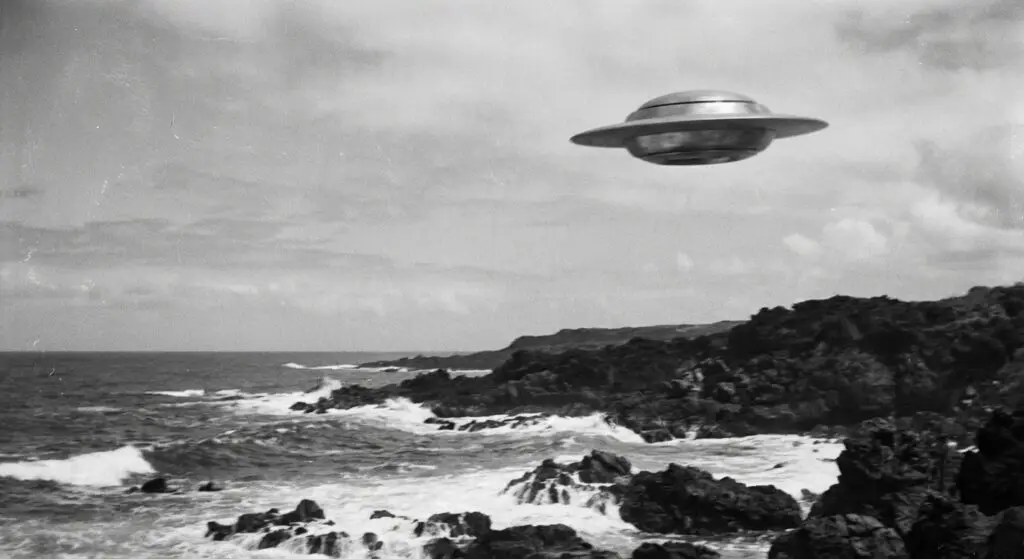
The Trindade Island photos keep resurfacing in UFO news and UAP news with the same problem every time: the images look “settled,” but the story around them keeps changing. One week the captions insist the Navy “confirmed everything”; the next week you get a cropped, contrast-pushed scan with a brand-new date, a new witness list, and a narrator who cites nobody.
Here is what is actually pinned down in the public record, often repeated but rarely kept together in one place: the photographs are dated January 16, 1958, were reportedly taken aboard the Brazilian Navy training ship Almirante Saldanha and are credited to photographer Almiro Baraúna (also spelled Barauna) in contemporary coverage and archival summaries (compiled summary; CIA references). They were widely published in Brazilian newspapers on February 21, 1958, including coverage summarized in period press compilations and secondary archives (case compilation).
The friction is that “Navy-linked” and “published in major papers” reads like authority, and authority feels like documentation. They are not the same thing. Mass reproduction can spread a claim faster than it preserves the chain of custody that would let you audit it.
This is where most write-ups fail you: they replace missing documentation with confident storytelling. This analysis will do the opposite. If a piece of the record is missing or unclear, it stays labeled as a gap, not a conclusion, especially on the two items that matter for verification: camera settings and the official Brazilian Navy memo trail.
You will leave with a method to separate sourced facts, reported claims, and unknowns in this specific 1958 photo case, without treating disclosure or cover-up narratives as evidence just because they are widely repeated.
What Happened at Trindade Island
The Trindade photos have lasted because the case rests on a small set of anchors that are easy to repeat: a named place in the South Atlantic, a specific date in 1958, and a credited photographer linked to a Brazilian Navy ship. The friction is that the most-cited “timeline” details in UFO talk, meaning an aerial object observers could not identify at the time, and in modern UAP framing, meaning the institutional label often used in government contexts, are exactly the details the sources cited below do not pin down with contemporaneous documentation. Treat this event as two layers: what you can anchor to place and date, and what arrives later as narrative.
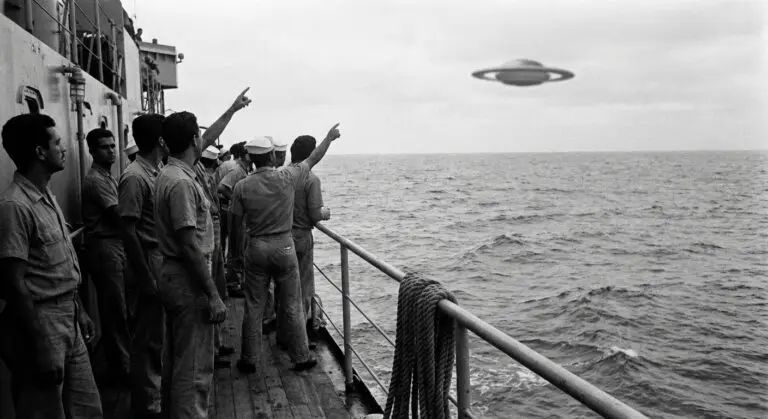
Trindade Island sits far off Brazil in the South Atlantic: approximately 1,100 to 1,167 km from the Brazilian coast depending on the measurement baseline used (coastal nearest point versus a reference city such as Vitória, Espírito Santo) (Trindade and Martim Vaz – Wikipedia; distance summary). It is also cited as being roughly 4,200 km from the African coast in several references (Wikipedia). Those distances are the hard, geographic reason the Trindade and Martim Vaz archipelago is treated as remote, regardless of what any single retelling claims about the sighting itself.
That remoteness is not just a map detail. Trindade is also documented in scientific literature as a nesting site for several seabird species; surveys and reviews cite about seven breeding seabird species at Trindade in modern assessments of the archipelago’s breeding fauna (review of seabird surveys (http://www.revbrasilornitol.com.br/BJO/article/view/1211); historical population note). This is why Trindade appears in official and scientific contexts unrelated to the UFO or UAP story. In practical terms, it is the kind of place ships visit with a purpose, not somewhere you casually “happen to be.”
The most repeated human anchors are also straightforward, but they are not established as “contemporaneous, primary-source” facts in the sources cited below: the photos are widely said to have been taken from aboard the Brazilian Navy training ship Almirante Saldanha, by photographer Almiro Baraúna (often spelled Barauna) (case compilation; CIA reference). Use these as identifiers for the story you will see retold, but do not treat them as fully documented until contemporaneous primary paperwork is produced and cited.
The commonly repeated description layer is consistent across many later summaries, and it is exactly that: reported witness-description, not a verified measurement record. The object is routinely labeled “Saturn-shaped,” a shorthand for a central body with a ring-like profile in silhouette or appearance.
Several accounts also add lighting claims. At least one description reports red, blue, and green lights around the object’s perimeter, and some retellings describe it as glowing. Those details matter because they are the features most likely to harden into “facts” over decades of repetition, even when the underlying documentation is not presented alongside them.
Motion is described in similarly narrative terms. At least one account states the object appeared to increase in size as it ascended, an observation that can mean multiple different things in practice: an actual change in apparent size due to distance and angle, a change in illumination, or a perceived change driven by expectation. The sources cited below support the existence of the claim, not the mechanism behind it.
The gap that controls how confidently you can narrate “what happened” is simple: the sources cited below do not contain a contemporaneous, primary-source chronology that locks down the sighting’s local time, its duration, or a verified witness count. Those missing fields are where later retellings often smuggle in specificity.
- Local time: Not established in the sources cited below, so any clock-time you see should be treated as later reporting unless a primary document is produced.
- Duration: Not established in the sources cited below, which blocks any confident reconstruction of sequence and pacing.
- Witness count: Not established in the sources cited below, so claims like “many sailors saw it” cannot be graded beyond repetition.
This matters because the case is often presented as if the photo event comes with a crisp, minute-by-minute naval log narrative. Without those contemporaneous fields, later accounts can unintentionally converge on a single “canonical” version that reads authoritative but is not actually anchored to primary documentation.
Rule to apply: keep Trindade in two layers until primary paperwork closes the gaps. Layer one is anchored context (a remote South Atlantic location and its distances). Layer two is the later narrative package (ship, photographer, “Saturn-shaped” form, colored lights, size-change on ascent) that you should treat as reported unless a dated, original source is placed on the table.
Those missing timeline fields are also why the next question is not simply what witnesses said, but what the images can-and cannot-support on their own. The photo set is where most retellings claim the case becomes self-evident, and where copy quality becomes the deciding variable.
Inside the Saturn Shaped Photo Set
The biggest analytical trap with contested historical photo sets is treating a reproduced scan as the original data. The real risk is not limited to “fake vs real.” It is “analysis built on degraded copies,” where each republication quietly changes the pixels you are arguing about. Once the same frames have been cropped, reprinted, screened, and rescanned, the photos stop behaving like measurements and start behaving like Rorschach tests: different viewers confidently extract different “structures” from the same low-information edges.
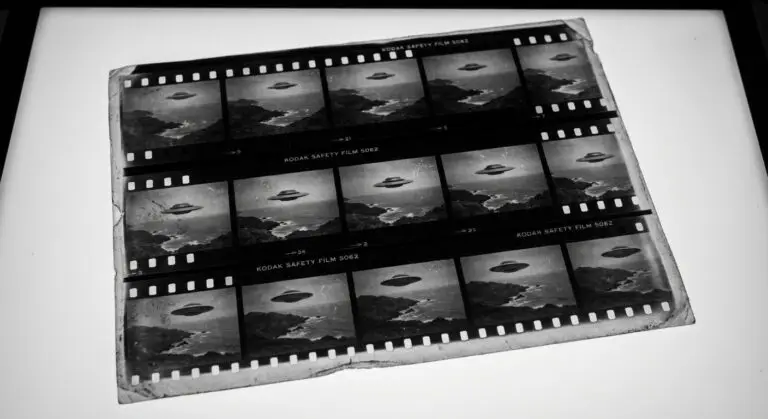
Across typical reproductions of the Trindade sequence, viewers report a series of frames captured from a Brazilian Navy ship in which a Saturn-shaped object appears against an open sky, with horizon or cloud context used as a reference for orientation and apparent motion. The object is usually described as a central disk or body with a surrounding ring-like contour, and the sequence format invites comparison of position and silhouette from one frame to the next.
The key point is that most public-facing versions are not the camera-original negatives in a controlled viewing workflow. They are secondhand images presented through newspapers, books, photocopies, and web scans. That matters because the “Saturn” impression is driven by boundary cues, and boundary cues are exactly what reproduction artifacts rewrite.
Proponents focus on internal consistency: the fact that the object is depicted across multiple frames, with a broadly stable “ringed” silhouette, is treated as evidence that the sequence records a real external target rather than a one-off artifact. They also lean on context cues inside the image, using the sky and horizon as anchors to argue the object occupies a coherent location in the scene and changes in a way that looks like motion or repositioning rather than random blemishing. This is the strongest pro-sequence claim because it is grounded in what a viewer can actually check in reproductions: do multiple frames appear to contain the same object-like form, in a coherent part of the composition, with similar proportions?
The complication is that consistency across reproductions can be mistaken for consistency in the original. If multiple publications all derive from a single processed intermediary, you can get “agreement” between frames that is really agreement between copies. The actionable pro-reading, if you want to argue from the visuals, is to treat cross-frame consistency as a hypothesis that must be tested on like-for-like source material, not as a conclusion pulled from mixed-quality clippings.
Skeptical interpretations stay close to the failure modes of human vision and low-resolution imagery. Edge ambiguity is the headline issue: in many reproductions the boundary that implies a ring is only a few tonal steps wide, so small changes in contrast or grain can flip a “structured rim” into a soft halo. Blur and focus uncertainty compound this, because a slightly defocused bright object naturally blooms and thickens at the perimeter. Distance and scale are also visually underconstrained in most copies: without verified lens parameters and reliable reference dimensions in the same plane, size estimates collapse into assumptions.
The practical skeptic’s point is not “therefore it is a hoax mechanism X.” It is that the reproduced images, as commonly circulated, do not carry enough stable geometric information to support strong claims about structure, size, or altitude. This is exactly where people reach for modern analytical approaches that try to extract measurements and 3D constraints from photographs using geometry and reference cues; reliable results depend on known lens parameters, camera geometry, and consistent source material. In the sources cited below, the camera model, lens, film type, and exposure settings are not established and must be treated as unknown unless a vetted source is added.
Three reproduction steps drive most disagreement because they directly change perceived shape and edge “hardness.”
Cropping changes the reference frame. Remove horizon cues or nearby clouds and you also remove the viewer’s orientation anchors. The same object can look higher, lower, nearer, or more isolated depending on what context gets cut away.
Contrast boosting changes the object. A hard contrast curve can invent a “ring” by forcing midtones to clip into a bright rim and a dark interior, or erase it by crushing subtle transitions into a uniform blob. If two analysts argue about rim thickness while using different contrast treatments, they are not analyzing the same data.
Generational copying adds structure that was never in the scene. Every reprint and rescan introduces halftone patterns, noise, and edge ringing; those artifacts preferentially accumulate at high-contrast boundaries, exactly where “craft-like” structure is easiest to imagine. Imagery-based UAP evidence becomes especially brittle under these conditions because pixel-level boundaries are no longer stable across sources.
- Compare only like-for-like versions: same crop, similar tonal mapping, same publication lineage when possible.
- Track image generation: original print or negative scan, first-generation press reproduction, later book reprint, modern web scan.
- Reject heavily processed scans as the baseline: use them for illustration, not measurement.
- Label missing camera metadata explicitly: camera model, lens, film type, and exposure settings are unknown here.
- Constrain measurement claims: without verified lens geometry and consistent sources, treat size, distance, and “structure” conclusions as unsupported.
The visual limitations above point to a narrower, more decisive question than silhouette debates: what happened to the physical materials after exposure? That is where a Navy-linked case should either become auditable or remain rhetorical.
Brazilian Navy Documentation and Handling
Official context without paperwork is not evidentiary closure. In this case, “Brazilian Navy involvement” gets treated like a stamp of authenticity, but it only becomes evidentiary leverage when the handling of the photographic materials is documented end to end. For photographic evidence, documentation of handling is not bureaucracy; it is the difference between an artifact and an anecdote.
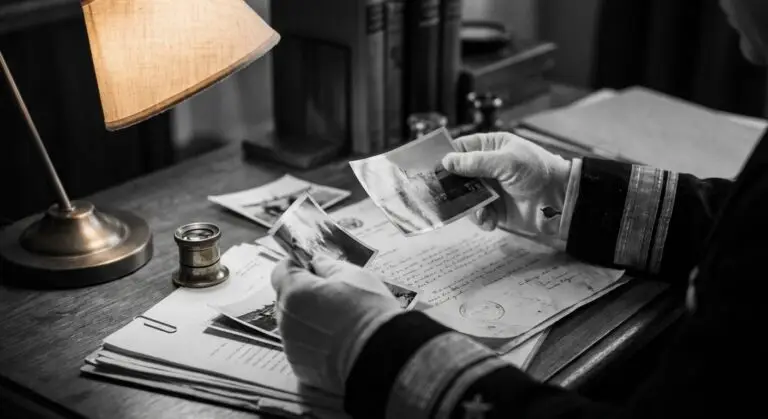
Some of the sources cited below associate the Trindade episode with a Brazilian Navy platform and Navy personnel as the operational setting. That matters because it anchors the story to a real institutional environment with established routines for reporting and safeguarding materials. The catch is that “Navy setting” is not the same thing as “Navy file.” A sighting occurring on a Navy ship can be true while the photographic materials still circulate informally, get copied outside official channels, or get separated from their originals without any institutional record.
The decisive gap is administrative, not visual. In the sources cited below, no specific Brazilian Navy office is identified as the receiving entity for the photos or negatives. The sources cited below also do not include official memos, inquiry reports, chain-of-custody notes, or dated correspondence documenting receipt, review, transfer, or return of the materials. Without those basics, “the Navy had it” remains an assertion rather than a verifiable archival fact. (See archival catalog entries and Navy repository listings for contemporaneous collections: Arquivo da Marinha catalog.)
This is where terminology turns operational. A chain of custody is the documented control of evidence (who possessed it, when, under what conditions), and the sources cited below provide no custody log that would let a researcher trace the materials across time. Provenance is the origin history of a specific item (a given print, negative, or copy), and it is the credibility bridge between “this image exists” and “this image is the same object produced at the claimed time and place.” The strongest baseline for authentication is the original negatives, the first-generation film negatives produced in-camera, because every later print or reproduction inherits whatever alterations, losses, or substitutions happen after that moment.
Authenticity debates often get pulled into “government UFO cover-up” or “UFO disclosure/UAP disclosure” framing. Treat that as context and allegation, not a conclusion, because the sources cited below do not supply the administrative record that would prove either suppression or validation. The practical issue is simpler: without documented control of negatives and prints, later analysis and reproduction chains become harder to trust, even when performed in good faith.
In disciplined evidence-handling terms, what’s missing is the paper trail that normally answers: who received the originals, the date and method of transfer, how they were stored, what was copied (and by whom), what was returned (and when), and who had access in between. Other navies and archives explicitly distinguish physical possession from legal control during transfers, and formal records-management rules exist to govern that process in documented systems.
If you want “Brazilian Navy involvement” to mean more than institutional ambiance, prioritize records that would lock down custody and provenance. Start with document types that create timestamps and named responsibility, then search likely federal repositories that preserve government documentation.
- Receipt records for physical delivery of negatives/prints (signed intake, protocol number, stamped cover sheet).
- Dated correspondence between ship, command, and any investigative or public-affairs office acknowledging receipt and disposition.
- Archive accession records showing when a collection was transferred, cataloged, or assigned an identifier in a government repository.
- Lab submission forms for development, duplication, or analysis specifying originals versus copies and listing chain-of-custody transfers.
- Finding aids and catalog entries in major Brazilian catalogs and periodical portals that might preserve official or contemporaneous references.
When custody is undocumented, arguments tend to drift toward narrative substitutes: a hoax story on one side, or institutional validation by implication on the other. Both can sound rigorous until you force them to make falsifiable predictions against actual materials.
Hoax Allegations and Counterarguments
The Trindade debate persists for one reason: neither the hoax camp nor the anomaly camp can lock the other down without primary materials. Plausible narratives are cheap. What matters is whether each explanation cashes out into testable expectations about (1) the physical record (negatives, first-generation prints, continuity across frames), (2) source quality (what generation of copy you are looking at), and (3) documentation (methods, controls, lab notes) that lets an independent party repeat the analysis.
The disciplined way to argue about authenticity is simple: every claim must specify what evidence would confirm it and what evidence would falsify it. If a theory cannot be wrong in principle, it is not an evidentiary theory; it is a story.
1) Staged model (miniature or suspended object). This hypothesis predicts artifacts consistent with a physical prop interacting with the scene: telltale support signatures (wires, rods, attachment points), lighting mismatches between object and background, depth-of-field behavior inconsistent with a distant object, and repeatable edge anomalies under controlled high-resolution scanning of the original negative. It also predicts an explainable production workflow: who built it, what materials were used, how it was transported and deployed, and why those steps leave no trace in logs or personal records.
Strong support for a model claim normally comes with documentation that looks like lab work, not commentary: scanning specifications, control images, measurement procedures, and side-by-side comparisons tied to the same generation of source material. Without first-generation artifacts, “I see a string” arguments collapse into subjective pattern matching.
2) Double exposure or composite. This category makes sharper physical predictions than most people realize. Composites leave technical seams: density discontinuities, inconsistent film grain behavior between subject and background, edge halos from masking, and continuity breaks across the sequence (for example, an object that changes position without corresponding changes in exposure or background parallax). If multiple frames exist, a composite explanation must also explain why the same manipulation artifacts do or do not repeat across frames, depending on the claimed technique.
A strong debunk here is procedural: it shows reproducible detection methods, reports scanner model and settings, documents how the negative was handled, and provides raw outputs so other analysts can re-check the work. That “methods and reporting” standard is normal in mature analytical disciplines that publish validated procedures and controls. The point is not to import an unrelated manual into a UFO case; it is to apply the same expectation of transparent methodology that formal analytical method compilations treat as baseline practice.
3) Misidentification (mundane object photographed at an unusual angle or distance). Misidentification predicts consistency with a real object in the environment: plausible size and distance ranges, plausible motion between frames, and image features that map to known shapes under the same lighting. It also predicts that improvements in source quality matter. If a claim relies on a low-generation reproduction, higher-quality material should sharpen the relevant cues rather than dissolve them into artifacts.
What strong documentation looks like here is modest but specific: calibrated measurements tied to camera and lens characteristics, sensitivity analysis that shows how conclusions change with reasonable uncertainty, and clear separation between what is measured in the image and what is assumed about the scene.
Three proponent arguments routinely carry the most weight: multiple witnesses, internal consistency across the photo sequence, and the naval environment as a context that plausibly constrains casual fakery. Treated correctly, these points can raise the bar for a hoax narrative. They are evidence of reported observation and of procedural handling, not proof of an anomalous craft.
Here is the line that matters. “Multiple witnesses” is evidence that more than one person reported the event; it is not evidence that the image content is immune to misidentification or to pre-planned staging. “Sequence consistency” is evidence that the published set behaves like a sequence; it is not, by itself, evidence that the sequence originated on a single unmanipulated negative strip. “Naval context” is evidence about setting and incentives; it is inference about capability and intent.
The hard constraint in the sources cited below is explicit: they do not include named skeptical publications with specific, testable claims, and they do not include documented lab analyses of negatives or prints tied to the Trindade set. No section that respects standards of evidence can fabricate citations or imply laboratory conclusions that are not in hand.
- Secure access to the original negatives or verified first-generation prints, with documented provenance for each item examined.
- Produce high-resolution scans from controlled equipment, with the full capture workflow recorded (scanner/camera model, settings, bit depth, color management, handling procedures).
- Run a transparent examination protocol aimed at the competing predictions: density continuity, grain structure, edge artifacts, and frame-to-frame continuity checks on the same material generation.
- Publish the full reporting package: methods, controls, raw outputs, and a clear statement of what findings would falsify the analyst’s preferred hypothesis.
The decision rule is strict because the case demands it: do not accept certainty, pro or con. Accept only claims that name the material they rely on, state what result would prove them wrong, and show their work at a level an independent analyst can reproduce.
That standard also explains why Trindade keeps getting repurposed: it is a legacy photo case that can be made to sound decisive in modern debates without anyone supplying the missing primary materials. The current disclosure-era framing is not the origin of the dispute, but it is the engine that keeps it visible.
A 1958 Case in a 2025 Debate
Modern disclosure debates reward archival cases that look official, even when the documentary trail is thin. Trindade stays in circulation because it is rhetorically powerful: it reads like a government-adjacent incident with photos, uniformed witnesses, and a shipboard setting, so it functions as “evidence” in online argument even when nobody has produced new 1958 documentation to settle the dispute.
In current reporting and policymaking, “UFO” and “UAP” are used to refer to largely overlapping sets of observed phenomena. The shift from “UFO” to “UAP” is a vocabulary and institutional framing change: it steers attention toward reporting pipelines, airspace safety, and data handling rather than a built-in extraterrestrial conclusion. That shift has coincided with renewed interest in archival cases and with the production of consolidated government reporting on UAP.
Official summaries consistently take a narrow position: many reports remain unresolved, and investigators have not found evidence of extraterrestrial technology. That stance does not authenticate Trindade, and it does not debunk it either. It mainly explains the media environment: unresolved plus officially discussed creates a vacuum that gets filled with recycled archives, especially photo cases that already carry an aura of procedure and custody.
Trindade’s hook is structural: photographs tied to a Brazilian Navy ship, with officers and crew reported as observers, read as “official-adjacent” on sight.
The complication is that disclosure-era attention does not upgrade the 1958 record. Instead, it rewards cases where contested evidence and missing documentation can be framed as certainty narratives: either “this proves it” or “this was covered up.” Policy activity amplifies that incentive. The House event titled “Unidentified Anomalous Phenomena: Implications on National Security, Public Safety, and Government Transparency” (118th Congress, July 26, 2023) and the FY 2024 NDAA signed into law on December 22, 2023 both keep “UAP” in the news cycle. Consolidated official reporting such as the ODNI FY2023 consolidated annual UAP report provides definitional framing and assessment language used by many summarizers (ODNI FY2023 Consolidated Annual Report on UAP).
Consume UAP news like an auditor. Separate (1) institutional statements, (2) evidentiary upgrades such as new primary documents or chain-of-custody disclosures, and (3) recycled archives. Treat Trindade and similar classics as stress tests for documentation standards, not as proof payloads.
That brings the case back to the same hinge it has had since 1958: the photos may be widely circulated, but wide circulation is not the same thing as an auditable record. The practical takeaway is not a verdict; it is a standard.
What the Trindade Photos Really Teach
Trindade remains influential because it has hard anchors but missing technical and documentary controls. It shows how a case can feel “settled” in the public mind while still failing the standards that actually authenticate an image.
The anchors are real and specific: the incident is tied in public reporting to Almiro Baraúna, the Almirante Saldanha, and rapid newspaper distribution in February 1958 (case compilation; archival PDF; CIA reference).
What drags the case back into dispute is what never got locked down: camera, film, and exposure details are missing in the sources cited below; the Brazilian Navy’s receiving-office trail and custody documentation stays unclear; and there are no documented independent lab findings that are explicitly tied to the original negatives and the prints in circulation. Chain of custody and reproducible forensic and archival methods are the difference between “widely seen” and “verified.”
- Prove provenance: Trace the negatives and prints through documented custody, not anecdotes.
- Demand corroboration: Prefer primary records that independently confirm handling, timing, and context.
- Insist on reproducibility: Require repeatable lab and archival work tied to the same physical materials.
- Map incentives: Identify who benefits from rapid publicity versus slow documentation.
Apply that checklist to every contested UFO or UAP photo, and Trindade’s strengths and gaps snap into focus immediately.
Sources / Further Reading
- 16 Jan 1958 Trindade Island – Bluebook desk archival PDF (The Black Vault)
- CIA reading room document referencing Brazilian newspaper photos (Feb 1958)
- Trindade Island 1958 case compilation (Patrick Gross / UFOlogie)
- Arquivo da Marinha – catalog entries for Trindade 1958 materials
- Trindade and Martim Vaz – Wikipedia (location and distance summary)
- Breeding seabird populations in the Trindade archipelago – survey/review (
http://www.revbrasilornitol.com.br/BJO/article/view/1211) - ODNI FY2023 Consolidated Annual Report on UAP (PDF)
- AARO Historical Record Report – Volume 1 (2024 PDF)
- House Oversight hearing: Unidentified Anomalous Phenomena – hearing page
- Public Law 118-31, National Defense Authorization Act for Fiscal Year 2024 (signed Dec 22, 2023)
Frequently Asked Questions
What are the Trindade Island UFO photos from 1958?
They are a sequence of photographs of a “Saturn-shaped” aerial object reportedly taken near Trindade Island in the South Atlantic. The article’s anchored facts are that the photos are dated January 16, 1958, and were widely published in Brazilian newspapers on February 21, 1958.
Who took the Trindade Island UFO photos and where were they taken?
The photos are credited to professional photographer Almiro Baraúna (also spelled Barauna). They are reported as taken aboard the Brazilian Navy training ship Almirante Saldanha on January 16, 1958.
When and where were the Trindade Island UFO photos first published?
They were first published on February 21, 1958. The article names the newspapers Correio da Manhã and O Jornal as the first outlets to publish them.
How far is Trindade Island from Brazil and Africa?
Trindade Island is approximately 1,167 km (725 miles) from the Brazilian coast. It is also over 4,200 km (2,600 miles) from Africa, which is why the location is treated as remote.
What does “Saturn-shaped” mean in descriptions of the Trindade photos?
It refers to an object described as a central body or disk with a ring-like contour, like Saturn’s profile. Some retellings also claim red, blue, and green lights around the perimeter, but the article treats these as reported descriptions rather than verified measurements.
What key technical details are missing for verifying the Trindade UFO photos?
The article says the camera model, lens, film type, and exposure settings are not established in the provided research packet. It also notes missing contemporaneous fields such as local time, duration, and a verified witness count.
What should you look for to judge whether the Trindade photos are authentic or a hoax?
Prioritize documented provenance and chain of custody for the original negatives or verified first-generation prints, plus controlled high-resolution scans with recorded methods. The article lists specific records to seek, including receipt records, dated correspondence, archive accession records, and lab submission forms documenting handling and transfers.