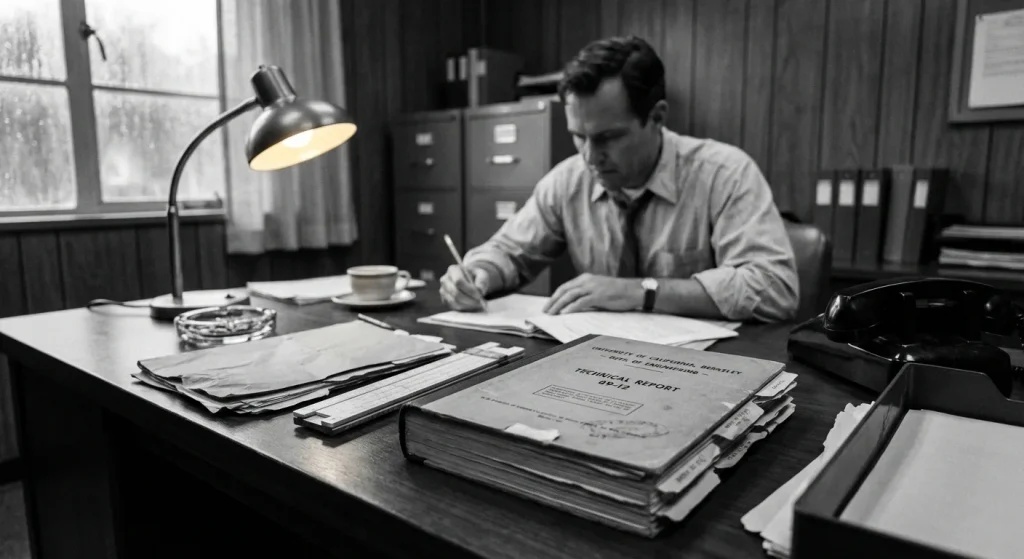
You watch a new piece of UAP footage trend, or a fresh hearing clip make the rounds, and the conversation snaps shut on cue: “The science settled this in 1969.” The citation is always the same, and it functions like a verbal deadbolt. The Condon Report, the 1969 scientific review of UFO reports best known for its policy-facing summary, did not end the question in practice; it institutionalized a dismissal that still gets deployed as a discussion-stopper.
The bluntest line is right up front. The committee’s published summary includes the sentence verbatim: “further extensive study of UFOs probably cannot be justified in the expectation that science will be advanced thereby.” (Condon Report, Summary and Conclusions; see the report PDF at Apps Dtic.) That single sentence is why “Condon” keeps showing up in UFO disclosure arguments, even when the current news cycle is driven by new sensors, new reporting pipelines, and new attention.
The friction comes from how summaries work versus how case files work. A summary can be definitive even when the underlying record is mixed, and the Condon Report’s mixed record is the part that never goes away. Critics have long pointed to an “unexplained residue” in the case outcomes. In the committee’s own case set the commonly cited accounting is that about 30 of 90 examined cases remained classified as unexplained (see the Condon statistical summary and case-count discussion in the report PDF at The Black Vault and the DTIC mirror at Apps Dtic). That figure refers specifically to the Condon report case set, not to the broader Project Blue Book corpus.
This is also why the terminology shift matters. “Unidentified Anomalous Phenomena (UAP)” reframes the problem as any observed event that remains unidentified after analysis, not just a “flying object” shaped like a classic saucer, and that framing now shows up in mainstream institutional communication, including NASA’s public meeting on May 31, 2023 (NASA). Use one practical filter whenever someone waves “1969” like a checkmate: separate (a) what the summary recommends from (b) what the case outcomes actually show, and track what today’s institutions mean when they say UAP instead of UFO.
That filter only works if you understand what the Colorado team actually did, what their case dispositions did (and did not) mean, and how the summary sentence became a policy tool. The sections below follow that same sequence: methods, outcomes, institutional aftereffects, and the modern disclosure-and-oversight machinery that has reopened the issue on different terms.
What the Condon Report actually studied
The Condon-era effort is easiest to understand if you treat it as two things at once: a case-investigation program that worked incident by incident, and a scientific-sounding adjudication aimed at decision-makers who wanted a bottom-line assessment. The formal project was the U.S. Air Force funded University of Colorado UFO study conducted from 1966 to 1968 under a contract set at $325,000 (see the contract amount documented in Air Force and agency records, archived at the CIA reading room mirror at CIA and referenced in historical summaries such as the Condon Report PDF at The Black Vault), and its public deliverable was the published report that appeared in 1969.
The commissioning context was straightforward: the United States Air Force funded a university team to investigate the UFO situation and produce a written assessment. The contract language also contemplated technical services, including measurements and enlargements of UFO photographs, which signals what policymakers thought “science” would look like in this domain. But “scientific” in this project did not primarily mean deploying purpose-built sensors into the field and generating controlled, instrument-rich datasets. Operationally, it meant collecting case files, conducting interviews, performing site visits when feasible, and trying to reconcile witness accounts with available records and physical traces.
The key personnel named in the report underscore that framing. Edward U. Condon is identified as Scientific Director, and Daniel S. Gillmor is identified with an editorial role. Those titles tell you what the final deliverable was meant to be: a scientifically credentialed report, edited into a coherent narrative for institutional readers, not a lab notebook of reproducible experiments.
If you want a single detail that keeps expectations realistic, use the one the project itself supplies: “By all odds the most used piece of physical equipment was the tape recorder.” That sentence appears in the methodology discussion of the Condon Report (see Condon Report PDF), and it indicates the dominant data stream was human testimony captured on audio rather than continuous instrument tracking.
This also clarifies why the report reads the way it does. A tape-recorder-centric workflow naturally yields narratives, timelines, and comparative judgments across cases, because those are the artifacts you can reliably produce from interviews. It does not yield continuous, multi-band tracking of objects across range, altitude, and time, because the project was not built around persistent instrumentation in the first place.
Case-based inquiry is still research, but it answers a different kind of question than instrument-heavy field science. The unit of analysis is typically the individual incident, and the core propositions are practical: what most likely happened here, what evidence supports that, and what remains unaccounted for given the information collected. In that frame, the Condon Report’s summary and its case investigations function like a structured set of adjudications across a portfolio of incidents, each constrained by the quality of reporting, the time lag before investigation, and the kinds of records that could be obtained.
The durable interpretive tool is simple: when someone treats the Condon Report as “lab proof,” mentally replace that phrase with what the investigators could actually do. They could interview, reconstruct, compare, and sometimes measure or enhance available materials. They generally could not instrument the sky on demand. Read its authority in proportion to its methods and tools, and you will stop asking the report to deliver answers it was never equipped to measure.
Unexplained cases versus unjustified research
The heat around the Condon Report comes from blending two different claims into one. “Unexplained” is a case disposition: what the investigators could or could not do with a specific report given the evidence available in that file. “Unjustified” is a research-policy conclusion: a leadership judgment about whether more systematic study is worth the expected scientific return. Treating “unexplained” as if it automatically refutes “unjustified” turns a filing decision into a referendum on the universe. The report’s controversy becomes legible once you separate those two moves.
Case disposition is a thresholded label. It reflects identification achieved given the data actually collected, not metaphysical certainty about what “really” happened. In plain language, investigated UFO or UAP reports tend to fall into at least three buckets:
Explained or identified: The file contains enough information to tie the observation to a specific cause (for example, an astronomical object, aircraft, balloon, atmospheric optics, instrument artifact, or a straightforward misperception). The point is not that the witness is lying; it is that the evidence supports a concrete identification.
Insufficient information (low-data): The report is too thin to adjudicate. The witness might be sincere, but the file lacks basics that let you test hypotheses: time stamps, direction of travel, elevation angles, weather, distance estimates with anchors, independent corroboration, or instrument metadata. In research and audit practice, “insufficient information” is treated as its own outcome because it blocks assessment rather than implying anything exotic, and decision frameworks separate it from other labels because missing source details prevent a determinate assessment.
Unknown or unexplained (resists explanation given available info): This is the category readers fixate on. It does not mean “aliens.” It means investigators had more than a bare anecdote, applied the tests they had, and still could not land a supported identification. Importantly, “unknown” sits downstream of a threshold: you only get there after a case has enough content to be investigated, yet still does not resolve.
The friction point is that many people use “insufficient information” and “unknown” as interchangeable synonyms for “mysterious.” They are not, and they do not carry the same evidentiary meaning.
Once you accept those buckets, a common rhetorical trap becomes obvious. You can have a large pile of low-quality, low-information reports and, at the same time, a smaller set of high-information cases that remain unexplained. Those two facts coexist without contradiction.
Leadership can look at the overall distribution and argue “unjustified” on marginal return grounds: if most incoming reports are too poorly documented to improve theory, a dedicated program mostly buys you more file management, not cleaner physics. Case-focused readers, meanwhile, can reasonably say the opposite: a single well-documented unknown is exactly the kind of anomaly science is supposed to chase, even if it is rare. The disagreement is not about whether unknowns exist as a disposition. It is about what they imply for research priorities under constraints.
A concrete, citable example from the report itself illustrates the bookkeeping difficulty. The Condon material includes a summary tally that has been noted to show two “Unexplained” cases in Category I-D; the tally appears in the report materials available in the official PDFs (see the tally and case-index material in the Condon Report PDF at The Black Vault and the DTIC mirror at Apps Dtic). Critics have observed small mismatches between the tallies and the clearly labeled individual case summaries, which demonstrates how counting-based claims depend on reading the report’s tables and notes carefully rather than relying on a paraphrase. That is exactly why “unknown” has to be read as “unknown given this evidentiary record.”
Use one habit on every new UFO or UAP headline: ask which bucket it belongs in, and then ask what specific evidence would move it.
- Classify the claim: Is it described as identified/explained, insufficient-information, or unknown/unexplained given the file?
- Interrogate the record: What primary data exist (timestamps, angles, radar parameters, weather, photos with metadata, calibrated sensors, multiple independent witnesses) versus what is story-only?
- Name the upgrade path: What would actually shift it to “identified” (better geometry, verified aircraft/astronomy matches, sensor calibration logs, recovered material with documented custody), versus what would merely keep it in “insufficient information” (more anecdotes, sharper retellings, secondhand summaries)?
Do that, and the core dispute stops being mystical. You can hold two ideas at once without incoherence: some investigated cases end as “unexplained,” and leadership can still judge further broad study “unjustified” based on expected scientific yield from the overall pipeline of reports.
That gap between case-level ambiguity and leadership-level closure is not an abstract philosophical problem; it is what made the report so useful to institutions. The next section is where that usefulness turns into durable policy.
How it shaped decades of UFO policy
The Condon Report’s real legacy is not any single case file, or even the percentage that stayed unresolved. Its legacy is the template for official closure language: a scientific-sounding summary that institutions can cite to end a program, freeze a research agenda, and normalize disengagement for decades.
That template turned into policy quickly because it solved a governance problem. The final report was widely distributed in early 1969; contemporaneous accounts note publication and a commercial paperback edition followed in January 1969 (see contemporary summaries and publishing notes at Wikipedia and reporting about the report’s release timing). In December 1969 the U.S. Air Force terminated Project Blue Book, the long-running official UFO investigation program; the National Archives provides a summary of Project Blue Book’s termination and archive status at National Archives.
The Air Force cited the Condon Report’s conclusions as a primary rationale for ending Project Blue Book and it canceled the Air Force regulation that established and controlled the program (see Project Blue Book historical materials and Air Force fact sheets at the National Archives and Air Force historical pages, for example National Archives and the Air Force Project Blue Book fact sheet at Secretsdeclassified Af).
Once a bureaucracy has a clean exit line, incentives line up around repeating it. The phrases that circulate in public memory are not the report’s caveats, edge cases, or methodological disputes; they are the takeaway slogans, commonly repeated as “no evidence of extraterrestrial visitors” and “no scientific value” after 21 years. Those lines function like institutional shorthand. They crowd out nuance because they are easy to quote, easy to headline, and easy to use as a stopping rule: if “the science” already closed the topic, additional attention looks unserious.
That dynamic creates what many commentators describe as a stigma effect for researchers and a rational incentive for agencies to disengage publicly. To signal that point clearly, the paragraph below is an interpretation supported by historical sources on the post-Condon environment: academic caution about the topic and agency incentives to limit re-engagement are documented in historical summaries and contemporary commentary. See the Condon Committee overview at Wikipedia and Project Blue Book closure and archive context at the National Archives page National Archives for background.
Interpretation: For academics, attaching your name to a topic publicly branded as offering “no scientific value” created reputational risk. For agencies, re-opening a topic officially invited media scrutiny, FOIA burden, and political risk. The rational organizational move was quiet disengagement paired with a simple citation to the report. Over time, that citation hardened into folk memory and then into a default standard applied to new reports.
This is also why “government UFO cover-up” claims find fertile ground without any need to prove a coordinated plot. When institutions lean on summary messaging to justify disengagement, skeptics notice the gap between the confident one-liners and the unresolved details that still exist in the record. That gap reads like suppression because the underlying evidence is no longer being actively worked in public.
The practical reader lens is “summary overshadow.” Whenever a document is cited to end debate, ask two questions: what decision did the summary enable, and what case-level details did the citation make it unnecessary to discuss?
Today’s UAP disclosure pressure campaign
That history explains why the argument keeps reappearing whenever new footage, new hearings, or new offices hit the news. The modern UAP era is being treated as an operational and intelligence intake issue, with formal channels, assigned offices, and scheduled deliverables rather than an ad hoc file cabinet of reports.
The Department of Defense formalized that continuity in a July 20, 2022 establishment memo creating the All-domain Anomaly Resolution Office (AARO) to carry forward duties previously assigned to the Airborne Object Identification and Management Synchronization Group (AOIMSG). See the DoD establishment memo at Department of Defense and the resourcing and leadership memo at Department of Defense. AARO’s public site is at Aaro.
AARO also sits inside a compliance reality: it collects and maintains submitted reports under a system of records, and DoD has launched a secure reporting mechanism to receive those reports. See the DoD announcement of the secure reporting mechanism and AARO launch at War and the AARO public reporting page at Aaro.
Congress also directed public-facing work products, including a Historical Record Report due by June 2024 as part of the FY2024 NDAA language for UAP records collection and related requirements; see Public Law text and legislative materials at Congress.gov, including the FY2024 Public Law PDF at Congress.gov.
Another concrete statutory timeline is the agency records-review requirement. The legislative and archival materials identify an October 20, 2024 deadline for agencies to review and organize UAP records in their custody; see the National Archives guidance and legislative references at National Archives and related NDAA texts at Congress.gov (Congress.gov).
Public disclosure pressure became harder to dismiss once it took the form of sworn congressional testimony. The House Permanent Select Committee on Intelligence Subcommittee held a public hearing on UAP on May 17, 2022; the official transcript and hearing materials are available at Congress.gov (Congress.gov). Contemporary coverage and the hearing record describe the May 17, 2022 event as the first public congressional hearing on UAP in roughly half a century; see the hearing transcript and contemporary reporting for that context (New York Times and the Congress.gov transcript above).
| Signal type | What it actually is | How to evaluate it fast |
|---|---|---|
| Official office statements and deliverables | AARO memos, reporting portals, briefings, and congressionally directed reports | Check for primary documents, dates, scope, and what evidence is explicitly cited or withheld as classified |
| Sworn testimony | Under-oath claims with legal accountability, but still bounded by access and classification | Separate first-hand observation from second-hand reporting; note what the witness says they personally saw |
| Media-characterized claims | Summaries, interpretations, and anonymous-sourcing narratives | Trace every claim back to an attributable document, an on-the-record statement, or hearing transcript language |
Congressional oversight and transparency tools
Once the issue sits inside offices, memos, and testimony, it also sits inside oversight. After decades where arguments about UAP often collapsed into trust, rumor, and tribal positioning, Congress has pushed the issue into a governance lane that is harder to hand-wave away: create an inspectable record, attach deadlines to it, and force executive-branch answers into durable artifacts. The point of oversight is not to win a debate. It is to turn ambiguity into accountable paperwork.
The House held a UAP hearing on May 17, 2022, and the transcript records a blunt institutional marker: it was described as the first such hearing in about half a century (official transcript at Congress.gov). That matters because hearings do two things that press conferences cannot. They lock witness statements into sworn or formal testimony, and they lock member questions into a searchable record that future committees can cite, quote, and revisit.
The friction is structural. Time limits compress complex topics into sound bites. Classification walls mean the most sensitive details, if they exist, get redirected to closed sessions or withheld entirely. The practical takeaway is to treat hearings as a documentation event: what was asked, what was refused, what was deferred, and what commitments were made on the record.
Hearings generate visibility; the National Defense Authorization Act generates obligations. The FY2023 NDAA required joint reporting by ODNI and DoD on UAP; related DoD and ODNI reports and annual reports are hosted at official intelligence and DoD sites (see ODNI UAP materials at DNI and DoD/AARO reporting links above).
The harder part is implementation. Mandates collide with classification rules, uneven records hygiene across agencies, and limited bandwidth for review. Congress can demand reports on a schedule; it cannot personally adjudicate every classification claim or instantly fix decades of inconsistent record-keeping.
One deadline is especially concrete: by October 20, 2024, each federal agency must review, identify, and organize each UAP record in its custody. That is records-management work, not rhetoric, and it is measurable through what agencies later say they completed and transferred (see National Archives guidance and the FY2024 Public Law at National Archives and Congress.gov).
Senator Schumer’s UAP Disclosure Act concept (as proposed) was built around a familiar transparency architecture: create a UAP Records Collection at the National Archives and Records Administration and pair it with an “expeditious disclosure” framework designed to move records toward public release on a controlled, reviewable track. Centralization is the point. When records live inside separate compartments, oversight becomes a scavenger hunt.
Legislative outcomes routinely modify, narrow, or contest proposed mechanisms during negotiations and final passage. Readers should treat that as normal congressional reality, not as proof of motive or as a prediction of result.
- Track deadlines tied to records work, especially the October 20, 2024 agency requirement to review, identify, and organize UAP records.
- Read report metadata for the ODNI and DoD joint UAP reporting pipeline, including whether deliverables are described as classified, unclassified, delayed, or consolidated.
- Compare transcripts across hearings for language shifts: “we do not have access,” “we will provide in a classified setting,” “we will follow up,” and whether follow-ups ever appear.
- Monitor NARA progress for signs that a centralized collection is actually being populated, including any public-facing descriptions of scope, transfer activity, or processing status.
What the Condon paradox means now
Case-level ambiguity can persist even when leadership-level conclusions declare further study “unjustified”: the Condon-style paradox is that a file can stay genuinely unexplained while the institution still chooses closure language.
The pattern repeats because institutions optimize for controlled outputs, not satisfying curiosity. The Condon Report’s summary wording framed continued UFO study as “unjustified,” even as a residue of unexplained cases remained inside the casework, and critics have long argued that this left an unresolved-residue problem sitting next to a public-facing shutdown message. Project Blue Book then functioned as the operational “closure linkage,” translating that leadership posture into an endpoint the bureaucracy could maintain. Modern UAP coverage runs into the same friction: AARO exists with a defined remit to receive, analyze, and report on UAP for the U.S. government, but public demand still gravitates to one binary answer. The gap between evidentiary ambiguity and institutional closure language is what keeps “disclosure” waves cycling.
Use this checklist to read 2025 and 2026 UFO news and UAP news like an auditor, not a fan. One limit upfront: the supplied research does not include a verified official AARO taxonomy or definition for what “unresolved” means in AARO reporting, so don’t let headlines smuggle certainty into that word.
- Track AARO public deliverables against what they actually publish, not what commentators imply they “must be sitting on.”
- Read hearing transcripts directly and separate sworn testimony and exhibit language from post-hearing narrative packaging.
- Log NDAA tools and timelines as calendar items, including the Oct 20, 2024 agency records-review deadline discussed above, then watch which deadlines are met, missed, or met in minimal form.
- Verify NARA and the UAP Records Collection for what gets accessioned, described, and released, and what remains withheld under stated authorities.
- Grade every big claim by its documentation trail: the strongest stories cite the record, the weakest cite the vibe.
The same practical filter from the opening still holds: separate what a summary recommends from what the underlying case outcomes actually show, then check how today’s institutions define and process UAP. Treated that way, “Condon in 1969” stops being a deadbolt and becomes what it always was-an administrative conclusion sitting on top of uneven casework.
Sources / Further reading
- Condon Report (Complete PDF mirror at The Black Vault)
- Condon Report (DTIC PDF mirror)
- Condon Report text transcription (Archive.org)
- National Archives – Project Blue Book and Air Force UFO records
- CIA reading room document referencing the Air Force-University of Colorado contract
- DoD memo – Establishment of the All-domain Anomaly Resolution Office (AARO), 07/20/2022
- All-domain Anomaly Resolution Office (AARO) official site
- Public Law 118-31 (FY2024 NDAA) – UAP records provisions and related requirements
- House Intelligence Subcommittee hearing transcript – May 17, 2022 (official Congress.gov PDF)
- NASA UAP Independent Study Team – meeting and report materials (May 31, 2023 and final report)
Frequently Asked Questions
-
What was the Condon Report and when was it published?
The Condon Report was the published 1969 scientific review of UFO reports produced from a U.S. Air Force-funded University of Colorado study conducted from 1966 to 1968. The Air Force contract for the study was set at $325,000.
-
Did the Condon Report conclude that further UFO study was unjustified?
Yes-on the first page of the report’s summary it states that further scientific study of UFOs was “unjustified.” That sentence became the widely quoted policy takeaway.
-
How many cases in the Condon Report were left unexplained?
Critics commonly describe an “unexplained residue” of roughly a third of the incidents, paraphrased as about 30 out of about 90 cases. In the article’s framing, “unexplained” means unresolved given the evidence in the file, not “aliens” and not “nothing.”
-
What methods and equipment did the Condon investigators mainly use?
The project primarily worked case by case using interviews, record checks, and site visits when feasible rather than deploying persistent sky-tracking instruments. The most used piece of physical equipment by investigators was tape recorders.
-
What’s the difference between “unexplained” cases and the report calling further research “unjustified”?
“Unexplained” is a case disposition meaning investigators couldn’t reach a supported identification with the evidence available in that specific file. “Unjustified” is a research-policy conclusion about whether more systematic study was worth the expected scientific return.
-
How did the Condon Report influence U.S. Air Force UFO policy and Project Blue Book?
The report was issued in January 1969, and in December 1969 the U.S. Air Force terminated Project Blue Book. The Air Force cited the Condon Report’s conclusions as a primary rationale and canceled the regulation that established and controlled the program.
-
What should I look for to evaluate a modern UAP claim or headline?
Classify it as identified/explained, insufficient-information, or unknown/unexplained given the file, then check what primary data exist (timestamps, angles, radar parameters, weather, photo metadata, calibrated sensors, and independent witnesses). Finally, identify what would move it toward “identified,” such as better geometry matches, sensor calibration logs, or recovered material with documented chain of custody.
