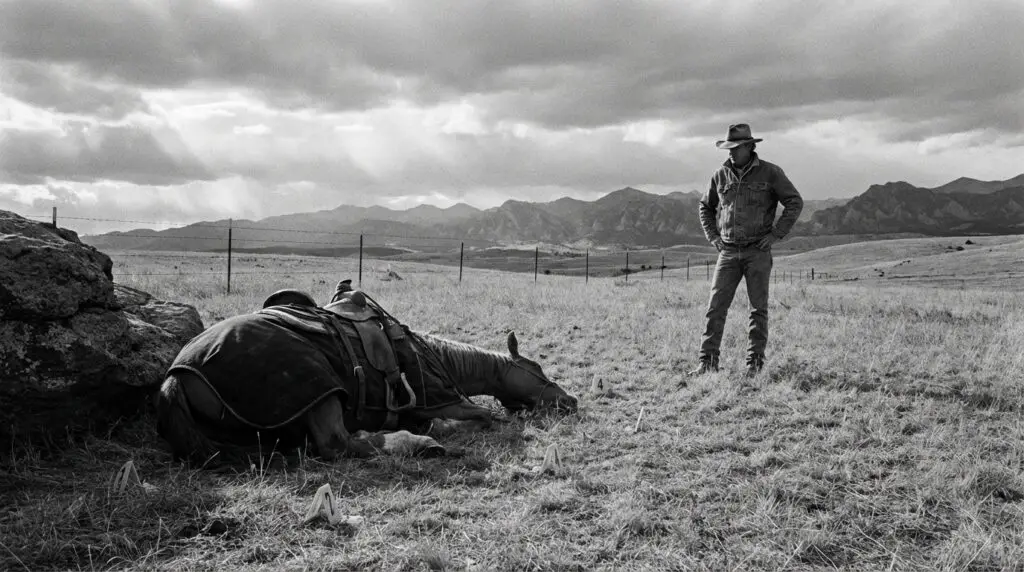
Snippy keeps resurfacing in UFO news and UAP news for one simple reason: the early documentation is thin, but endlessly reusable. If you have ever watched “UFO-linked animal mutilation” claims get recycled as if they are fresh evidence, you are reacting to a real pattern. A ranch animal found dead and described as “mutilated” is visceral, and the story’s emotional punch lets later storytellers fill gaps with whatever conclusion they already prefer.
The case’s staying power comes from a small set of anchors that repeat across early accounts and later summaries. Snippy is described as a 3-year-old Appaloosa horse. Snippy reportedly failed to return to the Harry King Ranch on September 7, 1967. The death was first circulated in wire-service coverage in early October 1967, with widespread press pickup beginning October 5, 1967; see a Denver Public Library retrospective on the incident and a newspaper reprint scan of an AP item for contemporaneous coverage (Denver Public Library) and (AP reprint scan at Newspapers.com). Those dates and identifiers matter because they are the fixed points you can actually test against archives, not the dramatic details that tend to mutate with repetition.
Here is the lens that keeps this story readable: prioritize contemporaneous reporting, meaning information published at the time or immediately after the event, because it is anchored to what witnesses and reporters were willing to put on record before the legend hardened. Later retellings routinely add specificity, confident motives, and implied chains of evidence that the early record simply does not carry.
That tension is the point of Snippy. The same sparse early record can be stretched into competing narratives, mundane or extraordinary, depending on how strictly you separate (1) identifiers that show up early, (2) what contemporaneous reporting actually states, and (3) what later amplification adds as “common knowledge.”
Some secondary sources describe Snippy as the first animal-mutilation case to be widely publicized internationally. Treat that as a claim that requires verification against earlier cases, not a settled fact. The most useful way to approach Snippy, then, is to start with the few dates that recur across accounts and see how much of the story can actually be pinned down from available archives and retrospectives.
Colorado 1967 and the Snippy timeline
What the public record contains and does not contain: contemporaneous wire-service coverage and later regional retrospectives anchor two widely cited dates, Sept 7, 1967 (last-known-alive) and early October 1967 (wire-service pickup beginning Oct 5, 1967). Publicly accessible primary documents from 1967 are limited in availability online; the clearest accessible references are a Denver Public Library history note and an AP reprint scan in newspaper archives showing early October distribution (Denver Public Library) and (AP reprint scan at Newspapers.com). Missing from easily accessible repositories are many contemporaneous details often cited later: the dated discovery moment, the name of the person who found the carcass, a contemporaneous necropsy report by an identified veterinarian, and a complete law-enforcement incident file with report numbers. Those gaps explain why later narratives diverge.
| Date | What we can responsibly say from available sources | Attribution status in public record |
|---|---|---|
| Sept. 7, 1967 | Snippy reportedly did not return to the Harry King Ranch in Colorado; this date appears in later reconstructions as the last-known-alive anchor. | Cited in later summaries and regional histories; contemporary 1967 documents with that precise wording are not widely available online. |
| Oct. 5, 1967 | Early wire-service distribution brought the Snippy story into wider circulation; press pickup began in early October 1967 via wire services such as the Associated Press and United Press. | Documented in newspaper reprints and regional retrospectives; see the Denver Public Library overview and an AP reprint scan (Denver Public Library) and (AP reprint scan at Newspapers.com). |
| 1975 | Later retrospective sources and press discussions referenced the broader animal-mutilation theme in Colorado media during the 1970s, including mentions in popular outlets that noted the topic’s prominence. | Referenced in later summaries; specific New Yorker item details for 1975 are widely cited in secondary literature but a direct online link to that specific New Yorker piece is not provided here [New Yorker, 1975 item]. |
A Denver Gazette retrospective explicitly calls Snippy “the granddaddy or grandmommy of all mutilation cases” and says it is considered the first mutilation “to be publicized internationally”; that retrospective was published May 22, 2022 and is available online (Denver Gazette, May 22, 2022). A History.com overview discusses how animal mutilation reports have been framed in UFO narratives and how certain cases, including Snippy, have been repeatedly referenced in later accounts (History.com overview).
The practical takeaway is a clean separation between anchors and everything that would normally be confirmed by contemporaneous documents: the discovery date, responding officials, an identified veterinarian and necropsy report, and a full law-enforcement file are not consistently available in online primary-source repositories for this incident. That absence means later retellings routinely add detail that cannot be traced to a single original 1967 document available in common archives.
The setting we can ground from public sources is broad but specific: Colorado, a ranch context, and continued association with Alamosa and the San Luis Valley in regional histories (Denver Public Library). The missing middle of the timeline is the key gap: the exact date the carcass was discovered, who first located it, who was notified, and who examined it on scene are details that generally come from contemporaneous documents that are not always accessible online.
How the UFO link took hold
Snippy became “UFO-linked” less through new evidence than through information flow: once a strange local death becomes a story, it starts collecting the kind of context and speculation that travels well. By early October 1967, wire-service pickup turned a local incident into a portable narrative: short, repeatable, and easy to frame as a mystery.
That same portability is why Snippy is routinely described as the first mutilation case to be publicized internationally. Scale changes the incentives. A tight local report can afford uncertainty and nuance; a broad pickup rewards a clean hook and a memorable angle.
The practical mechanism is syndication. Once a wire service distributes a bizarre incident, outlets can republish fast, rewrite for space, and headline for attention. Speed beats verification, and simplification beats precision. That is how “strange death” gets packaged as “strange death plus larger mystery.”
1967 was already an environment where “officials saw something” stories were circulating widely enough to feel normal. Archival items from 1967 show police-UFO narratives were available to readers that year, and once that template exists journalists and audiences reuse it: uniformed witnesses, a short timeline, and a sharp implied question about what authorities know.
Official attention also mattered, because it made UFO language feel legible rather than fringe. Project Blue Book documentation and contemporaneous military-public reporting established a backdrop in which the idea that authorities investigated certain reports was part of public understanding. Against that backdrop, a puzzling animal death does not need proof to attract a familiar frame; it only needs ambiguity.
Once the story is in circulation, later retellings do more than repeat facts; they select which parts feel “most explainable,” and UFO framing gives a ready-made explanation-shaped container. The Denver Public Library’s history write-up captures that long-running pattern: Snippy is repeatedly discussed alongside livestock mutilation narratives that keep UFO links in the conversation.
That social stickiness shows up in modern retellings that still report that people at the time suspected aliens. The critical media point is what happens next: the frame starts to steer sourcing. Writers look for “supporting” color, enthusiasts look for matchable motifs, and the case becomes a magnet for adjacent claims that were never part of the earliest write-ups.
“Nearby sightings” is the most common add-on. It arrives through dot-connecting by enthusiasts, selective emphasis by headlines, and repetition that upgrades proximity into insinuation. A sighting report in the same state or month becomes “nearby.” A separate police or military thread becomes “investigators.” After a few cycles, readers encounter confident-sounding specifics without seeing the first document that actually printed them.
Use the first widely distributed write-up as the baseline, then treat every later UFO-specific addition as a claim that needs primary sourcing.
- Anchor your understanding to what was circulating in early October 1967.
- Compare later versions line-by-line and mark what is new: sightings, official involvement, “nearby” timelines, named witnesses.
- Demand a first publication for each new detail; if it only appears after multiple retellings, it belongs in the “amplified narrative” bucket, not the evidentiary core.
That same discipline applies to the physical claims that make mutilation stories feel persuasive. If the story is going to carry explanatory weight, it has to survive basic forensic questions rather than rely on a familiar UFO frame.
Forensics, predators, and human causes
The key question is not “what’s the wildest theory.” The key question is: what observable evidence would discriminate between ordinary post-mortem processes, human interference, and an extraordinary cause.
“Clean” edges are a recurring flashpoint in mutilation stories because lay observers often equate smooth-looking tissue loss with a sharp instrument. In real carcasses, the same visual impression can be produced without precision tools. Scavenging concentrates on soft tissue first, and once lips, eyelids, tongue, and other easy-access areas are removed, what’s left can resemble deliberate “cuts” simply because there is a boundary between tougher hide and missing soft tissue. That boundary can look surprisingly crisp after drying, wind exposure, and repeated feeding.
Apparent lack of blood follows the same pattern: it’s a field impression, not a measurement. Blood can drain internally, pool in low areas, clot, or be absorbed into soil and vegetation. Predators and insects also remove and redistribute fluids. A “no blood” observation is only meaningful if it is documented with close photos, scene notes, and sampling, not just memory or secondhand retelling.
Even outside this case, surface checks can genuinely show “no visible blood” while still telling you very little about what happened physiologically. One report example explicitly notes a surface examination where no visible blood or fecal material was present, illustrating the gap between what the eye sees and what lab work could confirm.
The friction in the Snippy record is that the most debated features are exactly the features that require disciplined documentation. If you only have descriptions of “clean” and “bloodless,” you are not comparing mechanisms, you are comparing interpretations.
A defensible conclusion starts with evidence preservation, because post-mortem change is relentless. Once a carcass sits exposed, every hour adds confounders: more feeding, more dehydration, more insect activity, more environmental abrasion. That is why chain of custody matters. Without a documented record of collection, handling, and transfer, later claims about radiation, chemicals, tool marks, or even what was present at the scene cannot be validated.
Evidence preservation and chain of custody are prerequisites for reliable conclusions. Standard guidance for animal remains handling emphasizes rapid cooling and secure containment, clear labeling, and transfer to a veterinary diagnostic laboratory or a qualified veterinary pathologist for a formal necropsy. Place remains in a clean body bag or other approved containment, keep them refrigerated or otherwise cooled, and document every transfer with signed chain-of-custody forms so samples and the carcass remain admissible and verifiable.
From there, the record needs to be built, not assumed. A credible forensic file typically includes: scene photos that include a scale reference; wide shots that show access routes; close-ups of tissue margins; notes on weather and insect activity; diagrams; and a log of who handled what, when, and where it went. If samples are taken, the file lists container type, label, seal, storage temperature, and transfer signatures.
The missing keystone in the contemporaneous press and many later retellings is veterinary forensics. A necropsy is the animal equivalent of an autopsy: a post-mortem examination designed to determine cause of death and document findings in a way that can be evaluated later. Publicly available summaries of Snippy do not consistently cite a named veterinarian, credentials, or a contemporaneous necropsy report; that absence blocks diagnostic conclusions and leaves the case in the realm of narrative interpretation rather than documented pathology.
Modern evidence standards are higher precisely because experience has shown how easily uncontrolled scenes generate confident but wrong inferences. The older and thinner the record, the more conservative the conclusion has to be.
Human-caused scenarios, including pranks, illegal activity, or period “occult panic” dynamics, are testable because humans leave repeatable signatures. The problem is not that such scenarios are unthinkable. The problem is that they predict specific artifacts, and those artifacts are not documented in many retellings.
What you would expect if people did it:
- Tool marks consistent with blades, hooks, or saws, ideally photographed with scale and, if possible, cast or preserved tissue margins for later comparison.
- Access evidence such as vehicle tracks, tire patterns, turnarounds, dragged-body marks, cut fencing, gates manipulated, or footprints with measurable tread patterns.
- Handling artifacts including rope fibers, wire, tape, cartridges, cigarette butts, packaging, or staged arrangements that persistently recur across scenes.
- Witness and timeline anchors such as named interviewees, recorded statements, and documented canvassing of neighbors and nearby roads.
- Case administration such as an incident report number, responding agency identification, named personnel, and an evidence log showing what was collected and where it was stored.
In the public summaries of the Snippy incident, contemporary law-enforcement documentation of tool marks, vehicle tracks, or a formal criminal investigation are not consistently cited. Treat that as a missing record, not as support for any alternative theory. Without investigative artifacts, you cannot weigh a human hypothesis against scavenging and environment hypotheses in a disciplined way.
Extraordinary explanations are not rebutted by sarcasm. They are rejected by standards. A UFO-linked conclusion requires evidence that survives ordinary forensic challenges and independent review.
Minimum requirements before any non-human claim is even discussable:
- Preserved samples with intact chain of custody, stored under conditions that prevent degradation and contamination.
- Documented measurements of alleged anomalies, including instrument model, calibration status, units, uncertainty, and raw readings, not just summaries.
- Lab results from identifiable laboratories, with methods stated (for example, histology protocols, toxicology panels, radiological screening), plus QA documentation.
- Primary documentation such as original photos and negatives or originals with metadata, scene diagrams, and contemporaneous notes, not reconstructed accounts.
- Named professionals whose credentials are verifiable, whose observations are recorded, and whose conclusions can be challenged by other experts.
In the Snippy materials commonly cited in modern summaries, those pillars are not consistently present. That is the decisive constraint: the record does not allow extraordinary differentiation because it does not meet even basic forensic traceability.
- Demand photos that include scale, wide-to-close sequencing, and clear views of tissue margins and the surrounding ground.
- Confirm a named veterinarian performed a necropsy, and obtain the written report with findings, cause-of-death reasoning, and any histology or toxicology attachments.
- Verify chain of custody: who collected samples, how they were labeled and sealed, where they were stored, and who received them.
- Request law-enforcement identifiers: agency name, report number, responding personnel, and documented steps such as canvassing and evidence collection.
- Inspect the scene record for human signatures: tool mark documentation, vehicle and footwear impressions, and any collected trace evidence.
- Separate observations from conclusions: “no visible blood” and “clean edges” are descriptions that require tests, not endpoints.
Use that checklist on any new “mutilation” claim and the noise drops fast. If the documentation cannot clear these thresholds, the only honest conclusion is the narrow one: the case is under-documented, and competing theories cannot be reliably discriminated.
When those thresholds are not met, the story rarely disappears; instead, it becomes easier to retell in a standardized way. That is where Snippy’s longer legacy shows up most clearly.
The template for later mutilation cases
Snippy’s most durable impact is not what it proves, but what it taught people to expect. Once the story was in circulation, it functioned like a reporting template: later accounts were judged against a familiar set of details instead of against documentation.
The friction is that a template rewards motif-matching over verification. Reporters and readers start scanning for the same beats, missing soft tissue, clean edges, no blood, strange lights, because those motifs signal “this is one of those cases.” As that checklist hardens, the absence of a motif can feel like disconfirmation, while its presence can feel like proof, even though both are artifacts of what gets emphasized in retellings.
The practical result is standardization: later coverage often reads less like independent observation and more like a genre, because everyone is using the same mental form.
The later wave of attention was accompanied by institutional interest. In the mid-1970s, law-enforcement and federal offices reviewed scattered reports of animal mutilations in western and midwestern states. The FBI Vault hosts an “Animal Mutilation” file that collects documents from that period (FBI Vault Animal Mutilation collection), including multiple parts and downloadable files (sample Part 04 file). Contemporary press around 1975 also described large numbers of cattle found with parts removed; a specific press figure sometimes quoted is “around 196 cows plus other animals,” but a direct contemporaneous press clipping for that exact count is not linked here [contemporary press figure].
Volume plus saturation creates reinforcement: the more cases that get framed as “matching the pattern,” the more the pattern itself becomes the headline, and the easier it is for subsequent reports to be slotted into the same mold.
Patterns are useful because they let investigators and editors triage: repeated motifs can justify pulling records, checking geography, and comparing documentation. The problem is the feedback loop, where media framing influences what witnesses report, and those reports then reinforce the media framing, making later cases sound like earlier ones even when the underlying evidentiary base is thin.
That dynamic maps cleanly onto modern UFO news and UAP news packaging, where Snippy is routinely cited as an early “data point” in non-human intelligence narratives, regardless of evidentiary weakness. Social media regularly elevates claims of non-human intelligence visitation as if they are established disclosures, even when they rely on insinuation rather than records.
One example is a viral claim that an individual, with Pentagon approval, released accounts suggesting non-human intelligence visited Earth, a framing move that treats the narrative as validated by proximity to authority.
Against that, recent institutional reporting and oversight describe structured reviews and null findings on verifiable non-human explanations. See ODNI and AARO publications for current official positions and reporting frameworks: ODNI unclassified annual UAP report (2022) (ODNI, 2022 unclassified report) and AARO information resources including a 2025 declassification information paper (AARO, 2025 declassification info paper).
- Separate motif-matching from proof: a “classic” detail is a prompt to ask for records, not a conclusion.
- Demand primary documentation before you upgrade a story into a data point: incident reports, photos with provenance, veterinary notes, chain-of-custody.
- Track the first appearance of each motif in the coverage: if a detail enters only in later retellings, treat it as folklore until independently supported.
That tension between institutional language and evidentiary gaps is especially visible in today’s disclosure framing. Older cases get republished into a system that is built around documentation, even when the original incident never generated documentation of the kind modern readers assume.
Snippy in the UAP disclosure era
Disclosure cycles change what people do with old cases, not what those cases prove. When “UFO disclosure” and “UAP disclosure” spike in headlines, legacy incidents get republished as fresh “UFO news” and “UAP news” because they fit a familiar narrative template, and because modern audiences expect a government-facing paper trail that didn’t exist at the time.
That expectation is reinforced by the language shift from “UFO” to “UAP”, a term institutions use as a broader umbrella for “unidentified anomalous phenomena” rather than a craft-centric label. The rebrand matters operationally: today, the All-domain Anomaly Resolution Office (AARO) is formally tasked to receive, process, and adjudicate UAP reports, and it routinely accesses classified information, which is the opposite of 1967’s ad hoc information flow. But category breadth and a cleaner intake pipeline do not manufacture missing contemporaneous evidence, they only standardize how new reports get sorted and compared.
Modern disclosure is also document-driven. ODNI hosts an unclassified Annual Report on UAP and AARO provides information papers about declassification and case handling; see ODNI’s unclassified 2022 report (ODNI, 2022) and AARO’s 2025 declassification information paper (AARO, 2025). On Capitol Hill, recent legislative activity has addressed UAP reporting, whistleblower protection, and oversight processes, signaling process and reporting standards rather than retroactive rulings on individual historic cases.
Read modern attention as a clue about today’s disclosure machinery, not as new evidence grafted onto an old file.
What we can responsibly conclude
Snippy matters because the story became a template, not because the surviving record proves an extraordinary cause. Based on the anchors already on the table, we can responsibly say this: Snippy is widely cited as last known alive on Sept 7, 1967, and the incident entered broader public circulation via wire-service distribution in early October 1967, with widespread pickup beginning Oct 5, 1967; see contemporary wire-service reprints and regional retrospectives (Denver Public Library) and (AP reprint scan at Newspapers.com). Everything heavier than that, especially a clean UFO-causation narrative, remains unproven here because commonly circulated summaries do not consistently supply primary documentation such as a named veterinarian or a dated necropsy report.
This is also why the case is so reusable in modern UFO news and UAP news: the fixed points are easy to repeat, and the missing middle is easy to fill. In a thin record, the difference between “documented” and “dramatic” is not academic; it is the difference between a traceable file and an expandable legend.
The biggest problem is evidence integrity, not imagination. Evidence only holds up when it is preserved in its original state and tracked through an unbroken chain of custody, because that is what authenticates it. Against that standard, anecdotes and summary claims are low-chain-of-custody lore until primary documentation is produced.
Use a simple filter when modern headlines collide with legacy mutilation claims: source quality (named first-hand witness or official record, not a repost), documentation (photos, reports, lab results with dates, authors, and originals), and evidence integrity (provenance and chain of custody). The available public research also flags that common summaries, including encyclopedia entries, do not deliver primary-source specifics, which is exactly how later media templates end up motif-matching across cases. Curiosity is valid; certainty requires documentation.
Frequently Asked Questions
Who was Snippy the Horse in the 1967 Colorado UFO-linked mutilation story?
Snippy is described as a 3-year-old Appaloosa horse connected to the Harry King Ranch in Colorado. The case became a widely reused reference point in later UFO-linked animal mutilation narratives despite thin early documentation.
What are the only two firm dates the article says can be anchored in the Snippy case timeline?
Sept. 7, 1967 is used as the last-known-alive anchor when Snippy reportedly failed to return to the Harry King Ranch. Oct. 5, 1967 is identified as the first wide reporting date that turned the incident into a public story.
What key details about Snippy’s death are missing from the provided record according to the article?
The materials do not include a dated discovery moment, who found the carcass, which officials responded, or any identified veterinarian and necropsy report. The county/jurisdiction, responding agency, and any formal law-enforcement documentation are also not present in the excerpts.
How did the Snippy story become linked to UFOs according to the article?
The article says the UFO link took hold through information flow after wide reporting, especially via syndication that simplified and amplified the mystery by Oct. 5, 1967. Later retellings added “nearby sightings” and implied official involvement, often without primary sourcing.
Why can “clean cuts” and “no blood” on animal carcasses be misleading in mutilation claims?
The article explains that scavenging often removes soft tissue first, and drying/wind exposure can create sharp-looking boundaries between hide and missing tissue. “No visible blood” can result from internal drainage, pooling, clotting, absorption into soil, and insect/predator activity unless documented with photos, notes, and sampling.
What specific documentation does the article say you should demand before treating a mutilation as extraordinary or UFO-linked?
It calls for preserved samples with chain of custody, documented measurements with instrument details, lab results from identifiable labs, original photos/notes/diagrams, and named professionals with verifiable credentials. It also emphasizes confirming a written necropsy report by a named veterinarian plus law-enforcement identifiers like agency name and report number.
How should you evaluate modern UFO/UAP news claims that cite Snippy as evidence of non-human intelligence or a government cover-up?
Use Sept. 7 and Oct. 5, 1967 as the only anchors and treat later UFO-specific additions as claims that require primary sourcing and a first publication. The article’s decision filter is source quality (named firsthand witness or official record), documentation (photos/reports/lab results with dates and originals), and evidence integrity (provenance and chain of custody).